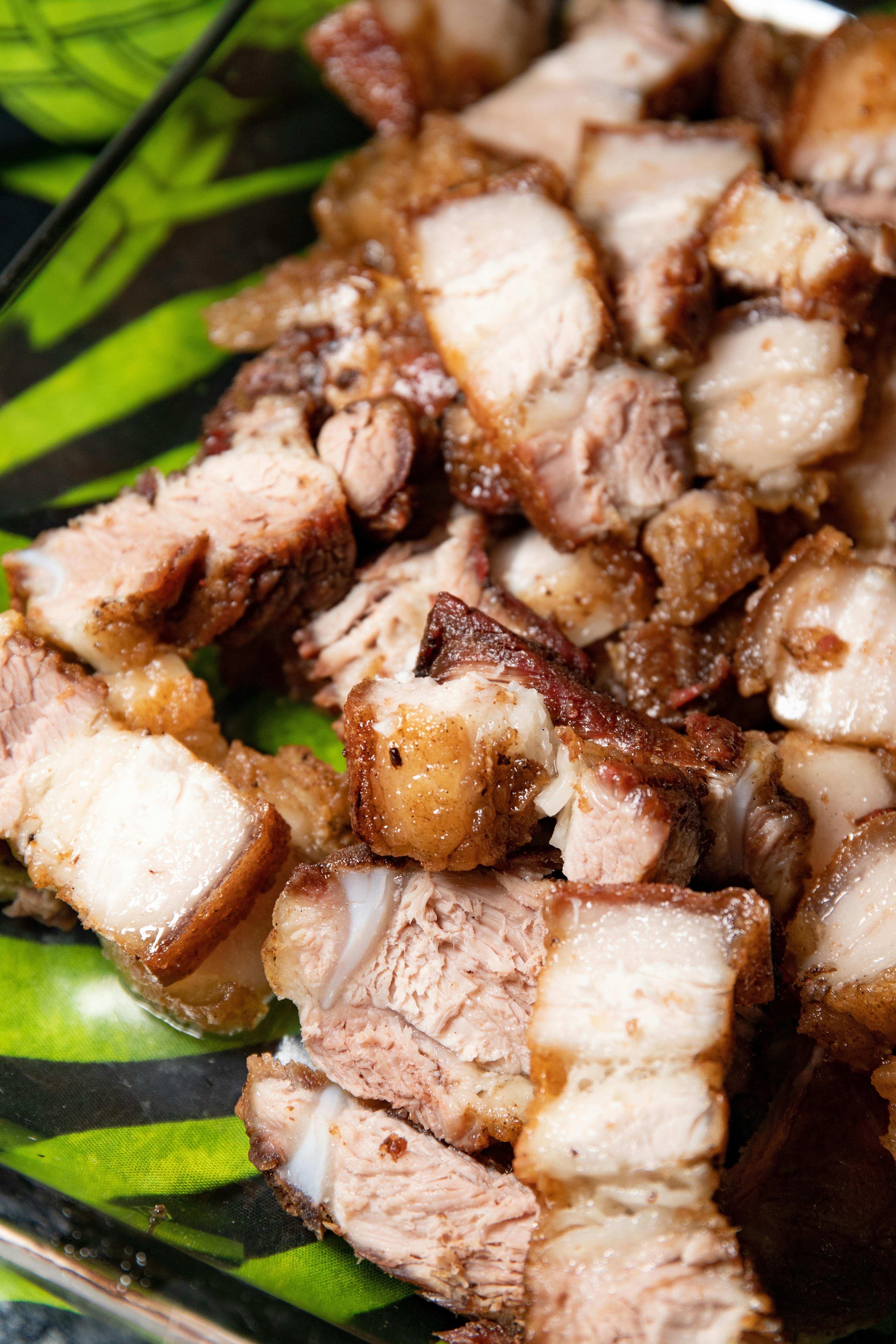
Photo: AMANDA LIM / Pexels
The diets react (see scores below)
Common Ingredients
- whole pig
- lemongrass
- garlic
- scallions
- salt
- bay leaves
- black pepper
- liver sauce
Specific recipes may vary.
Incompatible with 8 of 11 diets
Diet Ratings
Lechon itself — whole roasted pig with aromatic herbs — is fundamentally keto-friendly. Pork is an excellent high-fat, moderate-protein source, and the core stuffing ingredients (lemongrass, garlic, scallions, bay leaves, black pepper) add negligible net carbs. The crispy skin is particularly prized on keto for its fat content. However, the traditional liver sauce (sarsa) served alongside is a significant concern: it typically contains breadcrumbs, vinegar, sugar, and liver, pushing the carb count up considerably. The dish is rated 'caution' rather than 'approve' because lechon is almost universally served with this sauce, and eating it without sauce requires deliberate modification.
Some lazy keto and flexible keto practitioners argue the pig itself is a clear approve and simply advise skipping the liver sauce, effectively treating the meat and skin as a standalone high-fat protein with minimal carbs. They would score the pig portion alone as an 8-9.
Lechon is a whole roasted pig, making it entirely incompatible with a vegan diet. The primary ingredient is a whole pig — an animal product — and the liver sauce (sarsa ng lechon) is made from the pig's liver. There is no ambiguity here: this dish is centered on pork and animal-derived offal sauce, with aromatics only serving as flavor enhancers. It violates the most fundamental rule of veganism.
Lechon is a whole roasted pig flavored with lemongrass, garlic, scallions, bay leaves, and black pepper — most of which are paleo-approved aromatics. However, the dish includes two significant non-paleo components: added salt and liver sauce. Salt is explicitly excluded under paleo rules. The traditional Filipino liver sauce (sarsa) served with lechon is a processed condiment typically made from the pig's liver, vinegar, sugar, breadcrumbs or flour, and seasonings — containing both grains and refined sugar, which are strict paleo exclusions. The pig itself and the herb/aromatics stuffing are paleo-compliant, but the liver sauce is a dealbreaker ingredient as listed. Without the liver sauce and salt, a simply seasoned whole-roasted pork would be largely paleo-approved.
Lechon is a whole roasted pig, making pork (red meat) the primary and dominant ingredient. The Mediterranean diet explicitly limits red meat to a few times per month, and whole roasted pig represents a large, fatty cut with high saturated fat content — far exceeding any acceptable portion. The cooking method (whole roasting with skin) maximizes fat retention including saturated fat from the skin and subcutaneous fat. While the aromatic ingredients (lemongrass, garlic, scallions, bay leaves, black pepper) are Mediterranean-friendly, they are minor components that do not offset the fundamentally red-meat-centric nature of this dish. The liver sauce accompaniment adds organ meat, which is similarly discouraged. This dish stands in direct contrast to the plant-forward, olive-oil-based principles of the Mediterranean diet.
Lechon is a whole roasted pig, which at its core is a carnivore-friendly food. However, the traditional Filipino preparation stuffs the cavity with multiple plant-based aromatics — lemongrass, garlic, scallions, bay leaves, and black pepper — all of which are excluded on a carnivore diet. The accompanying liver sauce (sarsa) is also typically made with the pig's liver blended with vinegar, sugar, breadcrumbs, and onions, adding further non-carnivore ingredients. While the pork itself would score highly, the dish as traditionally prepared is heavily infused with plant compounds and processed condiments, making it non-compliant. A carnivore adaptation — plain roasted whole pig with salt only, served with plain liver — would be fully approvable.
Some flexible carnivore practitioners (aligned with Paul Saladino's 'animal-based' approach or those who use spices pragmatically) might accept the pork itself and overlook aromatic stuffing used only for flavoring during roasting, arguing that minimal plant residue absorbed into the meat is negligible. However, strict carnivore adherents following Baker or Berry would reject any dish intentionally prepared with plant ingredients.
The roasted pig itself — stuffed with lemongrass, garlic, scallions, bay leaves, black pepper, and salt — is fully Whole30-compliant. All of those aromatics and seasonings are explicitly allowed. The problem lies with the liver sauce (sarsa ng lechon / mang tomas-style sauce) that traditionally accompanies lechon. Commercial liver sauce almost universally contains sugar, vinegar, breadcrumbs or starch thickeners, and sometimes MSG or other additives. If the liver sauce is the traditional store-bought variety (e.g., Mang Tomas), it contains added sugar and likely starch, making that component a clear avoid. The dish earns a 'caution' rather than 'avoid' because the roasted pig itself is compliant and can be eaten without the sauce. Diners on Whole30 should skip the liver sauce entirely or seek a compliant homemade version made without sugar or starch.
Some Whole30 practitioners would rate this 'avoid' outright on the grounds that lechon is almost never served or ordered without the liver sauce, and the sauce is the defining condiment of the dish as commonly presented. Official Whole30 guidelines focus on ingredients as consumed, so if the sauce is included in the dish description, the non-compliant sauce pulls the entire dish into avoid territory.
Lechon as traditionally prepared contains multiple high-FODMAP ingredients that make it unsuitable during the elimination phase. Garlic is one of the highest-FODMAP foods tested by Monash University, rich in fructans at any culinary quantity. Scallions (green onions) — if the white bulb portions are used — are also high in fructans. Lemongrass is low-FODMAP in small amounts but its FODMAP contribution depends on quantity used. However, the most disqualifying element is the liver sauce (sarsa ng lechon), which is a traditional accompaniment made from the pig's liver, vinegar, breadcrumbs or crackers (wheat-based), sugar, garlic, onion, and bay leaves. The wheat-based thickener and onion/garlic in the liver sauce add significant fructan load. Even if one were to consume only the plain roasted pork skin and meat, garlic is typically stuffed or rubbed directly into the pig during roasting, meaning fructans are infused throughout the dish. Plain pork itself is low-FODMAP, but the preparation method and sauce make this dish high-FODMAP overall.
Lechon is a whole roasted pig, making it fundamentally incompatible with DASH diet principles. The dish is high in saturated fat (particularly from the skin, which is a celebrated feature of lechon), high in sodium from salting the pig, and is a red meat — all three of which DASH explicitly limits. The crispy skin is essentially pure saturated fat and sodium. The liver sauce (sarsa) accompaniment adds further sodium and cholesterol. DASH guidelines specifically call for limiting red meat, saturated fat, and sodium (<2,300mg/day standard, <1,500mg/day low-sodium variant). While the aromatics (lemongrass, garlic, scallions, bay leaves) are DASH-friendly, they are minor components that do not redeem the dish. Lechon as traditionally prepared and consumed represents nearly everything DASH is designed to minimize.
Lechon is a whole roasted pig, making it a protein-rich dish but one that includes both lean and very fatty cuts (belly, skin, ribs) in unpredictable ratios. The skin alone is extremely high in saturated fat, and the overall fat profile skews heavily toward saturated rather than the monounsaturated fats the Zone prefers. However, Zone is ratio-based, not exclusionary — a careful eater can select leaner cuts (leg, loin) and remove the skin to bring the macros closer to Zone targets. The aromatics (lemongrass, garlic, scallions, bay leaves) add negligible macros and are Zone-neutral or mildly favorable (polyphenols). The liver sauce (sarsa) is the more problematic component: traditional lechon sarsa contains sugar and breadcrumbs, raising the glycemic load, and the liver itself adds saturated fat. With selective portioning — lean meat only, no skin, minimal sauce — roughly 25g of protein can be extracted in a Zone-compatible serving, but the surrounding meal would need careful low-GI carb and monounsaturated fat pairing to hit 40/30/30. The dish is not inherently unavoidable but requires significant discipline.
Some Zone practitioners and later Sears anti-inflammatory writings acknowledge that pork, particularly fattier cuts, is not strictly forbidden but is an 'unfavorable' protein source. Earlier Zone books (Enter the Zone) placed lean pork cuts in acceptable categories while flagging high-fat preparations. The skin and rendered fat in lechon could theoretically be limited, but in practice the dish is served as a whole-animal celebration food where skin consumption is culturally central — making real-world Zone compliance difficult without fundamentally altering how the dish is consumed.
Lechon is a whole roasted pig — one of the most pro-inflammatory dishes in the Filipino culinary canon from an anti-inflammatory standpoint. The primary protein is fatty pork (skin-on, whole pig), which is high in saturated fat and arachidonic acid, both associated with increased inflammatory markers (CRP, IL-6). The skin, which is a celebrated feature of lechon, is essentially pure saturated fat and crispy rendered lard — the opposite of what anti-inflammatory eating emphasizes. High-heat roasting of fatty pork also produces advanced glycation end-products (AGEs) and oxidized fats, which directly promote inflammation. The liver sauce (sarsa), made from the pig's liver blended with vinegar, sugar, onions, and breadcrumbs, adds refined carbohydrates and sometimes high-fructose sweeteners to the profile. The aromatics used as stuffing — lemongrass, garlic, scallions, bay leaves, black pepper — are genuinely anti-inflammatory and earn some credit, but they are entirely incidental to the inflammatory load of the dish as a whole. Red or processed pork is explicitly in the 'limit' or 'avoid' category across virtually all anti-inflammatory frameworks, and lechon represents one of the highest-fat, highest-AGE preparations of pork imaginable. Occasional consumption as a cultural celebration food is understandable, but from a strict anti-inflammatory assessment, this dish scores very low.
Lechon is a whole roasted pig — skin-on, spit-roasted — making it extremely high in saturated fat and calories. The skin (lechon skin) is the centerpiece of the dish and is pure crispy rendered fat, directly worsening GLP-1 side effects including nausea, bloating, reflux, and slowed gastric emptying. Even the lean meat underneath carries significant intramuscular fat from a whole-pig preparation. The traditional liver sauce (sarsa ng lechon) adds additional fat and is typically high in sodium and sugar. While pork does provide protein, the fat-to-protein ratio in a typical lechon serving is far too high for GLP-1 patients, and the rich, heavy, greasy nature of the dish is precisely what GLP-1 dietary guidance warns against. Fried or roasted high-fat pork preparations consistently land in the avoid category for GLP-1 patients regardless of the cuisine context.
*See how scores were generated at our methodology page.
Nutritional profile
Six traits that cut across every diet.
Fiber & Plants
How much whole-plant food and fiber it delivers.
Healthy Fats
The quality of its fats (unsaturated, omega-3).
Whole / Unprocessed
How close it is to its natural, unprocessed form.
Gut Gentle
How easy it is on digestion (low FODMAP, few irritants).
Low Glycemic
How little it spikes your blood sugar.
Protein Density
How much protein it packs per calorie.
Controversy Index
Higher controversy = more disagreement between diets.
Diet-Specific Tips
 Keto — 6/10
View tips
- Whole roasted pork is high-fat and very low in net carbs — inherently keto-compatible
- Crispy pork skin (chicharon-style) is a keto staple and a highlight of lechon
- Core aromatics (lemongrass, garlic, scallions, bay leaves) add negligible carbs
- Traditional liver sauce (sarsa ng lechon) contains breadcrumbs and sugar — not keto-compatible
- Dish is rarely served without the liver sauce in traditional Filipino settings
- Keto-compliant if liver sauce is strictly avoided; portion of scallions and garlic stuffing is minimal
 Whole30 — 5/10
View tips
- Roasted whole pig with compliant aromatics (lemongrass, garlic, scallions, bay leaves, black pepper, salt) is fully Whole30-approved
- Liver sauce (sarsa ng lechon) as commercially prepared contains added sugar and starch thickeners — both excluded
- The dish as typically served includes the liver sauce, making the combined dish non-compliant
- Compliant if liver sauce is omitted or replaced with a sugar-free, starch-free homemade version
- Salt with iodized dextrose is explicitly allowed under Whole30 rules
 Zone — 4/10
View tips
- High saturated fat content especially from roasted pork skin
- Whole pig includes both lean (loin, leg) and very fatty (belly, skin) cuts — protein quality depends entirely on which cut is selected
- Traditional liver sauce (sarsa) contains sugar and breadcrumbs, adding high-glycemic carbs
- Aromatics (lemongrass, garlic, scallions) are Zone-favorable and anti-inflammatory
- Carb content from the pig itself is near zero, so carb balance must come entirely from side dishes
- Requires removal of skin and careful cut selection to approach Zone-compatible fat ratios
- No omega-3-rich fats; pork fat profile is primarily saturated and omega-6 heavy