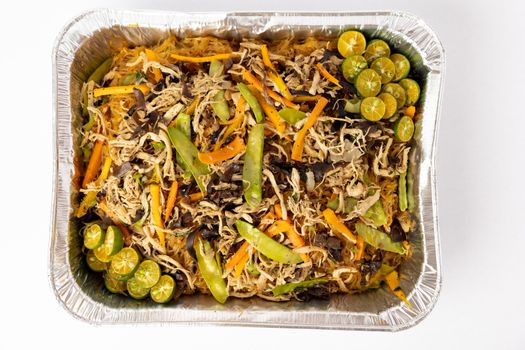
Photo: Christian Moises Pahati / Pexels
Filipino
Pancit Bihon
The diets react (see scores below)
Common Ingredients
- rice noodles
- pork
- chicken
- cabbage
- carrots
- soy sauce
- garlic
- calamansi
Specific recipes may vary.
Incompatible with 7 of 11 diets
Diet Ratings
Pancit Bihon is fundamentally incompatible with a ketogenic diet. The primary ingredient is rice noodles (bihon), which are almost pure starch with virtually no fiber. A standard serving (around 200g) of Pancit Bihon can easily contain 40-60g of net carbs from the noodles alone, which meets or exceeds the entire daily keto carb limit in a single dish. The carrots add additional net carbs, and soy sauce may contain trace carbs and wheat. The pork, chicken, cabbage, and garlic are keto-friendly components, but they are minor players overshadowed by the dominant rice noodle base. There is no practical way to consume a meaningful portion of this dish while maintaining ketosis.
Pancit Bihon as prepared here contains both pork and chicken, which are animal flesh and explicitly excluded under all vegan frameworks. While the base ingredients — rice noodles, cabbage, carrots, soy sauce, garlic, and calamansi — are entirely plant-based, the inclusion of two animal proteins makes this dish incompatible with a vegan diet. There is no ambiguity: this is a meat-containing dish.
Pancit Bihon is fundamentally incompatible with the Paleo diet. The dish's base is rice noodles, a grain product that is explicitly excluded under all paleo frameworks. Soy sauce introduces a double violation — it is both a legume derivative (soy) and a heavily processed, high-sodium condiment with additives. These two ingredients are non-negotiable disqualifiers. The remaining ingredients — pork, chicken, cabbage, carrots, garlic, and calamansi — are all paleo-approved, but they cannot redeem a dish whose core structure is built on grains and soy. The dish as traditionally prepared cannot be considered paleo in any interpretation.
Pancit Bihon contains several elements that conflict with Mediterranean diet principles. Rice noodles are refined grains with minimal fiber, which the Mediterranean diet discourages in favor of whole grains. The dual protein of pork and chicken together — with pork being a red/processed meat — pushes this toward the 'avoid' category, as red meat is restricted to a few times per month. Soy sauce is a highly processed, high-sodium condiment not traditional to Mediterranean eating. There is no olive oil, legumes, or Mediterranean-style fat source. On the positive side, cabbage and carrots provide some vegetable content, and garlic is a Mediterranean staple, but these are insufficient to redeem the dish's overall profile.
Some Mediterranean diet interpreters might rate this as 'caution' rather than 'avoid,' noting that the dish does include meaningful vegetable content, lean chicken, and garlic, and that the pork portion could be small or reduced. Modern flexible interpretations of the Mediterranean diet acknowledge that cultural adaptations can preserve the spirit of plant-forward eating even outside traditional Mediterranean cuisines.
Pancit Bihon is fundamentally incompatible with the carnivore diet. The dish is built around rice noodles as its primary base, which are a plant-derived grain product and strictly forbidden. Beyond the noodles, the dish contains multiple plant foods including cabbage, carrots, garlic, and calamansi (a citrus fruit). Soy sauce adds fermented soy, a legume-derived condiment also excluded. While pork and chicken are carnivore-approved ingredients, they represent a minor component in a dish that is overwhelmingly plant-based in structure and flavoring. No amount of modification short of removing essentially all defining ingredients would make this dish carnivore-compatible.
Pancit Bihon contains two excluded ingredients that make it non-compliant with Whole30. First, rice noodles are a grain-based product (rice is an excluded grain), and noodles/pasta are explicitly called out as forbidden even when made from compliant ingredients. Second, soy sauce contains soy (an excluded legume) and typically wheat (an excluded grain). Coconut aminos could substitute for soy sauce, but the rice noodles remain a fundamental structural component of the dish that cannot be substituted without it becoming a completely different dish. The vegetables (cabbage, carrots, garlic) and proteins (pork, chicken) are fully compliant, as is calamansi juice, but the foundation of this dish — rice noodles — is doubly excluded as both a grain product and a noodle/pasta format explicitly banned by Whole30 rules.
Pancit Bihon contains garlic as a listed ingredient, which is one of the highest-FODMAP foods on the Monash scale due to its extremely high fructan content. Even small amounts of garlic cooked into a dish render it high-FODMAP because fructans are water-soluble and leach into the dish during cooking. While several other ingredients are low-FODMAP (rice noodles, pork, chicken, carrots, soy sauce in small amounts, and calamansi), the presence of garlic is a dealbreaker during the elimination phase. Cabbage is also a moderate concern — Monash rates common cabbage as low-FODMAP at 75g but savoy cabbage is high-FODMAP, and typical Pancit Bihon portions may exceed safe thresholds. Soy sauce contains wheat in traditional formulations, adding fructans. The combination of garlic plus potentially wheat-based soy sauce makes this dish clearly high-FODMAP as traditionally prepared.
Pancit Bihon contains several DASH-friendly elements — rice noodles (refined but relatively low in sodium), vegetables like cabbage and carrots (rich in fiber, potassium, and vitamins), lean chicken, and garlic. However, the inclusion of pork (often fatty cuts like pork belly or shoulder in traditional preparation) adds saturated fat, and soy sauce is a major sodium concern. A single tablespoon of regular soy sauce contains ~900mg sodium, and Pancit Bihon typically uses several tablespoons, potentially pushing the dish well above DASH sodium thresholds in one serving. The dish is not inherently 'bad' but requires significant modification — using low-sodium soy sauce, limiting pork or substituting with lean protein, and controlling portion size — to align with DASH principles.
NIH DASH guidelines would flag soy sauce as a high-sodium ingredient warranting avoidance or strict limitation; however, updated clinical interpretations note that the vegetable content (cabbage, carrots), lean chicken component, and calamansi (vitamin C, potassium) do align with DASH goals, and some DASH-oriented dietitians accept dishes like this when prepared with low-sodium soy sauce and lean protein swaps, treating it as an acceptable cultural adaptation of the diet.
Pancit Bihon is a Zone-compatible dish in principle but requires careful portioning due to the rice noodle base. The dish has a solid structural foundation: lean proteins (chicken and pork), Zone-favorable vegetables (cabbage and carrots), and a light soy-calamansi seasoning with minimal added fat. However, rice noodles are a high-glycemic, low-fiber refined carbohydrate — an 'unfavorable' carb in Zone terminology. They spike blood sugar quickly and provide little nutritional value beyond calories, making it difficult to stay in the Zone without strictly limiting the noodle portion. In a typical Filipino serving, rice noodles dominate the dish by volume and calories, which would skew the macronutrient ratio heavily toward carbohydrates (well above the 40% target) and push the meal out of Zone balance. To fit the Zone, a practitioner would need to reduce noodles to a very small portion (roughly 1/4 cup cooked per block), increase the vegetable ratio significantly, ensure lean protein portions are adequate (~25g per meal), and add a monounsaturated fat source (e.g., a drizzle of olive oil or a few almonds on the side) since the dish is naturally very low in fat. The pork component also warrants attention — if fatty cuts are used, saturated fat content rises. With intentional portioning and modifications, Pancit Bihon can be a reasonable Zone meal, but as traditionally prepared and served, the noodle-heavy ratio makes it a caution food.
Pancit Bihon is a mixed dish from an anti-inflammatory perspective. On the positive side, it contains garlic (a well-established anti-inflammatory allium), cabbage and carrots (colorful vegetables rich in antioxidants and fiber), and calamansi (a citrus high in vitamin C and flavonoids). Soy sauce contributes sodium but also contains some beneficial compounds. The rice noodles are refined carbohydrates with minimal fiber and a moderate-to-high glycemic index, which is a mild concern — though they are gluten-free. The inclusion of both pork and chicken is the central tension: chicken is in the 'moderate' category (lean poultry), while pork occupies a gray zone — leaner cuts used in stir-fry or noodle dishes are less problematic than processed or fatty pork, but pork is still closer to the 'limit' category than poultry. The dish is not fried and is vegetable-inclusive, which works in its favor. The overall profile is that of a balanced, home-cooked dish with meaningful anti-inflammatory contributors (garlic, vegetables, calamansi) offset by refined noodles and pork. Acceptable in moderation, especially if lean pork cuts are used and vegetable content is generous.
Some stricter anti-inflammatory protocols would rate this more cautiously due to the refined rice noodles (high glycemic load) and the inclusion of pork, which some frameworks place firmly in the 'limit' category alongside red meat due to saturated fat and arachidonic acid content. Others following a more Mediterranean-influenced approach would view the vegetable and garlic content as sufficiently redeeming for a moderate score.
Pancit Bihon is a mixed dish with some GLP-1-friendly elements and some notable drawbacks. On the positive side, it includes lean chicken, vegetables (cabbage, carrots), garlic, and calamansi, which contribute fiber, micronutrients, hydration support, and vitamin C. The dish is light and easy to digest relative to heavier Filipino dishes. However, rice noodles are a refined carbohydrate with low protein density and low fiber, which makes them a nutritionally poor base for GLP-1 patients who need every calorie to count. Pork (depending on cut) adds saturated fat and variable protein quality — if using fatty cuts like belly or shoulder, this becomes a more significant concern. The overall protein content per serving is moderate at best and likely insufficient to meet the 15–30g per meal target without deliberate portion engineering. Soy sauce is high in sodium, which can contribute to water retention and is worth monitoring. The dish is portion-sensitive: a small serving is acceptable, but rice noodles tend to dominate the volume, crowding out protein and vegetable content. As a traditional preparation, it is far from the worst choice but falls short of the high-protein, high-fiber ideal for GLP-1 patients.
Some GLP-1-focused dietitians may rate this more favorably when prepared with predominantly chicken breast, abundant vegetables, and reduced noodle volume, arguing the dish can be modified into a reasonably protein-forward, easy-to-digest meal. Others maintain that refined rice noodles as the primary base disqualify it from routine inclusion, as the low protein-to-carb ratio makes meeting daily protein targets harder within reduced calorie intake.
*See how scores were generated at our methodology page.
Nutritional profile
Six traits that cut across every diet.
Fiber & Plants
How much whole-plant food and fiber it delivers.
Healthy Fats
The quality of its fats (unsaturated, omega-3).
Whole / Unprocessed
How close it is to its natural, unprocessed form.
Gut Gentle
How easy it is on digestion (low FODMAP, few irritants).
Low Glycemic
How little it spikes your blood sugar.
Protein Density
How much protein it packs per calorie.
Controversy Index
Higher controversy = more disagreement between diets.
Diet-Specific Tips
 DASH — 4/10
View tips
- High sodium from soy sauce — standard preparation likely exceeds 800–1,200mg sodium per serving
- Pork adds saturated fat, especially if fatty cuts are used
- Cabbage and carrots are DASH-approved vegetables rich in fiber and potassium
- Chicken (lean protein) aligns with DASH guidelines
- Rice noodles are refined carbohydrates — whole grain alternatives would score higher
- Calamansi provides vitamin C and adds potassium
- Low-sodium soy sauce substitution would significantly improve DASH compatibility
- Portion control critical — rice noodles are calorie-dense and easy to overeat
 Zone — 5/10
View tips
- Rice noodles are high-glycemic, low-fiber 'unfavorable' carbs in Zone terminology — dominant in this dish
- Lean proteins (chicken, pork) align well with Zone protein requirements if lean cuts are used
- Cabbage and carrots are Zone-favorable low-glycemic vegetables that improve the dish's carb quality
- Dish is naturally very low in fat — needs a monounsaturated fat addition to hit 30% fat target
- Typical serving sizes are noodle-heavy, skewing macros far above the 40% carb ceiling
- Soy sauce is high in sodium but negligible in macros; calamansi adds polyphenols with minimal glycemic impact
- Portioning down noodles and upping vegetables can bring this into Zone balance
 Anti-Inflammatory — 5/10
View tips
- Garlic: well-documented anti-inflammatory allium, present as a core ingredient
- Cabbage and carrots: antioxidant-rich vegetables supporting an anti-inflammatory profile
- Calamansi (citrus): high in vitamin C and flavonoids, mild anti-inflammatory benefit
- Rice noodles: refined carbohydrate with low fiber and moderate-to-high glycemic index — mild inflammatory concern
- Chicken: lean poultry, acceptable in moderation per anti-inflammatory guidelines
- Pork: falls in 'limit' territory — less favorable than poultry; impact depends on cut and quantity used
- Soy sauce: high sodium content is a concern in excess; fermented soy has minor beneficial compounds
- Not fried; stir-fry/simmer preparation method preserves nutrients and avoids added fats
 GLP-1 Friendly — 5/10
View tips
- Rice noodles are a refined carbohydrate — low fiber, low protein, moderate glycemic impact
- Protein content is moderate and portion-dependent; pork cut significantly affects fat and protein quality
- Cabbage and carrots add fiber and micronutrients, supporting digestive health
- Dish is generally easy to digest and light — a positive for GLP-1 GI side effect management
- High sodium from soy sauce warrants monitoring
- Calamansi adds vitamin C and brightness with negligible caloric cost
- Can be modified (more chicken, less noodle, more vegetables) to improve GLP-1 suitability
- As traditionally prepared, protein per serving likely falls short of the 15–30g per meal target