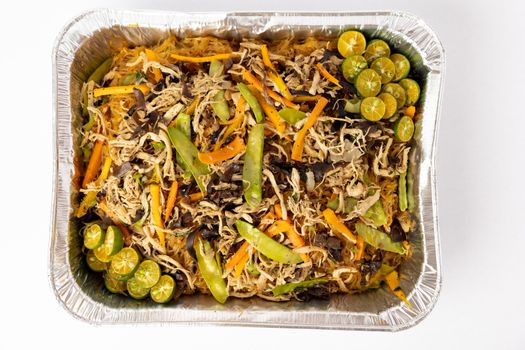
Photo: Christian Moises Pahati / Pexels
Filipino
Pancit Canton
The diets react (see scores below)
Common Ingredients
- egg noodles
- pork
- shrimp
- cabbage
- carrots
- soy sauce
- oyster sauce
- calamansi
Specific recipes may vary.
Incompatible with 6 of 11 diets
Diet Ratings
Pancit Canton is fundamentally incompatible with a ketogenic diet. The dish is built around egg noodles, which are a grain-based, high-carbohydrate ingredient delivering roughly 40-50g of net carbs per serving — far exceeding the entire daily keto allowance in a single dish. Oyster sauce adds hidden sugars, and carrots contribute additional net carbs. While the pork, shrimp, cabbage, calamansi, and soy sauce components are keto-friendly or manageable, the noodle base is the defining element of this dish and cannot be reduced to a token amount without fundamentally changing the dish entirely. There is no meaningful way to consume a standard serving of Pancit Canton and maintain ketosis.
Pancit Canton as described contains multiple animal products: egg noodles (eggs), pork (meat), shrimp (seafood), and oyster sauce (shellfish-derived). This dish fails vegan criteria on at least four separate counts, making it clearly incompatible with a vegan diet.
Pancit Canton is fundamentally incompatible with the Paleo diet. The dish is built on egg noodles, which are a grain-based pasta — grains are strictly excluded from Paleo. Beyond the noodles, soy sauce contains both wheat (a grain) and soy (a legume), making it doubly non-Paleo. Oyster sauce is a processed condiment typically containing added sugar, starch, and preservatives. Calamansi, pork, shrimp, cabbage, and carrots are individually Paleo-compatible, but the foundational ingredients — egg noodles and the soy-based sauces — are clear violations with no gray area in the Paleo framework.
Pancit Canton is a mixed dish with both problematic and acceptable elements from a Mediterranean diet perspective. The shrimp aligns well with the diet's emphasis on seafood, and the vegetables (cabbage, carrots) are positive contributions. However, the egg noodles are refined wheat noodles rather than whole grains, placing them in the discouraged refined carbohydrate category. Pork, depending on the cut, can lean toward red/processed meat territory, which Mediterranean guidelines limit to a few times per month. The sodium-heavy condiments (soy sauce, oyster sauce) are not part of Mediterranean culinary tradition, and the dish lacks olive oil as the fat source. The calamansi citrus is a positive acidic component similar to lemon use in Mediterranean cooking. Overall, the vegetable and seafood content partially redeem the dish, but refined noodles, pork, and non-Mediterranean condiments pull the score down.
Some Mediterranean diet interpreters would score the shrimp and vegetable components more favorably, noting that mixed dishes where seafood and vegetables dominate can be adapted to Mediterranean principles by substituting whole wheat noodles and reducing the pork portion — making this more of a 'modifiable' dish than an outright avoid.
Pancit Canton is fundamentally incompatible with the carnivore diet. The dish is built around egg noodles (a grain-based carbohydrate), and includes multiple plant foods: cabbage, carrots, soy sauce (fermented soy/wheat), oyster sauce (contains starch and sugar additives), and calamansi (citrus fruit). While pork and shrimp are carnivore-approved animal proteins, they are minor components of a dish that is overwhelmingly plant- and grain-based. No amount of modification short of a complete recipe overhaul would make this dish carnivore-compatible.
Pancit Canton contains multiple Whole30-excluded ingredients. First and most critically, egg noodles are a grain-based pasta, which falls squarely under the excluded category of grains and pasta/noodles — and is also explicitly listed in the 'no recreating' rule (noodles are named directly). Second, soy sauce contains soy (an excluded legume) and often wheat (an excluded grain). Third, oyster sauce typically contains added sugar and may contain soy or other excluded additives. There is no compliant workaround that would make this dish Pancit Canton — the noodles are definitional to the dish.
Pancit Canton is high-FODMAP due to multiple problematic ingredients. The primary concern is egg noodles (wheat-based), which are high in fructans — the same FODMAP found in wheat bread and pasta. Oyster sauce typically contains wheat and is high-FODMAP at standard serving amounts. Soy sauce, while used in small quantities, is also wheat-containing, though the FODMAP load per typical serving is lower. Cabbage in moderate-to-large portions can be moderately high in FODMAPs (polyols/fructans depending on variety). Traditional Pancit Canton preparation does not easily allow for ingredient substitution without fundamentally changing the dish. The combination of wheat-based noodles and oyster sauce alone makes this dish unsuitable during the elimination phase of the low-FODMAP diet at any standard restaurant or home serving size.
Pancit Canton presents a mixed nutritional profile for DASH adherence. While it contains positive elements — vegetables (cabbage, carrots), lean shrimp, and some pork — the dish is heavily problematic due to its sodium load. Soy sauce and oyster sauce are both extremely high in sodium; a typical tablespoon of soy sauce contains ~900–1,000mg sodium and oyster sauce ~500mg, making it very easy for a single serving of this dish to exceed 1,500–2,000mg sodium alone. The egg noodles are refined carbohydrates, not the whole grains DASH emphasizes. Pork, depending on the cut used (often fatty cuts in Filipino cooking), can add saturated fat concerns. The vegetables and shrimp are DASH-positive components, and calamansi adds vitamin C with negligible sodium. However, the condiment-heavy preparation method fundamentally conflicts with DASH's core sodium restriction principles. This dish could be made more DASH-compatible by using low-sodium soy sauce, reducing sauce quantities, increasing the vegetable-to-noodle ratio, and choosing lean pork loin or omitting pork entirely.
Pancit Canton presents a mixed Zone profile. The protein components (shrimp and pork) are generally acceptable Zone proteins — shrimp is lean and Zone-favorable, while pork depends on the cut but is typically moderate. The vegetables (cabbage and carrots) add low-glycemic bulk and polyphenols, supporting Zone balance. However, the primary concern is the egg noodles, which are a refined, higher-glycemic carbohydrate that Zone methodology classifies as 'unfavorable.' They drive up the glycemic load of the dish significantly, which can disrupt the hormonal balance (eicosanoid control) central to Zone philosophy. The oyster sauce also contributes sugar, further elevating the glycemic load. On the positive side, the dish does contain meaningful protein and vegetables, so it is not a pure carbohydrate bomb. With careful portioning — reducing noodle quantity, increasing the vegetable-to-noodle ratio, and controlling portion size to stay within 1-2 protein blocks — Pancit Canton can be worked into a Zone-compliant meal. The soy sauce adds sodium but doesn't affect macronutrient ratios meaningfully. The calamansi juice provides polyphenols and a small amount of low-GI carbohydrate, which is Zone-positive. This is a classic 'unfavorable carb' scenario where the dish is usable but requires deliberate modification.
Some Zone practitioners argue that egg noodles, while not ideal, can be portioned as a single carb block within a larger vegetable-heavy meal, making Pancit Canton workable without major modification if the serving size is small (roughly 1/3 cup cooked noodles). Dr. Sears' later writings also emphasize that the overall dietary pattern matters more than any single meal, and a dish with this level of protein and vegetables is far preferable to pure refined carbohydrate meals.
Pancit Canton is a mixed dish from an anti-inflammatory standpoint. On the positive side, it contains shrimp (a lean protein with some omega-3s and selenium), cabbage and carrots (antioxidant-rich vegetables providing fiber, vitamin C, and beta-carotene), and calamansi (a citrus providing vitamin C and polyphenols). Pork in moderate amounts is not strongly pro-inflammatory, though it is a red meat and should be limited. The main concerns are the egg noodles — a refined carbohydrate that raises blood sugar and can trigger inflammatory cascades — and the sodium-heavy condiments (soy sauce and oyster sauce), which contribute high sodium and often include additives. Oyster sauce frequently contains added sugars and preservatives. Neither of these sauces is a direct trigger of tissue inflammation, but they represent a pattern (refined, processed, high-sodium) inconsistent with anti-inflammatory emphasis. The dish lacks meaningful omega-3s, anti-inflammatory spices, or olive oil. It is a relatively balanced Filipino comfort dish — not inherently inflammatory in modest portions, but not anti-inflammatory by design. The refined noodle base is the primary limiting factor.
Some anti-inflammatory practitioners would rate this more favorably, noting that the vegetable content, lean shrimp, and calamansi polyphenols provide meaningful benefits, and that single-dish context (overall dietary pattern) matters more than any one ingredient. Others following stricter AIP or low-glycemic anti-inflammatory approaches would score it lower due to refined egg noodles and high-sodium processed sauces.
Pancit Canton is a mixed dish with both strengths and drawbacks for GLP-1 patients. On the positive side, shrimp is a lean, high-protein ingredient, and the cabbage and carrots contribute fiber and micronutrients with high water content. Calamansi adds brightness without significant sugar. However, egg noodles are refined carbohydrates with low fiber and protein density per calorie, and pork — depending on the cut — often contributes moderate-to-high saturated fat. Oyster sauce and soy sauce add meaningful sodium, which can contribute to bloating and water retention. The dish is carbohydrate-forward, meaning a typical serving may not deliver the 15–30g protein per meal target without generous portioning of the protein components relative to noodles. Gastric emptying is slowed on GLP-1 medications, and a heavy noodle-based meal can sit uncomfortably. Portion control is essential — a small, protein-weighted serving with extra shrimp and vegetables and a reduced noodle base is workable, but the standard restaurant or home serving tilts toward caution.
Some GLP-1-focused dietitians would rate this more favorably if the cook increases shrimp and reduces noodle volume, arguing the vegetable content and lean protein make it adaptable. Others flag refined egg noodles and high sodium as consistent concerns for GLP-1 patients who are prone to bloating and fluid retention, and would suggest shirataki or whole-grain noodle substitutions to meaningfully improve the dish.
*See how scores were generated at our methodology page.
Nutritional profile
Six traits that cut across every diet.
Fiber & Plants
How much whole-plant food and fiber it delivers.
Healthy Fats
The quality of its fats (unsaturated, omega-3).
Whole / Unprocessed
How close it is to its natural, unprocessed form.
Gut Gentle
How easy it is on digestion (low FODMAP, few irritants).
Low Glycemic
How little it spikes your blood sugar.
Protein Density
How much protein it packs per calorie.
Controversy Index
Higher controversy = more disagreement between diets.
Diet-Specific Tips
 Mediterranean — 4/10
View tips
- Shrimp is a Mediterranean-approved seafood protein
- Egg noodles are refined grains, not whole grain
- Pork is a limited red/processed meat in Mediterranean guidelines
- Cabbage and carrots are positive vegetable contributions
- Soy sauce and oyster sauce are high-sodium, non-Mediterranean condiments
- No olive oil; fat source is unspecified
- Calamansi is analogous to lemon, a Mediterranean-friendly acidic ingredient
 DASH — 4/10
View tips
- Very high sodium from soy sauce and oyster sauce — likely exceeds 1,500mg per serving
- Refined egg noodles rather than whole grain pasta
- Vegetables (cabbage, carrots) are DASH-positive ingredients
- Shrimp is a lean, low-saturated-fat protein acceptable in DASH
- Pork cut matters — fatty cuts add saturated fat; lean pork loin is borderline acceptable
- Low-sodium soy sauce substitution would meaningfully improve DASH compatibility
- Calamansi juice adds potassium and vitamin C with negligible sodium impact
 Zone — 5/10
View tips
- Egg noodles are a high-glycemic, 'unfavorable' carbohydrate in Zone terminology — the dominant concern
- Shrimp is a lean, Zone-favorable protein
- Pork is moderate — acceptable if lean cut, but less ideal than skinless poultry or fish
- Cabbage and carrots are Zone-favorable low-glycemic vegetables that improve the dish's profile
- Oyster sauce adds sugar, increasing glycemic load
- No added fat noted — the dish lacks monounsaturated fat supplementation, which would be needed to complete a Zone block
- Portion control is critical: reducing noodle volume and increasing vegetables can bring this closer to Zone ratios
- Calamansi provides polyphenols, a minor Zone-positive factor
 Anti-Inflammatory — 5/10
View tips
- Egg noodles are a refined carbohydrate — raises blood sugar, lacks fiber, pro-inflammatory in excess
- Shrimp provides lean protein, selenium, and modest omega-3s — mildly anti-inflammatory
- Pork is a limited red meat — acceptable in moderation but not anti-inflammatory
- Cabbage and carrots contribute antioxidants, fiber, and beta-carotene — anti-inflammatory positives
- Calamansi adds vitamin C and citrus polyphenols — mildly beneficial
- Soy sauce and oyster sauce are high in sodium and often contain additives/sugars — not aligned with anti-inflammatory principles
- No anti-inflammatory fats (olive oil, omega-3s) or featured spices (turmeric, ginger, garlic) present
 GLP-1 Friendly — 5/10
View tips
- Egg noodles are refined carbohydrates with low fiber — dominant ingredient by volume
- Shrimp is a lean high-protein component but may be undersized relative to noodles in standard portions
- Pork cut determines fat content — fatty cuts (belly, shoulder) push this toward avoid
- Cabbage and carrots add fiber, micronutrients, and water content — positive factors
- High sodium from soy sauce and oyster sauce may worsen bloating on GLP-1 medications
- Protein per serving may fall short of 15–30g target unless heavily weighted toward shrimp
- Slowed gastric emptying makes noodle-heavy meals a GI discomfort risk
- Portion-sensitive: a small, protein-forward, noodle-light serving is acceptable