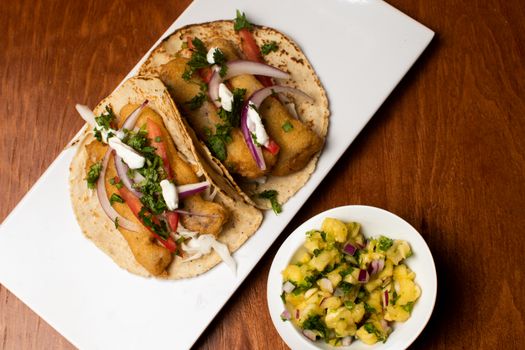
Photo: Amy Farías / Pexels
The diets react (see scores below)
Common Ingredients
- white fish fillets
- corn tortillas
- green cabbage
- lime
- Mexican crema
- cilantro
- jalapeño
- avocado
Specific recipes may vary.
Incompatible with 5 of 11 diets
Diet Ratings
Fish tacos as traditionally prepared are incompatible with keto primarily due to corn tortillas, which are a grain-based, high-carb wrapper. A standard corn tortilla contains approximately 12-15g net carbs each, and tacos typically use two per serving, contributing 24-30g net carbs from the tortillas alone — nearly or entirely consuming the daily keto carb budget in one dish before accounting for any other ingredients. The remaining ingredients (white fish, cabbage, avocado, crema, lime, cilantro, jalapeño) are largely keto-friendly, but the structural corn tortilla component makes the dish as a whole incompatible. Without modification, this dish cannot fit into a ketogenic diet.
Fish tacos contain two clear animal products: white fish fillets (seafood/animal flesh) and Mexican crema (a dairy product made from cow's milk). Both are unambiguously excluded under vegan dietary rules. The remaining ingredients — corn tortillas, green cabbage, lime, cilantro, jalapeño, and avocado — are all plant-based, but the presence of fish and dairy makes this dish entirely incompatible with a vegan diet.
Fish Tacos as presented contain two clear non-paleo disqualifiers: corn tortillas (a grain) and Mexican crema (dairy). Corn is a grain explicitly excluded from the paleo diet, and dairy in its standard form is equally excluded. While the remaining ingredients — white fish, green cabbage, lime, cilantro, jalapeño, and avocado — are all paleo-approved whole foods, the structural components of this dish (the tortilla shell and the crema topping) are foundational to the recipe and not minor additions. This dish cannot be considered paleo-compatible in its traditional form. A paleo adaptation would require replacing corn tortillas with lettuce wraps or cabbage leaves and substituting the crema with a compliant alternative such as guacamole or a coconut-based cream.
Fish tacos are built around white fish, a Mediterranean diet staple encouraged 2-3 times weekly, paired with numerous Mediterranean-friendly ingredients: cabbage (cruciferous vegetable), avocado (healthy monounsaturated fats), lime, jalapeño, and cilantro. Corn tortillas are a whole grain option and preferable to refined flour tortillas. The primary concern is Mexican crema, a dairy-based condiment higher in saturated fat than typical Mediterranean dairy choices like yogurt or small amounts of cheese. The dish is not traditionally Mediterranean in origin, but its nutritional profile aligns reasonably well with Mediterranean principles. The combination of lean fish, vegetables, healthy fats from avocado, and whole-grain corn tortillas makes this a solid, if non-traditional, choice. The crema keeps it from a full approval.
Some Mediterranean diet purists would note that corn tortillas, while whole grain, are not part of any traditional Mediterranean cuisine, and might prefer the fish served over greens or with whole grain bread instead. Conversely, modern flexible interpretations of the Mediterranean diet focus on the overall nutritional pattern rather than geographic authenticity, in which case the fish, vegetables, and avocado combination could merit a stronger approval with crema swapped for plain yogurt.
Fish Tacos are fundamentally incompatible with the carnivore diet. While white fish is a fully approved carnivore food, virtually every other component of this dish is plant-derived and strictly excluded. Corn tortillas are a grain-based carbohydrate — one of the most prohibited food categories. Green cabbage, lime, cilantro, jalapeño, and avocado are all plant foods (vegetables, fruit, and herbs). Mexican crema is a dairy product which is debated on carnivore, but it is entirely secondary to the overwhelming number of plant ingredients here. The dish as a whole cannot be adapted to carnivore — it would require removing every component except the fish and crema, at which point it is no longer Fish Tacos. The dish is structurally and culturally built around plant foods.
Fish tacos contain two excluded ingredients: corn tortillas (corn is a grain, explicitly excluded on Whole30) and Mexican crema (a dairy product, explicitly excluded). Even if the fish, cabbage, lime, cilantro, jalapeño, and avocado are all individually Whole30-compliant, the dish as presented cannot be approved. Furthermore, corn tortillas fall squarely into the 'no recreating baked goods/wraps' rule — tortillas and wraps are explicitly listed as off-limits even if made with compliant ingredients. The dish would need to be fundamentally restructured (e.g., served over cabbage slaw, topped with compliant avocado crema or guacamole) to be Whole30-compatible.
Fish tacos have a mixed FODMAP profile. The base ingredients are largely favorable: white fish is protein with no FODMAPs, corn tortillas are low-FODMAP (gluten-free grain), green cabbage is low-FODMAP at standard servings (up to 75g), lime juice is low-FODMAP, cilantro is low-FODMAP, and jalapeño is low-FODMAP in small amounts. However, two ingredients introduce meaningful concern. Mexican crema is a high-fat dairy product similar to sour cream — Monash rates sour cream as low-FODMAP at 2 tablespoons (40g) due to low lactose, but it becomes moderate at larger servings, and Mexican crema is often used more generously as a sauce drizzle. More significantly, avocado is the primary FODMAP risk: Monash rates it as low-FODMAP only at 1/8 of an avocado (30g) due to sorbitol (a polyol), but a typical taco serving would use far more — a quarter to half an avocado — pushing it firmly into high-FODMAP territory. The dish as typically served with a standard avocado portion warrants caution rather than approval.
Monash University technically approves avocado at 1/8 serving (30g) and sour cream/crema at ≤40g, so a strict reading could classify this dish as low-FODMAP with extreme portioning. However, most clinical FODMAP practitioners would flag avocado as a practical high-FODMAP risk in real-world taco servings, and many advise patients to omit it entirely during the elimination phase rather than attempt to measure 30g precisely.
Fish tacos contain several DASH-friendly components: white fish (lean protein explicitly encouraged by DASH), corn tortillas (whole grain option, low sodium), green cabbage (vegetable, high in fiber and potassium), lime and cilantro (flavor enhancers that reduce need for salt), jalapeño (vegetable), and avocado (heart-healthy monounsaturated fats, rich in potassium and magnesium). The primary concern is Mexican crema, a full-fat dairy product high in saturated fat that DASH guidelines recommend limiting — DASH specifies low-fat or fat-free dairy. Avocado, while nutrient-dense and DASH-compatible, is calorie-dense and requires portion control. Overall, this dish is largely aligned with DASH principles but the crema prevents a full approval. Substituting crema with non-fat Greek yogurt or a lime-based sauce would push this firmly into approve territory.
NIH DASH guidelines explicitly limit full-fat dairy (like Mexican crema) due to saturated fat content. However, updated clinical interpretations note that full-fat fermented dairy products may not adversely affect cardiovascular outcomes per recent meta-analyses, and some DASH-oriented practitioners now allow small portions of full-fat dairy, which would make this dish more clearly approvable as written.
Fish tacos have a solid Zone foundation but require careful portioning to hit the 40/30/30 target. White fish (cod, tilapia, halibut) is an excellent lean protein — one of the best Zone protein sources. Avocado provides ideal monounsaturated fat. Green cabbage, lime, cilantro, and jalapeño are all favorable low-glycemic vegetables. The problem areas are the corn tortillas and the Mexican crema. Corn tortillas are a moderate-glycemic grain carb; Sears classifies them as 'unfavorable' carbs, though each small tortilla (~12g net carbs) can be counted as roughly 1.3 carb blocks. Using one small tortilla rather than two keeps the carb load manageable. Mexican crema is a source of saturated fat that displaces the preferred monounsaturated fat allocation — it can be used in very small amounts but competes with the avocado for the fat block. A Zone-optimized version would use a single small corn tortilla, a generous portion of white fish (3–4 oz), load up on cabbage/jalapeño/cilantro, use avocado as the primary fat source, and minimize or replace the crema with a small drizzle of olive oil. As typically served in a restaurant (two tortillas, generous crema), the fat ratio skews toward saturated fat and carbs run high, making it a 'caution' dish that is very fixable at home.
Some Zone practitioners apply a stricter reading and would rate corn tortillas as avoid-tier carbs alongside white rice and bread, pushing this dish to a lower caution score. However, Sears' block system does technically accommodate corn tortillas in small quantities — they are 'unfavorable' but not excluded, and the presence of lean fish, avocado, and non-starchy vegetables gives this dish a better overall profile than most grain-based Mexican dishes.
Fish tacos in this form are a reasonably strong anti-inflammatory meal. White fish (such as tilapia, cod, or mahi-mahi) is lean, high in protein, and lower in omega-6 than red meat or processed proteins — though it lacks the potent omega-3 content of fatty fish like salmon or sardines. Corn tortillas are a whole grain option, preferable to refined flour tortillas, and provide fiber without added inflammatory ingredients. Avocado is a standout anti-inflammatory ingredient, rich in monounsaturated fats, vitamin E, and antioxidants. Green cabbage provides fiber, vitamin C, and glucosinolates with anti-inflammatory properties. Cilantro, jalapeño, and lime all contribute antioxidants and phytonutrients. The weakest link is Mexican crema, a full-fat dairy product that adds saturated fat — the anti-inflammatory framework recommends limiting full-fat dairy. If used in small amounts as a condiment, its impact is modest. Overall, this is a well-balanced dish with multiple anti-inflammatory contributors and only one ingredient (crema) that warrants moderation.
White fish as a primary anti-inflammatory protein is generally accepted but not as highly ranked as fatty fish; some practitioners (including Dr. Weil's pyramid guidance) would prefer salmon or mackerel for the omega-3 benefit. Additionally, some autoimmune-oriented protocols (AIP) flag corn as a potentially reactive grain due to lectin content, though mainstream anti-inflammatory nutrition considers whole corn and corn tortillas acceptable.
Fish tacos built on white fish and corn tortillas have a solid nutritional foundation — white fish (cod, tilapia, mahi-mahi) is a lean, easily digestible protein source, and corn tortillas are lower in fat and more nutrient-dense than flour tortillas. Green cabbage adds fiber and crunch with minimal calories. However, two ingredients pull this dish into caution territory for GLP-1 patients: Mexican crema is a high-fat dairy condiment that can worsen nausea, bloating, and reflux due to slowed gastric emptying, and avocado, while a healthy unsaturated fat, adds significant fat per serving that may increase GI discomfort. Jalapeño is a mild-to-moderate spice trigger that some GLP-1 patients tolerate fine but others find worsens reflux or nausea. Protein yield per taco is moderate — two tacos may deliver only 20-25g protein depending on fish portion, which is acceptable but requires mindful portioning. This dish can be upgraded to an approve-tier meal with simple swaps: replace crema with plain Greek yogurt-based sauce, reduce or omit avocado, and go light on jalapeño.
Some GLP-1-focused dietitians would rate this dish more favorably, noting that avocado's monounsaturated fats are well-tolerated by many patients and that the overall fat load is modest compared to truly problematic foods like fried items or fatty meats. Others would flag the crema and avocado combination as reliably problematic during early GLP-1 dose escalation when fat sensitivity is highest, recommending this dish only for stable, higher-dose patients with established GI tolerance.
*See how scores were generated at our methodology page.
Nutritional profile
Six traits that cut across every diet.
Fiber & Plants
How much whole-plant food and fiber it delivers.
Healthy Fats
The quality of its fats (unsaturated, omega-3).
Whole / Unprocessed
How close it is to its natural, unprocessed form.
Gut Gentle
How easy it is on digestion (low FODMAP, few irritants).
Low Glycemic
How little it spikes your blood sugar.
Protein Density
How much protein it packs per calorie.
Controversy Index
Higher controversy = more disagreement between diets.
Diet-Specific Tips
 Mediterranean — 6/10
View tips
- White fish is a core Mediterranean protein, encouraged 2-3 times weekly
- Avocado provides heart-healthy monounsaturated fats analogous to olive oil
- Corn tortillas are whole grain and preferable to refined flour alternatives
- Mexican crema adds saturated fat not typical of Mediterranean dairy choices
- Cabbage, lime, jalapeño, and cilantro are all plant-forward, Mediterranean-compatible ingredients
- Non-traditional cuisine origin, but nutritional profile largely aligns with Mediterranean principles
 Low-FODMAP — 5/10
View tips
- Avocado is high-FODMAP (sorbitol) at typical taco serving sizes (>30g); only safe at 1/8 avocado per Monash
- Mexican crema is low-FODMAP at ≤40g but FODMAP-moderate at larger drizzle portions due to lactose
- Corn tortillas are low-FODMAP and gluten-free — a safe grain choice
- White fish is completely FODMAP-free
- Green cabbage is low-FODMAP at standard slaw-sized portions (up to 75g)
- Lime, cilantro, and jalapeño are all low-FODMAP at typical serving sizes
- No onion or garlic listed — a positive omission for this cuisine
 DASH — 6/10
View tips
- White fish is lean protein explicitly encouraged by DASH
- Corn tortillas are a low-sodium, whole-grain option
- Mexican crema is full-fat dairy — a DASH-limited ingredient due to saturated fat
- Avocado provides DASH-valued potassium and monounsaturated fat but is calorie-dense
- Cabbage, jalapeño, lime, and cilantro add vegetables and flavor without sodium
- No added salt listed — sodium load depends heavily on preparation
- Substituting crema with non-fat Greek yogurt would significantly improve DASH compatibility
 Zone — 6/10
View tips
- White fish is an ideal Zone lean protein — favorable
- Avocado provides excellent monounsaturated fat — favorable
- Corn tortillas are 'unfavorable' moderate-glycemic carbs per Sears — caution
- Mexican crema adds saturated fat, displacing preferred monounsaturated fat allocation
- Cabbage, jalapeño, cilantro, and lime are all favorable low-glycemic carb sources
- Portioning is critical: one small tortilla vs. two significantly changes the carb block count
- Restaurant portions typically use two tortillas and generous crema, skewing macros unfavorably
- Home preparation allows easy Zone optimization by limiting tortillas and crema
 Anti-Inflammatory — 7/10
View tips
- Avocado provides monounsaturated fats and antioxidants — strong anti-inflammatory ingredient
- Corn tortillas preferred over refined flour; whole grain, gluten-free option
- White fish is lean and low in pro-inflammatory saturated fat, though lower in omega-3s than fatty fish
- Cabbage, cilantro, jalapeño, and lime contribute antioxidants and phytonutrients
- Mexican crema (full-fat dairy) is the primary inflammatory concern — limit portion size
- No processed ingredients, refined sugars, or seed oils in this preparation
 GLP-1 Friendly — 5/10
View tips
- White fish is a lean, high-quality, easily digestible protein — strong positive
- Corn tortillas preferred over flour: lower fat, reasonable fiber, more nutrient-dense
- Mexican crema is a high-fat dairy condiment that may worsen nausea and reflux
- Avocado adds healthy unsaturated fat but increases total fat load per serving
- Jalapeño may trigger reflux or nausea in GLP-1 patients with GI sensitivity
- Cabbage adds fiber and water content — supports digestion and hydration
- Protein per serving is moderate; portion size of fish fillet is critical to hitting protein targets
- Easy modification path: swap crema for Greek yogurt sauce to significantly improve rating