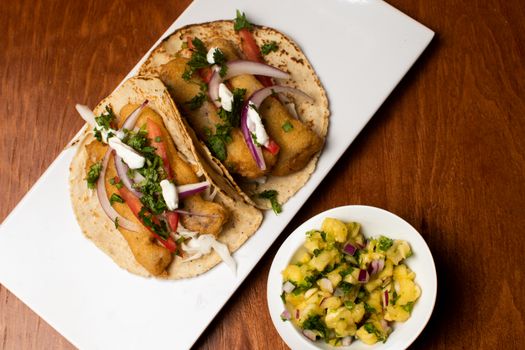
Photo: Amy Farías / Pexels
American
American Fish Tacos
The diets react (see scores below)
Common Ingredients
- white fish fillets
- corn tortillas
- cabbage
- sour cream
- lime
- cilantro
- jalapeño
- avocado
Specific recipes may vary.
Incompatible with 5 of 11 diets
Diet Ratings
American Fish Tacos are fundamentally incompatible with ketogenic diet due to the corn tortillas, which are a grain-based, high-carb ingredient. Each standard corn tortilla contains approximately 12-15g net carbs, and a typical serving of 2-3 tacos would deliver 24-45g net carbs from the tortillas alone — potentially exhausting or exceeding the entire daily keto carb budget before accounting for any other food. While several individual ingredients are keto-friendly (white fish is lean but acceptable protein, avocado is excellent for keto fats, cabbage and jalapeño are low-carb vegetables, sour cream and lime are fine in moderation, cilantro is negligible), the corn tortillas are a non-negotiable deal-breaker. The dish as traditionally prepared cannot be made keto-compatible without fundamentally altering it by substituting lettuce wraps or other low-carb shells — at which point it is a different dish entirely.
American Fish Tacos contain two clear animal-derived ingredients: white fish fillets (seafood/animal flesh) and sour cream (dairy product). Both are unambiguously excluded under vegan dietary rules. The remaining ingredients — corn tortillas, cabbage, lime, cilantro, jalapeño, and avocado — are fully plant-based, but the presence of fish and dairy makes this dish entirely incompatible with a vegan diet.
American Fish Tacos contain two clear paleo violations that make the dish incompatible with the diet. Corn tortillas are a grain product (corn is explicitly excluded from paleo), and sour cream is a dairy product, both of which are firmly on the avoid list with strong consensus across all major paleo authorities. The remaining ingredients — white fish, cabbage, lime, cilantro, jalapeño, and avocado — are all excellent paleo foods, but the structural components of the dish (the tortilla and the creamy topping) are foundational to the recipe and cannot simply be considered minor additions. This dish as presented is not paleo-compatible.
American fish tacos have a strong Mediterranean-compatible core: white fish is an excellent lean protein encouraged 2-3 times weekly, cabbage and avocado are whole plant foods, lime and cilantro are fresh aromatics, and corn tortillas are a whole grain option that is minimally processed. However, sour cream is a full-fat dairy ingredient that is not a Mediterranean staple — the diet favors yogurt or olive oil-based sauces over sour cream. The dish also lacks olive oil as a fat source, relying instead on avocado and sour cream. The overall dish is nutritious and fish-forward, but the sour cream and the non-Mediterranean format (tacos) introduce moderate divergence from core principles.
A stricter Mediterranean interpretation would rate this lower, noting that tacos are not a traditional Mediterranean format and that sour cream has no place in the diet — a Greek yogurt or tahini-based sauce with olive oil would be the recommended substitution. Conversely, a more flexible modern interpretation emphasizes the dietary pattern over specific foods, and would approve this dish given its fish, vegetables, and whole grain base.
American Fish Tacos are fundamentally incompatible with the carnivore diet. While white fish is a carnivore-approved protein, it is outnumbered by a long list of plant-based ingredients that are all strictly excluded. Corn tortillas are a grain-based food and a direct violation of carnivore principles. Cabbage, lime, cilantro, jalapeño, and avocado are all plant foods — vegetables, fruits, and herbs — none of which are permitted on any tier of the carnivore diet. Sour cream is a dairy product that some carnivore practitioners include, but it is irrelevant here given the overwhelming plant content of the dish. As a composed dish, this cannot be adapted or modified into a carnivore meal — it would need to be entirely deconstructed, leaving only the fish fillet itself.
This dish contains two excluded ingredients: corn tortillas (corn is a grain, excluded on Whole30) and sour cream (dairy, excluded on Whole30). Additionally, corn tortillas fall squarely into the 'no recreating wraps/tortillas' rule even if a grain-free version existed. The remaining ingredients — white fish, cabbage, lime, cilantro, jalapeño, and avocado — are all Whole30-compliant, but the dish as described cannot be made compliant without fundamentally changing its nature.
American Fish Tacos contain several individually manageable ingredients, but two create meaningful portion-control challenges during elimination. White fish (grilled or pan-fried) is low-FODMAP and safe. Corn tortillas are low-FODMAP at 2 small tortillas per Monash. Cabbage (common coleslaw base) is low-FODMAP at ½ cup but can become high-FODMAP at larger serves due to fructans/GOS. Cilantro, lime juice, and jalapeño are low-FODMAP. The two problematic ingredients are: (1) Avocado — Monash rates it low-FODMAP only at 1/8 of a whole avocado (~30g); a standard taco topping of ¼–½ avocado exceeds this threshold significantly and pushes into high-FODMAP polyol (sorbitol) territory. (2) Sour cream — low-FODMAP at 2 tablespoons (40g) per Monash due to low lactose content after fermentation, but restaurant or generous home portions often exceed this. The dish as described is achievable on a low-FODMAP diet with strict portion control of avocado and sour cream, but in a standard real-world serving, both are likely consumed in amounts that become problematic. This makes it a caution rather than an approve.
Monash University technically approves small amounts of avocado and sour cream individually, but most clinical FODMAP practitioners advise patients to avoid avocado altogether during the strict elimination phase given how easily the low-FODMAP threshold (1/8 avocado) is exceeded in practice — a single taco topping often uses 2–4x that amount.
American Fish Tacos contain several DASH-friendly components — white fish is lean protein explicitly supported by DASH guidelines, corn tortillas are a whole grain option lower in sodium than flour tortillas, and cabbage, lime, cilantro, jalapeño, and avocado are all vegetables/fruits rich in potassium, fiber, and beneficial micronutrients. However, sour cream is a full-fat dairy product that DASH specifies should be limited in favor of low-fat or fat-free dairy, contributing saturated fat. Avocado, while heart-healthy with monounsaturated fats, is calorie-dense and requires portion control. The overall sodium level depends heavily on preparation — if fish is seasoned with added salt or commercial spice blends, sodium can climb significantly. As a composed dish, this is better than many restaurant mains but falls short of a core DASH-approved meal due to the sour cream and preparation variability.
NIH DASH guidelines specify low-fat or fat-free dairy, which would flag sour cream as a concern; however, updated clinical interpretations note that full-fat fermented dairy like sour cream in small condiment-sized portions may have a neutral cardiovascular effect per emerging research, and some DASH practitioners focus more on overall sodium and saturated fat totals than on categorically excluding full-fat dairy condiments.
American Fish Tacos have a solid Zone foundation but require careful portioning to hit the 40/30/30 target. White fish (cod, tilapia, mahi-mahi) is an excellent lean protein source — low fat, high protein, ideal for Zone blocks. Avocado provides the preferred monounsaturated fat. Cabbage is a favorable low-glycemic vegetable carb. Lime and cilantro add polyphenols with negligible macro impact. However, corn tortillas are a moderate-glycemic starch and classified as 'unfavorable' carbs in Zone terminology — they're usable but need to be limited to 1 small tortilla (roughly 1-1.5 carb blocks) to avoid spiking the carb ratio. Sour cream adds saturated fat, which the Zone discourages in favor of monounsaturated fat; with avocado already present, sour cream should be used minimally or substituted with plain low-fat Greek yogurt. The dish as typically served (2 tortillas, generous sour cream) likely runs high on carbs and saturated fat, but a portioned version — 1 corn tortilla, generous white fish, avocado, cabbage slaw, minimal sour cream — can achieve reasonable Zone balance. The protein-to-carb ratio is the primary challenge to manage.
Some Zone practitioners and Sears' later writings place more emphasis on the overall anti-inflammatory profile of a meal rather than rigid glycemic classification of individual ingredients. In that framing, a fish taco with avocado, cabbage, and omega-3-rich white fish scores quite favorably as an anti-inflammatory meal — the corn tortilla's glycemic impact is moderated by the fiber from cabbage and fat from avocado, making this closer to an 'approve' in practice for flexible Zone followers.
American Fish Tacos present a genuinely strong anti-inflammatory profile. White fish (cod, tilapia, mahi-mahi) is lean, low in saturated fat, and provides complete protein; while it lacks the omega-3 density of fatty fish like salmon, it is a far better option than red meat or processed protein. Corn tortillas are a whole-grain alternative to flour tortillas — less refined, higher in fiber, and contain no gluten for most preparations. Avocado is a standout anti-inflammatory ingredient, rich in monounsaturated fats, vitamin E, and glutathione. Cabbage provides glucosinolates and vitamin C with documented anti-inflammatory and antioxidant activity. Jalapeño delivers capsaicin, a well-researched anti-inflammatory compound. Cilantro and lime contribute polyphenols and antioxidants. The one ingredient that pulls the score down is sour cream — full-fat dairy is in the 'limit' category due to saturated fat content, though the quantity used as a taco topping is modest. Overall, this dish is close to an anti-inflammatory ideal for a satisfying, restaurant-style meal, with the caveat that preparation method matters (grilled or baked fish scores higher than fried).
Sour cream is the main point of debate: mainstream anti-inflammatory guidelines (including Dr. Weil's framework) recommend limiting full-fat dairy due to saturated fat content, while some low-carb and ancestral health practitioners consider full-fat fermented dairy like sour cream neutral or even beneficial due to its probiotic content and fat-soluble vitamins. Swapping sour cream for a Greek yogurt-based sauce or avocado crema would resolve this tension for strict anti-inflammatory adherents.
American fish tacos built on white fish and corn tortillas have a solid nutritional foundation — white fish (cod, tilapia, halibut) is lean, high-protein, and easy to digest, making it one of the better GLP-1-friendly proteins. Corn tortillas are preferable to flour tortillas: lower in calories, gluten-free, and more portion-friendly in small servings. Cabbage adds fiber and crunch with minimal calories. Lime and cilantro are nutritional non-factors but digestively benign. The caution rating is driven by three ingredients: sour cream (saturated fat, low protein density — worsens GLP-1 GI side effects in larger amounts), avocado (healthy unsaturated fat but calorie-dense and fat-heavy per serving — slowed gastric emptying means high-fat foods linger and cause nausea), and jalapeño (spicy foods can worsen reflux and nausea, which are already common GLP-1 side effects). Protein per serving is moderate rather than high — two small tacos may deliver 20–25g protein depending on fish portion size, which is acceptable but portion-sensitive. The dish can be optimized by reducing or replacing sour cream with Greek yogurt, limiting avocado to a few slices, and skipping jalapeño if GI symptoms are present.
Some GLP-1-focused dietitians would rate this higher, noting that avocado provides beneficial monounsaturated fats and that the overall fat load of a standard fish taco is far lower than fried alternatives — the concern about fat-induced nausea is dose-dependent and many patients tolerate this well. Others would rate it lower, flagging that the combination of avocado fat plus sour cream fat plus slowed gastric emptying creates meaningful nausea risk, particularly in the first months of GLP-1 therapy or after a dose increase.
*See how scores were generated at our methodology page.
Nutritional profile
Six traits that cut across every diet.
Fiber & Plants
How much whole-plant food and fiber it delivers.
Healthy Fats
The quality of its fats (unsaturated, omega-3).
Whole / Unprocessed
How close it is to its natural, unprocessed form.
Gut Gentle
How easy it is on digestion (low FODMAP, few irritants).
Low Glycemic
How little it spikes your blood sugar.
Protein Density
How much protein it packs per calorie.
Controversy Index
Higher controversy = more disagreement between diets.
Diet-Specific Tips
 Mediterranean — 6/10
View tips
- White fish is a Mediterranean-approved protein encouraged multiple times weekly
- Cabbage, avocado, lime, jalapeño, and cilantro are whole plant-based ingredients
- Corn tortillas are a minimally processed whole grain — acceptable but not a Mediterranean staple
- Sour cream is a full-fat dairy not emphasized in the Mediterranean diet; Greek yogurt or olive oil sauce would be preferred
- No olive oil present as primary fat source
- Non-Mediterranean cuisine format but nutritionally compatible core ingredients
 Low-FODMAP — 5/10
View tips
- White fish is fully low-FODMAP — safe protein choice
- Corn tortillas are low-FODMAP at 2 small tortillas
- Avocado is high-FODMAP at standard serving sizes (>1/8 avocado) due to sorbitol
- Sour cream is low-FODMAP only at ≤2 tbsp; larger portions add significant lactose
- Cabbage is low-FODMAP at ½ cup but can become high-FODMAP in coleslaw-sized portions
- Lime, cilantro, and jalapeño are all low-FODMAP and safe
- Dish is achievable low-FODMAP with strict modifications but risky as typically served
 DASH — 6/10
View tips
- White fish is lean protein strongly supported by DASH guidelines
- Corn tortillas preferred over flour for lower sodium and whole grain content
- Sour cream is full-fat dairy — DASH specifies low-fat/fat-free dairy; substituting Greek yogurt improves score
- Avocado provides heart-healthy monounsaturated fats but requires portion control for calories
- Cabbage, jalapeño, lime, and cilantro are DASH-positive vegetables with negligible sodium
- Sodium level highly preparation-dependent — added salt, seasoning blends, or pre-marinated fish can significantly increase sodium content
- No added sugars, processed meats, or tropical oils — a positive for DASH compliance
 Zone — 6/10
View tips
- White fish is a lean Zone-favorable protein — ideal for hitting the 30% protein target
- Corn tortillas are 'unfavorable' moderate-glycemic carbs; limit to 1 small tortilla per serving
- Avocado provides excellent monounsaturated fat — a Zone ideal fat source
- Sour cream adds saturated fat; should be minimized given avocado already covers fat blocks
- Cabbage is a favorable low-glycemic vegetable carb that improves the carb quality of the dish
- As typically served (2 tortillas, heavy sour cream), the dish skews carb-heavy and saturated-fat-heavy
- With portioning adjustments, this dish can be brought into Zone balance reasonably well
 Anti-Inflammatory — 8/10
View tips
- White fish is lean, low in saturated fat, and a preferred protein over red meat
- Avocado provides anti-inflammatory monounsaturated fats and vitamin E
- Corn tortillas are less refined than flour tortillas and provide whole-grain fiber
- Jalapeño delivers capsaicin with documented anti-inflammatory properties
- Cabbage contributes glucosinolates and antioxidant vitamin C
- Sour cream (full-fat dairy) is a minor inflammatory concern — use sparingly or substitute
- Cilantro and lime add polyphenols and antioxidants
- Grilled or baked preparation strongly preferred over fried
 GLP-1 Friendly — 6/10
View tips
- White fish is lean, high-protein, and easy to digest — strong GLP-1-friendly protein source
- Corn tortillas preferred over flour: lower calorie, more portion-appropriate
- Sour cream adds saturated fat with minimal protein value — swap for Greek yogurt to improve score
- Avocado contributes healthy fats but is calorie-dense; high fat load worsens nausea with slowed gastric emptying
- Jalapeño is a spice risk — can worsen reflux and nausea already common on GLP-1s
- Cabbage provides fiber and water content — digestive benefit
- Protein yield is moderate and portion-sensitive — fish portion size determines whether meal hits 20–30g protein target
- Dish is highly modifiable — small adjustments significantly improve GLP-1 compatibility