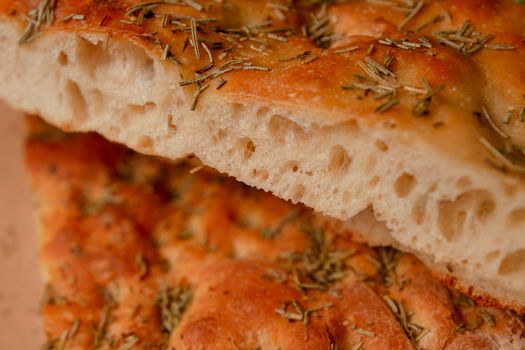
Photo: Natalia Olivera / Pexels
Italian
Rosemary Focaccia
The diets react (see scores below)
Common Ingredients
- bread flour
- olive oil
- yeast
- fresh rosemary
- sea salt
- water
Specific recipes may vary.
Incompatible with 5 of 11 diets
Diet Ratings
Rosemary Focaccia is made primarily from bread flour, a refined grain that is fundamentally incompatible with a ketogenic diet. A single standard serving (one small slice, ~60g) contains roughly 30-35g of net carbs, which can single-handedly exceed or severely erode an entire day's carb budget. The presence of olive oil is the only keto-friendly element, but it does nothing to offset the overwhelming carbohydrate load from the flour. Yeast-leavened grain-based breads are a zero-tolerance food under ketogenic principles. Rosemary and sea salt are negligible and irrelevant to the verdict.
Rosemary focaccia in this formulation is entirely plant-based. Every ingredient — bread flour, olive oil, yeast, fresh rosemary, sea salt, and water — is of plant or mineral origin with no animal products or animal-derived additives. Olive oil is a whole-food plant fat central to Italian cooking. Yeast is a fungus, not an animal product, and is universally accepted in vegan diets. This is also a relatively whole-food preparation compared to heavily processed vegan items, earning a high score within the approve range.
Rosemary Focaccia is fundamentally incompatible with the Paleo diet. The primary ingredient is bread flour, a refined wheat product and grain — one of the most clearly excluded food categories in Paleo. Grains are avoided due to their anti-nutrient content (lectins, phytates, gluten) and the fact that they were unavailable to Paleolithic hunter-gatherers before the agricultural revolution. While olive oil and fresh rosemary are Paleo-approved, and sea salt is a minor point of debate, they cannot redeem a dish whose entire structure is built on wheat flour and yeast-leavened bread. This is a processed grain-based food in its most classic form.
Rosemary focaccia is a traditional Italian bread with deep roots in Mediterranean culinary culture, particularly in Liguria. The ingredients are clean and wholesome — extra virgin olive oil, fresh rosemary, sea salt, and yeast — all consistent with Mediterranean principles. However, the primary flour is refined bread flour (white flour), which is a refined grain. The Mediterranean diet strongly favors whole grains over refined grains, and modern clinical guidelines (e.g., from Harvard and the American Heart Association's Mediterranean diet frameworks) emphasize this distinction. That said, focaccia is not a processed food and contains no added sugars or artificial ingredients, and the generous use of olive oil is a clear positive. It is best enjoyed in moderation as an occasional accompaniment rather than a daily staple.
Traditional Ligurian and broader Italian Mediterranean practice has long included white-flour focaccia as a normal part of the diet, and some Mediterranean diet authorities — particularly those focused on traditional eating patterns rather than modern nutritional optimization — would view this as a culturally authentic and acceptable food. The olive oil content and absence of industrial processing distinguish it favorably from mass-produced bread products.
Rosemary Focaccia is entirely plant-derived and contains no animal products whatsoever. Bread flour is a grain — one of the most excluded food categories on the carnivore diet. Olive oil is a plant-derived fat, explicitly excluded in favor of animal fats like tallow and lard. Yeast, rosemary, and even the sea salt aside (salt is acceptable), every substantive ingredient violates carnivore principles. This is essentially a grain-and-plant-oil bread, the antithesis of the carnivore dietary framework. There is no version of this dish that could be made carnivore-compatible without completely reconstructing it.
Rosemary Focaccia is bread made from bread flour (wheat), which is a grain explicitly excluded on the Whole30. Beyond the grain violation, focaccia is bread — a baked good explicitly called out as off-limits under the 'no recreating baked goods' rule. This dish fails on two independent grounds: the ingredient level (wheat flour = excluded grain) and the food-category level (bread = explicitly prohibited). There is no compliant version of this dish possible within the Whole30 framework.
Rosemary focaccia is made with bread flour, which is a standard wheat flour high in fructans — one of the primary FODMAPs restricted during the elimination phase. Wheat-based flours are consistently rated high-FODMAP by Monash University due to their fructan content, and there is no long-fermentation sourdough process here that might partially reduce fructan levels. Fresh rosemary, olive oil, yeast, sea salt, and water are all low-FODMAP ingredients at standard serving sizes, but the bread flour alone makes this dish unsuitable for the elimination phase at any normal portion size. Even a single slice of focaccia would deliver a significant fructan load.
Rosemary focaccia is made from refined bread flour rather than whole grain flour, which reduces its fiber, magnesium, and nutrient density compared to DASH-preferred whole grains. Olive oil is a heart-healthy unsaturated fat aligned with DASH principles, but focaccia is typically quite oil-heavy, adding significant calories. The primary DASH concern is sodium: traditional focaccia is generously salted, often with coarse sea salt both in the dough and sprinkled on top, which can push a single serving toward 300–500mg sodium or more — a meaningful portion of the 1,500–2,300mg daily DASH limit. Refined white flour provides little fiber or key DASH minerals (potassium, calcium, magnesium). As an occasional side in a portion-controlled context, it is not categorically excluded, but it is not an emphasized DASH food. A whole-wheat version with reduced salt would align better with DASH guidelines.
NIH DASH guidelines emphasize whole grains and low sodium, which focaccia largely does not deliver in its standard form. However, some DASH-oriented clinicians note that olive oil as the primary fat is a positive attribute, and that a small portion of focaccia within an otherwise potassium- and fiber-rich meal does not meaningfully undermine DASH goals — particularly for non-hypertensive individuals following the standard 2,300mg sodium threshold.
Rosemary focaccia is built primarily on bread flour, a refined high-glycemic carbohydrate that Dr. Sears classifies as an 'unfavorable' carb in Zone terminology. White/bread flour causes rapid blood glucose spikes, which disrupts the eicosanoid balance that is central to Zone philosophy. However, the Zone is ratio-based, not exclusion-based, and whole-grain or white-flour bread is acknowledged as a usable (if unfavorable) carb block — Sears allows 0-1 servings of grain-based carbs per day. A small portion of focaccia (roughly 1 oz) can serve as 1 carb block, but must be carefully portioned and paired with lean protein and monounsaturated fat to complete the 40/30/30 ratio. The olive oil in focaccia is a genuine Zone positive — it contributes monounsaturated fat, which is the preferred fat source. Rosemary also provides polyphenols, aligning with Sears' anti-inflammatory focus. The problem is that focaccia has no protein component (listed as 'none'), making it impossible to consume as a standalone Zone meal. As a side dish in a carefully constructed Zone meal, a small portion is workable but must be strictly limited. Most Zone practitioners would treat this as a treat carb to use sparingly rather than a regular component.
Rosemary focaccia is a mixed bag from an anti-inflammatory perspective. On the positive side, olive oil is a cornerstone of the anti-inflammatory diet — it contains oleocanthal and other polyphenols with well-documented anti-inflammatory effects, and focaccia is notably generous with it. Fresh rosemary contributes rosmarinic acid and carnosic acid, both recognized anti-inflammatory compounds. Sea salt and yeast are neutral. The significant drawback is the bread flour: refined white flour is a high-glycemic refined carbohydrate that can promote insulin spikes and modestly elevate inflammatory markers (CRP) in some studies. Anti-inflammatory guidelines consistently recommend whole grains over refined grains. The dish is not processed in the industrial sense — it's made from simple, recognizable ingredients — but the refined flour base prevents it from reaching 'approve' territory. If made with whole wheat or spelt flour, the score would rise meaningfully. As an occasional side, the olive oil and rosemary benefits partially offset the refined carb concern, landing this squarely in the 'acceptable in moderation' zone.
Dr. Weil's framework emphasizes whole grains but does not strictly exclude refined bread, particularly when paired with anti-inflammatory ingredients like olive oil — Mediterranean diet research (which overlaps substantially with anti-inflammatory principles) shows neutral-to-positive outcomes for traditional bread consumption in the context of an overall diet pattern. However, stricter anti-inflammatory protocols focused on glycemic load and leaky gut concerns (e.g., those aligned with Dr. David Perlmutter's work) would view any refined wheat product more negatively.
Rosemary focaccia is a refined-grain bread with no meaningful protein, moderate-to-high fat from olive oil, and low fiber. For GLP-1 patients eating significantly fewer calories, focaccia offers poor nutritional return per bite — it is calorie-dense relative to its protein and fiber content. Gastric emptying is slowed on GLP-1 medications, meaning a heavy bread can sit uncomfortably and crowd out more nutrient-dense foods in a small-appetite context. The olive oil is an unsaturated fat, which is a mild positive, and focaccia is generally easy to digest in small amounts. As a side dish in a small portion alongside a high-protein main, it is not harmful, but it contributes little toward the 100-120g daily protein target or the 25-30g fiber target. It scores as a caution rather than avoid because it is not fried, not high in sugar, not carbonated, and not otherwise a known GLP-1 side-effect trigger — it is simply a low-value choice given the caloric constraints these patients operate under.
*See how scores were generated at our methodology page.
Nutritional profile
Six traits that cut across every diet.
Fiber & Plants
How much whole-plant food and fiber it delivers.
Healthy Fats
The quality of its fats (unsaturated, omega-3).
Whole / Unprocessed
How close it is to its natural, unprocessed form.
Gut Gentle
How easy it is on digestion (low FODMAP, few irritants).
Low Glycemic
How little it spikes your blood sugar.
Protein Density
How much protein it packs per calorie.
Controversy Index
Higher controversy = more disagreement between diets.
Diet-Specific Tips
 Vegan — 9/10
View tips
- All six ingredients are fully plant-based or mineral in origin
- Olive oil is a vegan-approved whole-food fat with no animal derivation
- Yeast is a fungus universally accepted as vegan
- No dairy (butter, milk), eggs, or animal-derived additives present
- Minimal processing relative to packaged vegan breads — straightforward artisan preparation
- No cross-contamination concerns introduced by the listed ingredients themselves
 Mediterranean — 5/10
View tips
- Refined bread flour rather than whole grain flour is the primary concern
- Extra virgin olive oil is generously used, a core Mediterranean fat
- Fresh rosemary and sea salt are traditional, wholesome seasonings
- No added sugars, artificial ingredients, or industrial processing
- Deep roots in Italian (Ligurian) Mediterranean culinary tradition
- Best consumed in moderation as a side, not a dietary staple
 DASH — 5/10
View tips
- Refined bread flour lacks the fiber and micronutrients of DASH-preferred whole grains
- High sodium content from sea salt in dough and as topping is a primary DASH concern
- Olive oil is a DASH-compatible unsaturated fat, but quantity used in focaccia is high
- No significant source of potassium, calcium, magnesium, or dietary fiber
- Portion control is essential — a large slice can contribute substantially to daily sodium and calorie limits
- Whole-wheat, reduced-salt version would improve DASH compatibility
 Zone — 4/10
View tips
- Bread flour is a high-glycemic refined carbohydrate, classified as 'unfavorable' in Zone terminology
- Zero protein content — cannot balance macros without pairing with lean protein source
- Olive oil is a Zone-ideal monounsaturated fat, partially redeeming the fat profile
- Rosemary provides polyphenols consistent with Sears' anti-inflammatory focus
- Portion must be strictly limited to ~1 oz (1 carb block) to avoid glycemic disruption
- Grain-based carbs are allowed at 0-1 servings/day in Zone, so small inclusion is technically permissible
 Anti-Inflammatory — 5/10
View tips
- Olive oil is a primary ingredient and a cornerstone anti-inflammatory fat (oleocanthal, polyphenols)
- Fresh rosemary contributes rosmarinic acid and carnosic acid with anti-inflammatory properties
- Refined bread flour is a high-glycemic refined carbohydrate — a known concern in anti-inflammatory protocols
- No pro-inflammatory additives, seed oils, trans fats, or added sugars
- Simple, whole-food ingredient list with no industrial processing
- Whole grain substitution (spelt, whole wheat) would significantly improve the inflammatory profile
 GLP-1 Friendly — 4/10
View tips
- No meaningful protein — does not contribute to the 100-120g daily protein target
- Made from refined bread flour — low fiber, minimal nutritional density per calorie
- Moderate fat from olive oil — unsaturated and not a concern in itself, but adds calories without protein or fiber
- Easy to digest in small amounts — not a significant GI trigger
- Calorie-dense relative to nutritional value — poor fit for reduced-appetite patients who need every bite to count
- Acceptable only in small portions as an accompaniment to a high-protein, high-fiber meal