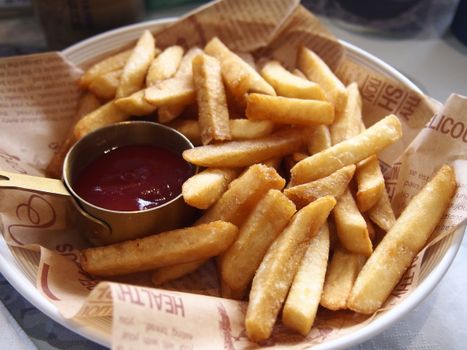
American
French Fries
The diets react (see scores below)
Common Ingredients
- russet potatoes
- vegetable oil
- salt
- black pepper
Specific recipes may vary.
Incompatible with 9 of 11 diets
Diet Ratings
French fries made from russet potatoes are one of the clearest examples of a keto-incompatible food. A medium serving (150g) contains approximately 35-40g of net carbs, which alone can exceed or nearly exhaust the entire daily net carb budget for ketosis. Russet potatoes are a high-glycemic starchy vegetable with virtually no fiber offset to reduce net carbs meaningfully. The vegetable oil used for frying (typically seed oils) adds further concern as an unhealthy fat source, though that is secondary to the carbohydrate issue. There is no portion size that makes french fries compatible with a ketogenic diet — even a small handful would consume a significant portion of the daily carb limit with negligible nutritional benefit.
French fries made from russet potatoes, vegetable oil, salt, and black pepper are entirely plant-based with no animal products or animal-derived ingredients. All four ingredients are vegan-compliant. The score is 7 rather than higher because frying in oil makes this a processed, high-fat preparation rather than a whole food, which whole-food plant-based advocates would consider suboptimal nutritionally. However, it fully meets the standard vegan definition.
French fries fail on multiple paleo criteria simultaneously. Vegetable oil (a seed oil) is a clear paleo violation, added salt is excluded, and the deep-frying process itself is antithetical to paleo principles. Even setting aside the debated status of white potatoes, the combination of a non-paleo seed oil, added salt, and industrial cooking method makes this dish firmly in the avoid category. There is no meaningful paleo case to be made for french fries as prepared here.
French fries are deep-fried in refined vegetable oil (typically high in omega-6 or even partially hydrogenated fats), not extra virgin olive oil, and represent a heavily processed preparation of potatoes. While potatoes themselves are a whole plant food, deep-frying transforms them into a high-calorie, high-fat food with minimal nutritional benefit. The Mediterranean diet emphasizes whole, minimally processed plant foods; deep-fried foods are largely absent from traditional Mediterranean eating patterns. Refined vegetable oils used for deep frying are not aligned with the diet's core fat source (EVOO), and the frying method introduces acrylamides and oxidized fats. This dish contradicts the diet's principles of minimal processing and healthy fat sourcing.
Some Mediterranean diet interpreters note that potatoes are a legitimate whole plant food consumed in Mediterranean regions (e.g., Greece, Spain), and if prepared by roasting or baking with olive oil, they would be acceptable. A minority view holds that occasional homemade oven-roasted versions with EVOO could approach 'caution' territory, but the classic deep-fried preparation remains problematic.
French fries are entirely plant-derived with no animal products whatsoever. Russet potatoes are a starchy carbohydrate-rich plant food, vegetable oil is a plant-based seed/vegetable oil, and black pepper is a plant spice — all explicitly excluded from the carnivore diet. This dish fundamentally contradicts every tier of carnivore eating, from the most lenient to the strictest Lion Diet. There is universal consensus across all carnivore authorities that potatoes and vegetable oils are incompatible with the diet.
French fries are explicitly listed in the Whole30 program as a prohibited food under Rule 4 ('No Recreating Baked Goods/Junk Food'). The official Whole30 rules specifically call out 'french fries' and 'tots' by name as disallowed items, even when made from compliant ingredients. While russet potatoes, oil, salt, and black pepper are all individually Whole30-compatible, the finished dish — french fries — is explicitly banned as a junk food recreation. This is one of the clearest 'avoid' cases in the entire program.
French fries made from russet potatoes, vegetable oil, salt, and black pepper are low-FODMAP at a standard serving. Monash University has tested potatoes and confirmed they are low-FODMAP — they contain minimal fermentable carbohydrates. A typical serving of plain french fries (approximately 75–100g) is well within safe limits. Vegetable oil is FODMAP-free (FODMAPs are water-soluble, not fat-soluble), and salt and black pepper contain no FODMAPs. The ingredients as listed contain no high-FODMAP components such as garlic, onion, lactose, or high-fructose additives.
French fries as commonly consumed are a poor fit for the DASH diet. While russet potatoes themselves contain beneficial potassium and are a whole food, the deep-frying process dramatically increases total fat content and adds significant calories. Restaurant-style french fries are typically high in sodium (often 300–500mg+ per serving), high in total fat, and may contain trans fats depending on the frying oil. Even when made with vegetable oil at home, the high fat load and salt content conflict with DASH principles. DASH emphasizes whole or minimally processed vegetables with limited added fats and sodium — a baked or boiled potato would be an 'approve,' but the fried preparation fundamentally alters the nutritional profile. The added salt further pushes this dish away from DASH targets of <2,300mg sodium/day, especially given that fries are rarely consumed in isolation.
French fries are one of the clearest 'avoid' foods in Zone Diet methodology. Russet potatoes are explicitly called out by Dr. Sears as a high-glycemic, unfavorable carbohydrate that spikes insulin rapidly. Deep-frying in vegetable oil (typically high omega-6 seed oil such as soybean or canola) compounds the problem by adding pro-inflammatory fats that directly contradict Zone's anti-inflammatory focus. The dish provides no protein, making any 40/30/30 block construction impossible without radical additions. The fat present is the wrong kind — omega-6-heavy and potentially containing trans fats from high-heat frying — rather than the monounsaturated fats Zone favors. Even in small portions, french fries deliver a high glycemic load, trigger an insulin spike, and contribute inflammatory eicosanoids, all of which undermine the core hormonal balancing goals of the Zone. This is not a ratio problem that careful portioning can fix; the fundamental macronutrient profile and fat quality are misaligned with Zone principles.
French fries present a strongly pro-inflammatory profile under anti-inflammatory dietary principles. The core issues are the cooking method and the oil used. Deep-frying potatoes in vegetable oil — typically high-omega-6 oils like canola, soybean, or corn oil — creates several inflammatory concerns: (1) High-temperature frying causes oxidation of polyunsaturated fatty acids, generating aldehydes, acrolein, and other oxidative byproducts that promote systemic inflammation. (2) The frying process dramatically increases the omega-6 load, worsening the omega-6:omega-3 ratio — a key driver of the inflammatory cascade. (3) High-heat starchy cooking produces acrylamide, a Maillard byproduct classified as a probable human carcinogen and associated with oxidative stress. (4) The high glycemic load of fried starchy potatoes triggers postprandial blood glucose spikes and corresponding inflammatory insulin response. Russet potatoes themselves are not inherently inflammatory — they contain some vitamin C and potassium — and black pepper adds a trivial amount of piperine (anti-inflammatory). But these negligible benefits are overwhelmed by the frying method. Salt alone is not inflammatory but contributes to overall dietary sodium load. This dish represents exactly the type of refined, high-heat, high-omega-6 preparation that anti-inflammatory diets consistently flag.
The debate here is less about potatoes themselves and more about seed oils and glycemic load. Some anti-inflammatory-leaning researchers (e.g., those following Mediterranean diet principles broadly) distinguish between occasional fried foods and regular consumption, arguing that context and frequency matter more than categorical avoidance. Additionally, if fried in a more stable fat like tallow or lard — which is not specified here — the oxidation concern would be reduced, though saturated fat concerns would apply. The nightshade question is also relevant: AIP and some autoimmune protocols flag potatoes (solanine, lectins) as inflammatory even before frying, while mainstream anti-inflammatory nutrition (Dr. Weil) does not categorically exclude potatoes.
French fries are a poor choice for GLP-1 patients on nearly every relevant dimension. They are deep-fried in vegetable oil, making them high in fat per serving, which directly worsens GLP-1 side effects including nausea, bloating, and reflux due to slowed gastric emptying. They provide virtually no protein, negligible fiber (the frying process and removal of skin eliminate most of the potato's natural fiber), and are calorie-dense with low nutrient density per calorie. Heavily salted versions also work against hydration goals. As a refined, fried starch with empty calories, they represent exactly the food category GLP-1 patients are advised to avoid. A small side-dish portion does not meaningfully redeem the nutritional profile.
*See how scores were generated at our methodology page.
Nutritional profile
Six traits that cut across every diet.
Fiber & Plants
How much whole-plant food and fiber it delivers.
Healthy Fats
The quality of its fats (unsaturated, omega-3).
Whole / Unprocessed
How close it is to its natural, unprocessed form.
Gut Gentle
How easy it is on digestion (low FODMAP, few irritants).
Low Glycemic
How little it spikes your blood sugar.
Protein Density
How much protein it packs per calorie.
Controversy Index
Higher controversy = more disagreement between diets.
Diet-Specific Tips
 Vegan — 7/10
View tips
- Russet potatoes are a whole plant food
- Vegetable oil is plant-derived and vegan
- Salt and black pepper are mineral/plant-derived seasonings
- No animal products, dairy, eggs, or animal-derived additives present
- Deep frying reduces nutritional quality compared to whole-food preparations
- Note: restaurant fries may be cooked in shared fryers with animal products, but the dish as described here uses only vegan ingredients
 Low-FODMAP — 8/10
View tips
- Russet potatoes are low-FODMAP per Monash University testing
- Vegetable oil is FODMAP-free — fats do not carry FODMAPs
- Salt and black pepper are FODMAP-free seasonings
- No onion, garlic, or other high-FODMAP additives in the listed ingredients
- Standard restaurant portions (~75–100g) fall within safe serving sizes
- Watch out for seasoning blends or flavored fries that may contain garlic or onion powder, which would change this rating