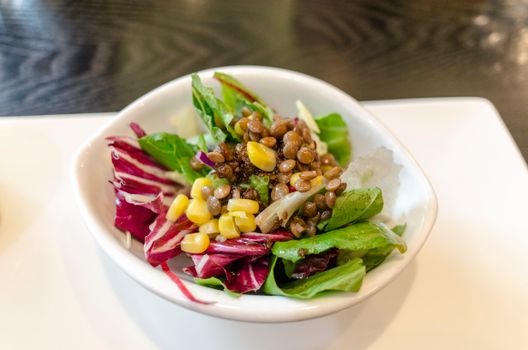
French
French Lentil Salad
The diets react (see scores below)
Common Ingredients
- Puy lentils
- Dijon mustard
- red wine vinegar
- shallots
- parsley
- olive oil
- carrots
- celery
Specific recipes may vary.
Incompatible with 5 of 11 diets
Diet Ratings
French Lentil Salad is fundamentally incompatible with a ketogenic diet. Puy lentils are a legume with extremely high net carb content — a single 100g cooked serving contains approximately 16-20g of net carbs, meaning even a modest salad portion (200-250g of lentils) would consume an entire day's carb allowance or exceed it. Lentils also lack the high fat profile required for keto. While the other ingredients (olive oil, Dijon mustard, red wine vinegar, parsley, celery) are keto-friendly or neutral, and carrots add only a minor additional carb burden, the lentils themselves are the disqualifying factor. This dish cannot be consumed in any meaningful portion without breaking ketosis.
French Lentil Salad is composed entirely of whole plant foods with no animal-derived ingredients. Puy lentils are an excellent plant-based protein and fiber source. Dijon mustard (in its standard form) is plant-based, made from mustard seeds, vinegar, and spices. Red wine vinegar, olive oil, shallots, parsley, carrots, and celery are all unambiguously plant-based. This dish exemplifies the whole-food plant-based ideal: minimally processed, nutrient-dense, and built around legumes and vegetables. The only minor note is that some commercial Dijon mustards may use white wine, which is occasionally filtered with animal-derived agents, but this is a cross-contamination/processing-aid edge case and does not affect the vegan status of the mustard itself.
French Lentil Salad is fundamentally incompatible with the Paleo diet. Puy lentils are legumes — one of the most clearly excluded food groups in Paleo due to their lectin and phytate content, which Paleo authorities argue interfere with nutrient absorption and gut health. This is not a debated exclusion; all major Paleo frameworks (Cordain, Sisson, Wolf) explicitly prohibit lentils. Dijon mustard also typically contains added salt, vinegar additives, and sometimes sugar or wine, placing it in processed/additive territory. The remaining ingredients — red wine vinegar (generally accepted in moderation), shallots, parsley, olive oil, carrots, and celery — are Paleo-compliant, but the dish is anchored by a non-negotiable Paleo exclusion. No amount of compliant supporting ingredients can rehabilitate a dish whose primary component is a legume.
French Lentil Salad is an excellent fit for the Mediterranean diet. Puy lentils are a nutrient-dense legume, providing plant-based protein, fiber, and complex carbohydrates — exactly the kind of food the Mediterranean diet emphasizes eating daily. The dressing is built on extra virgin olive oil and red wine vinegar, both staples of Mediterranean cuisine. Shallots, carrots, celery, and parsley add further vegetable nutrition. Dijon mustard is a minimally processed condiment used in small quantities. Every ingredient is whole, unprocessed, and plant-forward, making this dish a model Mediterranean meal.
French Lentil Salad is entirely plant-based and contains zero animal products. Every single ingredient — Puy lentils, Dijon mustard, red wine vinegar, shallots, parsley, olive oil, carrots, and celery — is explicitly excluded on the carnivore diet. Lentils are legumes, one of the most antinutrient-dense foods (high in lectins and phytates) that carnivore advocates specifically warn against. The remaining ingredients are vegetables, plant oils, and plant-derived condiments. There is no animal protein, no animal fat, and no animal-derived ingredient of any kind. This dish is the antithesis of carnivore eating.
Puy lentils are legumes, and legumes are explicitly excluded on the Whole30 program. Unlike green beans, sugar snap peas, and snow peas — which are specifically excepted despite being legumes — lentils have no such exception and are firmly on the excluded list. The remaining ingredients (Dijon mustard, red wine vinegar, shallots, parsley, olive oil, carrots, celery) are all Whole30-compatible, but the lentils make this dish non-compliant regardless of how it is otherwise prepared.
This French Lentil Salad contains multiple high-FODMAP ingredients that make it unsuitable during the elimination phase. Puy lentils (French green lentils) are high in GOS (galacto-oligosaccharides) — even canned lentils carry FODMAP risk, and dried/cooked lentils like Puy lentils are definitively high-FODMAP at a standard serving (around 100g cooked). Shallots are high in fructans and are one of the worst FODMAP offenders, comparable to onions — even small amounts can trigger symptoms. Celery becomes high-FODMAP at portions above about 10cm stalk (roughly 40g), and in a composed salad a standard serving would likely exceed this threshold. Dijon mustard, red wine vinegar, parsley, olive oil, and carrots are generally low-FODMAP and pose no concern. However, the combination of Puy lentils and shallots alone makes this dish a clear avoid during elimination phase.
French Lentil Salad is an excellent fit for the DASH diet. Puy lentils are a legume powerhouse, delivering high fiber, plant-based protein, potassium, magnesium, and iron — nutrients central to the DASH eating plan. The vegetables (carrots, celery, shallots) add additional fiber, potassium, and micronutrients. Olive oil is the recommended unsaturated fat in DASH, and red wine vinegar and Dijon mustard contribute flavor with minimal caloric cost. The primary concern is Dijon mustard, which can contain moderate sodium (~120-180mg per teaspoon); however, it is used in small amounts as a dressing component, keeping the overall dish sodium-controlled. There is no saturated fat, no added sugars, no processed ingredients, and no red meat. This dish aligns closely with the DASH emphasis on legumes (4-5 servings per week) and vegetables (4-5 servings per day).
French Lentil Salad is a nutritionally solid dish with several Zone-friendly elements, but requires careful portioning and ideally a lean protein addition to become a complete Zone meal. Puy lentils are a moderate-glycemic legume that serve dual roles in Zone as both a carbohydrate source and a supplementary protein source (vegetarian protein). However, because lentils are classified as a carb block in Zone (not a primary protein block), this dish lacks a dedicated lean protein component, making it incomplete as a Zone meal without an addition like grilled chicken, tuna, or egg whites. The olive oil dressing is ideal — a perfect monounsaturated fat source. Carrots and celery are favorable low-glycemic vegetables. Shallots, parsley, Dijon mustard, and red wine vinegar are essentially calorie-neutral Zone enhancers. The main challenge is that lentils are calorie-dense in carbohydrate blocks, so portions must be measured carefully (roughly 1/4 cup cooked per block). As a side dish or carb-block component paired with lean protein, this salad is quite Zone-compatible. As a standalone meal it falls short on protein.
In Zone vegetarian protein calculations, lentils can count partially toward protein blocks (roughly 1 protein block per ~1/2 cup cooked lentils alongside ~2 carb blocks). Some Zone practitioners, particularly those following Sears' later writings on anti-inflammatory eating, treat lentils more favorably as a dual-role food given their high fiber content (which lowers net carbs significantly) and sustained energy release. The fiber adjustment meaningfully reduces the carb block count, making lentils more Zone-efficient than their total carbohydrate content suggests.
French Lentil Salad is an exemplary anti-inflammatory dish. Puy lentils are a nutritional powerhouse — high in fiber, plant-based protein, folate, and polyphenols that support gut health and reduce inflammatory markers like CRP and IL-6. Olive oil provides oleocanthal and monounsaturated fats with well-documented anti-inflammatory effects. Carrots and celery contribute beta-carotene, flavonoids, and antioxidants. Shallots and parsley deliver quercetin, vitamin C, and additional flavonoids. Red wine vinegar has a modest polyphenol content and may support blood sugar regulation. Dijon mustard contains glucosinolates with anti-inflammatory properties. There are no pro-inflammatory ingredients in this dish — no refined carbohydrates, seed oils, added sugars, or processed components. This dish aligns perfectly with Dr. Weil's Anti-Inflammatory Food Pyramid emphasis on legumes and colorful vegetables dressed with extra virgin olive oil.
French Lentil Salad with Puy lentils is a strong GLP-1-friendly dish. Puy lentils are one of the best plant-based sources of both protein (~18g per cooked cup) and fiber (~16g per cooked cup), making them excellent for muscle preservation, satiety, and constipation prevention — both top priorities on GLP-1 medications. The dressing uses olive oil (unsaturated fat, modest amount typical in vinaigrettes) and red wine vinegar, which is low-calorie and may support blood sugar stability. Shallots, carrots, celery, and parsley add micronutrients, additional fiber, and water content. The dish is easy to digest, nutrient-dense per calorie, works well in small portions, and contains no fried, high-sugar, or high-saturated-fat components. The primary limitation is that lentils alone may not meet the 15-30g protein per meal target for GLP-1 patients — a standard serving (~3/4 cup cooked lentils) delivers roughly 13-14g protein, falling slightly short. Pairing with a supplemental protein source (e.g., a boiled egg, grilled chicken, or cottage cheese on the side) would make this a complete GLP-1 meal. The olive oil quantity in the vinaigrette should be kept moderate to avoid excess fat triggering nausea.
Some GLP-1-focused dietitians flag legumes including lentils as a caution for patients early in treatment, as the fermentable fiber (FODMAPs) in lentils can worsen bloating and gas in individuals whose gastric emptying is already slowed — GI tolerance tends to improve after the first few months. Others maintain lentils are well-tolerated by most patients and their fiber and protein benefits outweigh the bloating risk for the majority.
*See how scores were generated at our methodology page.
Nutritional profile
Six traits that cut across every diet.
Fiber & Plants
How much whole-plant food and fiber it delivers.
Healthy Fats
The quality of its fats (unsaturated, omega-3).
Whole / Unprocessed
How close it is to its natural, unprocessed form.
Gut Gentle
How easy it is on digestion (low FODMAP, few irritants).
Low Glycemic
How little it spikes your blood sugar.
Protein Density
How much protein it packs per calorie.
Controversy Index
Higher controversy = more disagreement between diets.
Diet-Specific Tips
 Vegan — 9/10
View tips
- Puy lentils: whole food legume, high protein and fiber, fully plant-based
- Dijon mustard: standard formulation is plant-based (mustard seed, vinegar, salt)
- Red wine vinegar: plant-derived fermentation product
- Olive oil: plant-based fat
- All vegetables (shallots, carrots, celery, parsley): unambiguously plant-based
- No animal products, dairy, eggs, or animal-derived additives present
- Whole-food composition scores at the high end of the approve range
 Mediterranean — 9/10
View tips
- Puy lentils are a high-quality legume, a Mediterranean diet cornerstone
- Extra virgin olive oil as the primary fat source
- Red wine vinegar is a traditional Mediterranean acidulant
- All vegetables (carrots, celery, shallots, parsley) are whole and unprocessed
- No red meat, refined grains, added sugars, or processed ingredients
- High fiber and plant-based protein content align with Mediterranean principles
 DASH — 9/10
View tips
- Puy lentils are an ideal DASH legume: high in fiber, potassium, magnesium, and plant protein
- Olive oil provides heart-healthy monounsaturated fat consistent with DASH guidelines
- Carrots and celery contribute vegetables toward the DASH daily vegetable target
- No saturated fat, trans fat, added sugar, or red meat
- Dijon mustard adds modest sodium but in typical dressing quantities remains within acceptable DASH sodium limits
- Naturally low in calories and cholesterol-free
- Shallots and parsley provide additional micronutrients and polyphenols
 Zone — 6/10
View tips
- Lentils provide dual carb+vegetarian protein role but are carb-dominant — careful portioning required
- No dedicated lean protein source makes this incomplete as a standalone Zone meal
- Olive oil dressing is an ideal monounsaturated fat source — Zone-perfect
- Carrots and celery are favorable low-glycemic Zone vegetables
- High fiber in Puy lentils reduces net carb count, improving Zone efficiency
- Excellent anti-inflammatory polyphenol profile (lentils, parsley, red wine vinegar) aligns with Sears' later writings
- Pairs well with added lean protein (tuna, chicken) to complete a Zone-balanced meal
 Anti-Inflammatory — 9/10
View tips
- Puy lentils: high-fiber legume rich in polyphenols and plant protein, associated with reduced CRP
- Olive oil: oleocanthal and monounsaturated fats with strong anti-inflammatory evidence
- Carrots: beta-carotene and carotenoids are potent antioxidants
- Shallots: quercetin content supports anti-inflammatory activity
- Parsley: rich in flavonoids including apigenin and luteolin
- Red wine vinegar: trace polyphenols, may aid glycemic regulation
- No pro-inflammatory ingredients: no refined grains, seed oils, added sugars, or additives
 GLP-1 Friendly — 8/10
View tips
- High fiber from Puy lentils (~16g per cup) directly addresses GLP-1 constipation risk
- Good plant-based protein (~18g per cup) but a standard salad serving may fall short of 15-30g meal protein target
- Olive oil dressing is unsaturated fat — acceptable in moderate amounts
- No fried, high-sugar, or high-saturated-fat ingredients
- Vegetables (carrots, celery, shallots) add water content, micronutrients, and additional fiber
- Works well in small portions — GLP-1 portion-friendly
- Potential for bloating in sensitive patients due to lentil fermentable fiber
- Pairs well with a supplemental lean protein to meet per-meal protein goals