American
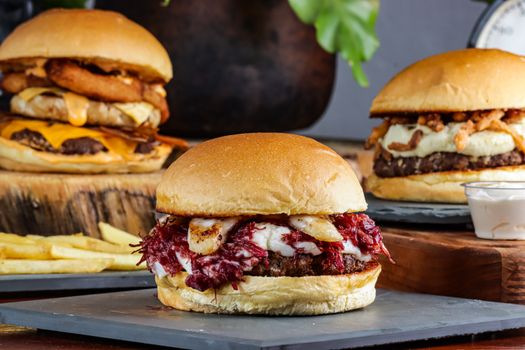
French Onion Burger
The diets react (see scores below)

That’s a heavy plate — want to see the leaner version?
Common Ingredients
- ground beefGround turkey
Lean ground turkey cuts the saturated fat of ground beef while keeping the dish a ground-meat dish.
- yellow onions
- Gruyère cheese
- brioche bunWhole wheat hamburger bun
A whole-wheat bun adds fiber over the refined brioche bun.
- butterExtra virgin olive oil
Extra-virgin olive oil swaps saturated fat for monounsaturated fat in place of butter.
- beef broth
- thyme
Specific recipes may vary.
Incompatible with 10 of 11 diets
Diet Ratings
The French Onion Burger is fundamentally incompatible with keto due to the brioche bun, which is a refined grain product containing roughly 30-40g of net carbs on its own — enough to exceed or nearly exhaust the entire daily keto carb budget in a single component. Caramelized yellow onions also add meaningful net carbs (10-15g depending on quantity). The remaining ingredients — ground beef, Gruyère, butter, beef broth, and thyme — are all keto-friendly and even desirable on the diet. However, the bun is a dealbreaker that makes the dish as presented incompatible with ketosis. A bunless version with onions in moderation would shift the verdict significantly.
The French Onion Burger contains multiple animal-derived ingredients that are strictly excluded from a vegan diet. Ground beef and beef broth are direct animal flesh and animal-derived liquid. Gruyère cheese is a dairy product, butter is an animal-derived fat, and brioche buns typically contain eggs and butter. Every primary component of this dish violates vegan principles, making it unambiguously non-vegan.
The French Onion Burger contains multiple clear paleo violations. The brioche bun is a wheat-based grain product — a hard exclude in all paleo frameworks. Gruyère cheese is dairy, excluded across all mainstream paleo authorities. Butter is also dairy, though ghee (clarified butter) occupies a gray area; regular butter retains casein and lactose and is excluded. Beef broth may contain added salt or additives depending on preparation, though plain homemade broth would be fine. The ground beef, yellow onions, and thyme are fully paleo-compliant, and the caramelized onion concept is sound — but the dish as constructed cannot be considered paleo due to the bun and cheese being foundational, non-optional components.
The French Onion Burger is fundamentally at odds with Mediterranean diet principles on multiple fronts. Ground beef is a red meat that should be consumed only a few times per month, and a burger places it as the central, dominant component. The brioche bun is a refined, enriched grain product with added butter and sugar, far from the whole grains emphasized in Mediterranean eating. Gruyère cheese, while a natural dairy product, is present in a heavy quantity alongside butter, compounding the saturated fat load. Beef broth is a minor ingredient and not problematic, and the onions and thyme are the only genuinely Mediterranean-aligned components. The overall dish is high in saturated fat, built around red meat, uses refined grains, and reflects a processed American fast-food tradition that is the antithesis of the Mediterranean dietary pattern.
The French Onion Burger is fundamentally incompatible with the carnivore diet. While the ground beef and butter are carnivore-approved, and the Gruyère cheese is at least animal-derived, the dish is disqualified by multiple plant-based ingredients: yellow onions (a vegetable), brioche bun (grain-based bread), and thyme (an herb/spice). The brioche bun alone — a processed grain product — is a hard disqualifier, and onions are a plant food excluded from any tier of carnivore eating. Even if you stripped the bun and onions, the thyme would still violate strict carnivore rules. This dish as presented is a classic sandwich heavily centered on plant ingredients and cannot be considered carnivore-compatible in any form without a near-total reconstruction.
This dish contains multiple excluded ingredients. Gruyère cheese is dairy (explicitly excluded). Butter is dairy (excluded — only ghee/clarified butter is the allowed exception). The brioche bun is a grain-based bread product (excluded both as a grain product and as a baked good/bread). Even if the cheese and butter were swapped for compliant alternatives, the brioche bun alone makes this dish non-compliant. The ground beef, onions, beef broth, and thyme are all compliant on their own.
The French Onion Burger contains multiple high-FODMAP ingredients that make it unsuitable during the elimination phase. Yellow onions are one of the highest-FODMAP foods tested by Monash University, containing significant fructans even at very small amounts (a standard serving of caramelized or raw onion far exceeds safe thresholds). The brioche bun is made from wheat flour, which is high in fructans — a primary FODMAP trigger. Gruyère cheese is a hard/semi-hard aged cheese and is generally low-FODMAP (aged cheeses have minimal lactose), so it is not a concern. Ground beef and butter are also low-FODMAP. However, the beef broth may contain onion or garlic as ingredients (most commercial broths do), adding further fructan load. Thyme is low-FODMAP. Despite several safe ingredients, the combination of yellow onions and a wheat-based brioche bun makes this dish clearly high-FODMAP with no practical modification that preserves the dish's identity. Even a small amount of onion is problematic for most IBS sufferers sensitive to fructans.
The French Onion Burger is problematic for the DASH diet on multiple fronts. Ground beef is a red meat high in saturated fat, which DASH explicitly limits. Gruyère cheese is a full-fat dairy product contributing significant saturated fat and sodium. Brioche bun is made with refined flour and butter, adding more saturated fat and offering minimal fiber. Butter used in caramelizing the onions further compounds the saturated fat load. Beef broth is typically high in sodium. Together, this dish likely exceeds 800–1,200mg of sodium per serving and delivers substantial saturated fat — directly opposing DASH's core principles of limiting red meat, full-fat dairy, saturated fat, and high-sodium foods. The only DASH-friendly element is the yellow onions, which provide potassium and fiber but are overwhelmed by the surrounding ingredients.
The French Onion Burger presents multiple Zone Diet challenges that push it toward the lower end of 'caution.' Ground beef (unless very lean, 90%+ lean) carries higher saturated fat than Zone-preferred lean proteins like skinless chicken or fish, making it an 'unfavorable' protein source. Gruyère cheese adds significant saturated fat on top of the beef's fat content, further skewing the fat profile away from Zone-preferred monounsaturated fats. Butter compounds this with additional saturated fat. The brioche bun is a high-glycemic, refined carbohydrate — exactly the type of carb Zone explicitly classifies as 'unfavorable,' contributing to an insulin spike that disrupts the Zone's hormonal balance goals. Caramelized yellow onions, while a vegetable, become moderately higher glycemic when cooked down and concentrated. On the positive side, onions do provide some polyphenols and the beef provides complete protein. A Zone practitioner could adapt this dish by using very lean ground beef (93%+ lean), eliminating or halving the bun and substituting a lettuce wrap or open-face on one slice of whole-grain bread, reducing cheese quantity, and replacing butter with olive oil for cooking the onions. As served in a restaurant context, however, the combination of fatty beef, full brioche bun, and liberal cheese and butter makes Zone-compliant portioning extremely difficult.
The French Onion Burger stacks multiple pro-inflammatory ingredients into a single dish. Ground beef is a red meat high in saturated fat and arachidonic acid, both linked to elevated inflammatory markers like CRP and IL-6 — red meat falls firmly in the 'limit to avoid' category in anti-inflammatory frameworks. Gruyère cheese is a full-fat dairy product contributing additional saturated fat. Butter adds yet more saturated fat and is explicitly limited in anti-inflammatory guidelines. The brioche bun is a refined carbohydrate made with white flour, eggs, and butter — refined carbs drive glycemic spikes and downstream inflammatory signaling. The only redemptive elements are thyme (a mildly anti-inflammatory herb) and yellow onions, which contain quercetin, a polyphenol with documented anti-inflammatory properties, and beef broth, which is neutral to mildly beneficial. However, these minor positives are completely overwhelmed by the cumulative inflammatory load of the dish. This is not a borderline case — the combination of red meat, full-fat cheese, butter, and refined bread represents a concentrated convergence of the food categories most consistently flagged as pro-inflammatory across virtually all anti-inflammatory dietary frameworks.
The French Onion Burger is a poor fit for GLP-1 patients across nearly every evaluation criterion. Ground beef (typically 80/20) is high in saturated fat, which worsens nausea, bloating, and reflux — the most common GLP-1 side effects. Gruyère cheese adds additional saturated fat and calories with modest protein return. The brioche bun is a refined, buttery grain with minimal fiber and high caloric density. Butter appears both in the bun and likely in the caramelized onion preparation, compounding the fat load. While the dish does contain protein from beef and cheese, the fat-to-protein ratio is unfavorable compared to lean alternatives, and the overall fat content is likely to significantly slow already-delayed gastric emptying further, increasing the risk of prolonged nausea and discomfort. Caramelized onions, while containing some fiber and beneficial compounds, are cooked down in butter and broth, reducing their fiber benefit. This is a heavy, calorie-dense, high-saturated-fat meal that conflicts with GLP-1 dietary priorities on multiple fronts.
*See how scores were generated at our methodology page.
Nutritional profile
Six traits that cut across every diet.
Fiber & Plants
How much whole-plant food and fiber it delivers.
Healthy Fats
The quality of its fats (unsaturated, omega-3).
Whole / Unprocessed
How close it is to its natural, unprocessed form.
Gut Gentle
How easy it is on digestion (low FODMAP, few irritants).
Low Glycemic
How little it spikes your blood sugar.
Protein Density
How much protein it packs per calorie.
Controversy Index
Higher controversy = more disagreement between diets.
Diet-Specific Tips
 Zone — 4/10
View tips
- Brioche bun is a high-glycemic refined carbohydrate — classified as 'unfavorable' in Zone methodology
- Ground beef fat content depends heavily on lean percentage; standard restaurant ground beef is typically 80/20, too fatty for Zone
- Gruyère and butter add substantial saturated fat, conflicting with Zone's monounsaturated fat preference
- Caramelized onions are moderately higher glycemic than raw onions but still provide polyphenol benefit
- Dish is protein-centric but fat macro is likely far above Zone's 30% target due to cheese, butter, and fatty beef
- Adaptable in home cooking (lean beef, lettuce wrap, reduced cheese, olive oil) but difficult as typically prepared