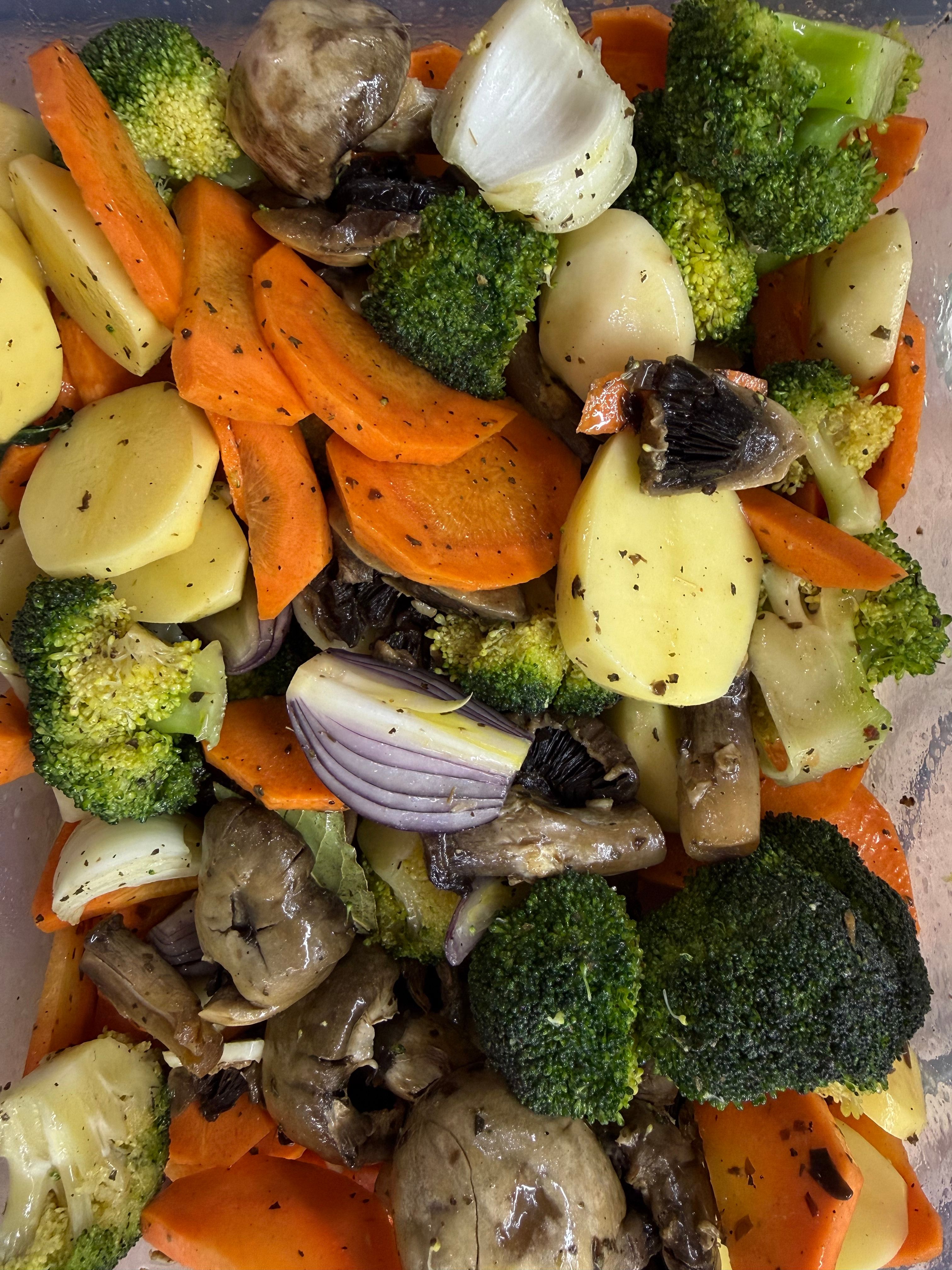
Photo: Випадкові кадри / Pexels
French
French Roasted Vegetables
The diets react (see scores below)
Common Ingredients
- carrots
- fennel
- leeks
- potatoes
- herbes de Provence
- olive oil
- garlic
- thyme
Specific recipes may vary.
Incompatible with 3 of 11 diets
Diet Ratings
This dish is dominated by high-carb vegetables that are fundamentally incompatible with ketosis. Potatoes are one of the most keto-incompatible foods (roughly 15-17g net carbs per 100g). Carrots (7-8g net carbs/100g), leeks (12-13g net carbs/100g), and fennel (4-7g net carbs/100g) compound the problem. A standard serving of this roasted vegetable medley would easily exceed 50g net carbs on its own, blowing the entire daily carb budget. The olive oil, garlic, herbes de Provence, and thyme are keto-friendly, but they cannot redeem the starchy, carb-heavy base of this dish. There is no realistic portion size that makes this compatible with maintaining ketosis.
French Roasted Vegetables is an exemplary whole-food, plant-based dish. Every ingredient — carrots, fennel, leeks, potatoes, herbes de Provence, olive oil, garlic, and thyme — is entirely plant-derived with no animal products or animal-derived additives. The dish relies on minimally processed whole vegetables seasoned with herbs and olive oil, placing it at the high end of the vegan approval spectrum. There is no meaningful debate within the vegan community about any of these ingredients.
Most ingredients in this dish are straightforwardly paleo-approved: carrots, fennel, leeks, garlic, thyme, herbes de Provence, and olive oil are all unprocessed plant foods and a paleo-friendly fat. The sticking point is the potatoes. White potatoes occupy a well-known gray zone in the paleo community — Cordain's original framework and The Paleo Diet's official guidance discourage them due to glycemic load and glycoalkaloid content, while many modern practitioners and protocols (Mark Sisson, Whole30) accept them as a whole-food starch. Because potatoes are a central ingredient here rather than a minor addition, the dish inherits that debate directly. Everything else clears paleo criteria cleanly, which keeps the score in the mid-caution range rather than near avoid.
Mark Sisson (Mark's Daily Apple) and the Whole30 protocol both include white potatoes as acceptable whole foods, arguing that a nutrient-dense, unprocessed starch should not be excluded. Under this view, the entire dish would be approved. Conversely, Loren Cordain's The Paleo Diet and The Paleo Foundation's strict guidelines discourage white potatoes, which would push the verdict toward avoid for that ingredient.
French Roasted Vegetables is an excellent Mediterranean diet dish. It is entirely plant-based, featuring a colorful array of vegetables (carrots, fennel, leeks, potatoes) cooked with extra virgin olive oil and aromatic herbs (garlic, thyme, herbes de Provence). Every ingredient aligns with core Mediterranean diet principles: abundant vegetables as the foundation, olive oil as the primary fat, and no processed ingredients, added sugars, or refined grains. Potatoes are a starchy vegetable that contribute some carbohydrate density, which is the only minor consideration, but they are whole, unprocessed, and entirely appropriate. This dish exemplifies the plant-forward, olive oil-based cooking style central to Mediterranean eating.
French Roasted Vegetables is entirely plant-based with zero animal-derived ingredients. Every component — carrots, fennel, leeks, potatoes, herbes de Provence, olive oil, garlic, and thyme — is explicitly excluded from the carnivore diet. Plant vegetables, plant oils, and plant-based herbs and spices are all forbidden under carnivore principles. This dish represents the exact opposite of what the carnivore diet prescribes.
French Roasted Vegetables consists entirely of Whole30-compliant ingredients. Carrots, fennel, leeks, and potatoes are all allowed vegetables. Herbes de Provence is a blend of dried herbs (typically thyme, rosemary, savory, marjoram, oregano, and sometimes lavender) with no excluded ingredients. Olive oil is a permitted natural fat. Garlic and thyme are allowed herbs/seasonings. There are no grains, legumes, dairy, added sugars, or any other excluded ingredients present. This is a straightforward whole-food vegetable dish that aligns perfectly with the spirit of the Whole30 program.
This dish contains multiple high-FODMAP ingredients that make it unsuitable during the elimination phase. Garlic is one of the highest-FODMAP foods tested by Monash University, rich in fructans, and must be avoided entirely — even small amounts are problematic. Leeks (the green and white parts) are high in fructans at standard serving sizes. Fennel bulb is high in fructans at portions above 47g. While carrots and potatoes are low-FODMAP, and olive oil is safe, the combination of garlic, leeks, and fennel at typical roasted vegetable serving sizes creates a high-FODMAP dish. Herbes de Provence is generally low-FODMAP in culinary amounts, and thyme is safe. However, the foundational aromatics — garlic and leeks — are disqualifying on their own.
French Roasted Vegetables align excellently with DASH diet principles. The dish is built entirely from DASH-core vegetables — carrots, fennel, leeks, and potatoes — all of which contribute meaningful amounts of potassium, fiber, and magnesium. Olive oil is the recommended vegetable oil in DASH guidelines, and garlic, thyme, and herbes de Provence are sodium-free flavor enhancers that reduce the need for added salt. There is no sodium concern inherent to these ingredients, no saturated fat, no added sugar, and no processed components. Potatoes are starchy but whole and unprocessed, fitting within the grain/starchy vegetable allowance. The dish scores slightly below a perfect 10 only because potatoes carry a higher glycemic load than non-starchy vegetables, and oil quantity should be moderate to control total fat intake.
French Roasted Vegetables is a mixed bag in Zone terms. The dish has genuine strengths: olive oil is an ideal Zone fat (monounsaturated), and carrots, fennel, leeks, and garlic are favorable Zone carbohydrates — low-to-moderate glycemic, fiber-rich, and polyphenol-dense. Herbes de Provence and thyme add anti-inflammatory polyphenols with zero macro impact, which Sears would appreciate. However, potatoes are explicitly called out in Zone methodology as a high-glycemic, unfavorable carb — comparable to white bread in glycemic impact — and their presence in what appears to be a roughly equal-ratio vegetable mix is the key detracting factor. The dish also contains no protein whatsoever, meaning it cannot stand alone as a Zone meal or snack; it would require pairing with a lean protein source to achieve 40/30/30 balance. As a side dish (as categorized), it can work in Zone context if potatoes are kept to a very small portion or replaced, and if it is plated alongside lean protein like grilled fish or chicken. The olive oil component actually helps slow glycemic response and contributes the fat block appropriately.
Some Zone practitioners — especially those following Sears' later Mediterranean-influenced writing — would argue that potatoes in modest amounts within a mixed vegetable dish, cooked in olive oil, have a meaningfully lower effective glycemic impact than a plain baked potato, due to the fat content, the dilution with other lower-GI vegetables, and the fiber from fennel and leeks. In that context, a small serving could be treated as a manageable unfavorable carb block rather than a disqualifying ingredient, pushing the score higher toward a 6-7.
French Roasted Vegetables is a strongly anti-inflammatory dish overall. Olive oil provides oleocanthal, a well-established anti-inflammatory compound comparable in mechanism to ibuprofen. Garlic and thyme (a component of herbes de Provence) are both recognized anti-inflammatory spices. Carrots supply beta-carotene and other carotenoids. Fennel contains anethole and quercetin, both studied for anti-inflammatory effects. Leeks provide prebiotic fiber, flavonoids, and polyphenols. Potatoes are the one nuanced ingredient: they are a nightshade and some autoimmune/anti-inflammatory protocols flag them due to solanine content, but mainstream anti-inflammatory nutrition (including Dr. Weil's framework) considers them acceptable, especially with the skin on for fiber and potassium. Herbes de Provence typically includes thyme, rosemary, oregano, marjoram, and lavender — all of which have documented antioxidant and anti-inflammatory properties. The dish contains no refined carbohydrates, added sugars, processed ingredients, or pro-inflammatory fats. The only reason this doesn't score a 9 or 10 is the moderate glycemic load from potatoes and the minor nightshade debate.
Mainstream anti-inflammatory nutrition (Dr. Weil's Anti-Inflammatory Pyramid, IF Rating system) endorses colorful vegetables with olive oil and herbs as exemplary. However, Autoimmune Protocol (AIP) advocates such as Dr. Sarah Ballantyne exclude nightshades like potatoes entirely, citing solanine and lectin content as potentially triggering gut permeability and inflammation in susceptible individuals — making this dish more problematic for those with autoimmune conditions.
French Roasted Vegetables offers meaningful fiber from carrots, fennel, leeks, and potatoes, along with beneficial micronutrients and the digestive-friendly properties of garlic and fennel. Olive oil provides heart-healthy unsaturated fat in moderate amounts, which is acceptable. However, this dish scores in the caution range primarily because it contains no meaningful protein source, which is the top dietary priority for GLP-1 patients. Potatoes, while nutritious, are starchy and calorie-dense relative to their protein content, and roasting concentrates their carbohydrate load. For a patient with already reduced appetite eating small portions, a protein-free side dish uses up valuable stomach capacity without contributing to the critical 100-120g daily protein target. The dish is easy to digest, low in saturated fat, and not inherently harmful — it simply lacks the nutritional density per calorie that GLP-1 patients require. Best used as a small accompaniment to a high-protein main, not as a standalone meal or primary dish.
*See how scores were generated at our methodology page.
Nutritional profile
Six traits that cut across every diet.
Fiber & Plants
How much whole-plant food and fiber it delivers.
Healthy Fats
The quality of its fats (unsaturated, omega-3).
Whole / Unprocessed
How close it is to its natural, unprocessed form.
Gut Gentle
How easy it is on digestion (low FODMAP, few irritants).
Low Glycemic
How little it spikes your blood sugar.
Protein Density
How much protein it packs per calorie.
Controversy Index
Higher controversy = more disagreement between diets.
Diet-Specific Tips
 Vegan — 9/10
View tips
- All ingredients are whole plant foods
- No animal products or animal-derived ingredients present
- Olive oil is plant-derived and universally accepted as vegan
- Herbes de Provence is a blend of dried plant herbs — fully vegan
- No processed or refined components that would lower the score
- Exemplifies the whole-food plant-based ideal
 Paleo — 5/10
View tips
- White potatoes are debated in the paleo community — excluded by Cordain and The Paleo Diet's official guide, accepted by Sisson and Whole30
- Carrots, fennel, leeks, and garlic are all paleo-approved vegetables
- Olive oil is a paleo-approved fat
- Herbes de Provence and thyme are natural herbs with no non-paleo additives
- No grains, legumes, dairy, seed oils, or processed ingredients present
- Dish is otherwise minimally processed and whole-food based
 Mediterranean — 9/10
View tips
- All-vegetable composition fully aligns with plant-forward Mediterranean principles
- Extra virgin olive oil used as primary fat — a core Mediterranean staple
- Garlic, thyme, and herbes de Provence are traditional Mediterranean aromatics
- No processed ingredients, refined grains, or added sugars
- Potatoes are whole and unprocessed, though slightly starchier than non-starchy vegetables
- Fennel and leeks are particularly characteristic of Mediterranean cuisine
 Whole30 — 9/10
View tips
- All vegetables (carrots, fennel, leeks, potatoes) are Whole30-approved
- Olive oil is an explicitly allowed natural fat
- Herbes de Provence is a compliant herb blend — check commercial blends for any added salt or fillers, but the herbs themselves are fine
- Garlic and thyme are permitted seasonings
- No excluded ingredients present
- Dish is a whole-food preparation consistent with Whole30 spirit
 DASH — 9/10
View tips
- All vegetables (carrots, fennel, leeks, potatoes) are DASH-approved whole foods rich in potassium, fiber, and magnesium
- Olive oil is the preferred DASH-compatible fat — heart-healthy monounsaturated fat
- Herbs and garlic provide flavor without sodium, supporting DASH sodium reduction goals
- No added sodium, saturated fat, sugar, or processed ingredients
- Potatoes are starchy — portion size should be moderate within daily starch allowances
- Low caloric density from vegetables supports weight management, a secondary DASH benefit
 Zone — 5/10
View tips
- Potatoes are a high-glycemic 'unfavorable' carb explicitly flagged in Dr. Sears' Zone materials — the primary concern here
- Carrots, fennel, leeks, and garlic are favorable Zone carbohydrates — low glycemic and polyphenol-rich
- Olive oil is an ideal Zone fat source (monounsaturated) and is correctly used here
- Zero protein content — dish cannot form a Zone meal on its own and must be paired with lean protein
- Herbes de Provence, thyme, and garlic contribute anti-inflammatory polyphenols consistent with Sears' later Zone philosophy
- As a side dish component, usability improves significantly if potato quantity is minimized relative to other vegetables
 Anti-Inflammatory — 8/10
View tips
- Extra virgin olive oil provides oleocanthal with strong anti-inflammatory action
- Garlic is a well-established anti-inflammatory ingredient
- Herbes de Provence (thyme, rosemary, oregano) are rich in antioxidants and polyphenols
- Carrots supply beta-carotene and carotenoids that reduce oxidative stress
- Fennel contains anethole and quercetin with anti-inflammatory properties
- Leeks offer prebiotic fiber and flavonoids supporting gut and immune health
- Potatoes are a nightshade — approved by mainstream anti-inflammatory frameworks but excluded in AIP protocols
- No refined carbohydrates, added sugars, seed oils, or processed ingredients
 GLP-1 Friendly — 5/10
View tips
- No protein content — fails the #1 GLP-1 dietary priority
- Good fiber contribution from carrots, fennel, leeks, and potatoes
- Olive oil provides acceptable unsaturated fat in moderate amounts
- Potatoes are starchy and calorie-dense relative to nutritional density for GLP-1 patients
- Fennel and garlic are gentle on digestion and may ease GI side effects
- Nutrient density per calorie is moderate but not high enough for a primary dish
- Appropriate only as a small side alongside a high-protein main