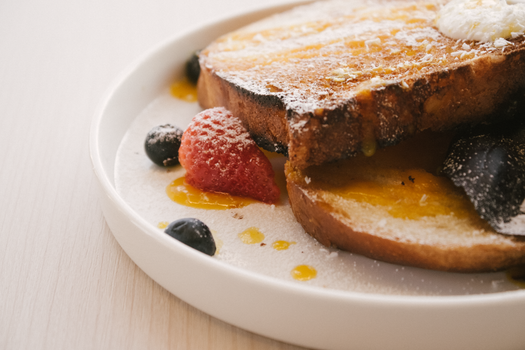
Photo: Vitaly Gorbachev / Pexels
American
French Toast
The diets react (see scores below)
Common Ingredients
- thick-cut bread
- eggs
- milk
- butter
- cinnamon
- vanilla
- maple syrup
- powdered sugar
Specific recipes may vary.
Incompatible with 8 of 11 diets
Diet Ratings
French toast is fundamentally incompatible with a ketogenic diet. The primary ingredient, thick-cut bread, is a grain-based product loaded with net carbs — a single thick slice can contain 25-35g of net carbs alone, easily exceeding the entire daily keto limit. This is compounded by maple syrup (pure sugar, ~13g carbs per tablespoon) and powdered sugar (100% refined sugar), making the dish an extreme carbohydrate and sugar bomb. While eggs and butter are keto-friendly, they are minor contributors here. The macronutrient profile of this dish is the polar opposite of ketogenic requirements: high carb, low fat relative to carbs, with added sugars throughout. There is no portion size small enough to make traditional French toast compatible with ketosis.
French toast as prepared here contains multiple animal products: eggs (a direct animal product), milk (dairy), and butter (dairy). These are core, non-incidental ingredients that fundamentally define the dish. There is no ambiguity — all three are unequivocally excluded under any mainstream vegan definition. A vegan version of French toast is possible using plant-based milk, flax or aquafaba egg substitutes, and vegan butter, but the dish as described does not qualify.
French Toast is fundamentally incompatible with the Paleolithic diet. The dish is built on thick-cut bread, which is a wheat-based grain product — one of the clearest exclusions in paleo across all schools of thought. Milk is dairy, also excluded. Butter, while used in traditional recipes, is a dairy product excluded by strict paleo (though ghee is sometimes accepted as a substitute). Powdered sugar is refined sugar, another hard exclusion. Maple syrup, while a natural sweetener with some paleo acceptance, is secondary to the more disqualifying ingredients. Eggs and cinnamon are paleo-approved, but they cannot redeem a dish whose foundational ingredients (bread, milk, powdered sugar) are all explicitly non-paleo. There is no meaningful way to prepare traditional French Toast as paleo-compliant without replacing most of the ingredient list.
French Toast as prepared here contradicts Mediterranean diet principles on multiple fronts. The base is thick-cut bread, almost certainly refined white bread, which is a refined grain. It is cooked in butter rather than olive oil, adding saturated fat from a non-preferred source. The dish is topped with maple syrup and powdered sugar, both added sugars with no nutritional benefit. While eggs and milk are acceptable in moderation, they are supporting a dish whose overall profile is dominated by refined carbohydrates, added sugars, and saturated fat — hallmarks of what the Mediterranean diet explicitly discourages.
French Toast is fundamentally incompatible with the carnivore diet. The dish is built on thick-cut bread (a grain-based plant food), which alone makes it a hard avoid. Beyond the bread, it contains cinnamon and vanilla (plant-derived spices/flavorings), maple syrup (plant-derived sugar), and powdered sugar (refined sugar) — all strictly excluded. While eggs, milk, and butter are animal-derived and would otherwise be acceptable (with varying degrees of debate), they are entirely overshadowed by the dominant plant-based and sugar-laden components. This dish represents nearly everything the carnivore diet eliminates: grains, plant sugars, refined sugar, and plant spices.
French Toast violates Whole30 on multiple fronts. First, bread (thick-cut) is a grain-based product and grains are entirely excluded. Second, regular butter is excluded (only ghee/clarified butter is permitted). Third, milk is dairy and excluded. Fourth, maple syrup is an added sugar, which is excluded. Fifth, powdered sugar is an added sugar and excluded. Beyond the individual ingredient violations, French Toast is explicitly called out in the Whole30 rules as a classic 'junk food recreation' — pancakes, French toast, and similar breakfast baked goods are specifically prohibited even if someone attempted to make a compliant version, as they violate the spirit of the program.
French Toast as traditionally prepared contains multiple high-FODMAP ingredients that make it unsafe during the elimination phase. The most significant offender is thick-cut bread, which is almost certainly wheat-based and therefore high in fructans — the primary FODMAP concern. Milk adds lactose (a disaccharide), and powdered sugar often contains cornstarch which is fine, but the milk alone at a standard serving (e.g., 1/4 cup or more) would push lactose over threshold. Maple syrup (pure) is actually low-FODMAP at ~2 tbsp, and cinnamon and vanilla are low-FODMAP. Butter is low-FODMAP. Eggs are low-FODMAP. However, the wheat bread alone is enough to make this dish a clear avoid — two slices of standard wheat bread far exceed the fructan threshold. Without substitutions (gluten-free bread + lactose-free milk), this dish is not suitable for the elimination phase.
French toast as commonly prepared presents a mixed DASH profile. The egg and milk base provides some protein and calcium, and cinnamon is DASH-friendly. However, thick-cut bread (often white or refined) lacks the whole-grain fiber DASH emphasizes, butter adds saturated fat, and the combination of maple syrup and powdered sugar creates a high added-sugar dish. The overall meal skews toward refined carbohydrates and added sugars rather than the nutrient-dense, low-saturated-fat profile DASH promotes. It is not categorically 'avoid' territory since the sodium load is relatively modest and eggs/milk contribute beneficial nutrients, but the sugar and saturated fat content place it firmly in 'caution.' Modifications — whole-grain bread, low-fat milk, minimal butter, no powdered sugar, and light syrup — would meaningfully improve its DASH compatibility.
NIH DASH guidelines discourage sweets, added sugars, and saturated fat (butter), which this dish contains in notable amounts, placing it outside core DASH foods. However, some DASH-oriented dietitians note that an occasional home-prepared French toast using whole-grain bread, low-fat dairy, and a modest drizzle of maple syrup fits within DASH's discretionary allowances for sweets (≤5 servings/week), particularly for non-diabetic individuals who are sodium-focused rather than sugar-focused in their DASH implementation.
French toast as traditionally prepared is a near-perfect storm of Zone Diet unfavorable ingredients. Thick-cut bread is a high-glycemic refined carbohydrate that Sears explicitly classifies as unfavorable. Maple syrup and powdered sugar are pure sugar additions that spike insulin dramatically — exactly the hormonal response Zone is designed to prevent. Butter adds saturated fat rather than the preferred monounsaturated fats. The egg component is the only Zone-favorable element, providing lean protein, but it is completely overwhelmed by the carbohydrate load and sugar toppings. Even with careful portioning, the dish as described cannot achieve a 40/30/30 macro ratio without fundamentally altering its character: the bread portion would need to be tiny, the maple syrup and powdered sugar eliminated entirely, butter replaced, and a substantial additional protein source added on the side. The combination of refined starch plus added sugars creates a high-glycemic carbohydrate avalanche that Sears identifies as the primary driver of eicosanoid imbalance and chronic inflammation. This is not a food that can be 'portioned into' Zone compliance — it would need to be reconstructed from scratch.
French toast as typically prepared sits in caution-to-avoid territory from an anti-inflammatory standpoint, though specific ingredients pull in different directions. On the positive side, eggs provide choline and selenium with some anti-inflammatory relevance, cinnamon is a well-documented anti-inflammatory spice that helps with blood sugar regulation, and vanilla has minor antioxidant properties. Milk contributes protein and calcium. However, the overall dish profile is problematic: thick-cut bread (almost certainly refined white bread in the classic preparation) delivers a high glycemic load that spikes blood sugar and promotes inflammatory cascades. Butter adds saturated fat. Maple syrup is a natural sweetener but still adds significant sugar load. The real concern is the powdered sugar topping — this is refined added sugar with zero nutritional benefit and directly pro-inflammatory at typical serving amounts. The combination of refined carbohydrates + added sugars + saturated fat from butter creates a breakfast that, in standard portions, is likely to promote post-meal inflammation. If made with whole grain or sourdough bread, reduced maple syrup, no powdered sugar, and prepared in olive oil or coconut oil instead of butter, the score could be higher. As classically prepared, this is a treat food rather than an anti-inflammatory staple.
French toast as described is a borderline food for GLP-1 patients. The eggs provide some protein, but the base is thick-cut refined bread — a high-glycemic, low-fiber refined carbohydrate that offers little nutritional density per calorie. Butter adds saturated fat, which can worsen nausea and slow gastric emptying further. Maple syrup and powdered sugar are pure added sugar with no fiber, protein, or micronutrient value — empty calories that GLP-1 patients can least afford. Cinnamon and vanilla are fine and may even help with blood sugar response marginally. The dish is not fried in the deep-fat sense, which keeps it out of avoid territory, but the combination of refined carbs, added sugar, saturated fat, and low protein density makes it a poor fit for GLP-1 dietary priorities. A single egg in the custard across 1-2 slices may yield only 6-12g protein — well below the 15-30g per meal target. It is not inherently intolerable but requires significant modification (whole grain bread, extra eggs, no syrup or powdered sugar, minimal butter) to become acceptable.
*See how scores were generated at our methodology page.
Nutritional profile
Six traits that cut across every diet.
Fiber & Plants
How much whole-plant food and fiber it delivers.
Healthy Fats
The quality of its fats (unsaturated, omega-3).
Whole / Unprocessed
How close it is to its natural, unprocessed form.
Gut Gentle
How easy it is on digestion (low FODMAP, few irritants).
Low Glycemic
How little it spikes your blood sugar.
Protein Density
How much protein it packs per calorie.
Controversy Index
Higher controversy = more disagreement between diets.
Diet-Specific Tips
 DASH — 4/10
View tips
- High added sugar from maple syrup and powdered sugar — DASH limits sweets to ≤5 servings/week
- Butter contributes saturated fat, which DASH advises limiting
- Thick-cut bread likely refined/white — DASH emphasizes whole grains over refined carbohydrates
- Eggs provide protein but raise moderate cholesterol considerations for some DASH clinicians
- Milk contributes calcium and aligns with DASH dairy goals if low-fat is used
- Relatively low sodium content is a positive factor
- Whole-grain bread substitution and reduced sugar would substantially improve DASH score
 Anti-Inflammatory — 4/10
View tips
- Refined white bread base creates high glycemic load — pro-inflammatory
- Powdered sugar topping is pure refined added sugar — pro-inflammatory
- Maple syrup adds natural but significant sugar load
- Butter contributes saturated fat
- Cinnamon is a genuine anti-inflammatory ingredient that helps modulate blood sugar response
- Eggs provide moderate nutritional value (choline, selenium)
- Overall macronutrient profile (refined carbs + sugar + saturated fat) is a classic pro-inflammatory combination
- Whole grain bread substitution would meaningfully improve the score
 GLP-1 Friendly — 4/10
View tips
- Low protein density per serving — eggs are diluted across refined bread, likely yielding under 12g protein per serving
- Refined bread is high-glycemic, low-fiber — poor nutrient density per calorie
- Maple syrup and powdered sugar are pure added sugar with no nutritional value — counterproductive on GLP-1
- Butter adds saturated fat, which can worsen nausea and GI discomfort
- Not fried, and eggs + milk provide some protein and micronutrients — keeps it out of avoid
- Cinnamon may marginally support blood sugar response
- Easily modified: whole grain bread, added egg whites, no sugar toppings would raise score to 6-7
Community
Healthiest French Toast recipes
One scanned recipe so far — scan yours to see how it stacks up.
Scan your French Toast recipe →