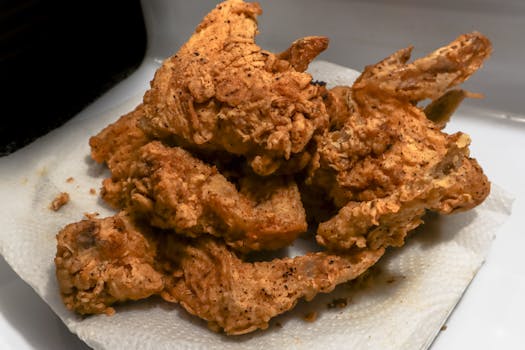
Photo: Terrance Barksdale / Pexels
American
Fried Chicken
The diets react (see scores below)
Common Ingredients
- chicken
- buttermilk
- flour
- paprika
- garlic powder
- cayenne
- black pepper
- vegetable oil
Specific recipes may vary.
Incompatible with 10 of 11 diets
Diet Ratings
Traditional fried chicken is incompatible with keto due to the wheat flour coating, which is a grain-based ingredient adding significant net carbs per serving (roughly 10-15g+ per piece depending on thickness of breading). Buttermilk also contributes a small amount of carbs. While the chicken itself and the spices are keto-friendly, and frying in oil aligns with high-fat requirements, the flour breading is the disqualifying factor. The standard preparation of this dish cannot be consumed on keto without fundamentally altering the recipe (e.g., substituting almond flour or pork rind crumbs for wheat flour).
Fried chicken contains two clear animal products: chicken (poultry/meat) and buttermilk (a dairy product). Both are explicitly excluded under vegan dietary rules. There is no ambiguity here — this dish is fundamentally built on animal-derived ingredients and is incompatible with a vegan diet in any mainstream interpretation.
Fried chicken as prepared here contains multiple non-paleo ingredients that make it clearly incompatible with the diet. Buttermilk is a dairy product, flour is a grain, and vegetable oil is a seed oil — all three are explicitly excluded from paleo. The chicken itself and the spices (paprika, garlic powder, cayenne, black pepper) are paleo-approved, but the core preparation method relies on three hard-no ingredients. There is no meaningful way to classify this dish as paleo-compatible in its traditional form.
Fried chicken is a poor fit for the Mediterranean diet on multiple counts. While chicken (poultry) itself is acceptable in moderation, the preparation method here is deeply problematic: deep-frying in vegetable oil (likely refined, high in omega-6 polyunsaturated fats) replaces the preferred extra virgin olive oil as the fat source. The refined white flour coating adds refined grains, and the buttermilk-and-flour breading creates a heavily processed, calorie-dense preparation. The Mediterranean diet emphasizes minimally processed foods, olive oil as the primary fat, and simple preparations. This dish contradicts those core principles through its cooking method and use of refined ingredients, regardless of the acceptable protein source.
Fried chicken as prepared here is fundamentally incompatible with the carnivore diet. While the chicken itself is an animal product, the dish is heavily coated in flour (a grain), fried in vegetable oil (a plant-based oil), and seasoned with plant-derived spices (paprika, garlic powder, cayenne). Buttermilk adds a debated dairy component, but it's the least problematic ingredient here. The flour breading and vegetable oil alone are hard disqualifiers — grains and seed/plant oils are among the most consistently excluded foods across all carnivore tiers. This is essentially a plant-heavy preparation using chicken as a vehicle.
Fried Chicken as described contains two excluded ingredients: buttermilk (dairy) and flour (a grain). Both are explicitly prohibited on the Whole30 program. Buttermilk is a dairy product used as a marinade/batter base, and flour (wheat) is a grain used for the breading coating. Even if those were substituted, the breaded-and-fried format itself falls into the 'recreating junk food' category (fried breaded coating mimics a comfort food format the program discourages). The spices and chicken itself are compliant, but the dish as described cannot be made Whole30-compatible without fundamentally changing its nature.
Traditional fried chicken contains multiple high-FODMAP ingredients that make it unsuitable during the elimination phase. The two primary concerns are: (1) wheat flour used for the coating is high in fructans, a major FODMAP trigger; and (2) garlic powder is one of the highest-FODMAP ingredients in common cooking, concentrated in fructans even in small amounts. Buttermilk is also high in lactose, adding a third FODMAP hit. The chicken itself, paprika, cayenne, black pepper, and vegetable oil are all low-FODMAP, but the combination of wheat flour, garlic powder, and buttermilk makes this dish a triple-threat FODMAP concern at any standard serving size.
Fried chicken is a poor fit for the DASH diet on multiple fronts. Deep-frying significantly increases total fat content, and while vegetable oil is used here (avoiding the worst saturated fats), the frying process still substantially elevates caloric density and total fat intake. The breading (flour coating) adds refined carbohydrates with little nutritional value. Buttermilk contributes some sodium, and the overall preparation method — deep frying — is antithetical to DASH principles, which emphasize baked, grilled, or poached lean poultry. DASH guidelines explicitly recommend limiting total fat and avoiding high-fat cooking methods. Although chicken itself is a DASH-approved lean protein, the preparation transforms it into a high-fat, calorie-dense food that does not align with DASH goals for cardiovascular health and blood pressure management.
Fried chicken presents multiple Zone Diet challenges despite its lean protein base. The chicken itself is a Zone-favorable lean protein, but the preparation method significantly alters its macro profile. The flour-based breading adds high-glycemic carbohydrates that are difficult to account for in Zone blocks. More critically, deep frying in vegetable oil (typically a high omega-6 seed oil like soybean or canola) substantially increases the fat content and shifts the fat profile away from the monounsaturated fats Dr. Sears recommends, toward pro-inflammatory omega-6 polyunsaturated fats. The absorbed frying oil also makes fat block calculation highly imprecise. Buttermilk adds minimal carbs and is not a major concern. The spices (paprika, garlic powder, cayenne, black pepper) are Zone-neutral or mildly positive as polyphenol sources. A typical fried chicken piece will carry excess fat calories and the wrong fat type, making the 40/30/30 ratio very hard to achieve without stripping the skin and breading — at which point it is essentially no longer fried chicken. It can technically be incorporated into a Zone meal in a small portion with careful vegetable balancing, but it is classified as an 'unfavorable' protein source in Zone terminology due to its preparation.
Fried chicken presents a strongly pro-inflammatory profile primarily due to the cooking method and oil used. Deep frying in vegetable oil (typically a high-omega-6 refined oil such as soybean, corn, or cottonseed blend) is a central concern: heating these polyunsaturated oils to frying temperatures drives oxidation and the formation of aldehydes, advanced glycation end-products (AGEs), and potentially trans fats from repeated heating — all linked to elevated inflammatory markers. The refined white flour coating adds refined carbohydrates with minimal nutritional value and contributes to AGE formation during frying. Buttermilk is full-fat dairy, which is in the 'limit' category. On the positive side, chicken itself is a lean protein that falls in the 'moderate' category, and the spice blend (paprika, garlic powder, cayenne, black pepper) contains genuinely anti-inflammatory compounds — capsaicin, allicin precursors, and piperine all have research support for reducing inflammatory markers. However, these spice benefits are insufficient to offset the deep-frying method and oil concerns. The dish as prepared is a textbook example of a cooking-method-driven inflammatory food regardless of the base protein.
Some anti-inflammatory practitioners note that the spices used (cayenne, garlic, paprika) carry real anti-inflammatory value, and that lean chicken is preferable to red meat. A minority view in nutrition science, aligned with AHA positions, argues that refined seed oils are not inherently pro-inflammatory at moderate dietary levels and that the concern about oxidation is overstated in typical home or restaurant frying conditions — this would push the dish toward 'caution' rather than 'avoid.' However, the dominant anti-inflammatory framework (Dr. Weil, IF Rating system) consistently flags both deep frying and refined omega-6 seed oils as inflammatory regardless of the base ingredients.
Fried chicken is a poor choice for GLP-1 patients across nearly every dietary criterion. Deep-frying in vegetable oil dramatically increases the fat content per serving, and high-fat meals are strongly associated with worsened GLP-1 side effects including nausea, bloating, and acid reflux — all amplified by the medication's slowing of gastric emptying, which causes fatty food to sit in the stomach far longer than usual. The buttermilk-and-flour coating adds refined carbohydrates and absorbs significant oil during frying, contributing empty calories with minimal nutritional value. The cayenne in the spice blend may further aggravate nausea and reflux, which are already common side effects. While chicken itself is an excellent protein source, the frying preparation method negates that advantage — the high fat load and low nutrient density per calorie make this a poor fit for patients eating significantly reduced portions and needing every calorie to work hard nutritionally.
*See how scores were generated at our methodology page.
Nutritional profile
Six traits that cut across every diet.
Fiber & Plants
How much whole-plant food and fiber it delivers.
Healthy Fats
The quality of its fats (unsaturated, omega-3).
Whole / Unprocessed
How close it is to its natural, unprocessed form.
Gut Gentle
How easy it is on digestion (low FODMAP, few irritants).
Low Glycemic
How little it spikes your blood sugar.
Protein Density
How much protein it packs per calorie.
Controversy Index
Higher controversy = more disagreement between diets.
Diet-Specific Tips
 Zone — 4/10
View tips
- Chicken is a Zone-approved lean protein, but skin-on fried preparation adds significant saturated and omega-6 fat
- Flour breading contributes high-glycemic carbohydrate blocks that are difficult to measure precisely
- Vegetable oil used for frying is typically high in pro-inflammatory omega-6 fatty acids, contrary to Zone anti-inflammatory principles
- Absorbed frying oil makes fat content highly variable and difficult to fit into Zone fat blocks
- Spices are Zone-neutral to mildly positive as polyphenol contributors
- Small portions could technically be incorporated into a Zone meal but undermine the spirit of the diet