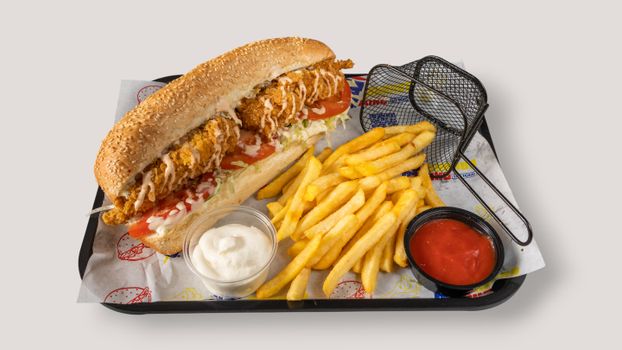
Photo: Mahmut Zeytin / Pexels
American
Fried Fish Sandwich
The diets react (see scores below)
Common Ingredients
- white fish fillet
- hamburger bun
- tartar sauce
- American cheese
- lettuce
- breadcrumbs
- vegetable oil
Specific recipes may vary.
Incompatible with 10 of 11 diets
Diet Ratings
The Fried Fish Sandwich is fundamentally incompatible with ketogenic eating. The hamburger bun alone contributes roughly 25-30g of net carbs, immediately pushing most keto dieters to or beyond their daily limit in a single item. The breadcrumb coating on the fish adds another 10-15g of net carbs, and the frying in vegetable oil (typically a high-PUFA seed oil) introduces inflammatory fats that many keto practitioners also avoid. While the white fish itself is a lean, acceptable protein and the tartar sauce and American cheese are relatively low-carb, these positives are completely overshadowed by the two major grain-based components. There is no realistic portion adjustment that makes this sandwich keto-compatible without fundamentally deconstructing the dish — at which point it is no longer a sandwich.
The Fried Fish Sandwich contains multiple animal-derived ingredients that make it entirely incompatible with a vegan diet. White fish fillet is a direct animal product (seafood), American cheese is a dairy product, and tartar sauce typically contains eggs (mayonnaise base). Even setting aside the fish itself, the cheese and tartar sauce independently disqualify this dish. There is no ambiguity here — this is a classic non-vegan fast-food item.
This dish contains multiple paleo-incompatible ingredients. The hamburger bun is a grain-based product (wheat), which is strictly excluded from the paleo diet. Breadcrumbs are also grain-derived and used as a coating on the fish. American cheese is a processed dairy product, doubly disqualified as both dairy and a heavily processed food. Tartar sauce typically contains mayonnaise made with seed oils (soybean or canola oil), added sugar, and other non-paleo additives. Vegetable oil is a seed oil explicitly excluded from the paleo framework. The only paleo-compliant ingredient in this dish is the white fish fillet itself and the lettuce. As a fast-food preparation, this sandwich is fundamentally incompatible with paleo principles on nearly every dimension.
While white fish is a Mediterranean diet staple, this fast-food preparation undermines virtually every core principle. The refined white hamburger bun is a processed refined grain, the breadcrumb coating adds more refined carbohydrates, the fish is deep-fried in industrial vegetable oil (not olive oil), American cheese is a highly processed dairy product, and tartar sauce typically contains refined seed oils and added sugars. The overall dish is a processed fast-food item high in refined carbohydrates, unhealthy fats, and sodium — the antithesis of Mediterranean eating patterns, despite the fish protein at its core.
The Fried Fish Sandwich is fundamentally incompatible with the carnivore diet. While white fish is a perfectly carnivore-approved protein, virtually every other component of this dish is plant-derived or heavily processed. The hamburger bun is a grain-based bread, the breadcrumbs coating the fish are also grain-derived, vegetable oil is a plant-based fat explicitly excluded from carnivore, lettuce is a plant food, and tartar sauce typically contains plant-based ingredients (pickles, capers, herbs, plant oils). The American cheese is a processed dairy product of minimal nutritional value. This is a quintessential fast-food item built around plant-based carbohydrates and industrial seed oils, with fish serving as a minor component buried under carnivore-incompatible ingredients. There is no meaningful way to adapt this dish within a carnivore framework — the fish would need to be stripped of its breading and served completely differently.
This dish contains multiple excluded ingredients that make it clearly non-compliant with Whole30. The hamburger bun is a grain-based bread product (wheat), which is excluded. Breadcrumbs are also grain-derived (wheat). American cheese is a dairy product, which is excluded. Tartar sauce typically contains added sugar and/or dairy. Beyond the individual ingredient violations, this dish also falls under the 'no recreating junk food' rule — a fried fish sandwich is a classic fast-food item that violates the spirit of the program regardless of ingredients. The only compliant elements are the white fish fillet, lettuce, and vegetable oil.
The fried fish sandwich contains multiple high-FODMAP ingredients that make it unsuitable during the elimination phase. The hamburger bun is made from wheat flour, which is high in fructans — a primary FODMAP offender. The breadcrumbs coating the fish are also typically wheat-based, adding further fructan load. American cheese is a processed cheese product that, while low in lactose individually, contributes to cumulative FODMAP intake. Tartar sauce frequently contains high-FODMAP ingredients such as onion, garlic, or high-fructose corn syrup. Taken together, the wheat bun alone is sufficient to classify this dish as high-FODMAP, and the breadcrumbs and potentially problematic tartar sauce compound the issue significantly. The white fish, lettuce, and vegetable oil are all low-FODMAP and safe, but the structural components of this fast-food sandwich make it incompatible with the elimination phase without substantial modification (e.g., gluten-free bun, GF breadcrumbs, FODMAP-safe condiment).
While white fish is a DASH-approved lean protein, the overall composition of a fried fish sandwich conflicts significantly with DASH principles. Deep frying in vegetable oil adds substantial calories and trans/oxidized fats depending on preparation. The refined white hamburger bun lacks the fiber of whole grains. Tartar sauce is high in sodium, saturated fat, and added sugar. American cheese is a processed full-fat dairy product high in sodium and saturated fat — both explicitly limited on DASH. Breadcrumb coating adds refined carbs and sodium. As a fast-food item, the total sodium content of this sandwich typically ranges from 700–1,200mg per serving, representing a significant portion of the 1,500–2,300mg daily DASH sodium limit in a single meal. The combination of deep frying, processed cheese, and high-sodium condiments makes this a poor DASH choice even though the underlying protein source is sound.
The fried fish sandwich presents a challenging Zone balance. The white fish fillet itself is an excellent lean protein source, but the preparation and accompanying ingredients undermine Zone compatibility significantly. The hamburger bun is a high-glycemic refined carbohydrate that Sears classifies as 'unfavorable.' The breadcrumb coating adds more refined carbs and disrupts the protein block purity. Tartar sauce is high in omega-6-heavy vegetable oils (typically soybean or canola), directly conflicting with Zone's anti-inflammatory fat principles. The American cheese adds saturated fat with minimal protein benefit. Vegetable oil used for frying is precisely the omega-6-heavy seed oil Sears discourages. The macro ratio skews heavily toward carbohydrates and unfavorable fats, with the protein diluted by the coating. A home-prepared version with a lettuce wrap, olive oil pan-sear, and avocado-based sauce could be Zone-adapted, but the standard fast-food preparation makes this very difficult to incorporate into Zone balance without radical modification.
The fried fish sandwich, while based on a lean white fish that is neutral to mildly beneficial, is rendered pro-inflammatory by its preparation and accompaniments. Deep frying in vegetable oil (likely corn, soybean, or sunflower oil — high in omega-6 fatty acids) introduces oxidized fats that promote inflammatory signaling. The refined white flour hamburger bun is a high-glycemic refined carbohydrate that spikes blood sugar and elevates inflammatory markers like CRP. Breaded coating adds more refined carbs and increases oil absorption during frying. Tartar sauce typically contains mayonnaise made from omega-6-rich oils, adding further pro-inflammatory fat. American cheese is a processed dairy product with artificial additives and saturated fat. Together, this dish combines nearly every anti-inflammatory 'avoid' or 'limit' category: refined carbs, seed oil frying, processed condiments, and processed cheese — while delivering none of the omega-3 benefit that makes fish anti-inflammatory in the first place (white fish is low in omega-3s compared to fatty fish, and frying further degrades any beneficial lipids). Lettuce is the only genuinely anti-inflammatory ingredient but is present in negligible quantity.
A fast-food fried fish sandwich is a poor choice for GLP-1 patients on nearly every key criterion. The fish fillet is deep-fried in vegetable oil, dramatically increasing fat content and introducing the kind of heavy, greasy food that directly worsens GLP-1 side effects — nausea, bloating, and reflux — because slowed gastric emptying means high-fat foods sit in the stomach far longer. Tartar sauce adds significant additional fat with minimal nutritional value. The refined white hamburger bun contributes empty refined carbohydrates with negligible fiber. American cheese adds saturated fat. While white fish is inherently a lean, high-quality protein, the preparation method negates that advantage entirely. The overall dish is low in fiber, high in fat, calorie-dense without meaningful nutrient density, and likely to trigger GI distress. This is precisely the category of food the guidelines identify as avoid regardless of the underlying protein source.
*See how scores were generated at our methodology page.
Nutritional profile
Six traits that cut across every diet.
Fiber & Plants
How much whole-plant food and fiber it delivers.
Healthy Fats
The quality of its fats (unsaturated, omega-3).
Whole / Unprocessed
How close it is to its natural, unprocessed form.
Gut Gentle
How easy it is on digestion (low FODMAP, few irritants).
Low Glycemic
How little it spikes your blood sugar.
Protein Density
How much protein it packs per calorie.
Controversy Index
Higher controversy = more disagreement between diets.
Diet-Specific Tips
 Zone — 4/10
View tips
- White fish is a favorable Zone protein but is compromised by breadcrumb coating
- Hamburger bun is a high-glycemic 'unfavorable' carbohydrate per Sears' classification
- Tartar sauce typically uses omega-6-heavy soybean oil, conflicting with Zone anti-inflammatory principles
- Frying in vegetable oil adds excessive omega-6 polyunsaturated fats
- American cheese contributes saturated fat with negligible protein block value
- Overall macro ratio skews heavily carb and unfavorable fat, far from 40/30/30
- Fast-food preparation offers no opportunity for block adjustment or substitution