Photo: Arian Fernandez / Pexels
Italian
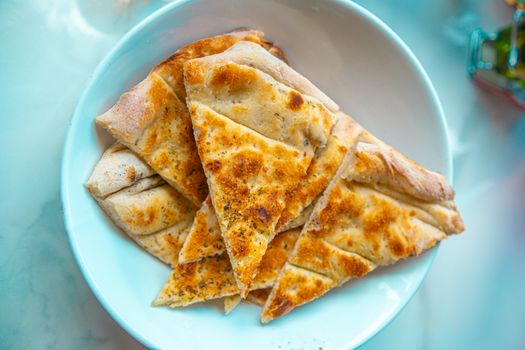
Italian Garlic Bread
The diets react (see scores below)
Common Ingredients
- Italian bread
- butter
- garlic
- parsley
- Parmesan
- olive oil
Specific recipes may vary.
Incompatible with 9 of 11 diets
Diet Ratings
Italian garlic bread is built on a foundation of Italian bread, a refined grain product that is fundamentally incompatible with ketogenic eating. A single typical serving (1-2 slices) delivers 30-50g of net carbs, which can single-handedly exceed or max out the entire daily carb allowance for ketosis. The other ingredients — butter, garlic, parsley, Parmesan, and olive oil — are keto-friendly on their own, but they cannot offset the dominant carbohydrate load from the bread. This dish must be avoided entirely to maintain ketosis.
Italian Garlic Bread as listed contains two clear animal-derived ingredients: butter (dairy fat) and Parmesan cheese (dairy, and traditionally made with animal rennet). These are unambiguously non-vegan under any mainstream definition of veganism. The base ingredients — Italian bread, garlic, parsley, and olive oil — are all plant-based, meaning a vegan version of garlic bread is easily achievable by substituting vegan butter (e.g., Earth Balance) and omitting or replacing Parmesan with nutritional yeast or a plant-based cheese. However, as described, this dish is not vegan-compatible.
Italian garlic bread is fundamentally incompatible with the Paleo diet. The base ingredient — Italian bread — is a grain-based product made from wheat flour, which is explicitly excluded from Paleo. Butter and Parmesan cheese are dairy products, also excluded. These are not minor or debated violations; grains and dairy are among the most clearly defined exclusions in Paleo dietary guidelines across all major authorities. While garlic, parsley, and olive oil are fully Paleo-compliant, they cannot redeem a dish whose core components are non-Paleo. This dish scores a 1 — it contains multiple foundational violations with no meaningful Paleo substitution in its traditional form.
Italian garlic bread as typically prepared uses refined white Italian bread, which is a refined grain offering little fiber or nutritional density. Butter is a saturated fat that contradicts the Mediterranean principle of olive oil as the primary fat. While the dish does include olive oil, garlic (a Mediterranean staple), parsley, and Parmesan in modest amounts, the foundation is a refined grain base with butter, making it more of an occasional indulgence than a diet-compatible food. The combination of refined carbohydrates and saturated fat from butter places this squarely in the 'avoid' category for regular consumption.
Some traditional Italian regional practices do incorporate bread (pane) as a staple, and a lighter version made with whole-grain bread, extra virgin olive oil instead of butter, and minimal cheese would shift this dish toward 'caution.' The garlic, parsley, and olive oil components are genuinely Mediterranean, and traditionalists might argue that bread with olive oil and garlic — a bruschetta-style preparation — is a legitimate part of the diet.
Italian Garlic Bread is almost entirely plant-based and grain-based, making it fundamentally incompatible with the carnivore diet. The primary ingredient is Italian bread — a grain product that is explicitly excluded from all tiers of carnivore eating. Garlic, parsley, and olive oil are all plant-derived ingredients. While butter and Parmesan are animal-derived, they are minor components of a dish dominated by prohibited foods. There is no meaningful animal protein present. This dish violates the core principle of eating exclusively animal products.
Italian Garlic Bread contains multiple Whole30-excluded ingredients. Italian bread is made from wheat flour, a grain that is explicitly excluded from the Whole30 program. Butter (regular, not ghee or clarified butter) is a dairy product and is also excluded. Parmesan cheese is dairy and likewise excluded. Even if the bread were somehow compliant, the dish itself is essentially a classic baked good/bread product, which falls squarely into the 'no recreating bread' rule. There is no compliant version of this dish as traditionally prepared.
Italian garlic bread contains two major high-FODMAP ingredients that make it unsuitable during the elimination phase. First, Italian bread is made from wheat flour, which is high in fructans — a primary FODMAP trigger. Second, garlic is one of the highest-FODMAP foods tested by Monash University, containing very high levels of fructans even in tiny amounts (a single clove is high-FODMAP). Parmesan cheese is generally low-FODMAP in standard servings (40g) as it is a hard, aged cheese with minimal lactose. Butter, olive oil, and parsley are all low-FODMAP. However, the combination of wheat-based bread and garlic makes this dish clearly high-FODMAP at any realistic serving size. There is no practical modification that preserves the dish's identity while making it low-FODMAP — garlic-infused oil could replace garlic, and sourdough or gluten-free bread could replace Italian bread, but that would be a fundamentally different dish.
Italian garlic bread is a borderline food for the DASH diet. The base (Italian white bread) is a refined grain rather than a whole grain, which DASH discourages in favor of whole-grain options. Butter adds saturated fat, which DASH explicitly limits. Parmesan cheese, while flavorful, contributes additional saturated fat and notable sodium. These concerns push it toward 'avoid.' However, the inclusion of olive oil (a DASH-approved unsaturated fat), garlic (associated with blood pressure benefits), and parsley (nutrient-rich herb) provide some redemption. The dish is best classified as 'caution' — acceptable occasionally in small portions, but not a food DASH emphasizes. Using whole-grain bread, replacing butter entirely with olive oil, and reducing Parmesan would significantly improve its DASH compatibility.
Italian garlic bread is built on a foundation of high-glycemic refined white Italian bread, which is explicitly classified as an 'unfavorable' and largely incompatible carbohydrate in Zone methodology. The bread provides rapid-digesting carbs with minimal fiber, causing a glycemic spike that disrupts the eicosanoid balance Sears seeks to control. While the dish does include some positive Zone elements — olive oil and garlic (a polyphenol source) — these are overwhelmed by the structural problem: the bread base. Butter adds saturated fat, and Parmesan adds minimal protein relative to the fat and carb load. The dish offers no meaningful lean protein block, is dominated by unfavorable high-GI carbohydrates, and its fat profile mixes saturated (butter) with monounsaturated (olive oil) in an unfavorable ratio. As a side dish with no protein component, it cannot anchor a Zone meal and actively works against the 40/30/30 ratio. Even small portions contribute little Zone value beyond empty carb blocks. This is one of the clearest 'avoid' cases in Zone methodology — refined bread with butter is essentially the archetype of what Dr. Sears warns against.
Italian garlic bread presents a mixed anti-inflammatory profile. On the positive side, garlic is a well-established anti-inflammatory ingredient rich in allicin and organosulfur compounds that reduce inflammatory markers, and olive oil contains oleocanthal, a potent anti-inflammatory phenolic. Parsley provides flavonoids and antioxidants, and Parmesan in small amounts is a relatively lean hard cheese. However, the base is refined white Italian bread — a refined carbohydrate that raises blood sugar, promotes insulin response, and can contribute to inflammatory signaling. Butter adds saturated fat, which at regular consumption is associated with increased inflammatory markers. The combination of refined carbs and saturated fat is the core concern. If the bread were whole grain and butter were replaced entirely with olive oil, this dish would rate higher. As typically prepared, garlic bread is a side dish consumed occasionally and in modest portions, making 'caution' rather than 'avoid' the appropriate call — the garlic and olive oil components do provide meaningful anti-inflammatory benefit, but are outweighed by the refined flour base and butter.
Italian garlic bread is a poor fit for GLP-1 patients on nearly every key criterion. It is made primarily from refined white bread — a low-fiber, low-protein, high-glycemic refined grain that offers minimal nutritional value per calorie. Butter adds significant saturated fat, which can worsen GLP-1 side effects including nausea, bloating, and reflux. Olive oil is a healthier fat but still adds caloric density without protein or fiber benefit. Parmesan contributes a negligible amount of protein at typical serving sizes. Garlic and parsley are fine, but they cannot offset the dish's core nutritional profile. As a side dish with no primary protein source, it occupies stomach space that GLP-1 patients — who have severely reduced capacity — need to fill with nutrient-dense foods. A slice or two delivers mostly empty refined carbohydrates and saturated fat, making it a counterproductive choice.
*See how scores were generated at our methodology page.
Nutritional profile
Six traits that cut across every diet.
Fiber & Plants
How much whole-plant food and fiber it delivers.
Healthy Fats
The quality of its fats (unsaturated, omega-3).
Whole / Unprocessed
How close it is to its natural, unprocessed form.
Gut Gentle
How easy it is on digestion (low FODMAP, few irritants).
Low Glycemic
How little it spikes your blood sugar.
Protein Density
How much protein it packs per calorie.
Controversy Index
Higher controversy = more disagreement between diets.
Diet-Specific Tips
 DASH — 4/10
View tips
- Refined white bread instead of whole grain — not aligned with DASH whole-grain emphasis
- Butter contributes saturated fat, which DASH limits
- Parmesan adds both saturated fat and sodium
- Olive oil is a DASH-approved fat and partially offsets the butter concern
- Garlic may offer modest blood pressure benefits
- Small portion size could make this acceptable occasionally within a DASH meal plan
- Whole-grain bread substitution and olive-oil-only version would score higher (6-7)
 Anti-Inflammatory — 4/10
View tips
- Refined white bread base — high glycemic, pro-inflammatory refined carbohydrate
- Butter adds saturated fat, associated with increased CRP at higher intakes
- Garlic is a potent anti-inflammatory ingredient (allicin, organosulfur compounds)
- Olive oil contributes oleocanthal and monounsaturated fats — anti-inflammatory
- Parsley provides flavonoids and vitamin C with antioxidant activity
- Parmesan in small quantities adds minimal saturated fat impact
- Occasional, moderate consumption mitigates overall inflammatory impact