Photo: www.kaboompics.com / Pexels
Italian
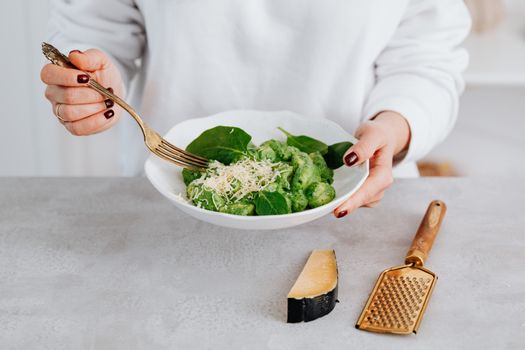
Gnocchi with Pesto
The diets react (see scores below)
Common Ingredients
- potato gnocchi
- fresh basil
- pine nuts
- Parmesan
- garlic
- olive oil
- Pecorino
Specific recipes may vary.
Incompatible with 7 of 11 diets
Diet Ratings
Potato gnocchi is the dominant ingredient and is fundamentally incompatible with a ketogenic diet. Made from potatoes and flour, a standard serving (about 200g) contains roughly 40-50g of net carbs on its own — potentially exceeding the entire daily keto carb allowance in a single dish. Potatoes are a high-glycemic starchy vegetable explicitly excluded from keto. While the pesto components (basil, pine nuts, Parmesan, Pecorino, garlic, olive oil) are largely keto-friendly and nutritious, they cannot offset the massive carb load from the gnocchi base. This dish would instantly knock virtually anyone out of ketosis.
This dish contains two dairy-based animal products: Parmesan and Pecorino. Both are hard cheeses made from animal milk — Parmesan from cow's milk and Pecorino from sheep's milk — making them clearly non-vegan. Traditional Italian pesto is defined by its inclusion of these cheeses, so this is not a borderline case. The remaining ingredients (potato gnocchi, fresh basil, pine nuts, garlic, olive oil) are all plant-based and would be fully vegan-compliant on their own. A vegan version of this dish is easily achievable by substituting the cheeses with nutritional yeast, cashew-based Parmesan, or a commercial vegan cheese alternative.
Gnocchi with Pesto contains multiple non-paleo ingredients that make it clearly incompatible with the diet. Potato gnocchi is a processed, flour-based product — traditional gnocchi is made with white potato and wheat flour, both of which are excluded (wheat is a grain; white potatoes are debated but processed gnocchi form removes any ambiguity). More critically, Parmesan and Pecorino are aged dairy cheeses, which are firmly excluded under all paleo frameworks. While the pesto base ingredients — fresh basil, pine nuts, garlic, and olive oil — are fully paleo-approved, the cheese components of the pesto (Parmesan and Pecorino) are not. The dish as presented cannot be made paleo-compliant without fundamental reconstruction.
Gnocchi with pesto contains several Mediterranean-friendly elements — extra virgin olive oil, fresh basil, pine nuts, and garlic are all core Mediterranean ingredients. However, potato gnocchi is a refined, starchy carbohydrate with minimal fiber, lacking the nutritional profile of whole grains emphasized in Mediterranean guidelines. The dish is also protein-light with no legumes, fish, or lean protein. Parmesan and Pecorino are traditional aged cheeses used in moderation in Mediterranean cuisines, which is acceptable. Overall, the pesto sauce is excellent, but the gnocchi base keeps this from being a fully endorsed choice.
Traditional Italian regional cuisine, particularly from Liguria and northern Italy, includes gnocchi as a legitimate staple, and some Mediterranean diet interpretations recognize that traditional whole-food starchy bases — even refined ones — can be acceptable when eaten in modest portions within an otherwise plant-rich meal. The high-quality fat from olive oil and the micronutrient density of the pesto partially offset the refined carbohydrate concern.
Gnocchi with Pesto is almost entirely plant-based and fundamentally incompatible with the carnivore diet. Potato gnocchi is made from potatoes and flour — both plant-derived carbohydrate sources that are strictly excluded. The pesto sauce compounds the problem: fresh basil, pine nuts, garlic, and olive oil are all plant-derived ingredients that violate carnivore principles. The only remotely carnivore-adjacent ingredients are Parmesan and Pecorino, which are animal-derived dairy products — but even these are minor components of a dish that is overwhelmingly plant-based. There is no animal protein as the primary component, no ruminant meat, and the dish is built around grains and vegetables. This dish has virtually no redeeming carnivore qualities.
This dish contains multiple excluded ingredients. Potato gnocchi is made from flour (a grain/wheat product), making it a grain-based food that is explicitly excluded on Whole30. Additionally, Parmesan and Pecorino are both dairy cheeses, which are excluded from the program. The combination of a grain-based pasta substitute and two dairy cheeses makes this dish clearly non-compliant regardless of how it is prepared.
This dish contains garlic as a listed ingredient, which is one of the highest-FODMAP foods known — even small amounts contain significant fructans and must be avoided during the elimination phase. Traditional potato gnocchi can also be problematic: commercial gnocchi typically contains wheat flour in addition to potato, making it high-FODMAP due to fructans. Homemade gnocchi made purely from potato, egg, and rice flour would be low-FODMAP, but standard recipes and store-bought versions use wheat. The remaining ingredients are largely fine — fresh basil is low-FODMAP, pine nuts are low-FODMAP at a standard serving (~1 tbsp), olive oil is safe, and hard aged cheeses like Parmesan and Pecorino are very low in lactose and generally considered low-FODMAP. However, the combination of garlic (a definitive avoid) and likely wheat-containing gnocchi makes this dish unsuitable during the elimination phase without significant modification.
Gnocchi with pesto presents a mixed DASH profile. Potato gnocchi is a refined carbohydrate with little fiber, falling short of the whole grain emphasis DASH recommends. Pesto contains olive oil (a DASH-approved vegetable oil) and fresh basil (beneficial), but both Parmesan and Pecorino are high-sodium, high-saturated-fat aged cheeses — Pecorino in particular is one of the saltier cheeses commonly used, and together they can push sodium well above what DASH targets per meal. Pine nuts add healthy unsaturated fats and magnesium, which are DASH-positive. Olive oil is explicitly compatible with DASH. However, the combination of two full-fat aged cheeses, refined-starch gnocchi, and no lean protein or meaningful vegetable content makes this dish only marginally compatible. Sodium in a typical serving can easily reach 600–900mg depending on portions, and saturated fat from the cheeses is a concern. This dish can fit DASH in moderation with portion control and reduced cheese quantities, but is not a core DASH meal.
NIH DASH guidelines emphasize limiting full-fat, high-sodium cheeses, which would place this dish firmly in 'caution.' However, some updated clinical interpretations of DASH note that olive oil and pine nuts provide cardiovascular benefit, and that moderate amounts of aged cheese in an otherwise Mediterranean-style diet may not meaningfully worsen blood pressure outcomes — a perspective increasingly supported by Mediterranean diet research that overlaps with DASH principles.
Gnocchi with pesto is highly problematic for the Zone Diet on multiple fronts. Potato gnocchi is the primary ingredient and represents a double Zone violation: potatoes are explicitly listed as unfavorable high-glycemic carbohydrates in Dr. Sears' published materials, and gnocchi is also a starchy, processed carbohydrate with a high glycemic index. The dish delivers a massive carbohydrate load almost entirely from high-GI sources. Compounding this, the dish contains no lean protein whatsoever — the primary protein sources (Parmesan, Pecorino, pine nuts) are minor contributors of fat-heavy or incomplete protein, making it impossible to hit the 30% protein target without radical modification. The pesto's olive oil and pine nuts are Zone-favorable fats, but they cannot rescue a dish that is fundamentally carbohydrate-dominant (from the wrong sources) and protein-deficient. To make this Zone-compatible, you would need to eliminate the gnocchi entirely and replace it with a low-GI carbohydrate base, then add a substantial lean protein source — at which point the dish is no longer gnocchi with pesto. The macronutrient ratio is approximately 70-75% carbohydrates, 10-15% protein, and 15-20% fat — nearly the inverse of Zone targets.
Gnocchi with pesto is a mixed dish from an anti-inflammatory standpoint. On the positive side, it contains several genuinely anti-inflammatory ingredients: olive oil provides oleocanthal and monounsaturated fats; fresh basil contributes polyphenols and anti-inflammatory flavonoids; garlic has well-documented anti-inflammatory properties (allicin, organosulfur compounds); and pine nuts offer some healthy fats and antioxidants. Pesto itself, in its traditional whole-food form, is reasonably aligned with anti-inflammatory principles. The main concern is the potato gnocchi base — a refined, starchy carbohydrate with a high glycemic index that can promote postprandial blood sugar spikes and, over time, contribute to low-grade systemic inflammation. Potato gnocchi offers minimal fiber and micronutrients relative to whole-grain alternatives. The Parmesan and Pecorino are full-fat aged cheeses, which fall in the 'limit' category due to saturated fat content, though their quantities in pesto are typically modest. Pine nuts, while healthy, are relatively high in omega-6 linoleic acid compared to other nuts, though this is not a major concern at typical pesto portions. Overall, this is a dish with a genuinely beneficial sauce applied to a pro-inflammatory starch base — the net result is moderate and context-dependent.
Some anti-inflammatory practitioners (including those following Dr. Weil's more flexible Mediterranean-leaning framework) would argue this dish is acceptable as an occasional meal, given that pesto's olive oil, garlic, and basil are strongly anti-inflammatory and the cheese amounts are small. Conversely, stricter anti-inflammatory protocols would flag the white potato gnocchi as a high-glycemic refined carbohydrate that should be replaced with whole-grain or legume-based alternatives, and would flag the full-fat aged cheeses as saturated fat sources to minimize.
Gnocchi with pesto is a poor fit for GLP-1 patients as a standalone main dish. Potato gnocchi is a refined, starchy carbohydrate with minimal fiber and negligible protein — exactly what GLP-1 patients need to minimize in their limited caloric budget. Traditional pesto is calorie-dense and high in fat from olive oil, pine nuts, and aged cheeses (Parmesan, Pecorino), which can worsen nausea, bloating, and reflux due to slowed gastric emptying. The dish offers essentially no lean protein, failing the #1 dietary priority. Pine nuts and olive oil provide beneficial unsaturated fats, and Parmesan/Pecorino contribute modest protein, but not nearly enough to justify the fat load and refined carb base. Nutrient density per calorie is low. The dish is not fried or ultra-processed, which prevents a lower score, and small portions with added protein (e.g., grilled chicken or shrimp alongside) could make it more acceptable. As served, however, it does not meet GLP-1 dietary priorities.
Some GLP-1-focused dietitians allow occasional pasta or gnocchi dishes in small portions, arguing that the Mediterranean fat profile (olive oil, pine nuts) is anti-inflammatory and that patient adherence matters — a satisfying small portion of a preferred dish may prevent overeating or diet abandonment. Others counter that the near-zero protein and low fiber density make this dish a poor use of a GLP-1 patient's reduced appetite capacity.
*See how scores were generated at our methodology page.
Nutritional profile
Six traits that cut across every diet.
Fiber & Plants
How much whole-plant food and fiber it delivers.
Healthy Fats
The quality of its fats (unsaturated, omega-3).
Whole / Unprocessed
How close it is to its natural, unprocessed form.
Gut Gentle
How easy it is on digestion (low FODMAP, few irritants).
Low Glycemic
How little it spikes your blood sugar.
Protein Density
How much protein it packs per calorie.
Controversy Index
Higher controversy = more disagreement between diets.
Diet-Specific Tips
 Mediterranean — 5/10
View tips
- Potato gnocchi is a refined starch, not a whole grain — conflicts with Mediterranean grain guidance
- Pesto base (olive oil, basil, pine nuts, garlic) is strongly Mediterranean-aligned
- Parmesan and Pecorino are acceptable in moderation as traditional Mediterranean dairy
- No primary protein source — dish lacks legumes, fish, or lean protein to round it out
- Overall dish is traditional Italian but not optimally aligned with modern Mediterranean diet principles
 DASH — 4/10
View tips
- Parmesan and Pecorino are high-sodium, high-saturated-fat cheeses — two of them together significantly raise sodium and saturated fat load
- Potato gnocchi is a refined carbohydrate; DASH favors whole grains over refined starchy carbs
- Olive oil is explicitly DASH-compatible as a heart-healthy vegetable oil
- Pine nuts provide magnesium and unsaturated fats, both DASH-positive
- Fresh basil contributes potassium and antioxidants with negligible sodium
- Dish lacks lean protein and vegetables, missing key DASH food group contributions
- Typical serving sodium can reach 600–900mg; low-sodium adaptation requires significantly reducing or replacing aged cheeses
- No fiber-rich whole grains or legumes to offset the refined carbohydrate base
 Anti-Inflammatory — 5/10
View tips
- Potato gnocchi is a high-glycemic refined carbohydrate with minimal fiber — a significant inflammatory concern
- Olive oil is a cornerstone anti-inflammatory fat (oleocanthal, monounsaturated fats)
- Fresh basil provides anti-inflammatory polyphenols and flavonoids
- Garlic contains allicin and organosulfur compounds with documented anti-inflammatory effects
- Parmesan and Pecorino are full-fat cheeses — saturated fat content is a limiting factor
- Pine nuts contribute omega-6 fats but in modest quantities at typical pesto servings
- No omega-3 sources, lean protein, or significant fiber to balance the glycemic load
 GLP-1 Friendly — 4/10
View tips
- Very low protein — no meaningful lean protein source in the dish
- Refined starchy carbohydrate base (potato gnocchi) with minimal fiber
- High fat content from pesto (olive oil, pine nuts, Parmesan, Pecorino) risks worsening GI side effects
- Pesto fat is predominantly unsaturated, which is the better fat profile
- Poor nutrient density per calorie for a patient eating significantly less
- Small portion tolerance partially mitigates risk but does not fix protein gap
- Dish can be improved significantly by adding a lean protein alongside