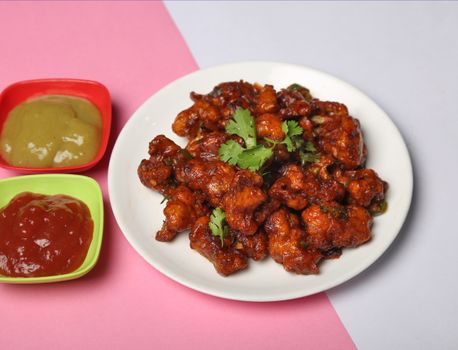
Photo: Milton Das / Pexels
Indian
Gobi Manchurian
The diets react (see scores below)
Common Ingredients
- cauliflower
- cornstarch
- soy sauce
- ginger
- garlic
- green chilies
- scallions
- tomato ketchup
Specific recipes may vary.
Incompatible with 5 of 11 diets
Diet Ratings
Gobi Manchurian is fundamentally incompatible with a ketogenic diet. The primary offenders are cornstarch (used as a batter/coating), which is nearly pure starch and contributes significant net carbs, and tomato ketchup, which contains added sugars. A typical serving of Gobi Manchurian can easily exceed 30-40g of net carbs from these two ingredients alone, wiping out most or all of a daily keto carb budget. While cauliflower itself is keto-friendly, the preparation method transforms it into a high-carb dish. Soy sauce adds minor carbs as well. This dish as traditionally prepared is not keto-compatible without a complete reformulation (e.g., replacing cornstarch with almond flour and ketchup with a sugar-free tomato paste).
Gobi Manchurian as described is entirely plant-based. Cauliflower serves as the main ingredient, coated in cornstarch and fried, then tossed in a sauce built from soy sauce, ginger, garlic, green chilies, scallions, and tomato ketchup. All listed ingredients are derived from plants with no animal products or animal-derived additives present. The dish is a whole-food vegetable centerpiece with minimally processed condiments, making it a strong vegan-compliant snack. One practical note: restaurant versions sometimes add egg to the batter for binding — diners should verify this when ordering out, though the base recipe as listed here contains no egg.
Gobi Manchurian contains multiple non-paleo ingredients that disqualify it entirely. Cornstarch is a grain-derived processed starch used as a batter/coating — strictly excluded. Soy sauce is a fermented legume-based condiment loaded with soy, wheat, and added salt — excluded on multiple counts. Tomato ketchup is a processed condiment containing refined sugar, added salt, and preservatives. While the base vegetables (cauliflower, ginger, garlic, green chilies, scallions) are paleo-approved, the dish as prepared is fundamentally incompatible with paleo principles due to the cornstarch coating, soy sauce, and ketchup.
Gobi Manchurian is a popular Indo-Chinese snack built around cauliflower, which is a Mediterranean-friendly vegetable. However, the dish relies on cornstarch (a refined starch used for deep-frying batter), soy sauce (high-sodium, highly processed condiment not part of traditional Mediterranean eating), and tomato ketchup (a processed condiment with added sugars). The preparation method—deep-frying the cauliflower in a cornstarch batter—adds refined carbohydrates and likely significant amounts of non-olive oil fat. While the base vegetable and aromatics (garlic, ginger, scallions, green chilies) align well with Mediterranean principles, the overall preparation and key sauces contradict the diet's emphasis on minimally processed, whole foods cooked with extra virgin olive oil. It is not an outright avoid because cauliflower is the star and the dish contains no red meat or added sugar beyond the ketchup, but it falls short of a true Mediterranean-aligned dish.
Some modern Mediterranean diet interpreters apply flexible, plant-forward logic: since cauliflower is the primary ingredient and the dish is vegetable-centric with no animal protein, a more permissive reading might score it higher—especially if baked rather than fried and the soy sauce and ketchup are minimized. Regional Mediterranean cuisines also absorb global culinary influences, and a home-baked version with minimal processed sauces could approach 'approve' territory.
Gobi Manchurian is entirely plant-based with zero animal-derived ingredients. Cauliflower is a vegetable, cornstarch is a grain derivative, soy sauce is a fermented legume/grain product, and the remaining ingredients (ginger, garlic, green chilies, scallions, tomato ketchup) are all plant-derived. There is no protein source of animal origin whatsoever. This dish is completely incompatible with the carnivore diet at every level — it violates the foundational rule of eating exclusively animal products.
Gobi Manchurian contains multiple excluded ingredients. Cornstarch is explicitly prohibited on Whole30. Soy sauce contains soy (a legume) and typically wheat (a grain), both of which are excluded categories. Standard tomato ketchup almost universally contains added sugar. Any one of these three ingredients alone would disqualify the dish; together they make it clearly non-compliant. Coconut aminos could substitute for soy sauce, arrowroot or tapioca starch could replace cornstarch, and a compliant ketchup or tomato paste could replace standard ketchup — but as commonly prepared, this dish is definitively off-limits.
Gobi Manchurian contains multiple high-FODMAP ingredients that make it unsuitable during the elimination phase. Garlic is one of the highest-FODMAP foods tested by Monash University (high in fructans even in tiny amounts). Scallions/green onions are high-FODMAP in their white bulb portions (fructans), though green tops are safe — the dish typically uses both parts. Cauliflower is high-FODMAP at standard serving sizes (Monash rates it as high-FODMAP at 1/2 cup or ~75g due to polyols/mannitol, though low-FODMAP at a very small 1/4 cup serving). Tomato ketchup often contains high-fructose corn syrup or excess fructose, and commercial versions can be high-FODMAP depending on brand and quantity used. Soy sauce in small amounts is generally considered low-FODMAP. Ginger and green chilies are low-FODMAP. Cornstarch is low-FODMAP. However, with garlic as a key flavor base and cauliflower as the primary ingredient in a typical serving size, this dish presents too many FODMAP triggers to be safe during elimination.
Gobi Manchurian features cauliflower, a DASH-friendly vegetable rich in fiber, potassium, and vitamins. However, the dish as commonly prepared is problematic for DASH adherence due to significant sodium contributions from soy sauce (one tablespoon contains ~900mg sodium) and tomato ketchup (which adds both sodium and added sugar). The cornstarch batter typically involves deep-frying, adding unhealthy fat load. The aromatics (ginger, garlic, green chilies, scallions) are all DASH-friendly. The core issue is the sauce: soy sauce alone can push a single serving close to or beyond the DASH daily sodium ceiling of 1,500–2,300mg. The dish sits in 'caution' territory because the base vegetable is excellent, but the preparation method and sauce components significantly undermine DASH compliance.
NIH DASH guidelines explicitly limit sodium and do not emphasize fried preparations, placing this dish firmly in caution-to-avoid range. However, an updated clinical interpretation would note that a home-modified version using low-sodium soy sauce (or coconut aminos), baking instead of frying, and reducing ketchup could meaningfully improve the sodium and fat profile, making it more DASH-compatible — some DASH-oriented dietitians would approve a modified version.
Gobi Manchurian is a popular Indo-Chinese snack featuring cauliflower (a Zone-favorable vegetable) battered in cornstarch and typically deep-fried, then tossed in a sauce containing soy sauce, ketchup, ginger, garlic, and chilies. The cauliflower base is genuinely Zone-friendly — it's a low-glycemic, polyphenol-rich vegetable Dr. Sears would approve of. However, several factors complicate its Zone compatibility. First, the cornstarch batter significantly raises the glycemic load; cornstarch is a high-glycemic refined starch that Sears classifies as unfavorable. Second, the tomato ketchup adds concentrated sugar. Third, the dish typically lacks meaningful protein (listed as 'none'), meaning it cannot stand alone as a Zone-balanced snack without pairing it with a lean protein source. Fourth, if deep-fried, it introduces omega-6-heavy seed oils, which directly conflict with Sears' anti-inflammatory focus. The dish is carbohydrate-dominant with poor protein balance, making the 40/30/30 ratio difficult to achieve as served. That said, it is not categorically 'avoid' — the cauliflower delivers polyphenols and low-GI bulk, and with modifications (baked rather than fried, reduced ketchup, added lean protein on the side), it can be incorporated into a Zone meal framework with careful portioning.
Some Zone practitioners argue that because cauliflower is the dominant ingredient by volume, and the cornstarch and ketchup are present in relatively small quantities per serving, the glycemic impact is more moderate than it appears. In Sears' later writings emphasizing polyphenols and anti-inflammatory eating, colorful vegetables prepared with garlic and ginger (both polyphenol-rich) receive positive framing even in non-traditional preparations. A small portion of Gobi Manchurian paired with grilled chicken and a salad could technically be assembled into a Zone-compliant meal, softening the caution rating toward a 5-6 range.
Gobi Manchurian presents a mixed anti-inflammatory profile. On the positive side, cauliflower is a cruciferous vegetable rich in sulforaphane and antioxidants with documented anti-inflammatory properties. Ginger, garlic, and green chilies are all well-regarded anti-inflammatory spices — garlic contains allicin and quercetin, ginger contains gingerols and shogaols, and chili contains capsaicin, all of which reduce inflammatory markers in research. Scallions contribute flavonoids. However, the dish has notable counterweights: cornstarch is a refined carbohydrate with minimal nutritional value that contributes to glycemic load. Tomato ketchup typically contains added sugars and sometimes high-fructose corn syrup, making it a mild inflammatory concern. Soy sauce is high in sodium and is a processed condiment, though fermented soy has some anti-inflammatory properties. Depending on preparation, the cauliflower is often deep-fried in refined seed oils (vegetable/canola oil) before being tossed in sauce — this cooking method significantly worsens the anti-inflammatory profile due to high-temperature oil exposure and potential trans fat formation. If air-fried or baked, the dish improves considerably. The net result is a dish with genuinely beneficial ingredients undermined by processing steps and refined additives, landing it in 'caution' territory.
Some anti-inflammatory nutrition advocates would score this lower, pointing to the cornstarch, ketchup (added sugars), high sodium from soy sauce, and especially the frying oil as collectively tipping the balance toward pro-inflammatory. Conversely, a whole-food-focused anti-inflammatory lens might give more credit to the dense spice profile (ginger, garlic, chili) and cruciferous vegetable base, particularly in a home-cooked, baked version without refined seed oil frying.
Gobi Manchurian is a cauliflower-based snack where florets are battered in cornstarch and typically deep-fried before being tossed in a savory sauce of soy sauce, ketchup, ginger, garlic, green chilies, and scallions. The dish has meaningful drawbacks for GLP-1 patients: it provides virtually no protein (cauliflower contributes negligible amounts and there is no protein source listed), the cornstarch batter adds refined carbohydrates with low nutritional value, and the standard preparation involves deep-frying which adds significant fat and is a known GLP-1 side effect trigger for nausea, bloating, and reflux. Ketchup adds sugar, and green chilies may worsen reflux in sensitive patients. On the positive side, cauliflower itself is low-calorie, high-fiber relative to its calorie load, and nutrient-dense. If prepared in a dry or baked version rather than fried, and eaten as a small side rather than a standalone snack, the dish becomes more tolerable. The sauce ingredients (soy sauce, ginger, garlic, scallions) are generally GI-neutral to mildly beneficial. Sodium content from soy sauce is worth noting. Scored 4: acceptable only in a baked preparation and small portions, but the typical fried version edges toward avoid territory.
Some GLP-1-focused dietitians would allow a baked or air-fried version of this dish as a vegetable-forward snack, arguing the fiber and micronutrient content from cauliflower provide value within a reduced-calorie day; others would caution against it entirely due to the complete absence of protein and the likelihood that the fried street-food version will be consumed, which is a consistent GI side effect trigger in this patient population.
*See how scores were generated at our methodology page.
Nutritional profile
Six traits that cut across every diet.
Fiber & Plants
How much whole-plant food and fiber it delivers.
Healthy Fats
The quality of its fats (unsaturated, omega-3).
Whole / Unprocessed
How close it is to its natural, unprocessed form.
Gut Gentle
How easy it is on digestion (low FODMAP, few irritants).
Low Glycemic
How little it spikes your blood sugar.
Protein Density
How much protein it packs per calorie.
Controversy Index
Higher controversy = more disagreement between diets.
Diet-Specific Tips
 Vegan — 8/10
View tips
- Cauliflower is the primary ingredient — fully plant-based
- Cornstarch batter contains no eggs as listed
- Soy sauce is plant-derived and vegan-compliant
- All aromatics (ginger, garlic, chilies, scallions) are plant-based
- Tomato ketchup is plant-based in standard formulations
- No dairy, egg, or animal-derived sauces (e.g., oyster sauce) in the listed ingredients
- Restaurant versions may add egg to batter — ingredient verification recommended when dining out
 Mediterranean — 4/10
View tips
- Cauliflower is a Mediterranean-approved vegetable and the star ingredient
- Deep-frying in cornstarch batter adds refined carbohydrates and non-EVOO fats
- Soy sauce is a heavily processed, high-sodium condiment absent from traditional Mediterranean diets
- Tomato ketchup introduces added sugars and is a processed condiment
- Garlic, ginger, scallions, and green chilies are beneficial aromatics
- No red meat or saturated animal fat present
- Dish is not traditional Mediterranean cuisine; preparation method conflicts with dietary principles
 DASH — 4/10
View tips
- High sodium from soy sauce (~900mg per tablespoon, likely multiple tablespoons used)
- Added sugar and sodium from tomato ketchup
- Typically deep-fried, adding saturated/trans fat
- Cauliflower base is a DASH-approved vegetable
- Garlic, ginger, scallions are DASH-friendly aromatics
- Low-sodium soy sauce substitution would significantly improve DASH compatibility
- Baked preparation would reduce fat concerns
 Zone — 4/10
View tips
- Cauliflower is a Zone-favorable low-glycemic vegetable with polyphenols
- Cornstarch batter is a high-glycemic refined starch — unfavorable in Zone terminology
- Tomato ketchup adds concentrated sugar, raising glycemic load
- No meaningful protein source — cannot balance 40/30/30 macros as a standalone snack
- Deep-frying introduces omega-6 seed oils, conflicting with Sears' anti-inflammatory focus
- Ginger, garlic, and green chilies are Zone-positive polyphenol and anti-inflammatory ingredients
- Requires pairing with lean protein and portion control to fit Zone blocks
 Anti-Inflammatory — 5/10
View tips
- Cauliflower: anti-inflammatory cruciferous vegetable, rich in sulforaphane and antioxidants
- Ginger and garlic: well-established anti-inflammatory spices with strong research support
- Green chilies: capsaicin has anti-inflammatory properties
- Cornstarch: refined carbohydrate, raises glycemic load, no nutritional benefit
- Tomato ketchup: often contains added sugars or HFCS — a mild inflammatory concern
- Soy sauce: processed, high sodium; fermented soy has mixed but mostly neutral profile
- Preparation method matters greatly: deep-frying in seed oils is pro-inflammatory; baking/air-frying significantly improves the dish's profile
 GLP-1 Friendly — 4/10
View tips
- Near-zero protein content — fails the #1 GLP-1 dietary priority
- Standard preparation is deep-fried — high fat, known GLP-1 GI side effect trigger
- Cornstarch batter is a refined carbohydrate with low nutritional density
- Ketchup adds sugar — modest but relevant given reduced calorie budgets
- Green chilies may worsen reflux or nausea in GLP-1 patients
- Cauliflower provides fiber and micronutrients — a genuine positive
- Baked or air-fried version significantly improves the rating
- High sodium from soy sauce — relevant for patients with hypertension comorbidity
- Works only as a small side dish, not a standalone snack given protein gap