Vietnamese
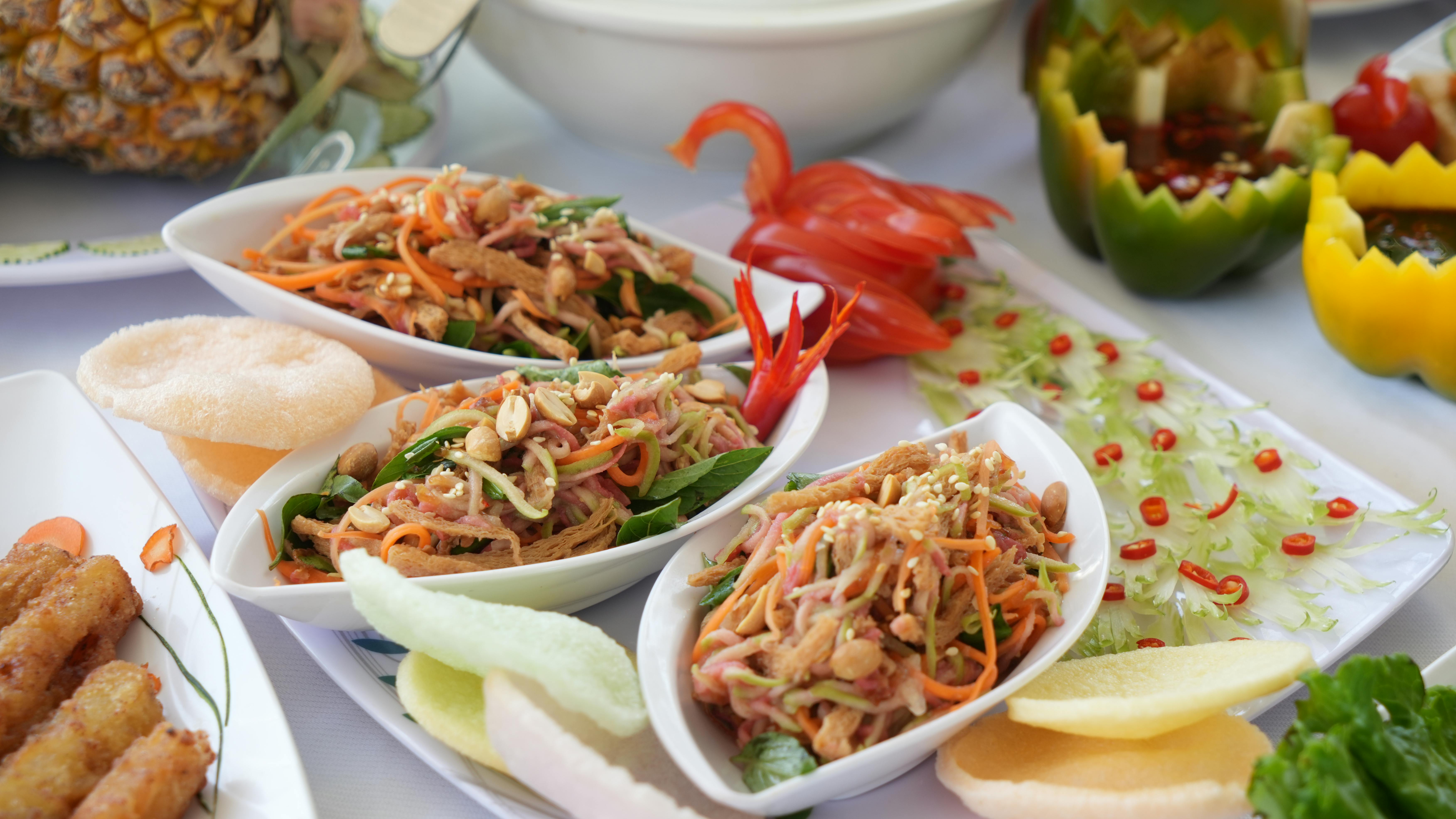
Vietnamese Papaya Salad (Gỏi Đu Đủ)
The diets react (see scores below)
Common Ingredients
- green papaya
- shrimp
- lime juice
- fish sauce
- peanuts
- mint
- Thai basil
- Thai chiles
Specific recipes may vary.
Incompatible with 4 of 11 diets
Diet Ratings
Vietnamese Papaya Salad is a borderline keto dish primarily due to green papaya, which contains roughly 7-8g net carbs per 100g serving. A typical salad serving uses 150-200g of shredded green papaya, putting the net carbs from papaya alone at 10-16g — significant but potentially manageable within a strict daily budget. Fish sauce may contain trace sugars, and peanuts add a few more net carbs (though also fat and protein). The shrimp, herbs (mint, Thai basil), chiles, and lime juice are all low-carb friendly. The salad lacks grains or added sugars in its traditional form, and the overall fat content is modest (mainly from peanuts). A small-portion version with careful tracking could fit keto, but a full restaurant-sized serving risks pushing daily carb limits, especially when combined with other meals.
Strict keto practitioners argue that green papaya is still a fruit with non-trivial net carbs and that the cumulative effect of fish sauce sugars, peanuts (a legume), and lime juice makes this dish too carb-risky for reliable ketosis maintenance; they recommend avoiding it entirely rather than relying on portion control.
The traditional Vietnamese Papaya Salad (Gỏi Đu Đủ) as described contains two clear animal-derived ingredients: shrimp (seafood/animal product) and fish sauce (fermented fish, an animal-derived condiment). Both are unambiguously non-vegan. While the base ingredients — green papaya, lime juice, peanuts, mint, Thai basil, and Thai chiles — are all fully plant-based, the dish as listed cannot be considered vegan. A vegan adaptation is straightforward: omit the shrimp and substitute fish sauce with a vegan fish sauce alternative (typically made from seaweed, soy, or fermented mushrooms), which would transform this into a fully approvable whole-food dish.
This Vietnamese papaya salad contains two non-paleo ingredients that disqualify it in its traditional form. Peanuts are legumes and are excluded from the paleo diet with clear consensus. Fish sauce, while derived from fish, is a fermented, processed condiment that typically contains added salt and sometimes sugar — both excluded from strict paleo. The remaining ingredients are paleo-friendly: green papaya (fruit/vegetable), shrimp (protein), lime juice (fruit), fresh mint, Thai basil, and Thai chiles are all approved. However, the presence of peanuts alone is enough for a firm avoid verdict. The dish could be made paleo-compliant by substituting peanuts with crushed macadamia nuts or almonds and replacing fish sauce with coconut aminos.
Vietnamese Papaya Salad aligns well with Mediterranean diet principles despite being a Southeast Asian dish. Green papaya is a nutrient-dense vegetable, shrimp is an excellent lean seafood protein encouraged 2-3 times weekly, and peanuts contribute healthy plant-based fats. Fresh herbs (mint, Thai basil) and lime juice are analogous to Mediterranean flavor profiles. Fish sauce is the main point of consideration — it is high in sodium and not a Mediterranean staple, but it is minimally processed and used in small amounts as a seasoning, similar in spirit to anchovy-based condiments used in Mediterranean cooking. The dish is whole-food, plant-forward, and free of refined grains, added sugars, or saturated fats.
Some strict Mediterranean diet frameworks flag fish sauce as a non-traditional, high-sodium processed condiment and would prefer olive oil and lemon as the dressing base. The absence of olive oil also means the dish lacks the diet's primary fat source, which some practitioners consider a meaningful gap rather than a trivial substitution.
Vietnamese Papaya Salad is overwhelmingly plant-based and entirely incompatible with the carnivore diet. The dish is built around green papaya (a fruit/vegetable), peanuts (a legume), mint, Thai basil, and Thai chiles — all strictly excluded plant foods. Lime juice adds further plant-derived content. Even the fish sauce, while animal-derived, is typically fermented with sugar and plant additives. The shrimp, if present, is the only carnivore-compatible ingredient, but it constitutes a minor component of a fundamentally plant-forward dish. No version of carnivore — from the strictest Lion Diet to the more liberal animal-based approach — would permit this salad.
This Vietnamese Papaya Salad contains peanuts, which are a legume and explicitly excluded on the Whole30 program. All other ingredients — green papaya, shrimp, lime juice, fish sauce (check for no added sugar), mint, Thai basil, and Thai chiles — are Whole30-compatible. However, the presence of peanuts makes the dish non-compliant as listed. If peanuts were omitted, the dish would likely be approvable (with a label-check on fish sauce for added sugar).
Vietnamese Papaya Salad has a mixed FODMAP profile. Green papaya is the key concern — Monash University rates it as low-FODMAP at 75g but high-FODMAP at larger servings due to excess fructose. A standard restaurant serving of papaya salad typically contains well over 75g of shredded papaya, pushing this dish into moderate-to-high FODMAP territory for the average eater. Shrimp is low-FODMAP and safe. Lime juice and fish sauce (in typical condiment amounts) are low-FODMAP. Fresh mint and Thai basil are low-FODMAP in small garnish quantities. Thai chiles are low-FODMAP. Peanuts are low-FODMAP at a small serving (32g / about 10 peanuts) but become moderate-FODMAP at larger amounts due to GOS — restaurant portions are often generous. The combination of potentially high green papaya portions plus a handful of peanuts creates cumulative FODMAP load risk. This dish can theoretically be made low-FODMAP with strict portion control on papaya (keep to ~75g) and peanuts, but as typically served, caution is warranted.
Monash University rates green papaya as low-FODMAP at 75g, which could support an 'approve' verdict for carefully portioned homemade versions. However, many clinical FODMAP practitioners advise caution with this dish during elimination because restaurant servings routinely exceed the safe papaya threshold and cumulative load from peanuts adds additional FODMAP burden.
Vietnamese Papaya Salad (Gỏi Đu Đủ) has a strong DASH-friendly foundation: green papaya is a low-calorie, fiber-rich vegetable high in potassium and vitamin C; fresh herbs (mint, Thai basil) add antioxidants with negligible calories; lime juice provides vitamin C and brightness without sodium; shrimp offers lean protein; and peanuts contribute healthy unsaturated fats, magnesium, and protein. However, fish sauce is the critical concern — a typical Vietnamese papaya salad dressing uses 2–3 tablespoons of fish sauce per serving, which can contribute 800–1,500mg of sodium, approaching or exceeding the standard DASH daily limit of 2,300mg (and well over the low-sodium DASH limit of 1,500mg) in a single dish. Peanuts, while healthy, are calorie-dense and require portion control. The dish is not inherently incompatible with DASH but as commonly prepared the sodium load from fish sauce warrants caution. Reducing fish sauce to 1 teaspoon and supplementing with lime juice and a small amount of low-sodium soy sauce would significantly improve the DASH profile.
NIH DASH guidelines emphasize limiting sodium to under 2,300mg/day, which standard fish sauce quantities in this dish can easily violate. However, updated clinical interpretations note that the overall dietary pattern matters — some DASH-oriented dietitians allow dishes with higher-sodium condiments if the rest of the day's intake is tightly controlled, and they may endorse this salad as an otherwise nutrient-dense choice with a recommendation to reduce fish sauce quantity.
Vietnamese Papaya Salad (Gỏi Đu Đủ) aligns well with Zone Diet principles with some caveats. Green (unripe) papaya is the critical factor here — it is substantially lower glycemic than ripe papaya, behaving more like a vegetable than a fruit, making it a favorable Zone carbohydrate source. Shrimp is an excellent lean protein that fits neatly into Zone protein blocks (roughly 7g protein per ounce). Lime juice, fish sauce, mint, Thai basil, and Thai chiles are essentially free foods in Zone terms, adding negligible macros. Peanuts introduce fat and some protein, but they are higher in omega-6 fatty acids than ideal Zone fats like macadamia nuts or almonds, and they add carbs that need to be tracked. The overall dish profile leans vegetable-heavy with lean protein, low-glycemic carbs, and modest fat — a reasonable Zone meal framework. The main adjustments needed are portion control on peanuts and ensuring the shrimp quantity is sufficient to balance the carb load (~3 oz shrimp per serving). Fish sauce contains some sodium but minimal macronutrient impact. This dish can be assembled as a Zone-balanced meal with modest attention to block ratios.
The confidence is medium because green vs. ripe papaya classification varies in Zone resources. Dr. Sears' earlier works list papaya (generally) as an 'unfavorable' higher-glycemic fruit. However, green/unripe papaya has a markedly lower glycemic index than ripe papaya and functions culinarily as a vegetable. Later Zone anti-inflammatory writing would likely view this dish more favorably given its polyphenol content (herbs, chiles) and omega-3 contribution from shrimp. Some strict Zone practitioners following early Sears guidelines might rate this as 'caution' due to papaya's listing as an unfavorable fruit, despite the green variety's significantly different glycemic profile.
Vietnamese Papaya Salad is built on a strong anti-inflammatory foundation. Green papaya is rich in papain, vitamin C, and antioxidants with emerging evidence for anti-inflammatory activity. Thai basil and mint are polyphenol-rich herbs consistently highlighted in anti-inflammatory frameworks. Thai chiles contain capsaicin, a well-documented anti-inflammatory compound. Peanuts provide monounsaturated fats, resveratrol, and fiber, though they are technically legumes with a higher omega-6 profile than tree nuts. Lime juice contributes vitamin C and flavonoids. Shrimp, when included, is a lean protein with some omega-3s (though not as concentrated as fatty fish) and low saturated fat. The main area of nuance is fish sauce: a fermented condiment that adds sodium and small amounts of beneficial compounds from fermentation, but its high sodium content can be pro-inflammatory at high intake levels in susceptible individuals. Overall, this dish is light, vegetable-forward, herb-heavy, and low in refined carbohydrates or added sugars — closely aligned with anti-inflammatory dietary principles.
Fish sauce is high in sodium, which some anti-inflammatory practitioners (e.g., Dr. Joel Fuhrman's nutritarian framework) flag as a driver of systemic inflammation, particularly for those with hypertension. Peanuts, while included in many anti-inflammatory guides, are excluded in AIP and some strict anti-inflammatory protocols due to lectin content and omega-6 load; tree nuts like walnuts would be a preferred substitution in those frameworks.
Vietnamese Papaya Salad is largely GLP-1 friendly but has a few notable caveats. Green papaya is high in fiber, low in calories, and has good water content — excellent for digestion and hydration support. Shrimp, when included, is a lean, high-protein addition that significantly improves this dish's suitability. Lime juice, fresh herbs (mint, Thai basil), and fish sauce are fine in typical serving amounts. The main concerns are: (1) Thai chiles — even a moderate amount can worsen reflux and nausea in GLP-1 patients due to slowed gastric emptying, which prolongs mucosal contact with capsaicin; (2) peanuts add healthy unsaturated fat but also meaningful fat calories in a context where calorie density matters, and some patients experience GI discomfort from them; (3) fish sauce is high in sodium, which can be a concern for patients prone to dehydration on GLP-1s. Without shrimp, the protein content is low — likely under 5g per serving — which is a significant drawback given the 15-30g per meal protein target. With shrimp, a standard serving reaches roughly 15-20g protein and becomes a more suitable meal. The dish is not fried or heavily processed and is generally easy to digest (aside from the chile concern), making it a reasonable choice with modifications.
Some GLP-1-focused dietitians would rate this dish more favorably, viewing the Thai chiles as an easily omitted ingredient rather than a defining feature of the dish, and considering the overall profile — lean protein, fiber-rich vegetables, minimal saturated fat — as well-aligned with GLP-1 dietary goals. Others would flag the low calorie and low protein density (especially without shrimp) as a concern, noting that GLP-1 patients cannot rely on volume eating to meet protein targets and should prioritize more protein-dense meals.
*See how scores were generated at our methodology page.
Nutritional profile
Six traits that cut across every diet.
Fiber & Plants
How much whole-plant food and fiber it delivers.
Healthy Fats
The quality of its fats (unsaturated, omega-3).
Whole / Unprocessed
How close it is to its natural, unprocessed form.
Gut Gentle
How easy it is on digestion (low FODMAP, few irritants).
Low Glycemic
How little it spikes your blood sugar.
Protein Density
How much protein it packs per calorie.
Controversy Index
Higher controversy = more disagreement between diets.
Diet-Specific Tips
 Keto — 4/10
View tips
- Green papaya has ~7-8g net carbs per 100g — a full serving can reach 10-16g net carbs
- Fish sauce may contain small amounts of added sugar
- Peanuts add additional net carbs (~4g per 30g serving) and are technically legumes
- Shrimp, Thai herbs, and chiles are keto-friendly
- No grains or direct added sugars in traditional preparation
- Portion size is critical — a small serving may fit within daily limits, a large one likely will not
- Low overall fat content makes this less ideal as a keto meal on its own
 Mediterranean — 8/10
View tips
- Green papaya is a nutrient-dense, low-calorie vegetable consistent with plant-forward Mediterranean eating
- Shrimp provides lean seafood protein aligned with the 2-3x weekly seafood recommendation
- Peanuts contribute healthy unsaturated plant fats and protein
- Fresh herbs and lime juice mirror Mediterranean emphasis on whole, fresh flavoring ingredients
- Fish sauce is high in sodium and non-traditional, though used sparingly and analogous to anchovy-based condiments
- No olive oil present, meaning the dish lacks the diet's canonical primary fat source
- No refined grains, added sugars, or red meat — avoids key dietary pitfalls
 Low-FODMAP — 5/10
View tips
- Green papaya is low-FODMAP at 75g but high-FODMAP at larger servings (excess fructose) — standard salad servings likely exceed this
- Peanuts are low-FODMAP at ~32g (10 peanuts) but high-FODMAP in generous restaurant portions due to GOS
- Shrimp is fully low-FODMAP and safe
- Fish sauce and lime juice are low-FODMAP in condiment quantities
- Fresh mint, Thai basil, and Thai chiles are low-FODMAP as garnishes
- Cumulative FODMAP load from papaya + peanuts together raises risk even if each is borderline individually
- Homemade version with strict portioning could achieve low-FODMAP status; restaurant version is risky
 DASH — 5/10
View tips
- Fish sauce is high in sodium — 2–3 tbsp can contribute 800–1,500mg sodium per serving, approaching or exceeding DASH limits
- Green papaya is a DASH-friendly vegetable rich in fiber, potassium, and vitamins
- Shrimp provides lean, low-fat protein aligned with DASH protein recommendations
- Fresh herbs (mint, Thai basil) and lime juice add nutrients with minimal calories or sodium
- Peanuts provide heart-healthy unsaturated fats and magnesium but are calorie-dense — portion control advised
- No saturated fat, no added sugar, no refined grains — macronutrient profile otherwise aligns with DASH
- Reducing fish sauce or substituting low-sodium alternatives would raise this dish to an 'approve' rating
 Zone — 7/10
View tips
- Green (unripe) papaya is low-glycemic, functioning more like a vegetable than fruit — favorable Zone carb
- Shrimp is an ideal lean Zone protein source (~7g protein per oz, negligible fat)
- Peanuts contribute omega-6 heavy fat — less ideal than Zone-preferred monounsaturated fats like macadamia nuts or almonds
- Fish sauce, lime, fresh herbs, and chiles are essentially macro-neutral Zone 'free' foods
- High polyphenol content from Thai basil, mint, and chiles aligns with Sears' anti-inflammatory focus
- No high-glycemic carbs, refined sugars, or processed ingredients present
- Portion control on peanuts required to maintain proper fat block balance
- Ripe papaya would score lower — the green/unripe variety is key to this approval rating
 Anti-Inflammatory — 8/10
View tips
- Green papaya: rich in papain, vitamin C, and antioxidant carotenoids
- Thai basil and mint: potent polyphenol and flavonoid sources
- Thai chiles: capsaicin is a well-documented anti-inflammatory compound
- Shrimp (optional): lean protein with modest omega-3 content, low saturated fat
- Lime juice: vitamin C and flavonoids support antioxidant status
- Fish sauce: fermented and adds flavor complexity, but high sodium may be a concern at large quantities
- Peanuts: provide healthy fats and resveratrol, but higher omega-6 than tree nuts and excluded in some strict protocols
- No refined carbs, added sugars, or inflammatory oils — clean macronutrient profile
 GLP-1 Friendly — 6/10
View tips
- Green papaya is high in fiber and water content — supports digestion and hydration
- Shrimp adds lean, high-quality protein (approx. 15-20g per serving) — strongly recommended to include
- Without shrimp, protein content is very low (<5g) — fails the 15-30g per meal target
- Thai chiles may worsen nausea and reflux due to slowed gastric emptying — consider omitting or reducing significantly
- Peanuts contribute healthy unsaturated fats but add calorie density and may cause GI discomfort in some GLP-1 patients
- Fish sauce is high in sodium — relevant hydration consideration for GLP-1 patients
- No fried components, no refined grains, no added sugar — favorable overall profile
- Low calorie density means nutritional value depends heavily on including shrimp to meet protein goals