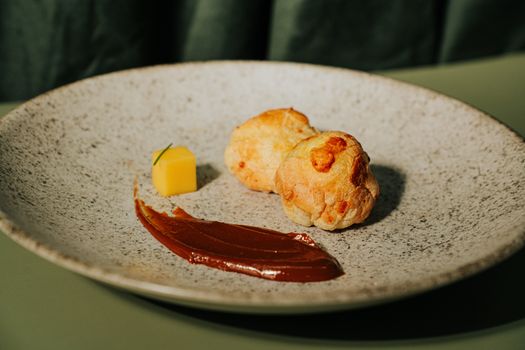
Photo: Emanuel Pedro / Pexels
The diets react (see scores below)
Common Ingredients
- flour
- butter
- eggs
- Gruyère
- milk
- water
- salt
- black pepper
Specific recipes may vary.
Incompatible with 8 of 11 diets
Diet Ratings
Gougères are French choux pastry cheese puffs whose primary structure depends on wheat flour, making them fundamentally incompatible with a ketogenic diet. Flour is a high-carb grain product that directly spikes blood glucose and would easily push a person out of ketosis with just a few pieces. A standard serving of 3-4 gougères contains roughly 15-20g of net carbs from the flour alone, making it very easy to exceed the daily keto limit. While the dish does contain keto-friendly ingredients like butter, eggs, and Gruyère, the flour is non-negotiable in the traditional recipe and disqualifies the dish entirely. Milk also adds minor additional carbs. This is not a borderline case — flour-based pastries are a clear avoid on any keto protocol.
Gougères are a classic French cheese puff made from choux pastry with Gruyère cheese. The ingredient list contains multiple animal-derived products: butter (dairy), eggs (animal product), Gruyère cheese (dairy), and milk (dairy). All four of these ingredients are explicitly excluded under vegan dietary rules. This dish is fundamentally incompatible with a vegan diet and cannot be made vegan without completely reformulating it using plant-based substitutes (vegan butter, flax/chia eggs or aquafaba, non-dairy milk, and vegan cheese).
Gougères are a classic French cheese puff made from choux pastry, which is fundamentally incompatible with the paleo diet. The dish contains multiple paleo-excluded ingredients: flour (a grain product, strictly excluded), Gruyère cheese and milk (dairy, excluded), butter (dairy, excluded or heavily debated), and added salt. While eggs are paleo-approved and water/black pepper are acceptable, the foundational ingredients — wheat flour and dairy — make this dish clearly off-limits. There is no meaningful way to call this dish paleo-compatible in its traditional form, as the grain and dairy components are structural and cannot be removed without fundamentally changing the recipe entirely.
Gougères are French cheese puffs made from choux pastry, combining refined white flour, butter (saturated fat), eggs, milk, and Gruyère cheese. The primary fat source is butter rather than olive oil, directly contradicting one of the Mediterranean diet's core principles. The base is refined flour (not whole grain), and the dish is cheese-heavy. While eggs and dairy are permissible in moderation, this preparation stacks multiple non-core ingredients together in a format that offers little nutritional value relative to Mediterranean staples. As a snack, it displaces healthier options like nuts, vegetables, or whole grain options.
Some Mediterranean diet interpretations acknowledge regional dairy and egg-based preparations in moderation; eggs and cheese are not forbidden, and as an occasional small appetizer portion, a purist might rate this 'caution' rather than 'avoid.' Traditional southern European cuisines do include some butter-based preparations, particularly in transitional regions bordering France.
Gougères are French cheese puffs made primarily from choux pastry, which is a flour-based dough. Flour is a grain product and a foundational plant food that is entirely excluded from the carnivore diet. While some ingredients are carnivore-compatible (eggs, butter, milk, Gruyère), the flour is the structural base of this dish and cannot be removed or substituted without fundamentally changing the food. Black pepper is also a plant-derived spice excluded on strict carnivore. This dish is categorically incompatible with carnivore principles due to its grain foundation.
Gougères are a classic French cheese puff pastry containing multiple excluded ingredients. Flour (wheat grain) is explicitly excluded on Whole30, butter (regular dairy) is excluded (only ghee/clarified butter is the allowed dairy exception), Gruyère cheese is excluded as dairy, and milk is excluded as dairy. Even setting aside the spirit-of-the-program concerns about recreating baked goods/snack foods, the foundational ingredients — wheat flour, butter, cheese, and milk — are all explicitly non-compliant. This dish cannot be made Whole30-compatible without a complete reinvention that would no longer resemble gougères.
Gougères are a classic French choux pastry made with wheat flour as the primary structural ingredient. Wheat flour is high in fructans, a key FODMAP group, and is clearly rated as high-FODMAP by Monash University. A standard serving of gougères (2-4 puffs) would contain a meaningful amount of wheat flour, making this dish high-FODMAP during the elimination phase. Additionally, milk contributes lactose, another FODMAP, though the quantity per puff is relatively small. Gruyère is a hard, aged cheese and is low-FODMAP (aged cheeses have minimal residual lactose). Butter is low-FODMAP. Eggs, salt, and black pepper are all low-FODMAP. The primary concern is the wheat flour — there is no realistic serving size of traditional gougères that would be low-FODMAP, as the dough is fundamentally wheat-based. A gluten-free flour substitution (e.g., rice flour or a GF blend) could make this dish low-FODMAP, but the traditional recipe as listed must be avoided.
Gougères are French cheese puffs made from pâte à choux dough with Gruyère cheese. This combination is problematic for DASH diet adherence on multiple fronts. Gruyère is a full-fat, aged cheese with high sodium content (typically 350-450mg per oz) and significant saturated fat (~5g per oz). Butter adds additional saturated fat. The refined white flour provides no fiber or meaningful micronutrients. A typical serving of 4-6 gougères can easily deliver 400-700mg of sodium and 8-12g of saturated fat, a substantial portion of DASH daily limits. There is no meaningful potassium, magnesium, or fiber to offset these negatives. DASH explicitly limits full-fat dairy, high-sodium foods, and saturated fat — all of which are central to this dish. Gougères are the antithesis of DASH-aligned snacking, which favors nuts, seeds, fruits, vegetables, or whole-grain options with low sodium and saturated fat profiles.
Gougères are classic French cheese puffs made from choux pastry (pâte à choux) with Gruyère. From a Zone perspective, they present several challenges: the base is refined white flour (a high-glycemic, 'unfavorable' carbohydrate in Zone terminology), butter is a saturated fat rather than the preferred monounsaturated fat, and Gruyère contributes both saturated fat and some protein. The macro ratio skews heavily toward refined carbs and saturated fat, far from the 40/30/30 Zone ideal. Eggs provide some lean protein and the dish does have protein from cheese and eggs, but the fat profile is predominantly saturated rather than monounsaturated. As a snack, a small portion (1-2 gougères) could technically be worked into a Zone day as a 'treat' block, but it would need to be carefully offset. The dish offers no fiber, no polyphenols, and no omega-3s — all priorities in the Zone's anti-inflammatory framework. It is not categorically 'avoid' because the protein from eggs and Gruyère provides some Zone-usable macros, but it requires significant portioning discipline and is firmly in the 'unfavorable' category for both carbs and fat type.
Gougères are classic French choux pastry puffs made with refined white flour, butter, eggs, milk, and Gruyère cheese. From an anti-inflammatory perspective, the ingredient profile is mixed at best. Refined white flour provides little fiber and has a high glycemic impact, contributing to blood sugar spikes that can promote inflammatory signaling. Butter and full-fat Gruyère are both high in saturated fat, which anti-inflammatory guidelines recommend limiting. Gruyère is a hard, aged cheese — one of the higher-fat dairy products and explicitly in the 'limit' category. Eggs contribute some beneficial nutrients (choline, selenium) but are a contested food. On the positive side, black pepper contains piperine with mild anti-inflammatory properties, and eggs offer some nutritional value. The dish is not fried and contains no trans fats, artificial additives, refined sugar, or seed oils, which prevents it from landing in 'avoid' territory. However, the combination of refined carbohydrates, saturated fat from butter, and high-fat cheese makes this a poor fit for an anti-inflammatory eating pattern. Occasional consumption as a treat is unlikely to be harmful, but it should not be a regular part of an anti-inflammatory diet.
Gougères are classic French cheese puffs made from choux pastry with Gruyère. While eggs and cheese provide some protein and the portions are naturally small, the macronutrient profile is problematic for GLP-1 patients: the dough is butter- and flour-based, making each puff relatively high in saturated fat and refined carbohydrates with modest protein per piece. A typical gougère (about 15-20g) delivers roughly 2-3g protein, 4-5g fat (mostly saturated from butter and Gruyère), and 4-5g refined carbs — meaning you would need to eat several to reach even a modest protein target, accumulating significant saturated fat and empty starch calories in the process. Butter is a primary ingredient, driving up saturated fat content, which can worsen GLP-1 side effects like nausea, bloating, and reflux. The refined flour base offers negligible fiber. On the positive side, they are small-portioned, relatively easy to chew, and the egg and cheese content provides some nutritional value. They are not fried, and the fat is baked-in rather than added at service. As an occasional small treat (1-2 pieces as part of a broader protein-forward meal), they are not catastrophic, but they do not serve GLP-1 dietary priorities well as a snack on their own.
Some GLP-1-focused RDs are permissive about small quantities of cheese-based snacks on the grounds that Gruyère is a meaningful protein and calcium source and that rigid restriction increases dropout risk — particularly for patients from food cultures where such foods carry social significance. Others counter that the saturated fat load per gram of protein is unfavorable compared to far better options, and that GLP-1 patients' reduced appetite makes every snack choice high-stakes nutritionally.
*See how scores were generated at our methodology page.
Nutritional profile
Six traits that cut across every diet.
Fiber & Plants
How much whole-plant food and fiber it delivers.
Healthy Fats
The quality of its fats (unsaturated, omega-3).
Whole / Unprocessed
How close it is to its natural, unprocessed form.
Gut Gentle
How easy it is on digestion (low FODMAP, few irritants).
Low Glycemic
How little it spikes your blood sugar.
Protein Density
How much protein it packs per calorie.
Controversy Index
Higher controversy = more disagreement between diets.
Diet-Specific Tips
 Zone — 4/10
View tips
- Refined white flour is a high-glycemic 'unfavorable' carbohydrate in Zone terminology
- Butter is a saturated fat, not the preferred monounsaturated fat (olive oil, avocado, almonds)
- Gruyère adds saturated fat alongside its protein contribution
- Eggs provide some lean protein, partially redeeming the dish
- No fiber, polyphenols, or omega-3s — misses Zone anti-inflammatory priorities
- Small portions could technically be incorporated but require careful macro offsetting
- Macro ratio is skewed far from the 40/30/30 Zone ideal
 Anti-Inflammatory — 4/10
View tips
- Refined white flour — high glycemic, low fiber, pro-inflammatory at excess intake
- Butter — saturated fat source, anti-inflammatory guidelines recommend limiting
- Gruyère — full-fat aged cheese, high in saturated fat, in the 'limit' category
- No added sugar, no trans fats, no seed oils, no artificial additives
- Eggs contribute some beneficial micronutrients (choline, selenium)
- Black pepper contains piperine, a mild anti-inflammatory compound
- Small portion size typical of this snack somewhat mitigates overall impact
 GLP-1 Friendly — 4/10
View tips
- High saturated fat from butter and Gruyère relative to protein delivered
- Refined flour base contributes empty calories with negligible fiber
- Small individual portion size partially mitigates overconsumption risk
- Eggs and Gruyère provide modest protein but not enough per piece to meet GLP-1 snack targets of 15-30g
- Not fried, which is a marginal positive
- May worsen nausea or reflux due to saturated fat content
- Poor nutrient density per calorie for a GLP-1 patient context