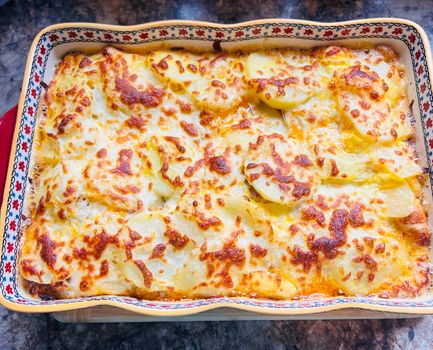
Photo: Meliha Ljaljic / Pexels
French
Gratin Dauphinois
The diets react (see scores below)
Common Ingredients
- potatoes
- heavy cream
- garlic
- Gruyère
- butter
- nutmeg
- salt
- black pepper
Specific recipes may vary.
Incompatible with 11 of 11 diets
Diet Ratings
Gratin Dauphinois is fundamentally built on potatoes, one of the highest net-carb vegetables available. A standard serving (roughly 150g) of potato-based gratin delivers approximately 20-25g of net carbs on its own, easily consuming or exceeding the entire daily keto carb budget in a single side dish. While the heavy cream, Gruyère, and butter are all excellent keto ingredients, they cannot offset the disqualifying carbohydrate load from the potatoes. This dish is structurally incompatible with ketosis regardless of portion size, as even a small portion provides excessive starch.
Gratin Dauphinois contains multiple animal-derived ingredients that are explicitly excluded from a vegan diet. Heavy cream is a dairy product derived from cow's milk, Gruyère is an animal-milk cheese, and butter is a dairy fat. These three ingredients are foundational to the dish — not optional garnishes — making it impossible to consider vegan in its traditional form. The remaining ingredients (potatoes, garlic, nutmeg, salt, black pepper) are all plant-based, but they cannot offset the core animal products. There is no ambiguity here within vegan discourse.
Gratin Dauphinois is fundamentally incompatible with the paleo diet. The dish is built around heavy cream and Gruyère cheese — both are dairy products explicitly excluded from paleo. Butter is also a dairy derivative, though ghee (clarified butter) occupies a gray area; regular butter does not. Salt is added, which is discouraged. White potatoes are themselves debated in paleo circles. With multiple core non-paleo ingredients forming the structural base of the dish, this cannot be redeemed even partially — it is a clear avoid.
Gratin Dauphinois is a rich French dish centered on heavy cream, butter, and Gruyère — a combination that directly contradicts Mediterranean diet principles. The primary fat source is saturated fat from dairy rather than olive oil. Heavy cream is not a Mediterranean staple, and the dish is loaded with full-fat dairy in large quantities rather than modest amounts. While potatoes and garlic are acceptable plant foods, they are overwhelmed by a sauce of cream and butter. This dish is emblematic of northern French cuisine, far removed from the olive oil- and vegetable-forward traditions of Mediterranean cooking.
Some Mediterranean diet interpreters note that dairy — including cheese and cream in small portions — is traditionally consumed in certain Mediterranean regions (southern France, Italy), and a small serving of this dish as an occasional indulgence could be accommodated. Modern clinical guidelines, however, emphasize that heavy cream as a primary ingredient places this firmly outside regular Mediterranean eating patterns.
Gratin Dauphinois is fundamentally incompatible with the carnivore diet. The primary ingredient is potatoes, a starchy plant food that is strictly excluded from all tiers of carnivore eating. While the dish does contain some animal-derived ingredients (heavy cream, Gruyère, butter), these are minor components and cannot redeem a dish built around a plant base. Additional plant-derived ingredients include garlic, nutmeg, and black pepper — all excluded even by lenient carnivore practitioners. The dish has no animal protein source and is categorized as a plant-based side dish. There is universal agreement across all carnivore frameworks that starchy vegetables like potatoes are among the most incompatible foods with the diet.
Gratin Dauphinois contains two clearly excluded dairy ingredients: heavy cream and Gruyère cheese. Both are explicitly prohibited on the Whole30 program. Regular butter is also excluded (only ghee or clarified butter is allowed). All three dairy components would need to be removed or substituted for this dish to be compliant, which would fundamentally alter the dish beyond recognition. The remaining ingredients — potatoes, garlic, nutmeg, salt, and black pepper — are all Whole30-compliant, but the core structure of this classic French gratin is built entirely around dairy.
Gratin Dauphinois contains two significant high-FODMAP ingredients that make it unsuitable during the elimination phase. First, garlic is one of the highest-FODMAP foods tested by Monash University, containing substantial fructans even in very small amounts — it cannot be made safe simply by reducing quantity in a cooked dish where it infuses throughout. Second, heavy cream is high in lactose at standard serving sizes used in this dish (Monash rates heavy cream as low-FODMAP only at 2 tablespoons/30ml, but a typical gratin serving contains far more cream than this threshold). Gruyère is a hard aged cheese and is low-FODMAP. Potatoes are low-FODMAP. Butter is low-FODMAP. Nutmeg, salt, and pepper are low-FODMAP. However, the combination of garlic (fructans) and cream in quantities typical of this dish make it a clear avoid. A low-FODMAP version could be made by substituting garlic-infused oil for garlic and limiting cream to safe portions, but the traditional recipe as presented is high-FODMAP.
Gratin Dauphinois is fundamentally incompatible with DASH diet principles. The dish is built on heavy cream and butter — both high in saturated fat, which DASH explicitly limits — and full-fat Gruyère cheese, which adds significant saturated fat and sodium. Heavy cream alone can contain 3–4g of saturated fat per tablespoon, and a typical serving of this gratin involves a substantial quantity. DASH guidelines call for fat-free or low-fat dairy and strictly limit saturated fat intake. While potatoes themselves are a DASH-friendly food (rich in potassium), they are overwhelmed here by the high-fat, high-sodium dairy components. The salt added in preparation, combined with the sodium naturally present in aged Gruyère, pushes sodium content well above DASH-friendly thresholds per serving. This dish is a concentrated source of exactly the nutrients DASH is designed to minimize: saturated fat, total fat, and sodium.
Gratin Dauphinois is essentially the antithesis of Zone Diet principles. The dish is built on potatoes — one of the most explicitly 'unfavorable' carbohydrates in Zone methodology due to their high glycemic index and glycemic load, which Sears specifically lists as foods to avoid. The fat profile is dominated by heavy cream, butter, and Gruyère cheese — all saturated fat sources, the opposite of the monounsaturated fats Zone favors. There is no lean protein to anchor a 40/30/30 ratio. The macro breakdown is approximately 40-50% fat (saturated), 40-50% carbohydrates (high-glycemic), and under 10% protein — a near-perfect inversion of Zone targets. Even with extreme portion control, this dish contributes almost nothing useful to a Zone meal: the carb block it provides comes from the worst possible source, the fat blocks are the wrong type, and there is no protein contribution. It would require pairing with very substantial lean protein and low-GI vegetables while consuming only a few bites — at which point the dish is functionally decorative. This is one of the rare cases where Zone methodology gives a genuinely low score.
Gratin Dauphinois is built on a foundation of ingredients that conflict with anti-inflammatory principles. Heavy cream is a primary component, delivering substantial saturated fat, which is explicitly in the 'limit to avoid' category under anti-inflammatory guidelines. Butter adds further saturated fat. Gruyère, a high-fat aged cheese, contributes additional saturated fat. Together these three dairy ingredients create a significant pro-inflammatory load. While potatoes themselves are a neutral-to-mildly-anti-inflammatory whole food, and garlic and nutmeg offer modest anti-inflammatory polyphenols and bioactives, these positives are vastly outweighed by the dish's heavy reliance on full-fat dairy. The dish is also calorie-dense with little fiber, no omega-3s, no meaningful antioxidant load, and no protective polyphenols beyond trace amounts from garlic and spices. This is precisely the type of preparation — cream- and cheese-heavy — that anti-inflammatory frameworks like Dr. Weil's pyramid and the IF Rating system flag as problematic. Occasional consumption by a healthy individual will not cause acute harm, but as a regular dish it represents a poor fit for an anti-inflammatory dietary pattern.
Gratin Dauphinois is a poor fit for GLP-1 patients across nearly every rating dimension. The dish is built around heavy cream and butter as its base — delivering a very high saturated fat load per serving — which directly worsens the most common GLP-1 side effects: nausea, bloating, and reflux. Slowed gastric emptying means high-fat foods linger in the stomach far longer than normal, compounding discomfort. Gruyère adds additional saturated fat with only modest protein payoff. The primary macronutrient is starchy carbohydrate from potatoes, with negligible fiber (potato skin is absent in the classic preparation) and virtually no usable protein. Caloric density is high relative to nutritional value, which is exactly what GLP-1 patients cannot afford given their reduced appetite. As a side dish with no primary protein, it occupies caloric real estate without advancing the two top dietary priorities. There is no meaningful redeeming nutritional angle here for this patient population.
*See how scores were generated at our methodology page.
Nutritional profile
Six traits that cut across every diet.
Fiber & Plants
How much whole-plant food and fiber it delivers.
Healthy Fats
The quality of its fats (unsaturated, omega-3).
Whole / Unprocessed
How close it is to its natural, unprocessed form.
Gut Gentle
How easy it is on digestion (low FODMAP, few irritants).
Low Glycemic
How little it spikes your blood sugar.
Protein Density
How much protein it packs per calorie.
Controversy Index
Higher controversy = more disagreement between diets.
Community
Healthiest Gratin Dauphinois recipes
One scanned recipe so far — scan yours to see how it stacks up.
Scan your Gratin Dauphinois recipe →