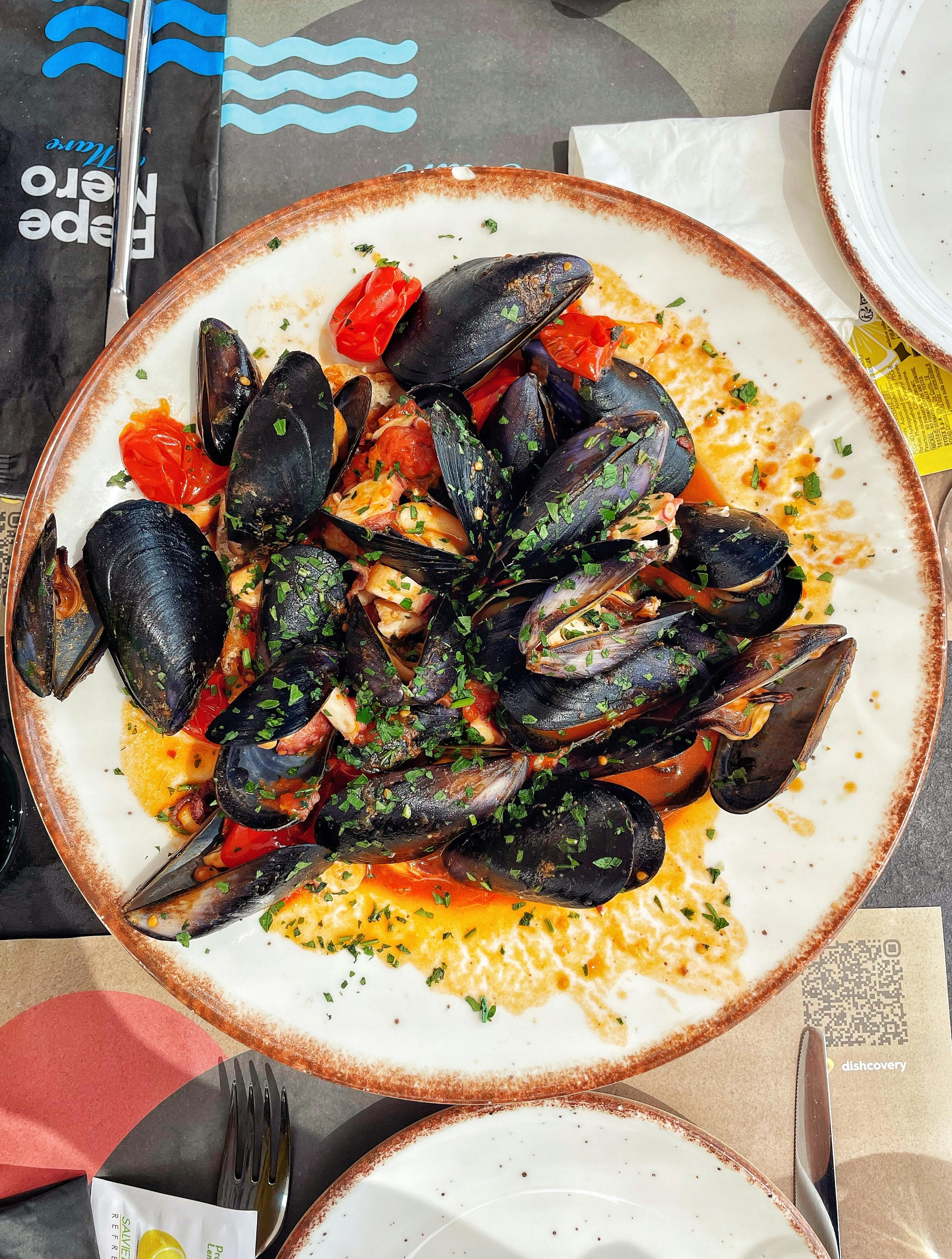
Photo: Tugce Turan / Pexels
Mediterranean
Mussel Saganaki
The diets react (see scores below)
Common Ingredients
- mussels
- tomatoes
- feta cheese
- ouzo
- garlic
- olive oil
- parsley
- red pepper flakes
Specific recipes may vary.
Incompatible with 5 of 11 diets
Diet Ratings
Mussel Saganaki sits in keto's gray zone. Mussels themselves are moderate in carbs (~7g net carbs per 100g due to natural glycogen), feta cheese and olive oil are keto-friendly, and garlic/parsley/red pepper flakes add negligible carbs. The main concerns are: (1) mussels in larger portions accumulate carbs quickly, (2) tomatoes add ~3-4g net carbs per 100g and are used in meaningful quantities in this dish, and (3) ouzo is an anise-flavored liqueur that typically contains residual sugars and carbs — even small cooking amounts contribute. The combination of tomato sauce base, mussel glycogen, and ouzo pushes this dish into caution territory, though a small, carefully portioned serving (focusing on mussels and limiting the tomato-ouzo sauce) can fit within a daily keto budget. Strict keto followers would want to minimize sauce consumption and keep portions modest.
Strict keto practitioners argue that mussels' natural glycogen content combined with even small amounts of ouzo and a tomato base creates too much carb uncertainty to be reliably keto-safe, especially since restaurant or traditional portions often exceed what fits a 20g daily net carb limit. Some lazy keto practitioners, however, would approve a small serving given the dish's healthy fat profile from olive oil and feta.
Mussel Saganaki contains multiple animal-derived ingredients that are unequivocally non-vegan. Mussels are shellfish (animals), and feta cheese is a dairy product made from sheep's or goat's milk. Both are direct animal products, making this dish entirely incompatible with a vegan diet. The remaining ingredients — tomatoes, ouzo, garlic, olive oil, parsley, and red pepper flakes — are all plant-based, but the presence of mussels and feta cheese disqualifies the dish entirely.
Mussel Saganaki contains two clear paleo violations that cannot be overlooked. Feta cheese is dairy — explicitly excluded under all mainstream paleo frameworks with no meaningful debate. Ouzo is an anise-flavored spirit that, while alcohol is a gray area in paleo, is a heavily processed distilled liquor; more critically, it is grain-adjacent in spirit (though technically distilled from grapes/pomace, the processing level is extreme). The feta alone is sufficient to push this dish into 'avoid' territory. The remaining ingredients — mussels, tomatoes, garlic, olive oil, parsley, and red pepper flakes — are all paleo-compliant and excellent, but two problematic ingredients make this dish non-paleo as prepared. A paleo adaptation would require removing the feta entirely and omitting or substituting the ouzo.
Mussel Saganaki is a quintessentially Mediterranean dish rooted in Greek coastal cuisine. Mussels are an excellent source of lean protein and omega-3 fatty acids, fully aligned with the Mediterranean diet's emphasis on seafood 2-3 times per week. The base of tomatoes, garlic, olive oil, and fresh parsley represents the plant-forward, olive-oil-centric foundation of Mediterranean eating. Feta cheese is a traditional dairy element used in moderation, consistent with the diet's moderate dairy allowance. Ouzo adds a small amount of alcohol used in cooking, which largely evaporates and is traditional in Greek cuisine. Red pepper flakes are a beneficial anti-inflammatory spice. There are no processed foods, refined grains, added sugars, or red meat. The dish is a whole-ingredient, seafood-forward preparation that exemplifies Mediterranean coastal cooking.
Some stricter modern clinical interpretations of the Mediterranean diet flag feta cheese as a source of saturated fat and sodium, suggesting it should be used very sparingly or omitted; traditional Greek practice, however, treats feta as an integral and moderate component of everyday cooking.
Mussel Saganaki is fundamentally incompatible with the carnivore diet. While mussels themselves are an acceptable animal-derived seafood, the dish is overwhelmingly built around plant-based and processed ingredients that are strictly excluded. Tomatoes, garlic, olive oil, parsley, and red pepper flakes are all plant-derived and prohibited. Ouzo is an alcohol distilled from plant sources and flavored with anise, making it doubly non-carnivore. Feta cheese is a dairy product that would already place the dish in 'caution' territory at best, but its presence is irrelevant given the volume of outright excluded plant ingredients. This dish cannot be modified within its traditional form to be carnivore-compatible — it would require removing virtually every ingredient except the mussels themselves.
Mussel Saganaki contains two clearly excluded ingredients: feta cheese (dairy) and ouzo (alcohol). Both are explicitly prohibited on the Whole30 program. Feta is a dairy product (milk/cheese) and falls squarely under the dairy exclusion. Ouzo is an anise-flavored liqueur — alcohol of any kind is excluded. The remaining ingredients (mussels, tomatoes, garlic, olive oil, parsley, red pepper flakes) are all Whole30-compliant, but the presence of feta and ouzo makes this dish a clear avoid.
Mussel Saganaki contains two clear high-FODMAP ingredients that make it unsuitable during the elimination phase. Garlic is one of the highest-FODMAP foods tested by Monash University, containing significant fructans even in tiny quantities — it cannot be made safe by portion reduction at a standard serving. Feta cheese, while lower in lactose than many cheeses, is rated by Monash as low-FODMAP only at a 40g serving; in a saganaki preparation it is typically used more generously and crumbled throughout the dish, making portion control difficult. Ouzo (anise-flavored liqueur) introduces additional uncertainty, as alcohol can be a gut irritant and anise/fennel-based spirits have limited Monash testing. The remaining ingredients — mussels, tomatoes (canned or fresh in moderate amounts), olive oil, parsley, and red pepper flakes — are all low-FODMAP and unproblematic. However, the garlic alone is disqualifying for the elimination phase, as there is no safe serving size for whole garlic. The dish could be modified using garlic-infused oil instead of garlic cloves, reducing feta to a strict 40g portion, and omitting or substituting the ouzo, but as traditionally prepared it must be avoided.
Mussel Saganaki contains several DASH-friendly components — mussels are an excellent lean protein source rich in potassium, magnesium, and omega-3 fatty acids; tomatoes provide potassium, fiber, and antioxidants; olive oil aligns with DASH's preference for healthy vegetable oils; and garlic, parsley, and red pepper flakes are sodium-free flavor enhancers. However, the dish has notable limitations for DASH adherence. Feta cheese is a full-fat, relatively high-sodium cheese (approximately 300-400mg sodium per ounce), which conflicts with DASH's emphasis on low-fat dairy and sodium restriction. Ouzo adds negligible nutrition and DASH does not encourage alcohol. The sodium burden from feta combined with the natural sodium in mussels (~300mg per 3oz serving) can push this dish toward the upper bounds of a single meal's sodium budget, especially on the stricter 1,500mg/day DASH variant. Mussels themselves are excellent, and with portion-controlled feta and attention to total daily sodium, this dish can fit within DASH guidelines — but it requires moderation rather than being a freely consumed staple.
NIH DASH guidelines specify low-fat dairy and limit sodium, which argues for reducing or substituting feta; however, updated clinical interpretations of the Mediterranean-DASH hybrid (MIND diet) and growing evidence that full-fat fermented dairy may not adversely affect cardiovascular outcomes lead some DASH-oriented practitioners to permit modest amounts of feta, particularly given its strong flavor allowing small quantities to satisfy.
Mussel Saganaki aligns reasonably well with Zone Diet principles. Mussels are an excellent lean protein source — low in fat, rich in omega-3 fatty acids, and highly nutrient-dense, making them a favorable Zone protein block. Tomatoes provide low-glycemic carbohydrates loaded with polyphenols (lycopene), which Sears specifically champions for anti-inflammatory benefit. Olive oil contributes the ideal monounsaturated fat profile Zone recommends. Garlic and parsley add polyphenol value with negligible macro impact. Feta cheese introduces some saturated fat and a small additional protein contribution, which requires modest portioning attention but is not disqualifying. The primary concern is ouzo: as an anise-flavored spirit, it contributes alcohol calories that don't fit neatly into any Zone block category, and in cooking most of the alcohol burns off, leaving negligible residual impact on macros — so it's largely a non-issue in practice. The dish as a whole can realistically be portioned to hit the 40/30/30 ratio when served with a side of additional low-GI vegetables to balance the carb blocks, since tomatoes alone may not fully satisfy the carbohydrate requirement for a complete Zone meal. Overall, this is a Mediterranean-style dish that embodies many of Sears' anti-inflammatory food priorities.
Some Zone practitioners may rate this higher (8-9) given the strong omega-3 protein source and polyphenol-rich ingredients, arguing that the feta and ouzo are negligible in typical serving amounts. Others following stricter early Zone guidelines might note feta's saturated fat content as a 'caution' flag, keeping the score in the mid-range. The dish's Zone compatibility also depends significantly on portion control and what accompanies it.
Mussel Saganaki is a strongly anti-inflammatory dish built on a foundation of excellent ingredients. Mussels are an outstanding anti-inflammatory protein — rich in omega-3 fatty acids (EPA and DHA), zinc, selenium, and B12, with very low saturated fat. Extra virgin olive oil contributes oleocanthal, a natural COX-inhibitor with ibuprofen-like anti-inflammatory action. Tomatoes deliver lycopene and vitamin C. Garlic contains allicin and sulfur compounds that suppress inflammatory cytokines. Parsley is rich in flavonoids (apigenin, luteolin) and vitamin K. Red pepper flakes add capsaicin, which modulates NF-κB inflammatory pathways. Feta, while a full-fat dairy product that should technically be limited, is present in a small supporting quantity and is a traditional, minimally processed cheese — its impact is modest. Ouzo introduces a small amount of alcohol, which is the primary concern here: the anti-inflammatory framework de-emphasizes alcohol beyond moderate red wine, and anise-based spirits are not specifically endorsed. However, the quantity used in cooking is typically small and largely evaporates, minimizing concern. Overall, the dish is Mediterranean in spirit, aligns closely with Dr. Weil's Anti-Inflammatory Food Pyramid, and the beneficial ingredients substantially outweigh the minor concerns.
The feta cheese (full-fat dairy) and ouzo (alcohol other than red wine) are mild flags under stricter anti-inflammatory interpretations. Mainstream anti-inflammatory authorities like Dr. Weil permit moderate dairy and occasional alcohol, but more conservative protocols (e.g., AIP or strict Weil followers) would recommend reducing feta quantity and substituting broth or white wine for the ouzo — or omitting alcohol entirely given newer research suggesting any alcohol intake may promote systemic inflammation.
Mussel Saganaki is a mixed profile for GLP-1 patients. Mussels are an excellent lean protein source — roughly 18-20g protein per 100g cooked, very low in fat, rich in zinc, iron, B12, and omega-3s, making them highly nutrient-dense per calorie. The tomato base adds fiber, lycopene, and hydration support. Olive oil and garlic are well-tolerated unsaturated fat sources. However, two ingredients introduce meaningful concerns: feta cheese adds saturated fat that can worsen GLP-1 GI side effects, and ouzo (an anise-flavored liqueur) is alcohol — a direct conflict with the avoid rule due to empty calories and dehydration risk. In restaurant or traditional preparations, ouzo is typically burned off during cooking, leaving behind flavor compounds rather than significant alcohol content, which partially mitigates this concern. Red pepper flakes are a mild-to-moderate spice that may irritate in patients prone to GLP-1-related reflux or nausea. The dish is not fried and is relatively easy to digest when mussels are not overcooked. As a main, protein yield per serving is solid if portion is adequate (200-300g mussels). The fat from feta and olive oil combined may push total fat per serving into a range that risks nausea or bloating in sensitive patients.
Some GLP-1-focused dietitians would rate this higher, arguing that the alcohol in ouzo is largely cooked off in traditional preparation and that feta is used in small enough quantities that saturated fat load remains manageable — framing this as a nutrient-dense Mediterranean dish worth endorsing. Others maintain stricter positions on any alcohol-containing ingredient regardless of cooking method, and flag that feta's fat content combined with olive oil can exceed the low-fat threshold that minimizes GI side effects in GLP-1 patients, particularly in the first months of treatment.
*See how scores were generated at our methodology page.
Nutritional profile
Six traits that cut across every diet.
Fiber & Plants
How much whole-plant food and fiber it delivers.
Healthy Fats
The quality of its fats (unsaturated, omega-3).
Whole / Unprocessed
How close it is to its natural, unprocessed form.
Gut Gentle
How easy it is on digestion (low FODMAP, few irritants).
Low Glycemic
How little it spikes your blood sugar.
Protein Density
How much protein it packs per calorie.
Controversy Index
Higher controversy = more disagreement between diets.
Diet-Specific Tips
 Keto — 5/10
View tips
- Mussels contain natural glycogen (~7g net carbs/100g), limiting safe portion size
- Tomato base adds meaningful net carbs to the dish
- Ouzo contributes residual sugars and carbs even in cooking quantities
- Feta cheese and olive oil are keto-friendly components
- Garlic, parsley, and red pepper flakes are negligible carb contributors
- Dish can fit keto with strict portion control but is not freely consumable
 Mediterranean — 9/10
View tips
- Mussels are an ideal Mediterranean protein — lean, seafood-based, rich in omega-3s
- Extra virgin olive oil as the primary cooking fat is a core Mediterranean principle
- Tomatoes, garlic, and parsley provide plant-based nutrition and antioxidants
- Feta cheese is traditional and used in moderation, consistent with moderate dairy allowance
- Ouzo is a traditional Greek culinary ingredient used in small amounts for cooking
- No processed foods, refined grains, added sugars, or red meat present
- Dish originates directly from Greek Mediterranean coastal culinary tradition
 DASH — 6/10
View tips
- Mussels are lean, nutrient-dense protein rich in potassium, magnesium, and omega-3s — strongly DASH-aligned
- Feta cheese is high-sodium and full-fat, conflicting with DASH low-fat dairy and sodium limits
- Tomatoes, garlic, olive oil, and herbs are core DASH-compatible ingredients
- Combined sodium from mussels and feta can be significant — requires careful portioning on 1,500mg/day DASH
- Ouzo (alcohol) is neither encouraged nor explicitly forbidden by DASH but adds no nutritional benefit
- Dish is DASH-compatible if feta is portioned carefully (1oz or less) and no additional salt is added
 Zone — 7/10
View tips
- Mussels are a lean, omega-3-rich protein — highly favorable Zone protein block
- Tomatoes are low-glycemic, polyphenol-rich carbohydrate — ideal Zone carb source
- Olive oil provides ideal monounsaturated fat profile
- Feta cheese adds saturated fat; requires moderate portioning
- Ouzo alcohol content largely burns off in cooking — minimal macro impact
- Garlic, parsley, and red pepper flakes add polyphenol benefit with negligible macro contribution
- Dish may need supplemental low-GI vegetables to fully balance Zone carbohydrate blocks
 Anti-Inflammatory — 8/10
View tips
- Mussels are rich in omega-3 fatty acids (EPA/DHA), highly anti-inflammatory protein source
- Extra virgin olive oil provides oleocanthal with COX-inhibiting anti-inflammatory properties
- Garlic contributes allicin and sulfur compounds that suppress inflammatory cytokines
- Tomatoes deliver lycopene and antioxidant vitamins C and E
- Red pepper flakes contain capsaicin, a known modulator of NF-κB inflammatory pathways
- Parsley provides flavonoids (apigenin, luteolin) and vitamin K
- Feta is full-fat dairy — a minor concern, but used in small amounts as a condiment
- Ouzo is a non-red-wine alcohol — small cooking quantity limits concern but is technically outside anti-inflammatory recommendations
 GLP-1 Friendly — 6/10
View tips
- Mussels are a high-quality lean protein source with strong omega-3 and micronutrient profile
- Ouzo contains alcohol — an avoid-category ingredient regardless of partial cook-off
- Feta cheese contributes saturated fat that may worsen nausea or bloating
- Tomato base adds fiber, hydration support, and lycopene
- Olive oil provides unsaturated fat but combined with feta raises total fat per serving
- Red pepper flakes may trigger reflux or nausea in GLP-1-sensitive patients
- Dish is not fried and is relatively easy to digest
- Protein yield is strong if a full mussel portion (200-300g) is consumed