Photo: Valeria Boltneva / Pexels
Mediterranean
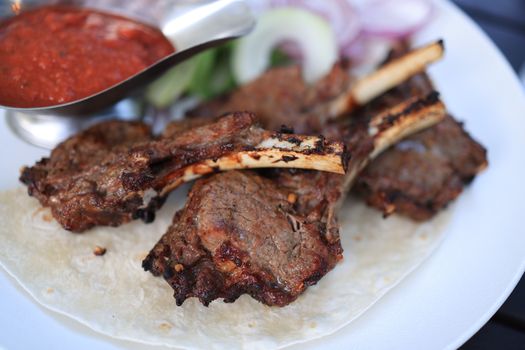
Paidakia (Grilled Lamb Chops)
The diets react (see scores below)
Common Ingredients
- lamb chops
- olive oil
- lemon juice
- oregano
- garlic
- salt
- black pepper
- rosemary
Specific recipes may vary.
Incompatible with 4 of 11 diets
Diet Ratings
Paidakia is an excellent keto dish. Lamb chops are high in fat and protein with zero carbohydrates. The marinade ingredients — olive oil, lemon juice, oregano, garlic, rosemary, salt, and black pepper — contribute negligible net carbs (trace amounts from garlic and lemon juice, well under 2g per serving). Olive oil adds healthy monounsaturated fats. This dish naturally aligns with ketogenic macros: high fat, moderate quality protein, and virtually zero net carbs.
Paidakia consists primarily of lamb chops, which are a direct animal product (meat from a young sheep). This is a fundamental violation of vegan dietary principles, which exclude all animal flesh. The remaining ingredients — olive oil, lemon juice, oregano, garlic, salt, black pepper, and rosemary — are all plant-based, but the primary protein source makes this dish entirely incompatible with a vegan diet. There is no ambiguity here: lamb is meat, and meat is categorically excluded from veganism.
Paidakia is fundamentally a paleo-friendly dish — grilled lamb is an excellent protein source, olive oil is a preferred paleo fat, and lemon juice, oregano, garlic, rosemary, and black pepper are all whole, unprocessed herbs and spices fully approved on paleo. However, the inclusion of salt is a disqualifying factor under strict paleo rules. Added salt was not available to Paleolithic humans in processed form and is explicitly excluded from the paleo framework. This single ingredient pushes the dish into 'avoid' territory under strict paleo orthodoxy, despite the otherwise exemplary ingredient list.
Many modern paleo practitioners, including Mark Sisson and authors of practical paleo guides, consider small amounts of high-quality salt (sea salt, pink Himalayan salt) acceptable or even beneficial, arguing that the anti-salt position is overly rigid and not well-supported by ancestral health evidence. In practice, this dish would be widely accepted in the broader paleo community with a simple omission or reduction of salt.
Paidakia is a beloved traditional Greek dish, but lamb is red meat and the Mediterranean diet recommends limiting red meat to a few times per month or once weekly at most. The preparation is excellent — olive oil, lemon, garlic, oregano, and rosemary are all Mediterranean staples with no processed ingredients or added sugars. The dish itself is clean and whole-food based, which mitigates concerns somewhat. Enjoyed occasionally as part of a broader plant-forward diet, it fits within the Mediterranean framework, but it cannot be a frequent staple.
Some traditional Mediterranean diet authorities, particularly those referencing Greek and Levantine pastoral traditions, note that lamb holds a culturally significant place in the diet and is consumed more regularly than 'red meat limits' in modern clinical guidelines suggest. Lamb also has a different fatty acid profile than beef, with some researchers arguing it warrants less restriction than other red meats.
While lamb chops themselves are an excellent carnivore food — ruminant meat, high in fat and protein, scoring at the top of the approval list — this dish is prepared with multiple plant-based ingredients that make it incompatible with the carnivore diet. Olive oil is a plant-derived oil; lemon juice is fruit-derived; oregano, garlic, rosemary, and black pepper are all plant-based seasonings. The marinade is essentially a Mediterranean herb blend that violates the core carnivore rule of excluding all plant foods. Only the lamb chops and salt are carnivore-compliant. To make this dish carnivore-friendly, the lamb chops would need to be cooked with only salt and an animal fat (tallow or lard), discarding all other ingredients entirely.
Paidakia (Grilled Lamb Chops) is a straightforward, whole-food dish with no excluded ingredients. Lamb is an explicitly allowed protein on Whole30. Olive oil is a compliant natural fat. Lemon juice, oregano, garlic, salt, black pepper, and rosemary are all compliant seasonings and aromatics. Every ingredient in this dish is either explicitly approved or falls clearly within the allowed categories of meat, natural fats, herbs, and spices. There are no added sugars, grains, legumes, dairy, alcohol, or any other excluded ingredients.
Paidakia as traditionally prepared contains whole garlic cloves as a key marinade ingredient, which is high-FODMAP at any serving size due to fructans. Garlic is one of the highest-FODMAP foods tested by Monash University and is a primary trigger for IBS symptoms. The remaining ingredients — lamb chops, olive oil, lemon juice, oregano, salt, black pepper, and rosemary — are all low-FODMAP and safe during elimination. However, because garlic is listed as a direct ingredient (not garlic-infused oil), the dish as described cannot be considered safe during the elimination phase. If the garlic were replaced with garlic-infused olive oil (where FODMAPs do not leach into fat), the dish would easily score a 9 and be fully approved.
Lamb chops are classified as red meat under DASH guidelines, which explicitly recommends limiting red meat intake due to its saturated fat and cholesterol content. DASH typically limits red meat to no more than a few servings per week, emphasizing leaner proteins like poultry and fish instead. Lamb chops, particularly rib or loin cuts, carry moderate-to-high levels of saturated fat. However, the preparation method here is favorable: grilling (not frying), with olive oil (a heart-healthy fat), lemon juice, garlic, oregano, and rosemary — all DASH-compatible ingredients with no processed additives. The added salt is a concern under DASH sodium limits, though the amount in home cooking is likely modest. This dish can fit into a DASH diet occasionally and in portion-controlled amounts (e.g., 3 oz serving), but it is not a DASH staple and should not be a frequent centerpiece of the eating plan.
NIH DASH guidelines categorize red meat as a food to limit due to saturated fat content. However, some updated clinical interpretations and Mediterranean diet researchers note that lean lamb in moderate portions provides high-quality protein, zinc, iron, and B12, and that when consumed as part of an overall Mediterranean-DASH hybrid pattern (MIND diet), occasional red meat is less categorically restricted than in strict DASH protocol.
Paidakia (grilled lamb chops) presents a mixed Zone Diet profile. On the positive side, lamb chops are a complete protein source and the marinade is exemplary Zone-friendly: olive oil provides ideal monounsaturated fat, lemon juice adds polyphenols with negligible glycemic impact, and oregano, garlic, and rosemary are anti-inflammatory polyphenol sources that Sears actively endorses in his later writings. However, lamb chops — particularly rib chops — carry significantly more saturated fat than the lean proteins Dr. Sears classifies as 'favorable' (skinless chicken, fish, egg whites, low-fat dairy). The fat content per serving can easily exceed Zone fat block targets and skew the 30/30/40 macro ratio. To fit the Zone properly, leaner cuts (loin chops, leg of lamb trimmed of visible fat) should be selected, portion size must be controlled to approximately 3 oz cooked (roughly 21g protein / 3 protein blocks), and the olive oil in the marinade must be counted toward the meal's fat blocks. Paired with a large serving of low-glycemic vegetables, this dish can be balanced into a Zone meal, but it requires deliberate portioning.
In Sears' earlier Zone books, lamb was categorized as an 'unfavorable' protein due to its saturated fat content relative to chicken or fish. However, in his later anti-inflammatory writing (notably 'The Zone Diet' updates and 'Toxic Fat'), Sears softened his stance on saturated fat somewhat, acknowledging that the overall inflammatory balance of the meal — including the omega-3 content of grass-fed lamb and the high polyphenol marinade — matters more than saturated fat in isolation. Some Zone practitioners therefore treat trimmed lamb as acceptable, especially grass-fed, which has a more favorable omega-6 to omega-3 ratio.
Paidakia presents a mixed anti-inflammatory profile. On the positive side, the marinade is a showcase of anti-inflammatory ingredients: extra virgin olive oil (oleocanthal, polyphenols), garlic (allicin), oregano and rosemary (strong polyphenolic herbs used extensively in Mediterranean anti-inflammatory traditions), lemon juice (vitamin C, flavonoids), and black pepper (piperine). These components are consistently emphasized across anti-inflammatory frameworks including Dr. Weil's pyramid. The problem is the primary protein: lamb. Lamb is red meat with a relatively high saturated fat content and arachidonic acid levels, both of which are associated with pro-inflammatory pathways (elevated CRP, IL-6) in research. Anti-inflammatory guidelines consistently place red meat in the 'limit' category. However, lamb chops are not processed, and grass-fed lamb in particular has a more favorable omega-6 to omega-3 ratio and higher CLA content than grain-fed red meats. The Mediterranean dietary context is also meaningful — lamb consumed occasionally in the context of an otherwise plant-rich, olive oil-based diet is quite different from routine red meat consumption. The marinade meaningfully offsets some inflammatory concern. The dish lands at 'caution': acceptable occasionally, not a regular staple.
Most anti-inflammatory protocols (Dr. Weil, IF Rating system) classify red meat as a 'limit' food due to saturated fat and arachidonic acid, supporting a cautious verdict. However, some researchers and Mediterranean diet advocates argue that unprocessed red meat consumed in moderate portions within an otherwise anti-inflammatory dietary pattern poses minimal risk, and that grass-fed lamb's omega-3 and CLA content partially mitigate its saturated fat profile.
Grilled lamb chops (paidakia) offer solid protein content — a typical 3-chop serving provides roughly 25-35g of protein — and the grilling method avoids added fats from frying. The Mediterranean marinade (olive oil, lemon, oregano, garlic) is anti-inflammatory and GLP-1 friendly in itself. However, lamb chops are a fatty cut of red meat: rib or loin chops typically contain 15-25g of fat per serving, with a significant saturated fat component. This elevated fat load can worsen GLP-1 side effects including nausea, bloating, and delayed gastric emptying, since fat is the macronutrient most responsible for slowing stomach emptying further. The dish has no fiber and relies entirely on portion control to manage fat intake. A lean lamb cut (leg of lamb, trimmed) would rate higher; rib chops specifically are among the fattier options. Acceptable occasionally in a small, well-trimmed portion, but not a go-to GLP-1 protein source.
Some GLP-1-focused dietitians accept lamb occasionally for patients who tolerate red meat well, citing its high protein density, zinc, iron, and B12 content as meaningful nutritional benefits in a calorie-restricted context. Others flag lamb's saturated fat load as a consistent nausea trigger and recommend avoiding it entirely in favor of leaner proteins, particularly in the first months of GLP-1 therapy when GI side effects are most pronounced.
*See how scores were generated at our methodology page.
Nutritional profile
Six traits that cut across every diet.
Fiber & Plants
How much whole-plant food and fiber it delivers.
Healthy Fats
The quality of its fats (unsaturated, omega-3).
Whole / Unprocessed
How close it is to its natural, unprocessed form.
Gut Gentle
How easy it is on digestion (low FODMAP, few irritants).
Low Glycemic
How little it spikes your blood sugar.
Protein Density
How much protein it packs per calorie.
Controversy Index
Higher controversy = more disagreement between diets.
Diet-Specific Tips
 Keto — 9/10
View tips
- Lamb chops are zero-carb, high-fat, high-quality protein — ideal keto macros
- Olive oil marinade reinforces healthy fat intake
- Lemon juice and garlic contribute only trace net carbs per serving
- No grains, sugars, or starchy ingredients present
- Whole, unprocessed ingredients throughout
- Grilling method avoids breading or carb-based coatings
 Mediterranean — 5/10
View tips
- Lamb is red meat — Mediterranean diet limits red meat to a few times per month
- Excellent traditional preparation with olive oil, lemon, herbs, and garlic — no processed components
- Culturally authentic Greek dish with deep Mediterranean roots
- No refined grains, added sugars, or ultra-processed ingredients
- Appropriate as an occasional meal, not a daily staple
 Whole30 — 10/10
View tips
- Lamb chops are a compliant Whole30 protein
- Olive oil is an approved natural fat
- Lemon juice is compliant (100% fruit juice)
- All seasonings (oregano, garlic, salt, black pepper, rosemary) are explicitly allowed
- No excluded ingredients present
- Simple, whole-food preparation honors the spirit of the Whole30 program
 DASH — 4/10
View tips
- Lamb is red meat — explicitly limited under DASH guidelines due to saturated fat content
- Moderate saturated fat in lamb chops, varying by cut (rib chops higher than leg cuts)
- Grilling is a DASH-favorable cooking method — no added fats from frying
- Olive oil is a DASH-approved heart-healthy fat
- Lemon juice, garlic, oregano, rosemary are all DASH-compatible, nutrient-supportive ingredients
- Added salt requires monitoring to stay within DASH sodium limits (<2,300mg/day)
- Acceptable occasionally in controlled portions (3 oz lean serving), but not a DASH staple protein
 Zone — 5/10
View tips
- Lamb is higher in saturated fat than Zone 'favorable' lean proteins like chicken breast or fish
- Olive oil marinade is an ideal Zone monounsaturated fat source but must be counted in fat blocks
- Lemon juice, garlic, oregano, and rosemary provide anti-inflammatory polyphenols — strongly Zone-aligned
- Grass-fed lamb improves the omega-6:omega-3 ratio, partially offsetting saturated fat concerns
- Portion control is critical: ~3 oz cooked lamb provides ~3 protein blocks but may also deliver 2–3 extra fat blocks
- No carbohydrate component present — must be paired with low-glycemic vegetables to complete a Zone meal
- No high-glycemic ingredients, processed additives, or trans fats — a clean whole-food preparation
 Anti-Inflammatory — 5/10
View tips
- Lamb is red meat — categorized as 'limit' in anti-inflammatory frameworks due to saturated fat and arachidonic acid
- Extra virgin olive oil in marinade is a top-tier anti-inflammatory fat (oleocanthal)
- Garlic, oregano, rosemary, and black pepper are potent anti-inflammatory herbs/spices
- Lemon juice contributes vitamin C and flavonoids
- Grass-fed lamb has a better omega-6:omega-3 ratio and higher CLA than grain-fed red meats
- No processed ingredients, additives, refined carbohydrates, or seed oils
- Mediterranean context suggests moderate, occasional consumption rather than dietary staple
 GLP-1 Friendly — 5/10
View tips
- High saturated fat content in lamb chops worsens GLP-1 GI side effects
- Grilling method preferred over frying — does not add excess fat
- Adequate protein per serving (25-35g) supports muscle preservation goal
- Zero fiber — no digestive or satiety benefit beyond protein
- Olive oil and lemon marinade are GLP-1-compatible in small amounts
- Portion size is critical — a large serving significantly increases fat load
- Leaner lamb cuts (leg, trimmed loin) would score higher than rib chops