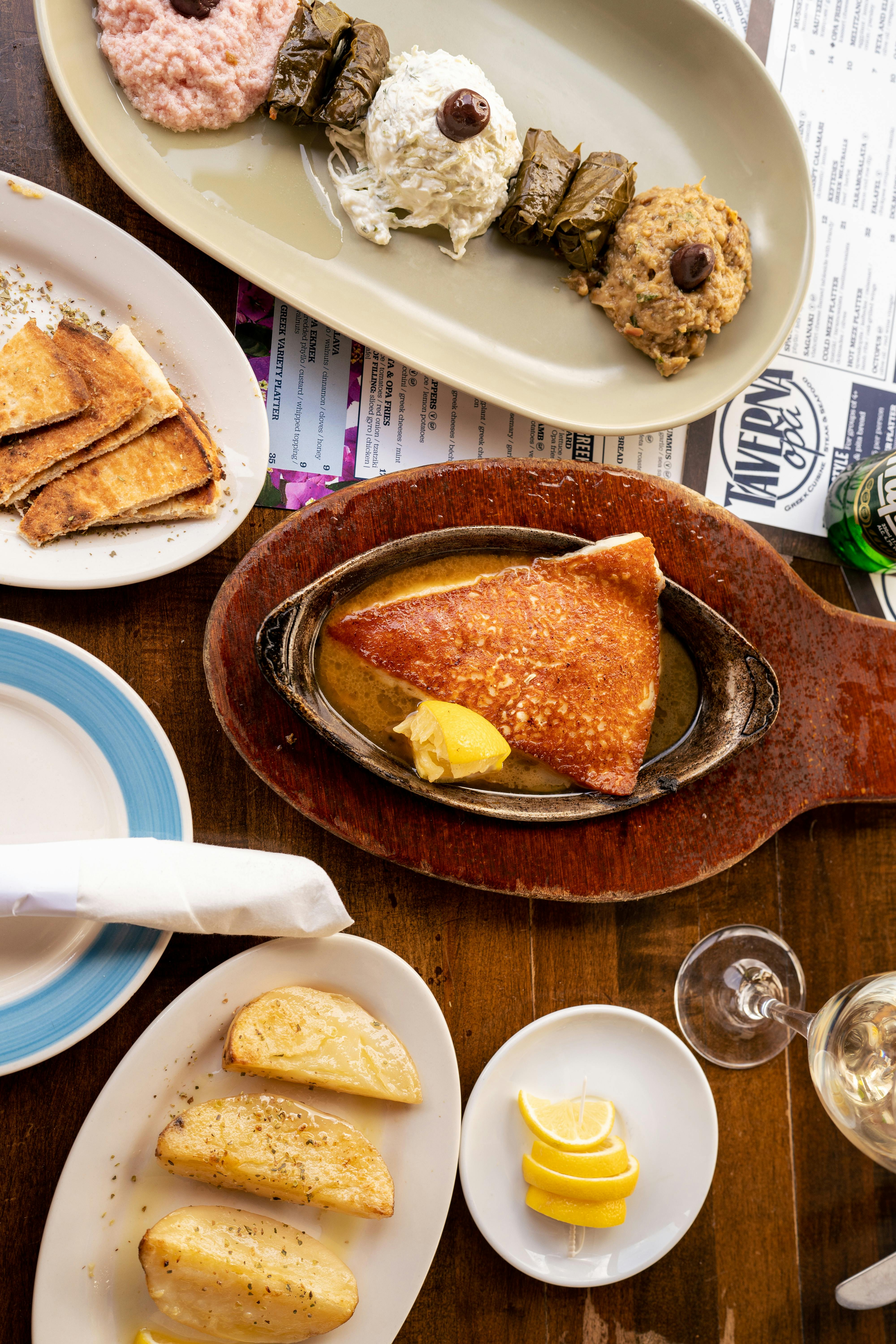
Photo: Christina Petsos / Pexels
Mediterranean
Saganaki
The diets react (see scores below)
Common Ingredients
- kefalograviera cheese
- flour
- olive oil
- lemon
- black pepper
Specific recipes may vary.
Incompatible with 6 of 11 diets
Diet Ratings
Saganaki is primarily fried cheese (kefalograviera), which is naturally high in fat and moderate protein — both keto-friendly. The problem is the flour coating used before pan-frying, which adds meaningful net carbs. A typical serving involves dredging in wheat flour, adding roughly 5-10g net carbs per serving depending on how heavily coated. The cheese itself (kefalograviera) is a hard, aged Greek cheese with very low net carbs (~0-1g per serving) and high fat content, making it excellent for keto. Lemon juice adds negligible carbs, olive oil is ideal, and black pepper is fine. The dish can be made keto-compatible by substituting almond flour, coconut flour, or skipping the coating altogether — but as traditionally prepared with wheat flour, it sits in caution territory due to the grain-based coating.
Strict keto practitioners would classify this as 'avoid' due to the wheat flour coating, arguing that any grain-based ingredient is incompatible regardless of portion size, and that the coating sets a bad precedent for glucose spikes. Conversely, lazy keto or targeted keto followers may approve it outright, arguing the small amount of flour used per serving keeps net carbs well within daily limits.
Saganaki is built around kefalograviera cheese, a hard Greek cheese made from sheep's and/or goat's milk. Dairy is an animal product explicitly excluded under all vegan frameworks. The remaining ingredients (flour, olive oil, lemon, black pepper) are plant-based, but the dish is fundamentally defined by and inseparable from its cheese component. There is no meaningful vegan version of traditional saganaki without replacing the cheese entirely.
Saganaki is fundamentally incompatible with the paleo diet due to two core non-paleo ingredients: kefalograviera cheese (a hard dairy cheese) and flour (a grain-based product used for dredging). Dairy is excluded from paleo due to its post-agricultural origins and the insulinogenic/inflammatory responses it can trigger, and grains are categorically excluded across virtually all paleo frameworks. While olive oil, lemon, and black pepper are fully paleo-approved, they cannot redeem a dish whose two primary functional ingredients are strict avoids. The dish as traditionally prepared cannot be made paleo-compliant without fundamentally changing its nature.
Saganaki is a traditional Greek fried cheese dish made with kefalograviera, a hard sheep/goat milk cheese. While it uses extra virgin olive oil (a core Mediterranean staple) and lemon for finishing, the dish is primarily composed of cheese — a high-saturated-fat dairy product that falls into the 'moderate' category of the Mediterranean diet. The flour coating is minimal and not a significant concern. As an occasional snack or meze in the Greek tradition, it is culturally authentic and acceptable, but its high dairy fat content means it should not be a daily staple. The use of quality EVOO rather than seed oils for frying is a point in its favor.
Some traditional Mediterranean diet purists would view saganaki more favorably, noting that fermented and aged cheeses like kefalograviera are a longstanding part of Greek culinary tradition and that small portions as a meze are consistent with the diet's social, moderate eating ethos. Conversely, modern clinical guidelines emphasizing cardiovascular health suggest limiting high-saturated-fat cheeses even within Mediterranean patterns.
Saganaki is fundamentally incompatible with the carnivore diet. While kefalograviera cheese is an animal-derived dairy product that would itself be debated within the carnivore community, the dish is prepared with flour (a grain — strictly excluded), olive oil (a plant oil — strictly excluded), lemon (a fruit — strictly excluded), and black pepper (a spice — excluded on strict carnivore). The majority of ingredients are plant-derived, and the cooking method relies on flour breading and plant oil frying. Even the most liberal 'animal-based' carnivore practitioners would reject this dish due to the grain coating and plant oil. There is no version of this dish that is carnivore-compatible without a complete reformulation.
Saganaki contains two excluded ingredients: kefalograviera cheese (dairy, which is explicitly prohibited on Whole30) and flour (a grain, also explicitly prohibited). Both are core components of this dish and cannot be omitted — the cheese is the primary ingredient and the flour coating is essential to the preparation. There is no compliant version of traditional saganaki possible within Whole30 rules.
Saganaki is fried cheese, and its FODMAP status hinges primarily on the type of cheese and the flour coating. Kefalograviera is a hard, aged Greek cheese. Hard aged cheeses are generally low-FODMAP because the aging process reduces lactose content significantly — Monash rates hard cheeses like cheddar and parmesan as low-FODMAP at standard servings (around 40g). Kefalograviera is similar in character, though it is not explicitly tested by Monash. The olive oil and lemon juice are low-FODMAP. Black pepper in culinary amounts is low-FODMAP. The problematic ingredient is the wheat flour coating: wheat flour is high in fructans, and even a light dusting used for dredging (typically 1-2 tablespoons absorbed per serving) introduces a moderate fructan load. Some practitioners consider the small amount of flour coating to be low enough to be tolerable, but during strict elimination phase, any wheat flour is typically flagged. Using a gluten-free flour substitute (rice flour, cornstarch) would make this dish clearly low-FODMAP. As prepared with standard wheat flour, caution is warranted.
Monash University suggests that very small amounts of wheat flour used as a coating may fall below the fructan threshold that triggers symptoms, and some FODMAP dietitians permit light coatings during elimination. However, most strict elimination phase protocols recommend avoiding all wheat-containing ingredients, making this dish risky without a gluten-free flour substitution.
Saganaki is a fried Greek cheese dish made from kefalograviera, a hard sheep/goat milk cheese that is high in sodium and saturated fat. A typical serving (about 60-90g of kefalograviera) contains roughly 400-600mg of sodium and 8-12g of saturated fat, both of which DASH guidelines explicitly limit. Full-fat hard cheeses are not among the approved dairy choices in DASH — the plan specifies low-fat or fat-free dairy. Additionally, the dish is pan-fried in olive oil, adding further fat calories. While olive oil itself is a heart-healthy unsaturated fat aligned with DASH principles, the overall nutritional profile of this dish — dominated by high-sodium, high-saturated-fat full-fat cheese — makes it a poor fit. The flour coating and frying process do not meaningfully improve its DASH compatibility. Even as an occasional snack, a single serving could consume a significant portion of the daily sodium and saturated fat allowance. DASH guidelines are explicit about limiting full-fat dairy and high-sodium foods, placing saganaki firmly in the avoid category.
NIH DASH guidelines clearly restrict full-fat cheese due to saturated fat and sodium content; however, some updated clinical interpretations note that emerging research on full-fat dairy and cardiovascular risk is mixed, and that small portions of flavorful cheese like saganaki could be incorporated very occasionally within an otherwise sodium-controlled DASH diet without significant harm.
Saganaki is a fried cheese dish that presents several Zone Diet challenges. Kefalograviera is a hard Greek cheese with a high saturated fat content — not the lean protein Sears recommends. While it does provide protein, it comes packaged with significant saturated fat, which Zone favors limiting. The flour coating adds high-glycemic refined carbohydrates that spike insulin, which is antithetical to Zone's core goal of controlling eicosanoids through blood sugar regulation. On the positive side, olive oil is the ideal Zone fat (monounsaturated), and lemon and black pepper are Zone-neutral. As a snack, the macro balance is problematic: it skews heavily toward fat (much of it saturated) and refined carbs, with protein secondary. A small, carefully portioned serving could theoretically be incorporated into a Zone meal as a fat block contributor combined with protein from another source, but as a standalone snack it fails the 40/30/30 ratio significantly. The dish is not impossible to work around — it is Mediterranean in origin and uses olive oil — but it is an 'unfavorable' Zone food due to the refined flour coating and saturated fat profile of the cheese.
Some Zone practitioners and Sears' later anti-inflammatory writings (The Mediterranean Zone) are more permissive about full-fat dairy and aged cheeses, viewing their polyphenol and CLA content as mitigating factors. From this perspective, a small portion of saganaki prepared with minimal flour could be treated as a combined protein-fat block in a Mediterranean Zone context, bumping the score slightly. However, the flour coating and the dish's snack format make this harder to defend.
Saganaki is a fried cheese dish centered on kefalograviera, a hard Greek cheese made from sheep and goat milk. From an anti-inflammatory perspective, the dish presents a mixed profile. On the negative side, kefalograviera is a full-fat, high-sodium cheese with significant saturated fat content — a category anti-inflammatory frameworks generally recommend limiting due to its association with elevated inflammatory markers in some research. The dish is also fried, which increases total fat intake and can produce advanced glycation end products (AGEs) depending on cooking temperature. The flour coating adds refined carbohydrates, another ingredient anti-inflammatory protocols suggest minimizing. On the positive side, olive oil is used for frying — notably better than seed oils or butter, and extra virgin olive oil retains some oleocanthal even at moderate heat, though high-heat frying degrades its beneficial compounds. Lemon provides vitamin C and flavonoids. Black pepper contains piperine with modest anti-inflammatory properties. The Mediterranean context is relevant: traditional Mediterranean eating does include modest portions of sheep and goat dairy, and some research suggests these cheeses may be better tolerated than cow's milk full-fat dairy. Still, as a snack built around a large serving of high-saturated-fat fried cheese with refined flour, this dish leans toward the pro-inflammatory end for regular consumption. Occasional, portion-controlled consumption in a broader anti-inflammatory diet is acceptable — hence 'caution' rather than 'avoid.'
Some anti-inflammatory frameworks distinguish sheep and goat milk cheeses (like kefalograviera) from cow's milk full-fat dairy, suggesting they may produce less inflammatory response due to different fatty acid profiles and casein types — a view supported by some Mediterranean diet researchers. However, mainstream anti-inflammatory guidance (including Dr. Weil's framework) still categorizes full-fat hard cheese as a 'use sparingly' food regardless of animal source, and the frying preparation further reduces this dish's standing.
Saganaki is a pan-fried cheese dish that conflicts with multiple core GLP-1 dietary principles. Kefalograviera is a high-fat, high-sodium hard cheese (roughly 25-30g fat per 100g serving, predominantly saturated), and the dish is shallow-fried in olive oil with a flour coating, further increasing fat load. High-fat meals are a primary driver of GLP-1 side effects including nausea, bloating, reflux, and delayed gastric emptying compounding the medication's own slowing effect. The flour coating adds refined carbohydrates with negligible fiber. While cheese does provide some protein, the protein-to-fat ratio is poor compared to GLP-1-preferred protein sources, and the portion required to hit meaningful protein targets would deliver an unacceptably high fat load. As a snack with no primary protein designation and high saturated fat content, it offers low nutrient density per calorie for a GLP-1 patient's limited appetite budget.
Some GLP-1-focused dietitians note that hard aged cheeses like kefalograviera do provide moderate protein and calcium, and a very small portion (15-20g) might be acceptable for patients who tolerate dairy well and are not experiencing active GI side effects. However, the fried preparation method is the critical disqualifier — most clinicians agree that fried high-fat foods should be avoided regardless of the base ingredient's partial nutritional merit.
*See how scores were generated at our methodology page.
Nutritional profile
Six traits that cut across every diet.
Fiber & Plants
How much whole-plant food and fiber it delivers.
Healthy Fats
The quality of its fats (unsaturated, omega-3).
Whole / Unprocessed
How close it is to its natural, unprocessed form.
Gut Gentle
How easy it is on digestion (low FODMAP, few irritants).
Low Glycemic
How little it spikes your blood sugar.
Protein Density
How much protein it packs per calorie.
Controversy Index
Higher controversy = more disagreement between diets.
Diet-Specific Tips
 Keto — 5/10
View tips
- Wheat flour coating adds 5-10g net carbs per serving — the primary concern
- Kefalograviera cheese is high-fat and very low in net carbs — keto-ideal base ingredient
- Olive oil frying medium is excellent for keto
- Flour can be substituted with almond or coconut flour to make fully keto-compliant
- Lemon juice and black pepper contribute negligible carbs
- As traditionally prepared, grain-based coating disqualifies it from full approval
 Mediterranean — 5/10
View tips
- Cheese is high in saturated fat — moderate/occasional consumption only
- Extra virgin olive oil used for frying — aligns with Mediterranean fat principles
- Culturally authentic Greek meze dish
- Lemon and black pepper are Mediterranean-compatible seasonings
- Flour coating is minimal and not a significant refined grain concern
- Best consumed in small portions as part of a varied Mediterranean meal
 Low-FODMAP — 5/10
View tips
- Kefalograviera is a hard aged cheese — likely low-lactose and low-FODMAP at standard serving (~40g), though not explicitly Monash-tested
- Wheat flour coating introduces fructans — the primary concern for FODMAP compliance
- Olive oil is low-FODMAP (FODMAPs are water-soluble, not fat-soluble)
- Lemon juice is low-FODMAP at standard amounts
- Black pepper in culinary amounts is low-FODMAP
- Substituting rice flour or cornstarch for wheat flour would likely make this dish approvable
 Zone — 4/10
View tips
- Kefalograviera is high in saturated fat, conflicting with Zone's preference for lean protein sources
- Flour coating adds refined, high-glycemic carbohydrates that spike insulin
- Olive oil is the ideal Zone monounsaturated fat — a positive element
- Macro profile skews toward fat and refined carbs, not the 40/30/30 Zone ratio
- As a standalone snack, no low-glycemic carbohydrates are present to balance the meal
- Mediterranean origin and olive oil use align with Sears' later Mediterranean Zone emphasis, offering partial redemption
 Anti-Inflammatory — 4/10
View tips
- Kefalograviera is a full-fat hard cheese high in saturated fat — a 'limit' category in anti-inflammatory frameworks
- High-heat frying in olive oil degrades beneficial compounds and generates AGEs
- Refined flour coating adds pro-inflammatory refined carbohydrates
- Olive oil is a better fat choice than seed oils or butter, a modest positive
- Lemon and black pepper contribute minor anti-inflammatory polyphenols and piperine
- Sheep/goat dairy may be better tolerated than cow's milk full-fat dairy for some individuals
- Portion size matters — saganaki is typically consumed in significant quantities as a snack