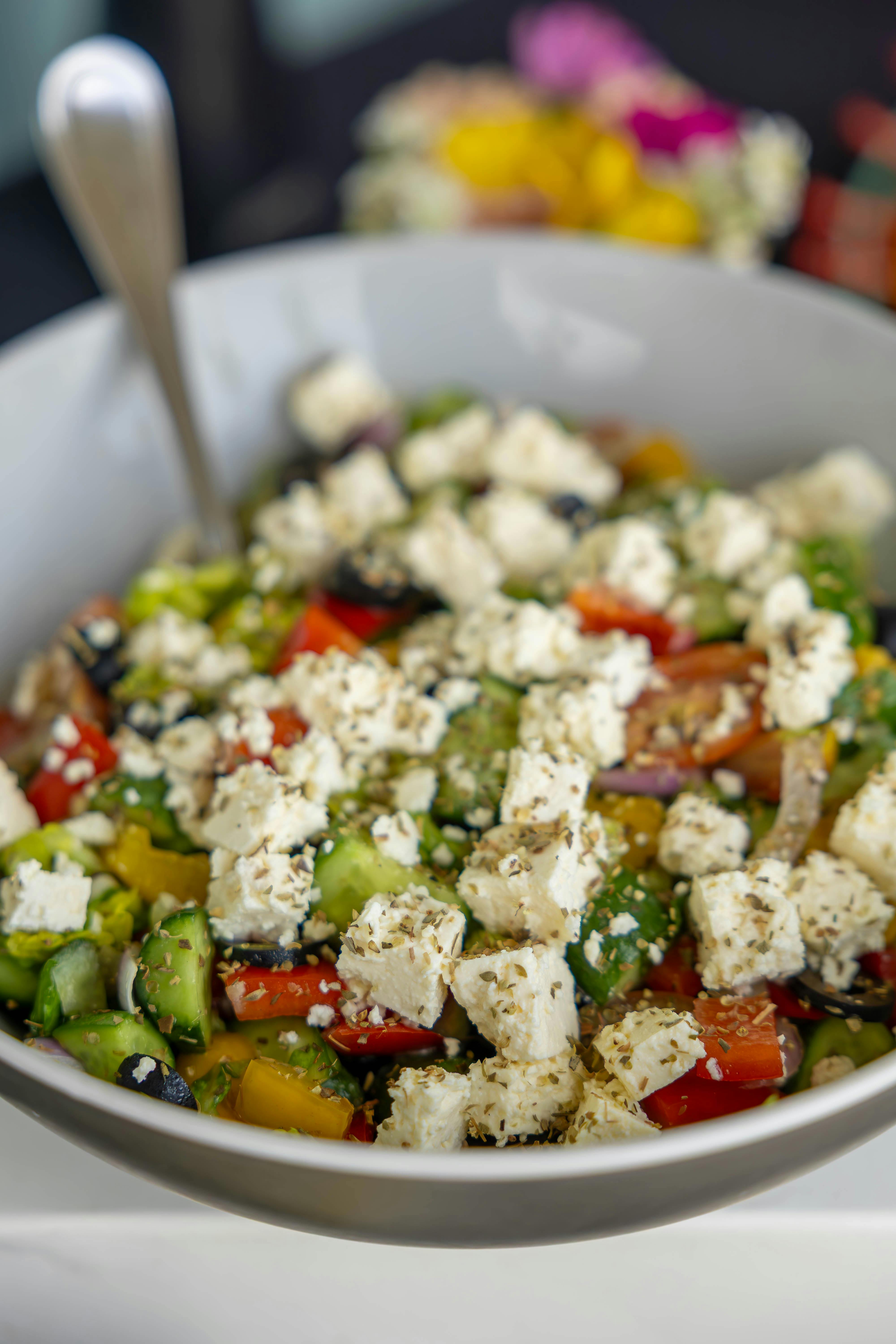
Photo: Sergei Starostin / Pexels
The diets react (see scores below)
Common Ingredients
- tomato
- cucumber
- red onion
- feta
- olives
- olive oil
- oregano
Specific recipes may vary.
Incompatible with 4 of 11 diets
Diet Ratings
Greek salad is largely keto-friendly: it's built on low-carb vegetables (cucumber, leafy components), high-fat feta and olives, and olive oil. Tomato and red onion contribute some net carbs, but in standard salad portions they remain well within a daily 20-50g net carb allowance. The macro profile skews appropriately toward fat with moderate protein from feta.
Strict/clinical keto and carnivore-leaning practitioners exclude or minimize tomato and onion due to their natural sugars, and some avoid dairy like feta citing potential insulin response or inflammation, which would push this dish toward a caution rating for them.
Traditional Greek Salad contains feta cheese, a dairy product made from sheep's and goat's milk. Dairy is unambiguously excluded from a vegan diet as it is an animal product. While the other ingredients (tomato, cucumber, red onion, olives, olive oil, oregano) are all plant-based and excellent, the presence of feta makes this dish non-vegan as prepared. A vegan version could be made by omitting feta or substituting plant-based feta alternatives.
Most ingredients (tomato, cucumber, red onion, olives, olive oil, oregano) are excellent paleo choices. However, feta cheese is dairy, which is excluded from standard paleo. Removing the feta would make this dish a clear approve.
Greek Salad is a quintessential Mediterranean diet dish, featuring fresh vegetables, extra virgin olive oil as the primary fat, and a moderate amount of feta cheese. It aligns directly with traditional Greek eating patterns and emphasizes plant-based, whole-food ingredients with healthy fats.
Greek Salad is overwhelmingly plant-based, consisting of vegetables (tomato, cucumber, red onion, olives), an herb (oregano), and plant oil (olive oil). The only animal-derived component is feta cheese, which is itself a debated dairy item within carnivore. A dish that is ~85% plant matter is incompatible with the carnivore diet regardless of which carnivore camp one follows.
Greek Salad contains feta cheese, which is dairy. Dairy is explicitly excluded on the Whole30 program (with the sole exception of ghee/clarified butter). Removing the feta would make this salad fully compliant.
Greek salad contains red onion, which is high in fructans and is a classic high-FODMAP ingredient even in small amounts (Monash rates onion as red/high-FODMAP at minimal servings). Feta cheese also contributes lactose, though it is lower than fresh cheeses and tolerated in small portions (~40g). The combination of red onion plus feta makes a standard serving unsuitable during the elimination phase.
Greek salad has an excellent vegetable base (tomato, cucumber, red onion) and heart-healthy olive oil aligned with DASH principles, but feta cheese and olives are both high-sodium ingredients that push this dish into caution territory. A typical serving can deliver 600-900mg of sodium, a substantial portion of the DASH daily limit. The dish would score higher with reduced feta, rinsed olives, or low-sodium feta alternatives.
Greek Salad has excellent Zone-favorable elements: low-glycemic vegetables (tomato, cucumber, red onion) and monounsaturated fat from olive oil and olives. However, it lacks a substantial lean protein source — feta provides only modest protein and is high in saturated fat, making it difficult to hit the 40/30/30 ratio without adding chicken, shrimp, or another lean protein. As a standalone meal it skews high in fat relative to protein. With added lean protein, this becomes a strong Zone meal.
Dr. Sears classifies full-fat cheeses like feta as 'unfavorable' protein sources due to saturated fat content, though his later anti-inflammatory writings are more permissive about moderate saturated fat in context. Some Zone practitioners accept feta in small portions as both a partial protein and fat block.
Greek Salad is built on a strong anti-inflammatory foundation: extra virgin olive oil (oleocanthal, monounsaturated fats), colorful raw vegetables rich in antioxidants (lycopene from tomato, quercetin from red onion), olives (polyphenols), and oregano (carvacrol, thymol). Feta is a full-fat dairy and a source of saturated fat, but it is consumed in modest amounts as a garnish and sheep/goat-milk feta is generally considered more tolerable than cow-milk cheeses. Overall this dish aligns closely with the Mediterranean pattern that anti-inflammatory nutrition is largely modeled on.
Mainstream anti-inflammatory guidance (Dr. Weil's pyramid, Mediterranean diet research) strongly endorses this combination, including tomatoes and feta in moderation. However, Autoimmune Protocol (AIP) advocates would flag two ingredients: tomatoes as a nightshade (solanine, lectins) and feta as dairy, both of which AIP excludes as potential inflammation triggers in sensitive individuals.
Greek salad offers good hydration, fiber from vegetables, and nutrient density per calorie, but it is low in protein (only feta provides modest protein, ~5-6g per serving) and relatively high in fat from feta, olives, and olive oil. For a GLP-1 patient where protein is the top priority, this dish falls short as a standalone meal. The fats are predominantly unsaturated (olive oil, olives) which is favorable, but total fat content can still aggravate nausea or reflux in sensitive patients. Best treated as a side dish or paired with a lean protein (grilled chicken, shrimp, or chickpeas) to convert it into a GLP-1-friendly meal.
Some GLP-1 clinicians would rate this higher given the Mediterranean-style unsaturated fats, high water content, and fiber — arguing the fat content is nutritionally beneficial and supports satiety. Others emphasize that without added protein it fails the #1 priority and the fat load can worsen GI side effects, especially in early titration phases.
*See how scores were generated at our methodology page.
Nutritional profile
Six traits that cut across every diet.
Fiber & Plants
How much whole-plant food and fiber it delivers.
Healthy Fats
The quality of its fats (unsaturated, omega-3).
Whole / Unprocessed
How close it is to its natural, unprocessed form.
Gut Gentle
How easy it is on digestion (low FODMAP, few irritants).
Low Glycemic
How little it spikes your blood sugar.
Protein Density
How much protein it packs per calorie.
Controversy Index
Higher controversy = more disagreement between diets.
Diet-Specific Tips
 Keto — 8/10
View tips
- Low-carb base vegetables (cucumber)
- High healthy fat from olive oil, olives, and feta
- Tomato and red onion add modest net carbs - portion matters
- Full-fat dairy (feta) is generally accepted on keto
- No grains, sugars, or starches
 Paleo — 5/10
View tips
- Feta is dairy — excluded from standard paleo
- Vegetables and olives are paleo-approved
- Olive oil is a preferred paleo fat
- Easily made paleo by omitting feta
 Mediterranean — 9/10
View tips
- Abundant fresh vegetables (tomato, cucumber, red onion)
- Olive oil as primary fat source
- Olives provide healthy monounsaturated fats
- Feta used in moderate, traditional amounts
- Minimal processing, no added sugars or refined grains
 DASH — 6/10
View tips
- High potassium from tomato and cucumber
- Heart-healthy monounsaturated fats from olive oil
- High sodium from feta cheese (~300mg per oz)
- High sodium from cured olives (~200-400mg per serving)
- Saturated fat from full-fat feta (DASH prefers low-fat dairy)
- No added sugar and minimal processing otherwise
 Zone — 6/10
View tips
- Low-glycemic vegetables are ideal Zone carbs
- Olive oil and olives provide monounsaturated fat (favorable)
- Feta is high in saturated fat and only modest protein
- Lacks a primary lean protein to hit 30% protein target
- Easily upgraded to a full Zone meal by adding grilled chicken or fish
 Anti-Inflammatory — 8/10
View tips
- Extra virgin olive oil provides oleocanthal and monounsaturated fats
- Raw vegetables deliver polyphenols, lycopene, and quercetin
- Olives and oregano add additional anti-inflammatory compounds
- Feta contributes saturated fat but typically in small quantities
- Tomatoes are nightshades — a concern only for autoimmune-sensitive individuals
 GLP-1 Friendly — 6/10
View tips
- Low protein content (~5-6g per serving) — fails primary GLP-1 priority
- Good fiber and high water content from vegetables
- Predominantly unsaturated fats (olive oil, olives) but total fat is moderate-to-high
- Feta adds saturated fat and may cause issues for patients with temporary lactose sensitivity
- Easily improved by adding a lean protein source
- Nutrient-dense per calorie with vitamins, minerals, and antioxidants