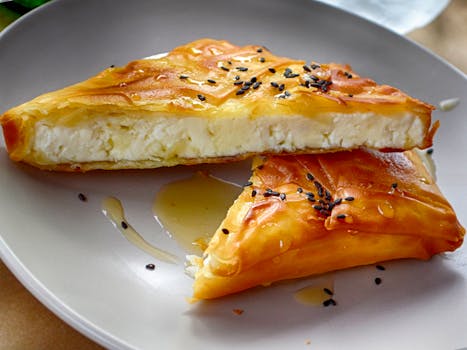
Photo: Daniela Elena Tentis / Pexels
Mediterranean
Greek Village Cheese Pie
The diets react (see scores below)
Common Ingredients
- phyllo dough
- feta cheese
- ricotta
- eggs
- butter
- olive oil
- fresh herbs
- milk
Specific recipes may vary.
Incompatible with 6 of 11 diets
Diet Ratings
Greek Village Cheese Pie (Tiropita) is fundamentally incompatible with ketogenic eating due to its primary structural ingredient: phyllo dough. Phyllo is a refined wheat flour pastry that is extremely high in net carbs — a standard serving of tiropita can easily deliver 25-40g of net carbs from the dough alone, which can meet or exceed the entire daily keto carb budget in a single snack. While the filling ingredients (feta, ricotta, eggs, butter, olive oil, herbs) are largely keto-friendly, the phyllo dough wrapper is non-negotiable in this dish and makes it categorically incompatible. Milk adds a small additional carb load. The dish cannot be modified into a keto-compliant version without fundamentally changing its nature (e.g., replacing phyllo with a fathead or almond flour crust).
Greek Village Cheese Pie contains multiple animal-derived ingredients that make it entirely incompatible with a vegan diet. Feta cheese and ricotta are both dairy products, eggs are explicitly excluded from veganism, butter is an animal fat, and milk is a dairy product. With five distinct animal ingredients present, this dish is unambiguously non-vegan. There is no debate within the vegan community about any of these ingredients.
Greek Village Cheese Pie is fundamentally incompatible with the Paleolithic diet. Phyllo dough is made from wheat flour, a grain that is strictly excluded from paleo. Feta cheese, ricotta, and milk are all dairy products, which are also excluded. Butter is a dairy derivative that is debated, but even setting that aside, the grain-based pastry and multiple dairy ingredients make this dish clearly off-limits. Eggs and olive oil are the only paleo-compliant ingredients in this recipe. With the majority of ingredients falling into hard-exclude categories (grains, dairy), this dish scores at the very bottom of the paleo scale.
Greek tiropita (cheese pie) is a traditional Mediterranean dish with genuine cultural roots in Greek cuisine. It contains feta cheese, a staple of the Greek Mediterranean diet, along with eggs, olive oil, and fresh herbs — all compatible ingredients. However, several factors pull it away from ideal Mediterranean alignment: phyllo dough is a refined grain product, butter is used alongside olive oil (animal-derived saturated fat, not the preferred Mediterranean fat), and the dish is relatively high in dairy fat from feta, ricotta, and milk. As a traditional occasional snack or meze it fits within the Mediterranean pattern, but its refined pastry base and butter content make it more of a moderate indulgence than a core staple.
Traditional Greek dietary practice embraces tiropita as a culturally significant food eaten regularly, particularly in rural and island communities, where handmade phyllo and local cheeses are considered wholesome. Some Mediterranean diet authorities, particularly those emphasizing the original Cretan model, would classify such traditional preparations more favorably, noting that the overall dietary pattern matters more than individual ingredient scrutiny.
Greek Village Cheese Pie is fundamentally incompatible with the carnivore diet. The dish is dominated by plant-based ingredients: phyllo dough (wheat flour) is a grain product and the structural base of the dish, olive oil is a plant-derived oil, and fresh herbs are plant matter — all strictly excluded. While eggs, butter, milk, feta, and ricotta are animal-derived and would be acceptable (with varying degrees of debate) on carnivore, they are minority components here and cannot redeem a dish built around a grain crust and plant oils. This is essentially a grain-and-plant-forward baked pastry with some dairy filling.
Greek Village Cheese Pie contains multiple excluded ingredients that make it clearly non-compliant with Whole30. Phyllo dough is made from wheat flour, a grain that is explicitly excluded. Feta cheese and ricotta are dairy products, both excluded (only ghee and clarified butter are permitted dairy exceptions). Butter (regular, not clarified/ghee) is also excluded dairy. Milk is another excluded dairy ingredient. This dish fails on four separate Whole30 exclusion categories simultaneously. Additionally, even if one were to imagine compliant substitutions, this dish falls squarely into the 'no recreating baked goods' rule — a cheese pie is a pastry/baked good analog that violates the spirit of the program regardless of ingredient swaps.
Greek Village Cheese Pie contains multiple high-FODMAP ingredients that make it unsuitable during the elimination phase. Phyllo dough is made from wheat flour, which is high in fructans — a primary FODMAP concern. Ricotta cheese is high in lactose and is clearly high-FODMAP at any standard serving. Milk also contributes significant lactose. While feta cheese is actually low-FODMAP (aged/brined cheeses have minimal lactose), eggs, butter, and olive oil are low-FODMAP safe ingredients. The combination of wheat-based phyllo and lactose-heavy ricotta plus milk creates two independent high-FODMAP vectors that cannot be portion-controlled away in a standard slice of this dish.
Monash University rates feta cheese as low-FODMAP and butter as low-FODMAP, so some clinical FODMAP practitioners might consider a very small portion tolerable if wheat-free phyllo were substituted and ricotta/milk were omitted or replaced with lactose-free alternatives — but in its traditional formulation, this dish is not suitable for elimination phase. The wheat-fructan issue from phyllo alone would be difficult to overcome even with dairy substitutions.
Greek Village Cheese Pie (spanakopita-style without spinach) presents a mixed DASH profile. While it contains DASH-friendly elements—olive oil, eggs, fresh herbs, and some dairy—several factors work against it. Feta cheese is notably high in sodium (around 316–400mg per ounce), and a typical serving of this pie can easily deliver 600–900mg of sodium from feta alone, which strains the DASH sodium limits. Butter adds saturated fat, and phyllo dough is a refined carbohydrate. The ricotta and milk provide calcium, which is DASH-positive, and olive oil is explicitly encouraged. The dish is not categorically excluded from DASH, but portion control is essential, and the sodium load from feta is a real concern. Substituting reduced-sodium or part-skim ricotta as the primary cheese and using less feta would significantly improve the profile. Prepared as described with standard feta quantities, this is best treated as an occasional moderate-portion item rather than a regular DASH staple.
NIH DASH guidelines emphasize low-fat dairy and strict sodium limits, which standard feta-heavy preparations clearly challenge. However, some DASH-aligned Mediterranean diet practitioners note that the olive oil base, fresh herbs, and egg content align well with cardiovascular health principles, and argue that small portions of traditional cheese pies—especially when feta is used sparingly—can fit within a Mediterranean-DASH (MIND) hybrid approach without meaningful blood pressure impact.
Greek Village Cheese Pie (Tiropita) presents several Zone Diet challenges but is not categorically off-limits. The phyllo dough is a refined, higher-glycemic carbohydrate that Zone classifies as 'unfavorable' — similar to white bread in its carb block contribution. Feta and ricotta provide moderate protein (Zone-usable, though feta is higher in saturated fat), and eggs are an excellent Zone protein source. The fat profile is mixed: butter contributes saturated fat (which the Zone limits), while olive oil is the ideal Zone fat. The dish skews heavily toward fat calories and refined carbs, making the 40/30/30 ratio very difficult to achieve with this food alone. As a snack, a small portion (1-2 blocks) could theoretically be incorporated if the rest of the day's meals compensate, but it lacks lean protein and low-glycemic carbs. The absence of vegetables means this contributes nothing toward the Zone's 8-daily-vegetable target.
Some Zone practitioners in Mediterranean contexts point out that Sears' later anti-inflammatory work acknowledges moderate saturated fat (from dairy like feta) is acceptable when omega-3 intake is adequate. The eggs and dairy do provide real protein blocks, and a very small portion of phyllo can serve as a carb block. Traditional tiropita made with whole-wheat phyllo and extra olive oil over butter edges this closer to Zone-compatible territory, and some practitioners treat it as an occasional 'unfavorable but manageable' snack block.
Greek Village Cheese Pie (Tiropita) presents a mixed anti-inflammatory profile. On the positive side, feta cheese is a traditionally fermented dairy product with some probiotic potential, and the inclusion of olive oil and fresh herbs (parsley, dill, mint are typical) adds meaningful anti-inflammatory polyphenols and antioxidants — consistent with Mediterranean diet principles. Eggs contribute choline and some anti-inflammatory nutrients. However, the dish also includes butter and full-fat dairy (feta, ricotta, milk), which are saturated-fat-containing ingredients the anti-inflammatory framework recommends limiting. Phyllo dough is a refined carbohydrate, which rates as neutral-to-mildly inflammatory. The butter used both in phyllo preparation and brushing is the primary concern, as it is specifically listed in the 'limit' category. Olive oil partially offsets this. Overall, this is a moderate Mediterranean snack — not strongly pro-inflammatory, but not optimized for anti-inflammatory eating either. Occasional consumption is acceptable; it should not be a dietary staple for those strictly following anti-inflammatory principles.
Some anti-inflammatory practitioners with a Mediterranean diet focus (including those following Dr. Weil's framework) would view this dish more favorably, noting that traditional Mediterranean cheese pies made with olive oil, fermented feta, eggs, and fresh herbs have been consumed for generations in populations with low inflammatory disease burden. Critics following stricter anti-inflammatory protocols would point to the combined saturated fat load from butter, feta, and full-fat milk as a meaningful concern that warrants limiting frequency.
Greek Village Cheese Pie offers moderate protein from feta, ricotta, eggs, and milk, but falls short of being an ideal GLP-1 snack. The combination of butter, full-fat cheeses, and phyllo dough (refined carbohydrate) creates a moderate-to-high fat load per serving, which can worsen GLP-1 side effects like nausea, bloating, and reflux due to slowed gastric emptying. The protein content is real but not dense enough per calorie to prioritize this over leaner options. Phyllo pastry adds refined carbs with minimal fiber. Olive oil is a positive element (unsaturated fat), and the eggs and cheeses do contribute meaningful nutrients. As an occasional small-portion snack, it is acceptable, but it is not optimized for GLP-1 patients who need maximum protein and fiber per calorie with minimal fat load.
Some GLP-1-focused dietitians consider cheese-and-egg-based dishes acceptable protein sources, particularly for patients struggling to meet protein targets through leaner foods, arguing that the fat content is partially offset by the satiety and nutrient value of full-fat dairy. Others flag that feta and ricotta combined with butter can reliably trigger nausea and bloating in GLP-1 patients, especially in the early weeks of treatment, making this a portion- and timing-sensitive food rather than a routine snack.
*See how scores were generated at our methodology page.
Nutritional profile
Six traits that cut across every diet.
Fiber & Plants
How much whole-plant food and fiber it delivers.
Healthy Fats
The quality of its fats (unsaturated, omega-3).
Whole / Unprocessed
How close it is to its natural, unprocessed form.
Gut Gentle
How easy it is on digestion (low FODMAP, few irritants).
Low Glycemic
How little it spikes your blood sugar.
Protein Density
How much protein it packs per calorie.
Controversy Index
Higher controversy = more disagreement between diets.
Diet-Specific Tips
 Mediterranean — 5/10
View tips
- Feta cheese is an authentic Mediterranean staple and primary protein source
- Phyllo dough is a refined grain, not a whole grain
- Butter is used alongside olive oil, adding saturated fat beyond Mediterranean norms
- Eggs and dairy (ricotta, milk) place this in the moderate/caution category
- Olive oil and fresh herbs are positive Mediterranean elements
- Culturally traditional dish in Greek cuisine — not processed or artificial
- Best consumed occasionally as part of a broader plant-forward dietary pattern
 DASH — 4/10
View tips
- Feta cheese is high in sodium (~316–400mg/oz), raising per-serving sodium significantly above DASH targets
- Butter contributes saturated fat, which DASH limits
- Phyllo dough is a refined grain, not a whole grain as DASH emphasizes
- Olive oil is DASH-approved and is a positive element
- Ricotta and milk contribute DASH-valued calcium
- Fresh herbs add micronutrients and flavor without sodium
- Portion size is critical — a small serving is more compatible than a large portion
- Low-sodium feta or reduced-feta preparation would improve DASH compatibility
 Zone — 4/10
View tips
- Phyllo dough is a refined, high-glycemic carbohydrate classified as 'unfavorable' in Zone terminology
- Butter contributes saturated fat, which Zone limits in favor of monounsaturated sources
- Olive oil is a Zone-ideal monounsaturated fat and partially offsets the butter
- Feta and ricotta provide usable protein blocks but also add saturated fat
- Eggs are a favorable Zone protein source
- No vegetables or low-glycemic carbs present — does not support Zone's vegetable emphasis
- Macro ratio skews toward fat-heavy with refined carbs; very difficult to hit 40/30/30 from this food alone
- Small portions (1 block equivalent) can be worked into a Zone day but require careful compensation at other meals
 Anti-Inflammatory — 5/10
View tips
- Olive oil provides oleocanthal and anti-inflammatory polyphenols
- Fresh herbs (e.g., dill, parsley, mint) contribute antioxidants and flavonoids
- Feta is a fermented dairy product with modest probiotic properties
- Butter is a saturated fat — listed in the 'limit' category of anti-inflammatory guidelines
- Full-fat dairy (feta, ricotta, milk) adds to saturated fat load
- Phyllo dough is a refined carbohydrate with limited nutritional value
- Eggs are neutral-to-slightly beneficial in moderate amounts
- Traditional Mediterranean dietary context moderates the overall inflammatory concern
 GLP-1 Friendly — 4/10
View tips
- Moderate protein from feta, ricotta, and eggs, but low protein density per calorie relative to fat content
- Butter and full-fat cheeses create a high saturated fat load that may worsen GLP-1 GI side effects
- Phyllo dough adds refined carbohydrates with minimal fiber
- Olive oil is a positive unsaturated fat contribution
- No primary protein source designated — protein is incidental rather than the focus of the dish
- Small portion required to manage fat and calorie load, making it portion-sensitive
- Easy digestibility is compromised by the fat content and pastry layers