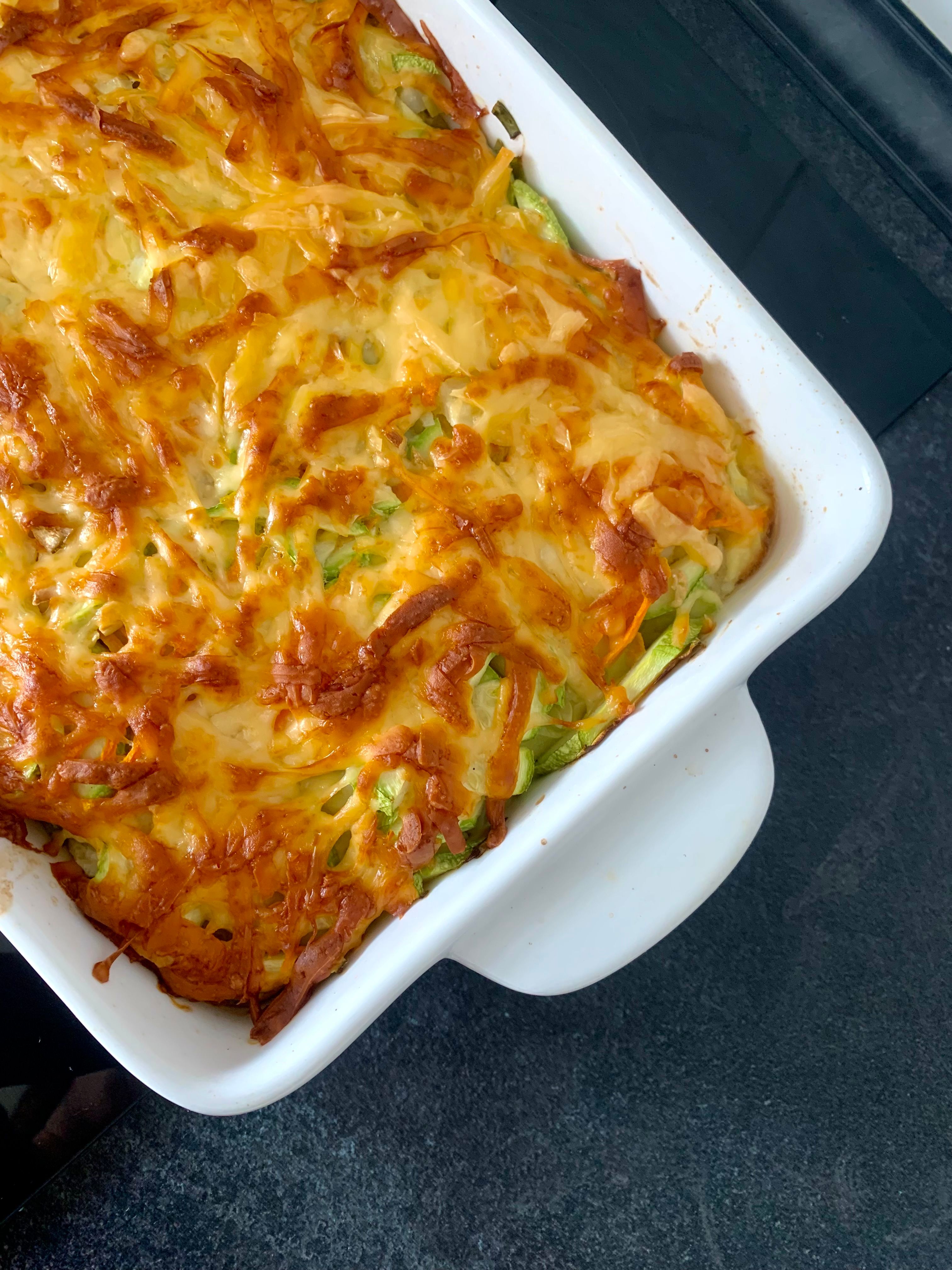
Photo: Helen Brudna / Pexels
American
Green Bean Casserole
The diets react (see scores below)
Common Ingredients
- green beans
- cream of mushroom soup
- milk
- fried onions
- soy sauce
- black pepper
Specific recipes may vary.
Incompatible with 8 of 11 diets
Diet Ratings
Green Bean Casserole is largely incompatible with a ketogenic diet due to several high-carb components. Cream of mushroom soup (especially canned/condensed versions) contains starch thickeners, added sugars, and significant carbohydrates. Fried onions (typically French's crispy fried onions) are breaded with flour and are a major source of net carbs and refined grains. Milk adds additional carbs via lactose. While green beans themselves are borderline acceptable in small portions on keto, the combination of these ingredients creates a dish with a net carb count that almost certainly exceeds a meaningful portion of the daily keto budget. The fried onion topping alone contains wheat flour and is essentially off-limits. This dish as traditionally prepared is not keto-compatible without extensive modification (e.g., substituting homemade cream sauce, swapping fried onions for pork rinds, and using heavy cream instead of milk).
Green Bean Casserole as listed contains two clear animal-derived ingredients: milk (dairy) and cream of mushroom soup (which in its standard commercial form, e.g., Campbell's, contains dairy or is made with milk/cream). Both are direct animal products that disqualify this dish under vegan rules. The green beans, fried onions, soy sauce, and black pepper are all plant-based, but the dairy components make the dish non-vegan as presented. A vegan version is easily achievable by substituting dairy-free cream of mushroom soup (made with plant-based milk and vegetable broth) and a non-dairy milk alternative, but the dish as described is not vegan-compliant.
Green Bean Casserole is deeply incompatible with the paleo diet. Nearly every ingredient beyond the green beans themselves violates paleo principles. Cream of mushroom soup is a heavily processed product containing wheat flour, dairy, and additives. Milk is excluded dairy. Fried onions are typically coated in wheat flour and deep-fried in seed oils. Soy sauce contains wheat and soy, both of which are excluded (grain and legume respectively). Even green beans themselves are considered a legume and are excluded under strict paleo rules. This dish is essentially a collection of paleo violations stacked together, making it one of the least paleo-compatible dishes possible.
While green beans are an excellent Mediterranean vegetable, this classic American casserole is built around heavily processed ingredients that contradict Mediterranean diet principles. Cream of mushroom soup is a processed, sodium-laden product with added thickeners, preservatives, and often unhealthy fats. Fried onions (typically the canned French's variety) are deep-fried in refined oils and coated in refined flour — a processed, high-sodium topping far from Mediterranean ideals. The dish lacks olive oil, whole grains, or legumes, and relies on convenience processed components rather than whole-food cooking. The soy sauce adds further sodium and is non-traditional. This dish is a textbook example of American processed comfort food that runs counter to Mediterranean whole-food, minimally processed philosophy.
Green Bean Casserole is entirely incompatible with the carnivore diet. Every single ingredient is either plant-derived or heavily processed with plant-based components. Green beans are a legume/vegetable, cream of mushroom soup contains mushrooms (fungi), starch, and plant-based fillers, milk is the only animal-derived ingredient but is overshadowed by all the plant components, fried onions are a plant food often coated in flour, soy sauce is a fermented plant-based condiment, and black pepper is a plant spice. There is no meaningful animal protein or fat present. This dish is the antithesis of carnivore eating — a plant-forward, processed, carbohydrate-laden casserole with zero redeeming carnivore qualities.
Green Bean Casserole contains multiple Whole30-excluded ingredients. Cream of mushroom soup typically contains dairy, wheat/grain-based thickeners, and often MSG or other additives. Milk is excluded dairy. Fried onions are typically coated in wheat flour (a grain) and often contain other non-compliant additives. Soy sauce contains soy (a legume) and wheat (a grain), both of which are explicitly excluded. While green beans themselves are Whole30-compatible (explicitly allowed despite being legumes), and black pepper is fine, the remaining ingredients make this dish entirely non-compliant in its traditional form.
Green Bean Casserole contains multiple high-FODMAP ingredients that make it unsuitable during the elimination phase. Cream of mushroom soup is a double problem: mushrooms are high in polyols (mannitol), and canned cream of mushroom soup typically contains onion and garlic as flavor bases, both of which are high in fructans. Fried onions (French's crispy onions) are a major FODMAP offender — onions are among the highest-fructan foods tested by Monash, and frying does not reduce FODMAP content. Milk contributes lactose, which is a disaccharide FODMAP. Standard soy sauce contains wheat (fructans), though in very small amounts the impact may be minimal. Green beans themselves are low-FODMAP at a standard serving (75g), and black pepper is fine. However, the combination of cream of mushroom soup, fried onions, and milk creates a dish that is high-FODMAP at any realistic serving size. This is a classic dish that would need complete reformulation — using low-FODMAP cream of mushroom soup substitute (homemade with lactose-free milk, no onion/garlic), garlic-infused oil, lactose-free milk, and omitting fried onions — to become elimination-phase safe.
Green Bean Casserole is a sodium-heavy dish that conflicts significantly with DASH diet principles. While green beans are an excellent DASH vegetable, the other ingredients undermine its compatibility. Cream of mushroom soup (condensed) is notoriously high in sodium, typically containing 800-900mg per half-cup serving, and also contributes saturated fat. Soy sauce adds another substantial sodium load (~900mg per tablespoon). Fried onions are processed and contain added sodium, saturated fat, and refined carbohydrates. Together, a single serving of this casserole can easily contain 700-1,000mg of sodium, representing nearly half the standard DASH daily sodium limit (2,300mg) or two-thirds of the low-sodium DASH target (1,500mg) in just one side dish. The cream of mushroom soup also introduces saturated fat from cream, conflicting with DASH's emphasis on low-fat dairy and limited saturated fat. This dish as traditionally prepared is not compatible with DASH guidelines.
Green Bean Casserole has a mixed Zone profile. The green beans themselves are excellent Zone-favorable vegetables — low glycemic, high fiber, and a solid carbohydrate block source. However, the dish is heavily compromised by its other components. Cream of mushroom soup (typically canned, condensed) is processed, high in sodium, and contains added starch and fat that skews the macro balance. Milk adds some protein and carbohydrates but in an uncontrolled ratio. The fried onions (French's-style crispy fried onions) are the biggest problem: they are deep-fried in omega-6 seed oils, coated in refined flour, and are essentially a processed, high-glycemic, pro-inflammatory topping — the opposite of Zone-friendly fat sources. Soy sauce adds negligible macro impact but high sodium. The overall dish lacks any lean protein block, has saturated and omega-6 fat rather than monounsaturated fat, and the cream of mushroom soup adds processed carbohydrates. As a side dish it could theoretically be paired with a lean protein to build a Zone meal, but the fried onion topping and processed soup base make it a 'use caution and control portions' item rather than a Zone-favorable choice. A homemade version with low-fat mushroom sauce and almonds instead of fried onions would score significantly higher.
Some Zone practitioners would argue that as a vegetable-forward side dish, green bean casserole is workable in very small portions — the green beans are highly favorable and the total carbohydrate load per small serving may fit within 1-2 carb blocks. Dr. Sears' later writings on anti-inflammatory eating, however, would specifically flag the omega-6-heavy seed oils in fried onions and the processed nature of canned cream of mushroom soup as problematic beyond just macros.
Green bean casserole has a mixed anti-inflammatory profile. The base ingredient — green beans — is a solid anti-inflammatory vegetable, providing fiber, vitamins C and K, and modest antioxidants. Mushrooms (in the cream of mushroom soup) are generally encouraged in anti-inflammatory eating, though the canned/processed soup form dilutes this benefit significantly. Black pepper and soy sauce (in small amounts) are net neutral to mildly positive. However, the dish has several pro-inflammatory components that drag it down: cream of mushroom soup is typically high in sodium, contains refined starches, and often includes additives and preservatives; the dairy (milk) component is low-fat and modest, landing in the 'moderate' category, but combined with the processed soup base it adds saturated fat and refined content; fried onions are the biggest liability — they are deep-fried in refined oils (often high-omega-6 seed oils), coated in refined flour, and add significant sodium, making them a processed food ingredient. The overall dish is a classic comfort food that leans processed rather than whole-food, with its beneficial vegetable base largely offset by a processed, high-sodium, refined-fat preparation.
Green bean casserole is a low-protein, moderate-fat side dish that offers limited nutritional value per calorie for GLP-1 patients. The green beans themselves provide fiber and are easy to digest, but the cream of mushroom soup adds saturated fat and sodium, and the fried onion topping introduces unhealthy fats and empty calories. With no meaningful protein source, this dish fails the #1 GLP-1 dietary priority. The small amount of soy sauce contributes sodium without nutritional benefit. In a small portion alongside a high-protein main, it is tolerable, but it should not be a dietary staple. The fried onions are the most problematic element — greasy toppings worsen nausea and bloating on GLP-1 medications.
*See how scores were generated at our methodology page.
Nutritional profile
Six traits that cut across every diet.
Fiber & Plants
How much whole-plant food and fiber it delivers.
Healthy Fats
The quality of its fats (unsaturated, omega-3).
Whole / Unprocessed
How close it is to its natural, unprocessed form.
Gut Gentle
How easy it is on digestion (low FODMAP, few irritants).
Low Glycemic
How little it spikes your blood sugar.
Protein Density
How much protein it packs per calorie.
Controversy Index
Higher controversy = more disagreement between diets.
Diet-Specific Tips
 Zone — 4/10
View tips
- Green beans are Zone-favorable low-glycemic vegetables
- Fried onions are processed, refined-flour-coated, and fried in omega-6 seed oils — anti-inflammatory concern
- Cream of mushroom soup adds processed carbohydrates, sodium, and saturated fat
- No lean protein present — cannot stand alone as a Zone meal
- Milk contributes minor protein and carbohydrates but in uncontrolled ratio
- Overall fat profile skews omega-6 and saturated rather than monounsaturated
- Dish could be rescued with lean protein pairing and small portion, but as-is is unfavorable
 Anti-Inflammatory — 4/10
View tips
- Green beans are anti-inflammatory — fiber-rich, antioxidant-containing vegetable
- Mushrooms in soup are a positive ingredient but processing negates most benefit
- Cream of mushroom soup is high-sodium, additive-laden processed food
- Fried onions are deep-fried in likely high-omega-6 seed oils with refined flour coating
- Overall dish is high in sodium and relies heavily on processed convenience ingredients
- Small amounts of soy sauce and black pepper are net neutral to mildly positive
 GLP-1 Friendly — 4/10
View tips
- Negligible protein — fails the #1 GLP-1 dietary priority
- Green beans provide modest fiber and are easy to digest
- Cream of mushroom soup adds saturated fat and excess sodium
- Fried onion topping introduces grease and empty calories that may worsen GLP-1 GI side effects
- Acceptable only as a very small portion alongside a high-protein main dish
- Not nutrient-dense per calorie — limited value when appetite is suppressed