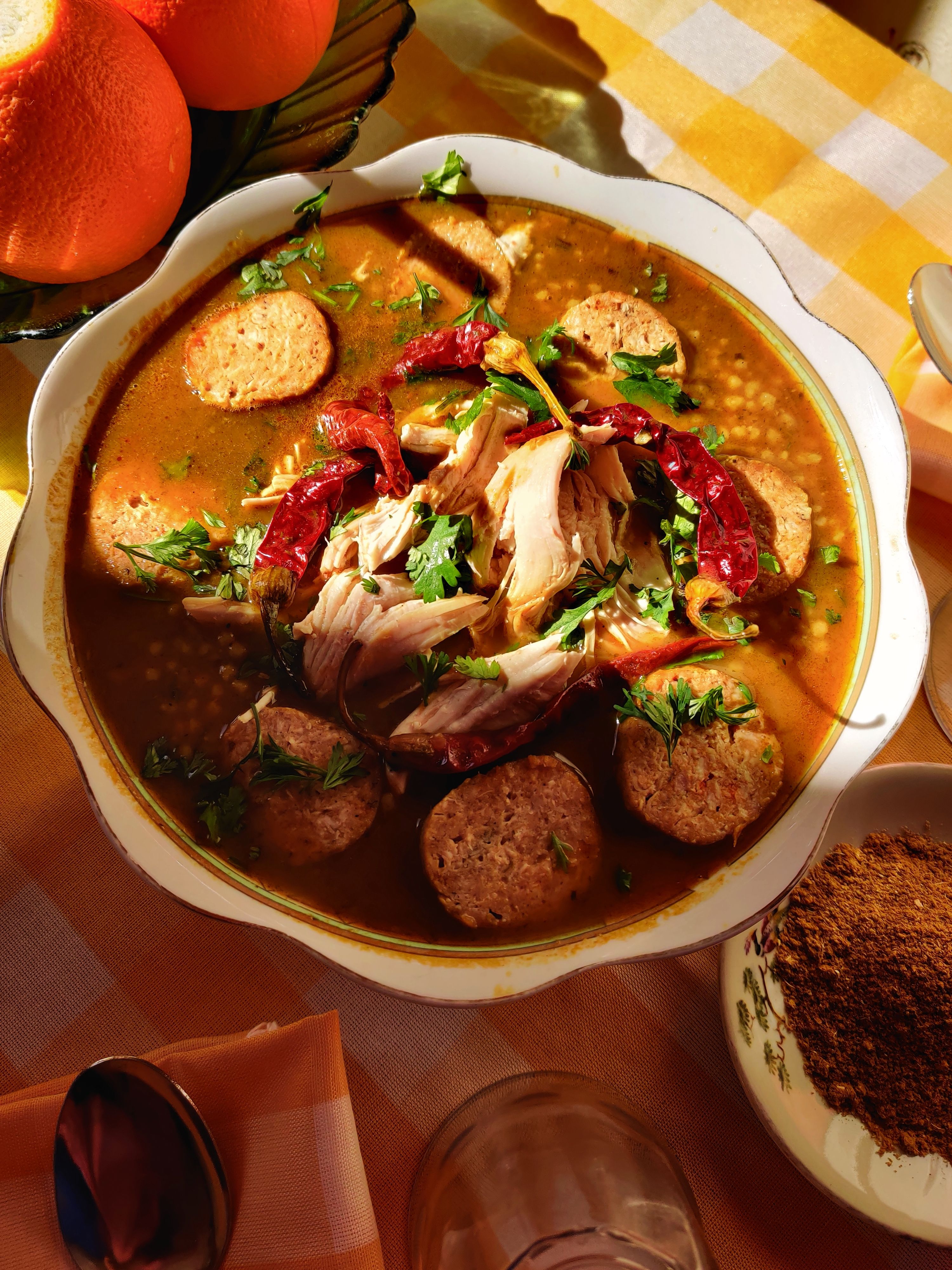
Photo: Nour Al Huda Zardan / Pexels
The diets react (see scores below)

That’s a heavy plate — want to see the leaner version?
Common Ingredients
- andouille sausageTurkey sausage
Turkey sausage replaces pork andouille: substantially lower saturated fat and sodium, the processed-red-meat penalty cited by dash, mediterranean and anti-inflammatory.
- chicken thighs
- shrimp
- celery
- bell pepper
- onion
- okra
- white riceBrown rice
Brown rice replaces white rice: whole grain adds fiber and lowers glycemic load, the refined-grain penalty cited by zone, glp-1 and dash.
Specific recipes may vary.
Incompatible with 8 of 11 diets
Diet Ratings
Traditional gumbo as described is fundamentally incompatible with ketogenic diet due to white rice, which is a high-glycemic grain delivering roughly 45g of net carbs per cup serving alone — enough to exceed the entire daily keto carb budget in a single meal. Beyond the rice, the holy trinity of celery, bell pepper, and onion adds moderate carbs, and okra contributes additional net carbs. While the protein components (andouille sausage, chicken thighs, shrimp) are individually keto-friendly and high-fat or moderate-protein as required, the dish as a whole — with rice as a core ingredient — cannot be consumed on keto without fundamental reformulation. A keto adaptation would require eliminating the rice entirely (or substituting cauliflower rice) and moderating the vegetable base.
This gumbo contains multiple animal products: andouille sausage (pork-based meat), chicken thighs (poultry), and shrimp (seafood). All three are direct animal products and are categorically excluded from a vegan diet. There is no ambiguity here — this dish is fundamentally incompatible with veganism in its described form.
Gumbo contains multiple paleo-incompatible ingredients. White rice is a grain, excluded under strict paleo rules. Andouille sausage is a processed meat typically containing added salt, preservatives, and sometimes fillers. Together, these two ingredients alone disqualify the dish. Even setting aside rice and sausage, the core paleo-friendly components — chicken thighs, shrimp, celery, bell pepper, onion, and okra — are all perfectly paleo-approved, but they cannot redeem a dish built around a grain staple and processed meat. Traditional gumbo is fundamentally structured around white rice as a base, making it incompatible with the paleo framework.
Gumbo contains several ingredients that conflict with Mediterranean diet principles. Andouille sausage is a highly processed red/cured meat, high in saturated fat and sodium, which is strongly discouraged. While chicken thighs and shrimp are individually acceptable (poultry in moderation, seafood encouraged), the dominant protein is processed sausage. The dish is served over white rice, a refined grain that displaces preferred whole grains. The vegetables (okra, celery, bell pepper, onion) are positive elements, but they are not sufficient to offset the processed meat and refined grain components. This dish as a whole does not align with Mediterranean diet principles.
Gumbo is fundamentally incompatible with the carnivore diet. While it does contain animal proteins (chicken thighs, andouille sausage, shrimp), the dish is defined by its plant-heavy base: the 'holy trinity' of celery, bell pepper, and onion; okra (used as a thickener); and white rice as a starchy base. These plant ingredients are not incidental — they are structural and inseparable from the dish itself. Andouille sausage also typically contains spices, garlic, and often sugar or other additives that would further disqualify it on a strict carnivore protocol. This is a plant-forward dish that happens to contain meat, not an animal-based dish with minor additions.
Gumbo as listed contains two excluded ingredients. First, white rice is a grain and is explicitly excluded on Whole30. Second, andouille sausage almost universally contains added sugar and/or other non-compliant additives in commercially available versions. Either of these alone would disqualify the dish. Even if a compliant andouille sausage were sourced, the white rice makes this dish non-compliant. The remaining ingredients — chicken thighs, shrimp, celery, bell pepper, onion, and okra — are all Whole30-approved whole foods.
Traditional gumbo as described contains multiple high-FODMAP ingredients that make it unsuitable during the elimination phase. Onion is one of the highest-FODMAP foods tested by Monash University, rich in fructans, and is a foundational ingredient in the gumbo base — it cannot be omitted without fundamentally changing the dish. Garlic (implied in andouille sausage and traditional gumbo seasoning) is similarly a major fructan source. Celery is low-FODMAP only at very small amounts (less than one stalk per serving) and is easily over-consumed in soups. Bell pepper is low-FODMAP and fine. Okra becomes high-FODMAP at portions above 6 pods due to excess fructose, and gumbo typically uses substantial quantities. Andouille sausage almost certainly contains garlic and onion powder (high-FODMAP) as standard ingredients. The chicken, shrimp, and white rice are all low-FODMAP and would be safe, but the onion and sausage seasoning alone disqualify this dish at any standard serving size.
Gumbo as traditionally prepared is problematic for DASH diet adherence primarily due to andouille sausage, which is a high-sodium, high-saturated-fat processed red meat — exactly the type of food DASH explicitly limits. A single serving of andouille sausage can contribute 600-900mg of sodium, and a full bowl of gumbo can easily exceed 1,500-2,000mg of sodium, consuming an entire day's DASH sodium budget in one dish. Additionally, andouille is a processed meat high in saturated fat, which DASH directly discourages. The chicken thighs and shrimp are acceptable DASH proteins, and the vegetable trinity (celery, bell pepper, onion) plus okra are genuinely DASH-positive ingredients rich in potassium, fiber, and micronutrients. However, white rice is a refined grain (DASH favors whole grains), and the overall dish is dominated by the sodium burden of the sausage and typical high-sodium broth base. The combination of processed meat, high sodium load, and refined grain makes this a clear avoid under standard DASH guidelines.
Gumbo has several Zone-compatible elements but also notable challenges. On the positive side, the holy trinity (celery, bell pepper, onion) and okra are low-glycemic vegetables that contribute favorable carb blocks and polyphenols. Shrimp is an excellent lean protein. However, the dish has significant Zone concerns: (1) Andouille sausage is a processed, high-fat, high-saturated-fat meat — exactly the type of protein Sears classifies as unfavorable. It throws off the 30% protein target with excess saturated fat calories. (2) Chicken thighs are higher in saturated fat than the preferred skinless chicken breast. (3) White rice is a high-glycemic carbohydrate that Sears explicitly categorizes as unfavorable, causing rapid insulin spikes that push the meal out of the Zone. Together, the sausage and white rice represent two core structural problems that make this dish difficult to fit into Zone blocks without significant modification. A Zone-adapted gumbo would swap white rice for cauliflower rice, replace andouille with a leaner protein, and use skinless chicken breast — but as traditionally prepared, this dish sits firmly in caution territory rather than approve.
Gumbo presents a genuinely mixed anti-inflammatory profile. On the positive side, the 'holy trinity' of celery, bell pepper, and onion provides antioxidants, flavonoids, and quercetin. Shrimp contributes lean protein and some omega-3s. Okra is a standout anti-inflammatory ingredient — rich in polyphenols, fiber, and mucilaginous compounds that support gut health. Chicken thighs fall in the 'moderate' category as lean-ish poultry. However, andouille sausage is a significant liability: it's processed red meat, high in saturated fat, sodium, and often contains nitrates/nitrites — all pro-inflammatory signals. White rice is a refined carbohydrate with a high glycemic index, contributing to blood sugar spikes and downstream inflammatory response. The dish is also typically made with a roux (butter or oil + flour), which adds refined carbs and potentially saturated fat. The overall dish is a classic case of beneficial vegetables and seafood undermined by a processed meat base and refined carbohydrates. Swapping andouille for a leaner smoked turkey sausage and white rice for brown rice would significantly improve the profile.
Some anti-inflammatory practitioners would score this lower, pointing to andouille sausage as a hard 'avoid' ingredient (processed meat with nitrates is consistently linked to elevated CRP and IL-6 in research), bringing the dish closer to a 3. Conversely, culinary medicine advocates like Dr. Daphne Miller might note that the dense vegetable base and traditional cooking method preserve meaningful phytonutrient content, and that moderate portions of traditional cultural foods should not be assessed the same way as ultra-processed convenience foods.
Gumbo presents a mixed nutritional profile for GLP-1 patients. On the positive side, it contains meaningful protein from chicken thighs and shrimp, plus fiber-supporting vegetables (okra, celery, bell pepper, onion). Okra in particular is a GLP-1-friendly ingredient — high fiber, mucilaginous texture that aids digestion. However, andouille sausage is a high-fat, high-sodium processed meat with significant saturated fat, which can worsen GLP-1 side effects like nausea, bloating, and reflux. Chicken thighs add additional saturated fat compared to breast meat. The roux base (flour and fat) traditional to gumbo adds caloric density with limited nutritional return. White rice is a refined carbohydrate with low fiber and low nutrient density per calorie — a poor fit for the reduced-appetite context of GLP-1 therapy. The combination of high-fat sausage, a heavy roux, and refined rice makes a standard gumbo preparation likely to cause GI discomfort and represents suboptimal calorie use. A modified version substituting chicken breast, reducing or omitting sausage, using a lighter roux, and swapping white rice for cauliflower rice or brown rice could shift this to an approve-range dish.
Some GLP-1-focused dietitians note that broth-based soups are generally well-tolerated due to easy digestibility and hydration support, and may accept gumbo in small portions if sausage is minimized — the disagreement centers on whether the sausage component is a dealbreaker or a manageable moderation issue. Others flag that the high sodium content of andouille, combined with reduced fluid intake common on GLP-1s, raises additional concern around hydration and blood pressure management.
*See how scores were generated at our methodology page.
Nutritional profile
Six traits that cut across every diet.
Fiber & Plants
How much whole-plant food and fiber it delivers.
Healthy Fats
The quality of its fats (unsaturated, omega-3).
Whole / Unprocessed
How close it is to its natural, unprocessed form.
Gut Gentle
How easy it is on digestion (low FODMAP, few irritants).
Low Glycemic
How little it spikes your blood sugar.
Protein Density
How much protein it packs per calorie.
Controversy Index
Higher controversy = more disagreement between diets.
Diet-Specific Tips
 Zone — 4/10
View tips
- Andouille sausage is a processed, high-saturated-fat, high-sodium protein — unfavorable in Zone
- Chicken thighs add additional saturated fat beyond Zone recommendations
- White rice is explicitly high-glycemic and unfavorable in Zone methodology
- Shrimp is an excellent lean Zone protein source
- Celery, bell pepper, onion, and okra are all favorable low-glycemic Zone carb sources
- Traditional preparation makes 40/30/30 macro balance difficult to achieve
- Cauliflower rice substitution and leaner proteins would make this Zone-adaptable
 Anti-Inflammatory — 4/10
View tips
- Andouille sausage: processed red meat, high saturated fat and sodium, likely contains nitrates — pro-inflammatory
- Shrimp: lean protein with modest omega-3 content — mildly anti-inflammatory
- Okra: rich in polyphenols and soluble fiber — anti-inflammatory
- Bell pepper, celery, onion: antioxidants, quercetin, flavonoids — anti-inflammatory
- White rice: refined carbohydrate, high glycemic index — mildly pro-inflammatory
- Chicken thighs: moderate category poultry — neutral to mildly anti-inflammatory
- Typical roux base (not listed): adds refined flour and saturated fat — mildly pro-inflammatory
 GLP-1 Friendly — 4/10
View tips
- Andouille sausage is high in saturated fat and sodium — a known GLP-1 side effect trigger
- Chicken thighs add additional saturated fat; breast would be preferable
- Shrimp is a lean, high-protein positive contributor
- Okra is an excellent GLP-1-friendly ingredient: high fiber, easy to digest
- Trinity vegetables (celery, bell pepper, onion) provide fiber and micronutrients
- Traditional roux base adds fat and refined carbohydrate with low nutrient return
- White rice is a low-fiber refined carbohydrate — poor fit for reduced-calorie GLP-1 eating
- Overall fat load may worsen nausea, bloating, or reflux
- Portion sensitivity: a small bowl focused on broth, shrimp, and vegetables is more acceptable than a full serving