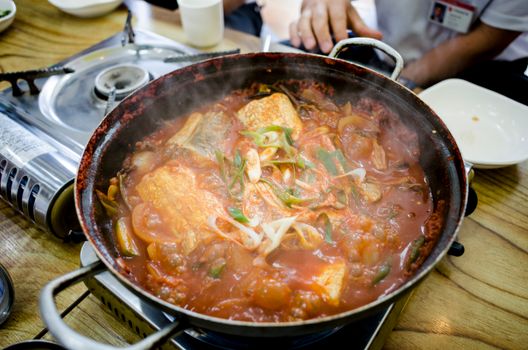
Korean
Korean Seafood Stew (Haemul Jeongol)
The diets react (see scores below)
Common Ingredients
- shrimp
- mussels
- squid
- tofu
- mushrooms
- Napa cabbage
- gochugaru
- scallions
Specific recipes may vary.
Incompatible with 4 of 11 diets
Diet Ratings
Korean Seafood Stew (Haemul Jeongol) has a generally keto-friendly protein base — shrimp, mussels, squid, and tofu are all low-carb, high-quality protein sources. Mushrooms and Napa cabbage are low-net-carb vegetables acceptable in moderation. The primary concern is gochugaru (Korean red pepper flakes), which contains a moderate amount of carbs per tablespoon and is often used generously in this dish. Traditional recipes may also include rice cakes (tteok) or glass noodles, but as listed, the ingredient set is cleaner. Cumulative carbs from mussels (which carry ~3-4g net carbs per 100g), squid, and the vegetables could push the dish toward the edge of daily limits depending on portion size. Without added starch, a moderate portion is manageable on keto, but the dish requires portion awareness and ideally reducing gochugaru quantity.
Strict keto practitioners may flag this dish as avoid due to the cumulative carb load from shellfish (especially mussels and squid), gochugaru, and Napa cabbage in a typical serving, arguing that combination dishes with multiple moderate-carb ingredients are too risky for maintaining ketosis without precise tracking.
Korean Seafood Stew (Haemul Jeongol) contains multiple animal products as its primary ingredients: shrimp, mussels, and squid are all seafood derived from animals. Despite the presence of vegan-friendly components such as tofu, mushrooms, Napa cabbage, gochugaru, and scallions, the dish is fundamentally non-vegan due to its seafood base. Fish and shellfish are unambiguously excluded under all mainstream vegan definitions.
This Korean seafood stew contains tofu, which is a soy-based legume product — a clear paleo exclusion. The seafood base (shrimp, mussels, squid), mushrooms, Napa cabbage, scallions, and gochugaru are all paleo-compliant, but tofu is a processed soy food and soy is a legume explicitly excluded from the paleo diet. The dish cannot be approved in its listed form due to this single disqualifying ingredient. Without tofu, the stew would rate highly as a clean seafood and vegetable dish.
Korean Seafood Stew aligns strongly with Mediterranean diet principles despite its non-Mediterranean origin. The dish is built around mixed seafood (shrimp, mussels, squid), which satisfies the 2-3 times weekly seafood recommendation, and is loaded with plant-based ingredients: tofu (legume-derived protein), mushrooms, Napa cabbage, and scallions. Gochugaru (Korean chili flakes) is a whole spice with no significant nutritional concerns. The dish is minimally processed, low in saturated fat, and rich in lean protein, fiber, and micronutrients. The main caveat is the absence of olive oil as the primary fat and the non-Mediterranean flavor profile, but the nutritional architecture is highly compatible.
Some strict Mediterranean diet frameworks emphasize not just nutrient composition but also culinary tradition and the social/cultural context of eating — dishes outside the Mediterranean basin may use different cooking fats (e.g., sesame oil) or sodium-heavy broths (e.g., soy sauce or fish sauce) that diverge from Mediterranean principles, warranting a slightly more cautious rating depending on preparation.
Korean Seafood Stew (Haemul Jeongol) is fundamentally incompatible with the carnivore diet. While the mixed seafood base (shrimp, mussels, squid) is carnivore-approved, the dish is dominated by multiple plant-based ingredients that are strictly excluded. Tofu is a soy-based product (legume-derived), mushrooms are fungi, Napa cabbage is a vegetable, gochugaru is a plant-derived spice, and scallions are plants. The dish cannot be considered carnivore in any tier of the diet. Even the most permissive carnivore practitioners who include seafood and spices would not accept tofu, cabbage, and multiple vegetables as acceptable inclusions. This is a plant-heavy stew that happens to contain some animal protein — not a meat dish with minor plant additions.
This Korean Seafood Stew contains tofu, which is a soy-based product and therefore a legume — explicitly excluded on Whole30. All other ingredients (shrimp, mussels, squid, mushrooms, Napa cabbage, gochugaru, and scallions) are fully Whole30-compliant. However, the presence of tofu makes the dish as described non-compliant. If tofu were removed, this stew would be a strong approve candidate.
Korean Seafood Stew (Haemul Jeongol) contains several problematic ingredients for the low-FODMAP elimination phase. Mushrooms are a significant concern — common varieties like shiitake are high in mannitol (a polyol) even at moderate servings, though oyster mushrooms are lower-FODMAP in small amounts. The type of mushroom used matters greatly. Scallions (green onions) are acceptable at the green tops only, but the white bulb portions are high in fructans and are commonly used in Korean cooking. Gochugaru (Korean red pepper flakes) is generally low-FODMAP in moderate amounts as a spice. Napa cabbage is low-FODMAP at servings up to 75g. The seafood components (shrimp, mussels, squid) are all low-FODMAP. Tofu — firm or extra-firm — is low-FODMAP as most FODMAPs leach into the soaking water. The dish's FODMAP safety hinges heavily on: (1) which mushroom variety and how much is used, (2) whether scallion whites are included, and (3) the cumulative FODMAP stacking effect across multiple moderate-FODMAP ingredients in a single dish. As traditionally prepared, this stew would likely exceed safe FODMAP thresholds.
Monash University rates firm tofu and scallion greens as low-FODMAP, but many clinical FODMAP practitioners caution that FODMAP stacking across multiple borderline ingredients (mushrooms, scallion whites, cabbage quantity) in a hot pot-style dish makes it difficult to control cumulative FODMAP load during strict elimination. The mushroom variety used is rarely specified in restaurant settings, adding further practical risk.
Korean Seafood Stew (Haemul Jeongol) contains several DASH-friendly components — lean mixed seafood (shrimp, mussels, squid) as protein sources, tofu for plant-based protein, mushrooms and Napa cabbage as vegetables, and scallions. These align well with DASH emphasis on lean protein, vegetables, and potassium/magnesium-rich foods. However, the dish as typically prepared poses sodium concerns: Korean hot pot dishes commonly incorporate gochujang, doenjang, fish sauce, soy sauce, or anchovy broth as base flavors, and even a gochugaru-forward preparation can accumulate significant sodium from shellfish (mussels and shrimp naturally contain moderate sodium) plus any seasoning broth. Traditional restaurant or home preparations of jeongol frequently exceed 800–1,500mg sodium per serving, which is a substantial portion of the DASH daily limit. The gochugaru itself is not a sodium concern but the overall broth sodium load is. The dish earns credit for its excellent ingredient profile but is downgraded by sodium risk in standard preparation.
NIH DASH guidelines would flag this dish for its typically high-sodium broth base common in Korean hot pot preparations. However, updated clinical interpretations note that home preparation using low-sodium broth, reduced soy sauce, and fresh seafood can bring this dish well within DASH parameters — some DASH-oriented dietitians would approve a carefully prepared version given its strong vegetable, lean seafood, and tofu profile.
Korean Seafood Stew (Haemul Jeongol) aligns exceptionally well with Zone Diet principles. The protein base — shrimp, mussels, and squid — are all lean, low-fat seafood rich in omega-3 fatty acids, which directly supports Sears' anti-inflammatory focus. Tofu adds plant-based protein and a modest amount of healthy fat. The carbohydrate sources are predominantly low-glycemic: Napa cabbage and mushrooms are favorable Zone vegetables (low glycemic index, high fiber, high polyphenol content). Scallions add flavor and phytonutrients with negligible glycemic impact. Gochugaru (Korean chili flakes) is a polyphenol-rich spice that aligns with Sears' later emphasis on polyphenols for eicosanoid regulation. The dish is naturally low in saturated fat and contains no processed ingredients, refined sugars, or high-glycemic starches. The primary consideration for Zone compliance is portion control on the tofu (to keep protein blocks accurate) and ensuring the broth does not contain added sugar (some Korean stew bases include small amounts). Overall, this dish functions as an excellent Zone-compliant meal base that naturally hits a favorable macro ratio without significant adjustment.
Korean Seafood Stew (Haemul Jeongol) is a powerhouse anti-inflammatory dish. The mixed seafood base — shrimp, mussels, and squid — provides lean protein and meaningful amounts of omega-3 fatty acids and selenium, both associated with reduced inflammatory markers. Tofu contributes whole soy protein, which Dr. Weil's Anti-Inflammatory Pyramid specifically emphasizes. Mushrooms (common in Korean hotpot preparations) are well-established anti-inflammatory foods, rich in beta-glucans and polysaccharides shown to modulate immune response. Napa cabbage is a cruciferous vegetable high in antioxidants and fiber. Gochugaru (Korean red chili flakes) contains capsaicin, a potent anti-inflammatory compound. Scallions provide quercetin and other flavonoids. The dish is broth-based, meaning it avoids inflammatory fats like seed oils or saturated fats entirely. There are no refined carbohydrates, added sugars, processed ingredients, or trans fats. The overall nutrient profile — omega-3s, plant-based protein, colorful vegetables, capsaicin-containing spice, and fiber — aligns strongly with nearly every principle of the anti-inflammatory framework.
Korean Seafood Stew (Haemul Jeongol) is a strong GLP-1 friendly dish overall. The mixed seafood base (shrimp, mussels, squid) provides lean, high-quality protein that is low in fat and easy to digest, while tofu adds additional plant-based protein and soft texture. Mushrooms and Napa cabbage contribute fiber, micronutrients, and high water content — directly supporting hydration and digestive health. The broth-based format is ideal for GLP-1 patients: small servings are satisfying, gastric load is low, and the liquid content aids hydration. The primary concern is gochugaru (Korean red pepper flakes), which introduces moderate-to-high spice that can worsen reflux, nausea, or gastric irritation in GLP-1 patients — a real and common side effect trigger. The spice level is adjustable, so a mild preparation scores well; a traditional full-spice version warrants more caution. No frying, minimal saturated fat, no refined grains, and no added sugar make this a nutritionally clean dish.
Most GLP-1 nutrition guidance would approve the base dish, but clinicians diverge on spicy Korean preparations specifically because gochugaru can exacerbate nausea and reflux — side effects that are already prevalent, especially in early dose escalation phases. Some practitioners would recommend this dish only in a reduced-spice version, while others consider individual tolerance sufficient grounds to adjust rather than categorically limit it.
*See how scores were generated at our methodology page.
Nutritional profile
Six traits that cut across every diet.
Fiber & Plants
How much whole-plant food and fiber it delivers.
Healthy Fats
The quality of its fats (unsaturated, omega-3).
Whole / Unprocessed
How close it is to its natural, unprocessed form.
Gut Gentle
How easy it is on digestion (low FODMAP, few irritants).
Low Glycemic
How little it spikes your blood sugar.
Protein Density
How much protein it packs per calorie.
Controversy Index
Higher controversy = more disagreement between diets.
Diet-Specific Tips
 Keto — 5/10
View tips
- Shrimp and tofu are very low net carb — keto-friendly proteins
- Mussels and squid carry moderate net carbs (~3-4g per 100g) that accumulate in stew portions
- Gochugaru adds carbs and should be used sparingly
- Napa cabbage and mushrooms are acceptable low-carb vegetables in moderate amounts
- No grains, sugar, or starchy ingredients listed — cleaner than typical Korean stews
- Dish lacks significant fat content, requiring supplemental fat sources to meet keto macros
 Mediterranean — 8/10
View tips
- High seafood content (shrimp, mussels, squid) aligns with 2-3x weekly recommendation
- Tofu provides plant-based protein consistent with legume emphasis
- Abundant vegetables (cabbage, mushrooms, scallions) support plant-forward eating
- Minimally processed ingredients with no refined grains or added sugars
- Gochugaru is a whole spice — no nutritional concern
- Potential caution if prepared with high-sodium sauces or non-olive oil fats
- Non-Mediterranean cuisine origin introduces preparation variable uncertainty
 Low-FODMAP — 4/10
View tips
- Mushrooms (especially shiitake) are high in mannitol — a high-FODMAP polyol at standard serving sizes
- Scallion white bulbs are high-FODMAP (fructans); only green tops are safe
- Shrimp, mussels, and squid are all low-FODMAP proteins
- Firm tofu is low-FODMAP in standard servings (up to ~170g)
- Napa cabbage is low-FODMAP at controlled portions (≤75g)
- Gochugaru is low-FODMAP as a spice in typical culinary quantities
- FODMAP stacking risk from multiple borderline ingredients in one dish
- Restaurant preparation makes portion control and ingredient verification difficult
 DASH — 5/10
View tips
- Lean mixed seafood (shrimp, mussels, squid) aligns with DASH lean protein guidelines
- Tofu provides plant-based protein and magnesium
- Mushrooms and Napa cabbage contribute potassium, fiber, and vegetable servings
- Gochugaru adds flavor without significant sodium burden
- High sodium risk from broth base in standard preparation — traditional jeongol broths often use anchovy stock, soy sauce, or fish sauce
- Shellfish naturally contribute moderate baseline sodium
- Low-sodium home preparation can significantly improve DASH compatibility
- No saturated fat concerns — seafood and tofu are low in saturated fat
 Zone — 8/10
View tips
- Mixed seafood (shrimp, mussels, squid) provides lean, omega-3-rich protein — highly favorable in Zone
- Tofu adds complementary plant protein with a modest monounsaturated fat contribution
- Napa cabbage and mushrooms are low-glycemic, high-fiber Zone-favorable vegetables
- Gochugaru is polyphenol-rich, supporting Sears' anti-inflammatory dietary strategy
- No high-glycemic carbohydrates, refined sugars, or processed ingredients present
- Naturally low in saturated fat with no trans fats
- Watch for added sugar in commercial or restaurant broth preparations — homemade is preferred
- Portion the tofu carefully to manage protein block count if combining with seafood
 Anti-Inflammatory — 9/10
View tips
- Mixed seafood (shrimp, mussels, squid) provides omega-3 fatty acids and selenium
- Tofu is an emphasized whole soy food in anti-inflammatory protocols
- Mushrooms contain beta-glucans with documented immune-modulating and anti-inflammatory effects
- Gochugaru provides capsaicin, a well-researched anti-inflammatory compound
- Napa cabbage is a cruciferous vegetable rich in antioxidants and fiber
- Scallions contribute quercetin and other anti-inflammatory flavonoids
- Broth-based cooking method avoids inflammatory fats entirely
- No refined carbohydrates, added sugars, trans fats, or processed additives
 GLP-1 Friendly — 8/10
View tips
- Lean mixed seafood provides high-quality, low-fat protein from shrimp, mussels, and squid
- Tofu adds additional plant-based protein and is soft and easy to digest
- Broth-based format supports hydration and is gentle on a slowed digestive system
- Napa cabbage and mushrooms contribute fiber and micronutrients at low calorie cost
- Gochugaru (red pepper flakes) is a meaningful spice that may worsen GLP-1 nausea or reflux
- Dish is naturally low in saturated fat, refined carbohydrates, and added sugar
- Small portions are satisfying due to protein, fiber, and broth volume — well suited to reduced appetite
- Spice level is preparation-dependent; mild versions score higher than traditional spice levels