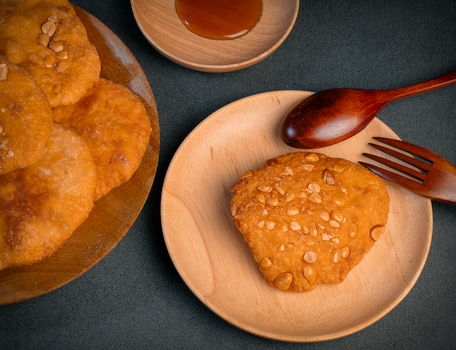
Photo: Hải Nguyễn / Pexels
The diets react (see scores below)
Common Ingredients
- flour
- yeast
- brown sugar
- cinnamon
- walnuts
- milk
- sugar
- oil
Specific recipes may vary.
Incompatible with 11 of 11 diets
Diet Ratings
Hotteok is a Korean sweet pancake that is fundamentally incompatible with a ketogenic diet. The primary ingredient is wheat flour, a high-carb grain that alone would exceed most people's daily net carb limit in a single serving. This is compounded by multiple sugar sources — brown sugar in the filling, additional sugar, and yeast (which feeds on sugar during fermentation). A single hotteok likely contains 40-60g of net carbs, obliterating the 20-50g daily keto limit in one snack. There are no meaningful fat or fiber offsets to reduce this carb load. Walnuts are the only keto-friendly ingredient, but they are a minor component in an otherwise completely incompatible dish.
Hotteok as listed contains milk, which is a dairy product and therefore not vegan. All other ingredients — flour, yeast, brown sugar, cinnamon, walnuts, sugar, and oil — are plant-based. The single disqualifying ingredient is milk. Vegan versions of hotteok are easily made by substituting dairy milk with a plant-based alternative (oat, soy, almond milk), which is common in vegan Korean cooking.
Hotteok is a Korean sweet pancake that is fundamentally incompatible with the paleo diet. The dish is built around wheat flour, a grain explicitly excluded from paleo, and yeast, a processed leavening agent. It also contains both brown sugar and refined sugar — processed sweeteners that are firmly off-limits. Milk is a dairy product, another clear paleo exclusion. The unspecified 'oil' is likely a seed or vegetable oil, which is also avoided on paleo. The only paleo-friendly ingredients in the entire dish are walnuts and cinnamon. With the majority of core ingredients falling into hard-avoid categories, this dish receives the lowest possible score.
Hotteok is a Korean sweet pancake that fundamentally conflicts with Mediterranean diet principles. The dish is built on refined white flour and contains two forms of added sugar (brown sugar and plain sugar), making it high in refined carbohydrates and added sugars — both of which the Mediterranean diet explicitly minimizes. The cooking oil is unspecified and likely not extra virgin olive oil. While walnuts and cinnamon are genuinely Mediterranean-friendly ingredients, they play a minor supporting role in what is essentially a sugary fried snack. Milk adds minimal concern on its own, but cannot redeem the overall nutritional profile. This is a processed, sugar-forward snack with no meaningful plant-forward or whole-food qualities.
Hotteok is a Korean sweet pancake that is entirely plant-based and processed, containing no animal products whatsoever. Every single ingredient — flour, yeast, brown sugar, cinnamon, walnuts, milk (likely plant-based given no protein listed, but even if dairy, it's a minor component in an otherwise wholly non-carnivore dish), sugar, and oil — is either plant-derived or refined carbohydrate. This dish is fundamentally incompatible with the carnivore diet at every level: it is grain-based (flour), sugar-laden (brown sugar, sugar), contains plant fats (oil), nuts (walnuts), and plant spices (cinnamon). There is complete consensus across all carnivore tiers — from the strictest Lion Diet to the most liberal animal-based approaches — that this food must be avoided.
Hotteok contains multiple excluded ingredients. Flour is a grain (wheat), which is explicitly prohibited on Whole30. Brown sugar and sugar are added sugars, also explicitly excluded. Milk is a dairy product, which is excluded. Furthermore, hotteok is a filled pancake — a fried dough snack — which falls directly into the 'no recreating baked goods/junk food' rule (pancakes, bread-like items). Even if the excluded ingredients were substituted, recreating this type of treat would violate the spirit of the program.
Hotteok is a Korean sweet pancake that is fundamentally incompatible with the low-FODMAP elimination diet. The primary ingredient is wheat flour, which is high in fructans — one of the most significant FODMAPs. A standard serving of hotteok involves a substantial amount of wheat dough, far exceeding any safe fructan threshold. Additionally, milk contributes lactose (a disaccharide FODMAP), and walnuts, while generally low-FODMAP at small servings (~10 walnut halves), are often used generously in the filling. Brown sugar and cinnamon in typical quantities are low-FODMAP, and oil is fine. However, the wheat flour alone makes this dish clearly high-FODMAP at any reasonable serving size. There is no practical way to make a traditional hotteok low-FODMAP without substituting the wheat flour with a gluten-free alternative and replacing dairy milk.
Hotteok is a Korean sweet pancake filled with brown sugar, cinnamon, and walnuts, fried in oil. From a DASH perspective, this snack is problematic primarily due to its high added sugar content (brown sugar and sugar in the dough), refined white flour, and frying oil. DASH guidelines explicitly limit sweets and added sugars, and refined grains are not emphasized over whole grains. The frying process adds significant fat, and the overall nutritional profile — calorie-dense, sugar-heavy, low in fiber, potassium, magnesium, or calcium relative to calories — runs counter to DASH priorities. While walnuts are a DASH-friendly ingredient, they are a minor component relative to the sugar and refined flour base. Milk adds a small amount of calcium, but this does not offset the high sugar and refined grain content.
Hotteok is a Korean sweet pancake that is fundamentally incompatible with Zone Diet principles. The dish is built almost entirely on high-glycemic, unfavorable carbohydrates: refined white flour and multiple sugar sources (brown sugar, granulated sugar) form the structural and filling base. There is no meaningful lean protein source — no protein block is provided at all. The walnuts offer some fat and a trace of protein, but not nearly enough to balance the carbohydrate load. The fat present is primarily from oil (likely a seed/vegetable oil, which Sears discourages due to omega-6 content) and walnuts. The macronutrient ratio is wildly skewed toward carbohydrates with negligible protein, making it essentially impossible to construct a Zone-balanced meal around this food. The high glycemic load from refined flour plus two sugar sources would spike insulin dramatically — precisely the hormonal response Zone is designed to prevent. Even with extreme portioning, there is no practical way to achieve a 40/30/30 ratio using hotteok as a component without a completely restructured accompanying plate that would dwarf the hotteok itself.
Hotteok is a Korean street food pancake that presents multiple anti-inflammatory concerns. The base is refined white flour, which is a refined carbohydrate with a high glycemic index that promotes inflammatory responses. The filling and dough contain both brown sugar and added sugar, contributing to glycemic load and pro-inflammatory effects via advanced glycation end-products (AGEs) and insulin spikes. The oil used for frying is unspecified but typically a refined seed oil (such as vegetable or corn oil), which is high in omega-6 fatty acids and poses oxidation risk at frying temperatures — a concern across most anti-inflammatory frameworks. Milk adds minimal inflammatory risk but contributes saturated fat. The two genuinely positive elements are cinnamon (a well-supported anti-inflammatory spice with blood sugar-modulating properties) and walnuts (an excellent source of ALA omega-3 fatty acids and polyphenols, explicitly emphasized in anti-inflammatory diets). However, these beneficial ingredients are present in modest amounts within a larger pro-inflammatory matrix. The overall profile — refined carbs, multiple added sugars, and frying oil — outweighs the benefits of cinnamon and walnuts. This is an occasional treat food, not compatible with regular anti-inflammatory eating patterns.
Hotteok is a pan-fried Korean street pancake filled with brown sugar, cinnamon, and walnuts. It is essentially a high-sugar, refined-carbohydrate, fried snack with negligible protein and minimal fiber. The primary ingredients — white flour, brown sugar, and oil for frying — represent exactly the combination GLP-1 patients should avoid: empty refined calories, high added sugar, and fat from frying. The sugar filling causes rapid blood glucose spikes, which is counterproductive for metabolic goals. The fried preparation worsens GLP-1 side effects including nausea, bloating, and reflux due to slowed gastric emptying. Walnuts provide a small amount of healthy fat and trace fiber, but their contribution is negligible relative to the overall nutritional profile. There is no meaningful protein source. This food fails on nearly every GLP-1 dietary priority: low protein, low fiber, high sugar, fried, and nutritionally empty per calorie.
*See how scores were generated at our methodology page.
Nutritional profile
Six traits that cut across every diet.
Fiber & Plants
How much whole-plant food and fiber it delivers.
Healthy Fats
The quality of its fats (unsaturated, omega-3).
Whole / Unprocessed
How close it is to its natural, unprocessed form.
Gut Gentle
How easy it is on digestion (low FODMAP, few irritants).
Low Glycemic
How little it spikes your blood sugar.
Protein Density
How much protein it packs per calorie.
Controversy Index
Higher controversy = more disagreement between diets.