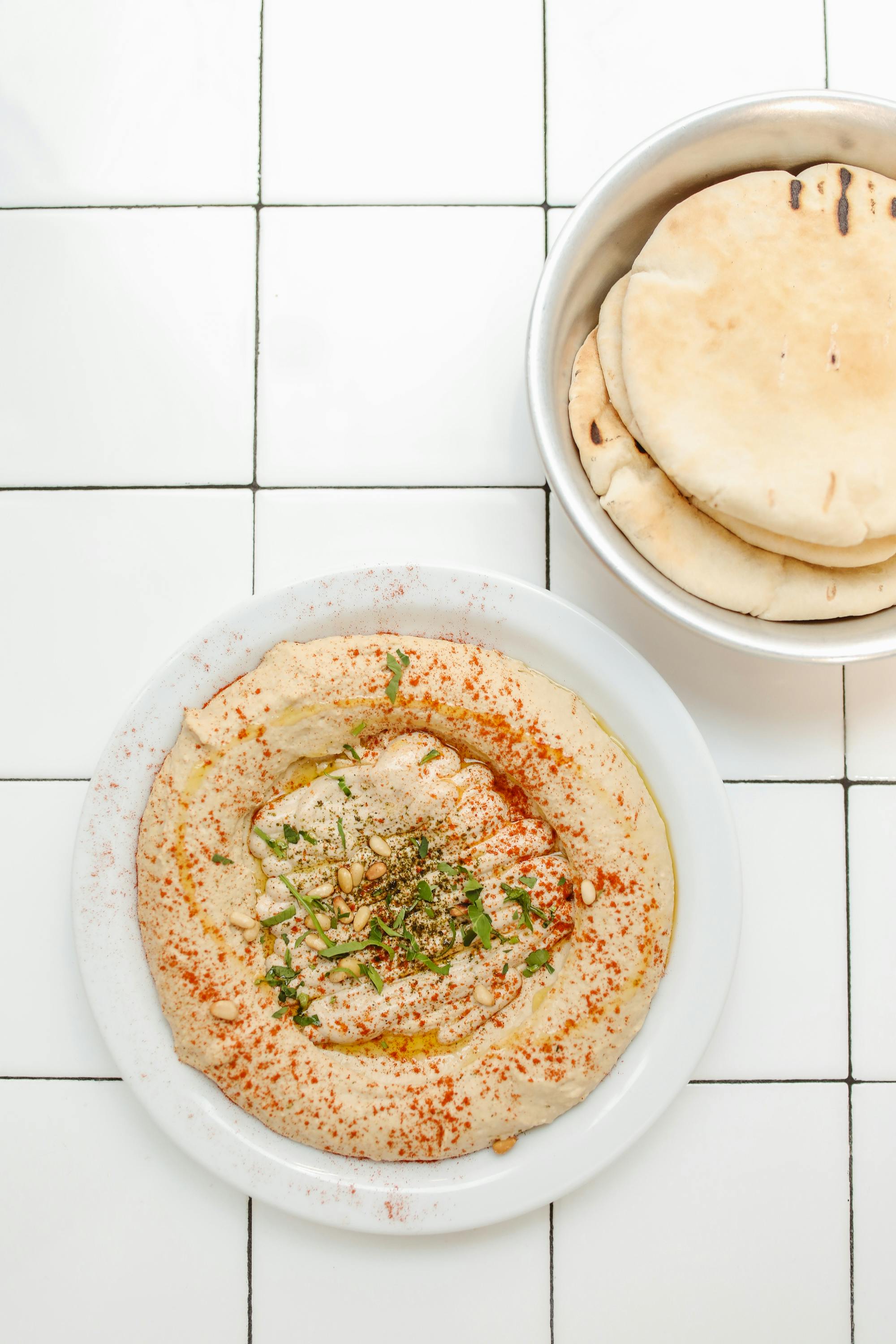
Photo: Polina Tankilevitch / Pexels
Levantine
Hummus with Pita
The diets react (see scores below)
Common Ingredients
- chickpea
- tahini
- olive oil
- lemon
- garlic
- pita
Specific recipes may vary.
Incompatible with 5 of 11 diets
Diet Ratings
Hummus with pita combines two high-carb components incompatible with ketosis. Chickpeas contain roughly 27g net carbs per cup, and a single pita bread adds another 30-35g net carbs from refined wheat. A standard serving easily exceeds an entire day's keto carb allowance, making this dish a clear avoid.
All listed ingredients are fully plant-based: chickpeas, tahini (sesame), olive oil, lemon, garlic, and pita (typically flour, water, yeast, salt). Chickpeas and tahini provide whole-food protein, healthy fats, and fiber, making this a nutritionally strong vegan dish.
This dish combines two foods that are explicitly excluded from paleo: chickpeas (a legume) and pita (a wheat-based grain product). Legumes contain lectins and phytic acid, and wheat is a grain — both are foundational exclusions in paleo. While tahini, olive oil, lemon, and garlic are paleo-compliant, they cannot redeem a dish built on chickpeas and pita bread.
Hummus with pita is a quintessential Mediterranean (Levantine) dish that aligns perfectly with the diet's core principles. It combines legumes (chickpeas) as a plant-based protein, tahini (sesame seeds) for healthy fats, extra virgin olive oil as the primary fat, plus fresh lemon and garlic. Paired with pita bread, it provides plant-forward whole-food nutrition consistent with traditional Eastern Mediterranean eating patterns.
This dish is entirely plant-based. Chickpeas are legumes (explicitly excluded on carnivore), tahini is ground sesame seeds, olive oil is a plant oil, lemon and garlic are plants, and pita is a wheat-based bread (grain). There is no animal product in this dish whatsoever, making it fundamentally incompatible with any tier of the carnivore diet.
This dish contains two explicitly excluded ingredients: chickpeas (a legume) and pita bread (a wheat-based grain product). Both legumes and grains are fully eliminated on Whole30, making this dish non-compliant on multiple counts.
This dish stacks multiple high-FODMAP ingredients at standard serving sizes. Chickpeas contain significant GOS (galacto-oligosaccharides) — Monash rates them low-FODMAP only at 1/4 cup canned/rinsed, but hummus typically uses unrestricted amounts. Garlic is one of the highest-FODMAP foods (fructans) with no safe serving. Wheat-based pita bread is high in fructans. The combination makes this unequivocally unsuitable during the elimination phase.
Hummus with pita aligns well with DASH principles. Chickpeas are a core DASH legume providing fiber, plant protein, potassium, and magnesium. Tahini (sesame paste) contributes calcium and healthy unsaturated fats, olive oil is a recommended vegetable oil, and garlic and lemon add flavor without sodium. The main caveats are that commercial hummus can be high in sodium (often 200-400mg per serving) and pita bread should ideally be whole-wheat rather than refined white pita to maximize fiber and align with DASH's whole grain emphasis. Portion control on both the pita and the olive oil/tahini-rich dip is important given calorie density.
Hummus with pita is carb-heavy and protein-light, making it difficult to hit the Zone's 40/30/30 ratio. Chickpeas provide some protein but are primarily an unfavorable carbohydrate in Zone terminology, and pita bread is a high-glycemic refined grain that Sears classifies as unfavorable. The olive oil and tahini contribute favorable monounsaturated fats, but without a lean protein source, this dish skews heavily toward carbs and fat. It can be incorporated as a small side with grilled chicken or fish, but on its own it does not balance to Zone proportions.
Hummus is built on strongly anti-inflammatory ingredients: chickpeas (fiber, legume polyphenols), tahini (sesame lignans, healthy fats), extra virgin olive oil (oleocanthal, monounsaturated fats), lemon (vitamin C), and garlic (allicin, sulfur compounds). The hummus component alone would rate approve/high. The score is pulled down by the pita, which is typically made from refined wheat flour — a refined carbohydrate that anti-inflammatory frameworks recommend limiting. If whole-grain or sprouted pita is used, the dish moves closer to a clear approve.
Dr. Weil's Anti-Inflammatory Pyramid embraces whole grains and legumes like chickpeas as foundational, treating traditional Mediterranean dishes like hummus and pita as exemplary. However, lower-carb anti-inflammatory practitioners and autoimmune protocol (AIP) advocates view refined-flour pita as pro-inflammatory due to its glycemic load, and AIP excludes legumes entirely citing lectin content — so this dish would be flagged in stricter protocols.
Hummus with pita offers fiber from chickpeas and some plant protein, but the protein density is modest (roughly 3-4g per serving of hummus) while the fat content from tahini and olive oil is relatively high per calorie. Pita adds refined carbohydrates with minimal protein, making the overall dish carb- and fat-dominant rather than protein-dominant. It can fit into a GLP-1 eating pattern as a small side or snack, especially if paired with a lean protein source, but as a standalone meal it falls short of the 15-30g protein-per-meal target and the higher fat load may aggravate nausea or reflux in sensitive patients.
Some GLP-1 dietitians view hummus favorably because chickpeas and tahini provide fiber, plant protein, and unsaturated fats that support satiety and gut health, and recommend it (especially with whole-grain or whole-wheat pita and vegetables) as a nutrient-dense small-portion snack. Others limit it due to its calorie density per gram of protein and the refined-carb pita, preferring patients get fiber and protein from lower-fat, higher-protein sources like Greek yogurt or lentils.
*See how scores were generated at our methodology page.
Nutritional profile
Six traits that cut across every diet.
Fiber & Plants
How much whole-plant food and fiber it delivers.
Healthy Fats
The quality of its fats (unsaturated, omega-3).
Whole / Unprocessed
How close it is to its natural, unprocessed form.
Gut Gentle
How easy it is on digestion (low FODMAP, few irritants).
Low Glycemic
How little it spikes your blood sugar.
Protein Density
How much protein it packs per calorie.
Controversy Index
Higher controversy = more disagreement between diets.
Diet-Specific Tips
 Vegan — 9/10
View tips
- Legume-based protein from chickpeas
- No animal-derived ingredients
- Standard pita is vegan (flour, water, yeast, salt)
- Whole-food plant ingredients with minimal processing
 Mediterranean — 9/10
View tips
- Legume-based protein (chickpeas) — a Mediterranean staple
- Olive oil as primary fat
- Tahini provides healthy unsaturated fats
- Minimal processing; whole-food ingredients
- Pita is ideally whole-grain; refined white pita would slightly lower the score
 DASH — 7/10
View tips
- Chickpeas are a DASH-recommended legume rich in fiber, potassium, and magnesium
- Tahini and olive oil provide heart-healthy unsaturated fats
- Sodium content varies significantly between homemade and commercial hummus
- Whole-wheat pita is preferred over refined white pita for DASH alignment
- Calorie-dense due to tahini and olive oil — portion control matters
 Zone — 5/10
View tips
- Pita is a high-glycemic refined carb (unfavorable in Zone)
- Chickpeas are an unfavorable Zone carb but provide some protein
- Olive oil and tahini provide favorable monounsaturated fats
- Lacks adequate lean protein to hit 30% protein target
- Workable only as a small component alongside lean protein
 Anti-Inflammatory — 7/10
View tips
- Chickpeas provide fiber and polyphenols
- Extra virgin olive oil contributes oleocanthal and monounsaturated fats
- Tahini adds sesame lignans and healthy fats
- Garlic and lemon supply allicin and vitamin C
- Pita is typically refined wheat, lowering the overall score
- Whole-grain pita would improve the rating
 GLP-1 Friendly — 5/10
View tips
- Moderate fiber from chickpeas supports digestion
- Low protein density relative to calories and fat
- Tahini and olive oil raise fat content, which can worsen GI side effects
- Pita is typically refined carbohydrate with minimal protein/fiber
- Portion-sensitive: small serving as a side is fine, large servings are calorie-dense
- Better when paired with a lean protein (grilled chicken, shawarma-style lean meat, or added Greek yogurt)