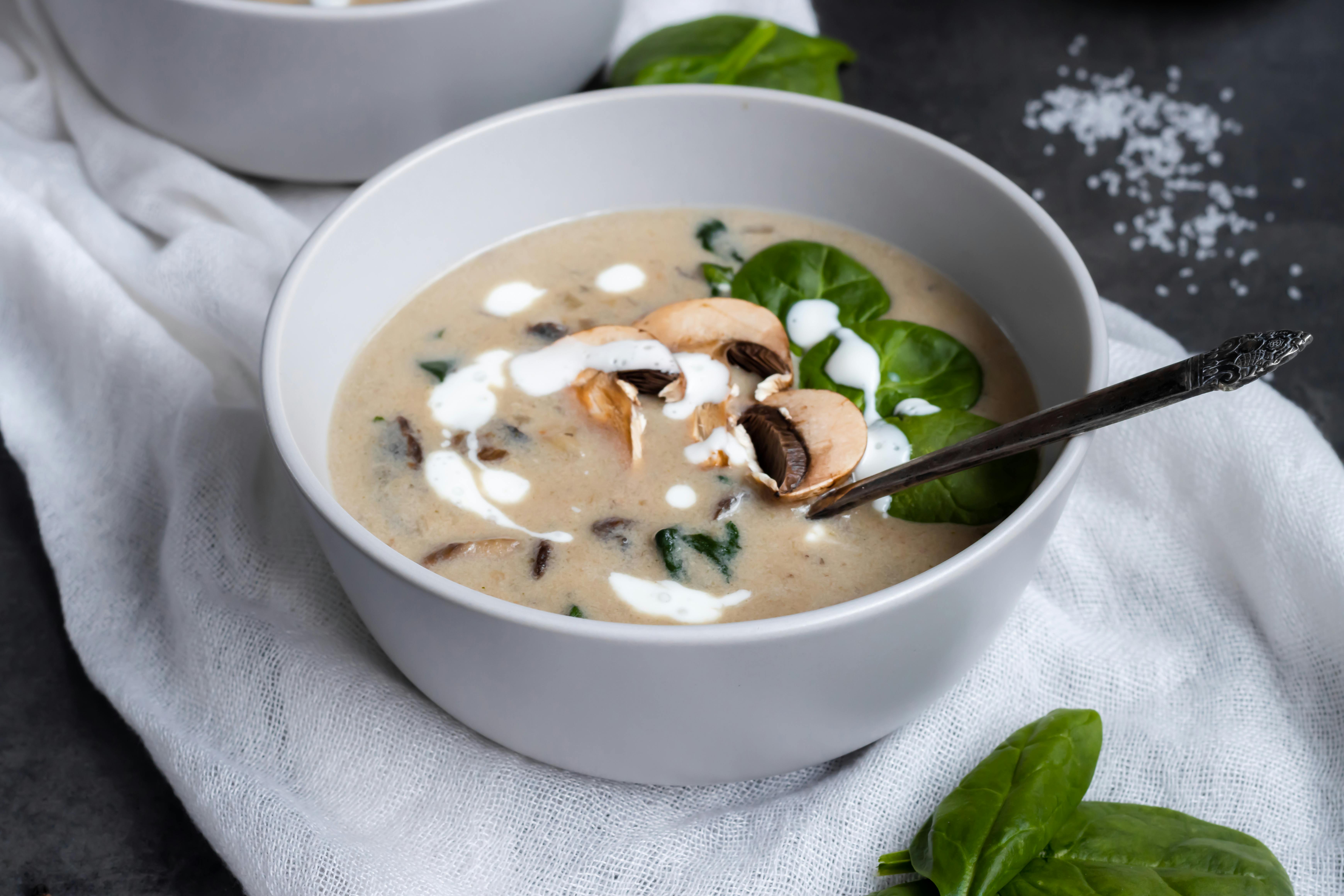
Photo: Anna Pyshniuk / Pexels
Eastern-European
Hungarian Mushroom Soup
The diets react (see scores below)

That’s a heavy plate — want to see the leaner version?
Common Ingredients
- mushrooms
- onion
- Hungarian paprika
- dill
- sour creamGreek yogurt (plain, nonfat)
Nonfat Greek yogurt keeps the creamy body of sour cream with more protein and far less fat.
- butterExtra virgin olive oil
Extra-virgin olive oil swaps saturated fat for monounsaturated fat in place of butter.
- flourWhole wheat flour
Whole-wheat flour adds fiber and lowers the refined-grain load versus flour.
- chicken stock
Specific recipes may vary.
Incompatible with 5 of 11 diets
Diet Ratings
Hungarian Mushroom Soup is problematic for keto primarily due to the flour used as a thickener, which adds significant net carbs. A typical serving may contain 10-15g net carbs depending on the amount of flour used. The other ingredients are largely keto-friendly: mushrooms are low-carb, butter and sour cream provide healthy fats, onion in small amounts is acceptable, and spices add negligible carbs. However, the flour cannot be overlooked — even a few tablespoons thickens a pot of soup and distributes carbs across servings. A keto-adapted version replacing flour with xanthan gum or simply omitting the thickener would shift this to an 'approve' rating. As written with flour, it warrants caution with strict portion control.
Hungarian Mushroom Soup as listed contains multiple animal-derived ingredients that make it incompatible with a vegan diet. Sour cream is a dairy product, butter is an animal-derived fat, and chicken stock is made from poultry. All three are clear violations of vegan principles. While the base of mushrooms, onion, paprika, dill, and flour is entirely plant-based, the dish as described cannot be considered vegan in any form. A vegan adaptation would require substituting sour cream with a plant-based alternative (e.g., cashew cream or coconut cream), replacing butter with a vegan fat (e.g., olive oil or vegan margarine), and swapping chicken stock for vegetable broth.
Hungarian Mushroom Soup contains multiple non-paleo ingredients that disqualify it outright. Flour (wheat) is a grain and a core paleo exclusion. Sour cream and butter are dairy products, excluded under strict paleo guidelines. While mushrooms, onion, paprika, dill, and chicken stock are all paleo-approved, the combination of a grain-based thickener and two dairy components makes this dish firmly non-paleo. It would require significant reconstruction — substituting arrowroot or coconut flour for the wheat flour, and replacing sour cream and butter with coconut cream and ghee or olive oil — to approach paleo compliance.
Hungarian Mushroom Soup contains several elements that partially align with Mediterranean principles but also deviate meaningfully. Mushrooms and onions are excellent plant-based ingredients fully consistent with the diet. However, the fat base is butter rather than olive oil, sour cream adds saturated dairy fat beyond moderate amounts, and white flour is a refined grain. Chicken stock is acceptable. The dish is not heavily processed or high in added sugar, and the vegetable foundation gives it nutritional merit, but the combination of butter, sour cream, and refined flour makes it a moderate-caution dish rather than a Mediterranean staple.
Some Mediterranean diet interpreters, particularly those drawing on broader European culinary traditions, would note that dairy in moderation is permissible and that a vegetable-forward soup with modest dairy enrichment can fit within flexible weekly allowances. A simple substitution of olive oil for butter would substantially improve its Mediterranean compatibility.
Hungarian Mushroom Soup is almost entirely plant-based and contains multiple carnivore-incompatible ingredients. Mushrooms are fungi (not animal products), onion is a vegetable, Hungarian paprika and dill are plant-derived spices, and flour is a grain-based thickener — all strictly excluded on the carnivore diet. The chicken stock and butter are the only animal-derived components, and sour cream is dairy (debated but present in a minor role). The dish's foundation is plant matter with no meaningful animal protein, making it a clear avoid with high confidence across all carnivore tiers.
Hungarian Mushroom Soup contains three excluded ingredients: sour cream (dairy), butter (dairy — only ghee/clarified butter is allowed), and flour (a grain-based thickener). Any one of these would be sufficient to disqualify the dish. The remaining ingredients — mushrooms, onion, Hungarian paprika, dill, and chicken stock — are all Whole30-compliant, but the dairy and grain components are core to this soup's identity and cannot simply be omitted without fundamentally changing the dish.
Hungarian Mushroom Soup contains multiple high-FODMAP ingredients that make it unsuitable during the elimination phase. Mushrooms are high in polyols (mannitol) and are high-FODMAP at standard soup servings (typically 75-150g or more per bowl). Onion is one of the highest-FODMAP foods tested by Monash, containing significant fructans even in small quantities. Wheat flour contains fructans and is used as a thickener. Sour cream contains lactose (high-FODMAP above ~2 tablespoons). Chicken stock may contain onion or garlic. With three to four independently high-FODMAP ingredients at standard serving sizes, this dish cannot be made low-FODMAP without fundamental recipe changes.
Hungarian Mushroom Soup contains several DASH-friendly ingredients — mushrooms are rich in potassium and fiber, onion adds flavor without sodium, paprika and dill are excellent low-sodium flavor enhancers, and the dish has no red meat. However, sour cream and butter introduce saturated fat, which DASH explicitly limits. Full-fat sour cream is a concern since DASH specifies low-fat or fat-free dairy. Standard chicken stock is typically high in sodium, which is a significant DASH concern. Flour adds refined carbohydrates. The dish is moderately acceptable in the context of DASH if prepared with low-sodium chicken stock, reduced-fat sour cream substituted for full-fat, and butter minimized or replaced with a vegetable oil. As commonly prepared with standard ingredients, it sits in the caution zone.
NIH DASH guidelines clearly limit saturated fat and specify low-fat dairy, placing this recipe under caution due to full-fat sour cream and butter. However, some updated clinical DASH interpretations note that full-fat fermented dairy (like sour cream) may have a neutral or less harmful cardiovascular effect than once thought, and that the vegetable and spice-forward base makes this soup more adaptable to DASH than many Eastern European dishes — swapping in low-fat sour cream and low-sodium broth could push this closer to an 'approve' rating.
Hungarian Mushroom Soup has several Zone-friendly elements but also notable concerns that place it firmly in 'caution' territory. On the positive side, mushrooms are excellent Zone carbohydrates — low glycemic, high in polyphenols, and nutrient-dense. Onions, dill, and paprika are all favorable Zone additions (paprika is particularly rich in polyphenols). Chicken stock is a lean, low-calorie base. However, the problematic components are butter (saturated fat rather than preferred monounsaturated), sour cream (saturated fat, though it does contribute some protein), and flour (higher-glycemic refined carb used as thickener). The flour thickener is the biggest Zone concern as it raises the glycemic load of the soup and represents an 'unfavorable' carbohydrate. The fat profile skews heavily saturated rather than monounsaturated. The dish also lacks a meaningful lean protein source, making it difficult to build a balanced Zone meal around it — it would require significant protein addition (grilled chicken, shrimp, etc.) to approach the 40/30/30 ratio. With modifications (replace butter with olive oil, reduce or eliminate flour thickener, use Greek yogurt instead of sour cream, add lean protein), this soup could be made more Zone-compatible. As written, it's a caution food best used as a side dish component alongside lean protein.
Some Zone practitioners and Sears' later anti-inflammatory writings (particularly 'The Zone') show more tolerance for small amounts of saturated fat when the overall meal context is balanced. The sour cream and butter portions in a single serving of soup may be modest enough that, with careful portioning and a lean protein pairing, this soup fits within a Zone meal framework. Mushrooms as the primary carbohydrate source are genuinely favorable, and the overall glycemic load may be lower than the flour presence suggests if the thickener is used sparingly.
Hungarian Mushroom Soup has a genuinely mixed anti-inflammatory profile. On the positive side, mushrooms are among the most emphasized anti-inflammatory foods — they contain beta-glucans, ergothioneine, and polyphenols that reduce inflammatory markers. Onions provide quercetin (a potent flavonoid). Hungarian paprika is rich in capsaicin and carotenoids (especially if made from red peppers), giving it meaningful antioxidant value. Dill contributes flavonoids and volatile oils with mild anti-inflammatory properties. These ingredients form a solid anti-inflammatory core. However, the dish is undermined by several moderately pro-inflammatory components: butter is a saturated fat that should be limited; sour cream is full-fat dairy, also in the 'limit' category; flour is a refined carbohydrate that adds glycemic load without nutritional benefit; and conventional chicken stock may contain sodium and additives depending on preparation. None of these are in the 'strictly avoid' category (no trans fats, no HFCS, no processed oils), but the combination of butter, sour cream, and refined flour tips this away from a clean approval. The soup could easily be modified toward a stronger anti-inflammatory profile (substitute olive oil for butter, Greek yogurt for sour cream, use a whole grain thickener or skip the flour roux). As written, it's a moderately acceptable dish — enjoyable occasionally but not a dietary centerpiece for someone prioritizing anti-inflammatory eating.
Some anti-inflammatory practitioners, including those following Dr. Weil's more flexible pyramid, would argue that the modest amounts of butter and sour cream in a largely vegetable-forward soup are acceptable in the context of an overall healthy diet, and would rate this more favorably given the strong mushroom base. Conversely, stricter AIP or dairy-free anti-inflammatory protocols would flag both full-fat dairy components and refined flour more harshly, potentially pushing this toward an 'avoid' rating for individuals with autoimmune concerns or dairy sensitivity.
Hungarian Mushroom Soup has some redeeming qualities — mushrooms provide fiber, some B-vitamins, and antioxidants, while the chicken stock adds a small protein base and hydration support. However, the dish is fundamentally limited for GLP-1 patients. The primary protein source is listed as none, and the ingredient list confirms this: mushrooms contribute minimal protein (~2-3g per cup), and the soup's body comes largely from butter, flour, and sour cream — a combination that adds saturated fat, refined carbohydrate, and calorie density without meaningful protein payoff. The sour cream and butter together create a higher-fat profile that can worsen GLP-1 side effects including nausea, bloating, and reflux due to slowed gastric emptying. The flour-thickened base adds refined starch with little nutritional return. On the positive side, the dish is warm, liquid-based (hydration-supportive), easy to eat in small portions, and not fried or spicy. Paprika and dill are fine. A standard serving would likely deliver under 5g protein, moderate fat, modest fiber (~2-3g), and enough saturated fat to be a GI concern. It can be consumed cautiously in small portions, ideally modified — substituting Greek yogurt for sour cream, reducing butter, and pairing with a lean protein source to address the protein gap.
Some GLP-1-focused dietitians accept sour cream-based soups in small portions, arguing that the liquid format, vegetable base, and warm texture make them practical comfort foods for patients struggling with appetite and GI discomfort, and that the fat content per small serving is manageable. Others flag full-fat dairy and butter combinations as reliably problematic for GLP-1 patients given slowed gastric emptying, recommending modification or avoidance rather than moderation.
*See how scores were generated at our methodology page.
Nutritional profile
Six traits that cut across every diet.
Fiber & Plants
How much whole-plant food and fiber it delivers.
Healthy Fats
The quality of its fats (unsaturated, omega-3).
Whole / Unprocessed
How close it is to its natural, unprocessed form.
Gut Gentle
How easy it is on digestion (low FODMAP, few irritants).
Low Glycemic
How little it spikes your blood sugar.
Protein Density
How much protein it packs per calorie.
Controversy Index
Higher controversy = more disagreement between diets.
Diet-Specific Tips
 Keto — 4/10
View tips
- Flour thickener is a direct keto violation — even small amounts add meaningful net carbs
- Mushrooms contribute moderate carbs (~3-4g net per cup) but are manageable in a standard serving
- Sour cream and butter provide keto-friendly fat content
- Onion adds minor carbs but is typically used in small quantities for flavor
- Easy keto modification: swap flour for xanthan gum or heavy cream reduction to eliminate grain-based carbs
- A single bowl could approach 12-15g net carbs, consuming a large portion of the daily carb budget
 Mediterranean — 5/10
View tips
- Mushrooms and onions are encouraged plant-based ingredients
- Butter used as primary fat instead of extra virgin olive oil
- Sour cream adds saturated fat beyond recommended dairy moderation
- White flour is a refined grain inconsistent with whole-grain emphasis
- No red meat or added sugars — not a severe violation
- Eastern European cuisine not traditionally Mediterranean, but dish is vegetable-forward
 DASH — 5/10
View tips
- Mushrooms are a DASH-positive ingredient: low sodium, rich in potassium and fiber
- Sour cream is full-fat dairy — DASH specifies low-fat or fat-free dairy; increases saturated fat
- Butter adds saturated fat, which DASH limits
- Standard chicken stock is high in sodium — a significant DASH concern; low-sodium stock would improve the rating substantially
- No red meat or added sugars — positive for DASH
- Hungarian paprika and dill provide flavor without sodium, supporting sodium reduction
- Refined flour used as thickener — whole grain alternatives preferred on DASH
- Overall dish can be adapted to DASH with ingredient substitutions (low-fat sour cream, low-sodium broth, minimal butter)
 Zone — 5/10
View tips
- Mushrooms are excellent low-glycemic Zone carbohydrates
- Flour thickener is an unfavorable high-glycemic carbohydrate in Zone terms
- Butter and sour cream create a saturated fat profile vs. preferred monounsaturated fats
- No primary lean protein source — difficult to balance the 40/30/30 ratio without additions
- Paprika, dill, and onions contribute Zone-friendly polyphenols and anti-inflammatory compounds
- Could be improved significantly by substituting olive oil for butter and Greek yogurt for sour cream
 Anti-Inflammatory — 5/10
View tips
- Mushrooms: strong anti-inflammatory — beta-glucans, ergothioneine, polyphenols
- Paprika and dill: antioxidant-rich spices with carotenoids and flavonoids
- Onion: quercetin content is beneficial
- Butter: saturated fat — should be limited on anti-inflammatory diets
- Sour cream: full-fat dairy — in 'limit' category
- Flour: refined carbohydrate, modest glycemic impact, no nutritional benefit
- Chicken stock: neutral to mildly beneficial depending on preparation
 GLP-1 Friendly — 4/10
View tips
- Very low protein — no meaningful protein source; fails the 15-30g per meal protein target significantly
- Sour cream and butter add saturated fat that may worsen nausea, bloating, and reflux on GLP-1 medications
- Flour-thickened base contributes refined starch with low nutritional density
- Liquid and warm format is GLP-1-friendly — easy to digest in small portions and supports hydration
- Mushrooms provide modest fiber and micronutrients but insufficient to elevate the dish nutritionally
- Should be paired with a lean protein (e.g., grilled chicken, cottage cheese side) to make it a viable GLP-1 meal
- Modification potential is high: Greek yogurt for sour cream, reduce butter, add lentils or white beans for protein and fiber