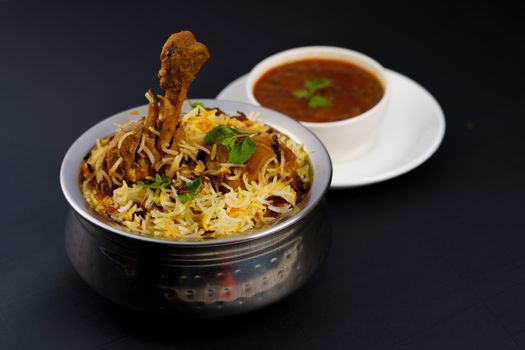
Photo: Kunal Lakhotia / Pexels
Indian
Hyderabadi Biryani
The diets react (see scores below)
Common Ingredients
- basmati rice
- lamb
- yogurt
- fried onions
- saffron
- mint
- green chilies
- whole spices
Specific recipes may vary.
Incompatible with 7 of 11 diets
Diet Ratings
Hyderabadi Biryani is fundamentally built around basmati rice, which is a high-glycemic grain delivering approximately 45-50g of net carbs per cup (cooked). A standard serving of biryani contains 1.5-2 cups of rice, meaning a single portion can deliver 70-100g of net carbs — far exceeding the entire daily keto limit of 20-50g. While the lamb or chicken protein, yogurt, and spices are keto-compatible ingredients, the rice is the structural foundation of the dish and cannot be meaningfully reduced without the dish ceasing to be biryani. The fried onions also add a moderate amount of additional carbs. There is no practical way to consume this dish in a standard form while maintaining ketosis.
Hyderabadi Biryani contains multiple animal-derived ingredients that are unambiguously non-vegan. Lamb (or chicken) is direct animal flesh, yogurt is a dairy product derived from animal milk, and the dish is defined by these core animal ingredients. There is no meaningful version of this dish that is plant-based while still being called Hyderabadi Biryani in its traditional form. All other ingredients — basmati rice, fried onions, saffron, mint, green chilies, and whole spices — are plant-based, but the primary protein and the yogurt marinade make this dish entirely incompatible with a vegan diet.
Hyderabadi Biryani contains multiple non-paleo ingredients that are central to the dish and cannot be removed without fundamentally changing it. Basmati rice is a grain and strictly excluded from the paleo diet. Yogurt is a dairy product, also excluded. Fried onions are typically prepared in seed oils (such as canola or vegetable oil), adding another violation. While the lamb or chicken, saffron, mint, green chilies, and whole spices are all paleo-approved, the foundational ingredients — rice, yogurt, and likely seed oils — make this dish incompatible with paleo guidelines. There is strong, broad consensus across paleo authorities (Cordain, Sisson, Wolf) that grains and dairy are excluded, making this a clear avoid.
Hyderabadi Biryani presents several conflicts with Mediterranean diet principles. The primary protein is lamb, a red meat that should be limited to only a few times per month. The rice is white basmati, a refined grain rather than a whole grain. The dish is also cooked with fried onions (likely in oil not specified as extra virgin olive oil) and relies heavily on animal fat from the lamb itself. While some individual ingredients — yogurt, mint, green chilies, whole spices, saffron — are compatible or even beneficial, the overall composition is centered on red meat and refined grains, making it a poor fit for regular Mediterranean diet consumption. If made with chicken instead of lamb, the profile improves meaningfully, shifting toward caution territory.
If prepared with chicken rather than lamb, several Mediterranean diet practitioners would score this dish more favorably, as poultry, yogurt, herbs, and spices are all acceptable. Additionally, basmati rice has a lower glycemic index than many other white rices and appears in some Eastern Mediterranean and Middle Eastern culinary traditions, leading some integrative Mediterranean diet interpreters to treat it more leniently than other refined grains.
Hyderabadi Biryani is fundamentally incompatible with the carnivore diet. The dish is built around basmati rice, a grain that is entirely excluded on carnivore. Beyond the rice, virtually every other non-meat ingredient is also off-limits: fried onions (plant), saffron (plant spice), mint (herb), green chilies (plant), and whole spices (plant-derived). Yogurt is a dairy product that some carnivore practitioners include, but it is secondary and irrelevant given the overwhelming plant content. The lamb itself would be approved in isolation, but as prepared in this dish, it is inseparable from a matrix of excluded ingredients. This is not a dish that can be modified into a carnivore-compatible version — it would need to be deconstructed entirely, leaving only the meat.
Hyderabadi Biryani contains two hard-excluded ingredients: basmati rice (a grain, explicitly excluded on Whole30) and yogurt (dairy, explicitly excluded on Whole30). These are not edge cases or debatable — both grains and dairy are core exclusions of the Whole30 program. The dish cannot be made compliant without fundamentally changing its identity, as rice is the defining ingredient of any biryani and yogurt is essential to the traditional marinade and cooking method. The remaining ingredients — lamb, fried onions, saffron, mint, green chilies, and whole spices — are all Whole30-compatible, but the presence of rice and yogurt makes this dish a clear avoid.
Hyderabadi Biryani contains multiple high-FODMAP ingredients that make it unsuitable during the elimination phase. The two most problematic components are fried onions and yogurt. Fried onions are a concentrated source of fructans — frying and caramelizing onions does not reduce their FODMAP content, and biryanis typically use a generous quantity of them as a foundational flavoring. Yogurt used as a marinade for the meat contains lactose, and the quantity used in this dish (typically 150–200g or more) far exceeds the low-FODMAP threshold of about 2 tablespoons (23g). Basmati rice and lamb/chicken are individually low-FODMAP. Saffron, mint, green chilies, and whole spices (cardamom, cloves, cinnamon, bay leaf) are generally low-FODMAP at culinary doses. However, the fried onions alone are sufficient to categorize this dish as high-FODMAP — they are a defining, non-optional ingredient in authentic Hyderabadi Biryani and cannot be reduced to a negligible amount without fundamentally altering the dish.
Hyderabadi Biryani presents a mixed DASH profile. On the positive side, basmati rice is a refined but moderate-GI grain, yogurt provides calcium and is a DASH-friendly dairy component, and herbs/spices (mint, saffron, green chilies, whole spices) add flavor without sodium. However, several concerns arise: (1) Lamb is a red meat with higher saturated fat content, which DASH explicitly limits — if chicken is substituted, the profile improves significantly. (2) Fried onions add oil and potentially significant calories and fat. (3) Traditional biryani preparations often involve ghee or oil in notable quantities, raising saturated fat load. (4) Sodium content varies widely by preparation — restaurant versions can be high in sodium due to added salt throughout cooking layers. (5) Portion sizes for biryani tend to be large, making it easy to exceed DASH serving limits for grains and protein. The dish is not inherently disqualifying but requires meaningful modifications (chicken over lamb, reduced oil/ghee, controlled sodium, moderate portions) to fit within DASH guidelines comfortably.
NIH DASH guidelines clearly limit red meat and saturated fat, making lamb-based biryani a poor fit. However, updated clinical interpretations note that when biryani is prepared with skinless chicken, low-fat yogurt, minimal ghee, and no added salt, it can align reasonably well with DASH principles — some DASH-oriented dietitians consider home-prepared versions with these modifications acceptable in moderate portions.
Hyderabadi Biryani presents a classic Zone challenge: it combines several components that individually or collectively skew the macronutrient balance away from the ideal 40/30/30 ratio. Basmati rice is the primary carbohydrate source — while it has a lower glycemic index than white rice, it is still a high-starch grain that the Zone classifies as 'unfavorable.' A typical serving of biryani is rice-heavy, meaning carbohydrates will dominate well beyond the 40% target. The lamb protein, depending on the cut, carries moderate-to-high saturated fat, making it less ideal than skinless chicken or fish. Fried onions add additional fat (likely from seed oils, which Sears discourages due to omega-6 load) and some glycemic load. On the positive side, yogurt provides lean protein and some probiotics, saffron and mint offer polyphenols aligned with Zone's anti-inflammatory focus, and green chilies add beneficial phytonutrients. If made with chicken instead of lamb, and portion-controlled so that rice is a minor component (~1 carb block) supplemented with a large vegetable side, the dish becomes more Zone-workable. As traditionally served, however, the rice-to-protein ratio is heavily skewed and fat quality is suboptimal, making it a 'caution' food that requires significant portion discipline.
Some Zone practitioners note that basmati rice, with its relatively lower GI (~50-58) compared to other white rices, is a borderline carbohydrate. Dr. Sears' later writings in 'The Mediterranean Zone' placed greater emphasis on polyphenol-rich spices and anti-inflammatory whole foods, which biryani's spice profile (saffron, green chilies, whole spices) partially satisfies. A chicken-based biryani with a small rice portion and a large vegetable accompaniment could be argued as a moderate Zone meal by more flexible Zone practitioners.
Hyderabadi Biryani presents a genuinely mixed anti-inflammatory profile. On the positive side, the dish contains several strongly anti-inflammatory ingredients: whole spices (typically including cumin, coriander, cardamom, cloves, cinnamon, bay leaf, and black pepper) contribute polyphenols and bioactive compounds with documented anti-inflammatory effects. Saffron contains crocin and safranal, which have shown anti-inflammatory properties in research. Mint and green chilies provide antioxidants and capsaicin respectively. Yogurt, if used in meaningful quantities as a marinade, contributes probiotics that can support gut health and reduce systemic inflammation. Basmati rice, while a refined carbohydrate, has a lower glycemic index than most white rices, partially mitigating its inflammatory potential. The problematic elements are lamb (red meat, high in saturated fat and arachidonic acid — a precursor to pro-inflammatory eicosanoids) and fried onions (deep-fried in oil, often seed oil, adding oxidized omega-6 fats). Traditional preparation also uses ghee or oil throughout the layering process, increasing saturated fat load. If made with chicken instead of lamb, the score would lean toward 6, as poultry is listed as 'moderate' rather than 'limit.' The dish overall is a culturally rich, spice-forward preparation that partially offsets its red meat and frying concerns, landing it solidly in the 'acceptable in moderation' category rather than outright avoidance.
Some anti-inflammatory practitioners, including those influenced by Dr. Weil's broadly inclusive Mediterranean-adjacent framework, would view the abundant whole spice profile and yogurt marinade as sufficiently offsetting the lamb content for occasional consumption. Conversely, stricter anti-inflammatory and AIP-adjacent approaches would flag red meat's arachidonic acid content and the frying oil (likely high-omega-6 vegetable oil) as reasons to avoid this dish more categorically, particularly for those managing autoimmune conditions or elevated CRP.
Hyderabadi Biryani is a mixed dish with meaningful protein from lamb or chicken, but several factors complicate its GLP-1 compatibility. The lamb version is the more problematic variant — lamb is a fatty red meat with significant saturated fat, which can worsen nausea, bloating, and reflux by compounding the gastric-emptying slowdown caused by GLP-1 medications. The chicken version fares better on the fat dimension. Fried onions are a consistent concern regardless of protein choice — they add saturated fat and are difficult to digest, a meaningful issue given slowed gastric emptying. Basmati rice is a refined grain with low fiber and moderate glycemic impact, contributing empty carbohydrate calories in a context where every bite needs nutritional density. Green chilies and whole spices may trigger nausea or reflux in GLP-1 patients who are already GI-sensitive. On the positive side, yogurt in the marinade adds a small protein and probiotic contribution, and the dish does deliver real protein, particularly in the chicken version. Portion size is also a significant variable — biryani is typically served in large portions, and the rice volume can crowd out more nutrient-dense foods in an already reduced appetite context. A small, carefully portioned chicken biryani with reduced fried onions is more defensible than a standard restaurant serving of lamb biryani.
Some GLP-1-focused dietitians would rate the chicken version more favorably, noting that basmati rice has a lower glycemic index than many refined grains and that the yogurt marinade and whole spices may actually support digestion for patients who tolerate spice well. Others are more cautious about any spiced, mixed rice dish given how unpredictably GI symptoms manifest on GLP-1 medications, particularly around dose escalation periods.
*See how scores were generated at our methodology page.
Nutritional profile
Six traits that cut across every diet.
Fiber & Plants
How much whole-plant food and fiber it delivers.
Healthy Fats
The quality of its fats (unsaturated, omega-3).
Whole / Unprocessed
How close it is to its natural, unprocessed form.
Gut Gentle
How easy it is on digestion (low FODMAP, few irritants).
Low Glycemic
How little it spikes your blood sugar.
Protein Density
How much protein it packs per calorie.
Controversy Index
Higher controversy = more disagreement between diets.
Diet-Specific Tips
 DASH — 4/10
View tips
- Lamb (red meat) is high in saturated fat — DASH strongly limits red meat; chicken substitution significantly improves compatibility
- Fried onions add excess oil and fat, not aligned with DASH emphasis on minimal added fats
- Basmati rice is refined grain — acceptable in DASH but whole grain alternatives are preferred
- Yogurt is a positive DASH element, providing calcium and beneficial probiotics
- Sodium levels vary widely — restaurant preparations often exceed DASH sodium limits (<2,300mg/day)
- Herbs and whole spices (mint, saffron, chilies) are DASH-positive flavor additions that reduce need for salt
- Portion size concern — traditional biryani servings may exceed DASH grain and protein allotments
- Ghee or cooking oil often used in preparation adds saturated fat burden
 Zone — 4/10
View tips
- Basmati rice is high-starch and Zone-unfavorable, typically dominating the dish's carb profile far beyond one block
- Lamb is higher in saturated fat than Zone-preferred lean proteins; chicken version is meaningfully better
- Fried onions likely cooked in seed oils (omega-6 heavy), contrary to Zone's anti-inflammatory fat recommendations
- Yogurt is a Zone-favorable lean protein component
- Saffron, mint, green chilies, and whole spices provide polyphenols aligned with Zone anti-inflammatory principles
- Dish is inherently carbohydrate-heavy as traditionally served, making 40/30/30 ratio difficult to achieve without significant modification
- Portion control and pairing with low-GI vegetables could partially rehabilitate this dish for Zone use
 Anti-Inflammatory — 5/10
View tips
- Lamb (red meat): high in saturated fat and arachidonic acid — pro-inflammatory, falls in 'limit' category
- Whole spices (cardamom, cloves, cinnamon, cumin, black pepper): rich in polyphenols and bioactive compounds with anti-inflammatory properties
- Saffron: contains crocin and safranal with documented anti-inflammatory activity
- Fried onions: deep-frying adds oxidized omega-6 fats, a pro-inflammatory concern
- Yogurt marinade: probiotic contribution supports gut health and may reduce systemic inflammation
- Green chilies and mint: capsaicin and antioxidants provide anti-inflammatory benefit
- Basmati rice: lower GI than most white rice, but still a refined carbohydrate
- Ghee or cooking oil used in preparation: saturated fat (ghee) or potential high-omega-6 oil adds inflammatory load
- Chicken version would score higher (~6) as poultry is preferable to red meat in anti-inflammatory frameworks
 GLP-1 Friendly — 4/10
View tips
- Lamb version has high saturated fat — significantly worsens GLP-1 GI side effects
- Fried onions add fat and digestive burden regardless of protein choice
- Basmati rice is a refined grain — low fiber, moderate glycemic impact, low nutrient density per calorie
- Green chilies and whole spices risk triggering nausea or reflux in GLP-1-sensitive patients
- Chicken version substantially better than lamb on fat profile
- Yogurt marinade contributes modest protein and probiotics — minor positive
- Typically large portion size conflicts with small-meal GLP-1 eating pattern
- Not easily modified in restaurant or takeout settings