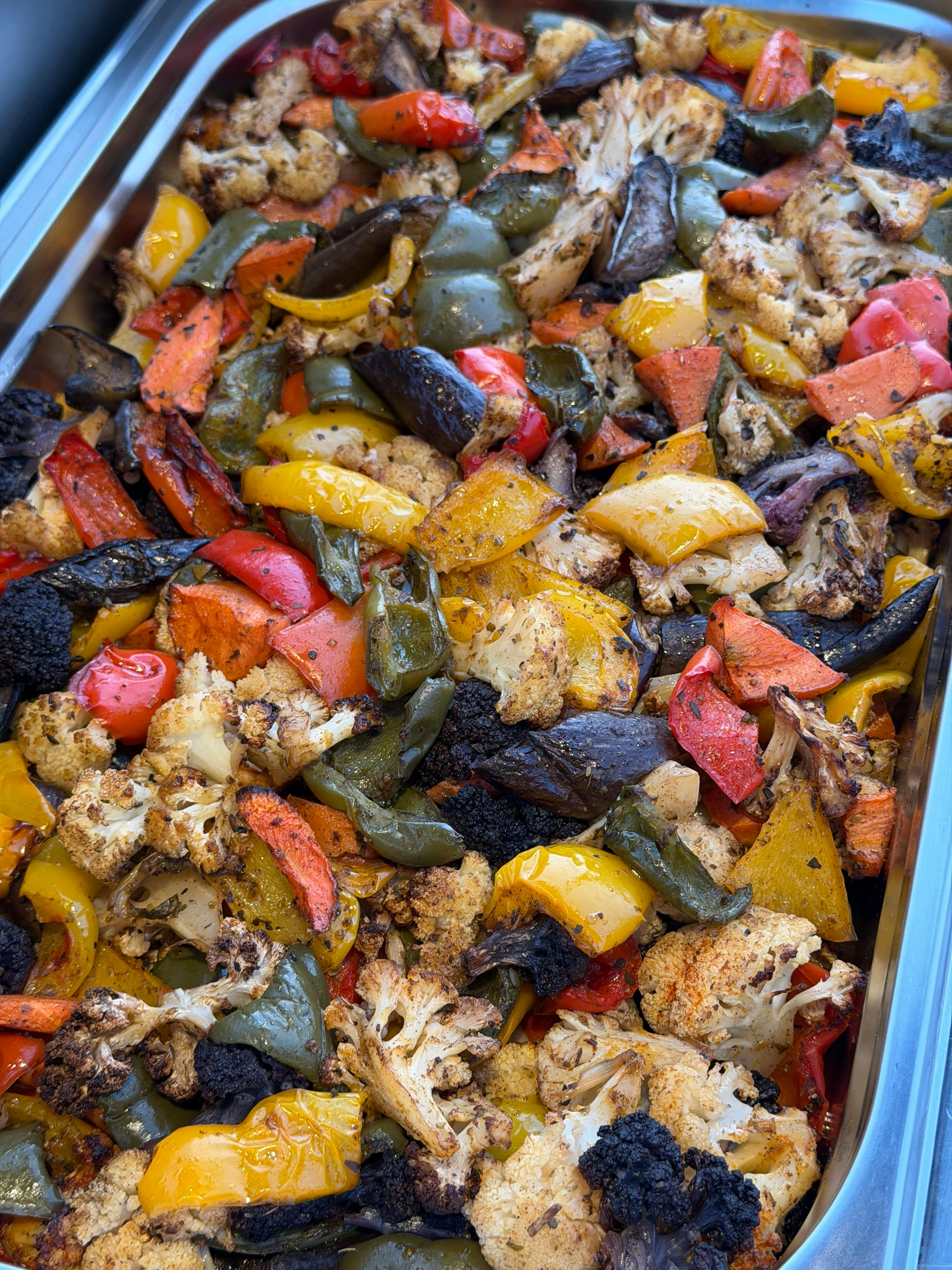
Photo: Anthony Rahayel / Pexels
Italian
Italian Roasted Vegetables
The diets react (see scores below)
Common Ingredients
- zucchini
- eggplant
- bell peppers
- red onion
- olive oil
- balsamic vinegar
- oregano
- garlic
Specific recipes may vary.
Incompatible with 2 of 11 diets
Diet Ratings
This dish is largely keto-friendly due to the low-carb vegetables (zucchini, eggplant) and olive oil, but has two notable concerns. Bell peppers add moderate carbs (~4-6g net per cup), and red onion contributes meaningful carbs (~8-10g net per half cup). The primary issue is balsamic vinegar, which contains added sugars and roughly 2-3g net carbs per tablespoon — it's the most keto-contentious ingredient here. In a small serving with light use of balsamic, this dish can fit within daily carb limits, but a generous portion or heavy balsamic drizzle could push totals uncomfortably high. Olive oil is excellent for keto. Overall, this is a caution dish requiring portion awareness and minimal balsamic vinegar.
Stricter keto practitioners would flag balsamic vinegar outright as incompatible due to its sugar content and glycemic impact, recommending substitution with red wine vinegar. Some would also argue that red onion and bell peppers should be minimized or swapped for lower-carb options like zucchini and leafy greens exclusively.
Italian Roasted Vegetables is an exemplary whole-food, plant-based dish. Every ingredient — zucchini, eggplant, bell peppers, red onion, olive oil, balsamic vinegar, oregano, and garlic — is entirely plant-derived with no animal products or animal-derived additives. Olive oil is a minimally processed plant fat, and balsamic vinegar is grape-based. This is exactly the kind of nutrient-dense, minimally processed preparation that both strict vegans and whole-food plant-based advocates enthusiastically endorse.
Italian Roasted Vegetables is largely paleo-friendly. Zucchini, eggplant, bell peppers, red onion, oregano, and garlic are all whole vegetables and herbs that would have been available to or are consistent with Paleolithic eating. Olive oil is a well-accepted paleo fat. Balsamic vinegar is the one ingredient that introduces mild debate — it is a fermented, aged, and often sweetened reduction of grape must, making it more processed than plain wine vinegar and containing added sugars in many commercial versions. Traditional aged balsamic (Aceto Balsamico Tradizionale) contains no additives, but the widely available grocery store variety typically includes caramel coloring, thickeners, or added sulfites. The dish as a whole scores well given that balsamic vinegar is used as a condiment-level flavoring rather than a primary ingredient, and the rest of the dish is clean paleo.
Strict paleo adherents following Loren Cordain's original framework may flag commercial balsamic vinegar due to added sugars, sulfites, and processing. Those following a more permissive approach (Mark Sisson, Practical Paleo) generally accept small amounts of quality balsamic vinegar as a condiment, especially if sourced from traditional producers without additives.
Italian Roasted Vegetables is a quintessential Mediterranean dish. Every ingredient aligns perfectly with Mediterranean diet principles: a colorful array of non-starchy vegetables (zucchini, eggplant, bell peppers, red onion) as the base, extra virgin olive oil as the primary fat, garlic and oregano as traditional aromatics, and balsamic vinegar adding depth without added sugars or processed ingredients. This dish exemplifies the plant-forward, whole-food foundation of the Mediterranean diet and could be eaten daily or multiple times per week.
Italian Roasted Vegetables is entirely plant-based and contains zero animal products. Every single ingredient — zucchini, eggplant, bell peppers, red onion, olive oil, balsamic vinegar, oregano, and garlic — is explicitly excluded on the carnivore diet. Plant vegetables are the core of what carnivore eliminates, olive oil is a plant-derived fat (excluded in favor of animal fats like tallow or lard), balsamic vinegar is a fermented plant product, and oregano and garlic are plant-based seasonings. There is no animal protein, no animal fat, and no animal-derived ingredient of any kind. This dish is the antithesis of carnivore eating.
All ingredients in Italian Roasted Vegetables are fully compliant with the Whole30 program. Zucchini, eggplant, bell peppers, and red onion are whole vegetables with no restrictions. Olive oil is an explicitly allowed natural fat. Balsamic vinegar is compliant (it is not malt vinegar and contains no gluten). Oregano and garlic are allowed herbs and seasonings. There are no excluded ingredients — no grains, legumes, dairy, added sugars, or any other off-limits components. This is a clean, whole-food side dish entirely in the spirit of the Whole30 program.
This dish contains two high-FODMAP ingredients that make it unsuitable during the elimination phase at standard servings. Garlic is one of the highest-FODMAP foods tested by Monash University, containing significant fructans even in tiny amounts — it cannot be made safe by portion control at any reasonable serving. Red onion is similarly high in fructans and must be avoided entirely during elimination. These two ingredients alone disqualify the dish. Additionally, eggplant is low-FODMAP only at a small serve (75g per Monash), and balsamic vinegar becomes high-FODMAP above 1 tablespoon due to excess fructose. The remaining ingredients — zucchini (up to 65g), bell peppers (up to 52g red), olive oil, and oregano — are low-FODMAP. However, the presence of garlic and red onion makes this dish a clear avoid during elimination regardless of other ingredient adjustments.
Italian Roasted Vegetables is an exemplary DASH diet dish. The core ingredients — zucchini, eggplant, bell peppers, and red onion — are all non-starchy vegetables that DASH explicitly emphasizes (4-5 servings/day). These provide abundant potassium, magnesium, fiber, and antioxidants with virtually no sodium. Olive oil is the recommended fat source in DASH (unsaturated, heart-healthy). Balsamic vinegar, oregano, and garlic are low-sodium flavor enhancers that add depth without compromising nutritional quality. The dish contains no saturated fat, no added sugar, no sodium-laden ingredients, and no processed components. It aligns perfectly with DASH's vegetable-forward, low-sodium, healthy-fat principles.
Italian Roasted Vegetables is an excellent Zone-compatible side dish. The core ingredients — zucchini, eggplant, bell peppers, red onion, and garlic — are all low-glycemic, colorful vegetables that Dr. Sears explicitly categorizes as 'favorable' carbohydrate sources. They are rich in polyphenols and fiber, supporting the anti-inflammatory goals central to Zone methodology. Olive oil is the quintessential Zone fat, providing monounsaturated fats that align perfectly with the 30% fat target. Balsamic vinegar adds negligible carbohydrates and brings polyphenol benefits. Oregano contributes additional anti-inflammatory compounds. The only minor consideration is that this dish is carbohydrate-dominant with no protein, so it must be paired with a lean protein source (e.g., grilled chicken, fish) to achieve the 40/30/30 block balance at a meal. As a side dish component, it functions ideally as the carbohydrate and fat portion of a Zone plate, easily portioned into blocks. Red onion is slightly higher glycemic than most vegetables but is used in modest quantities and poses no real concern.
Italian Roasted Vegetables is an exceptionally anti-inflammatory dish by nearly every measure. Extra virgin olive oil is a cornerstone of anti-inflammatory eating, rich in oleocanthal (a natural COX inhibitor) and monounsaturated fats. Bell peppers and red onion are high in vitamin C, quercetin, and other polyphenols that reduce inflammatory markers. Garlic contains allicin and organosulfur compounds with well-documented anti-inflammatory properties. Oregano is one of the more potent anti-inflammatory herbs, rich in rosmarinic acid and carvacrol. Balsamic vinegar contains polyphenols from grapes and has a modest glycemic impact when used in cooking quantities. Zucchini contributes antioxidants and fiber. The only meaningful debate in this dish centers on eggplant and bell peppers as nightshade vegetables, which lowers the confidence rating from high to low despite the otherwise strong and settled anti-inflammatory profile of all other ingredients.
Mainstream anti-inflammatory nutrition, including Dr. Weil's Anti-Inflammatory Pyramid, strongly endorses colorful vegetables including nightshades (eggplant, bell peppers) for their high antioxidant content — lycopene, capsanthin, and nasunin. However, the Autoimmune Protocol (AIP) and advocates like Dr. Tom O'Bryan argue that solanine alkaloids and lectins in nightshade vegetables can trigger or perpetuate inflammation in individuals with autoimmune conditions or gut permeability issues, and exclude them entirely.
Italian Roasted Vegetables is a nutrient-dense, fiber-rich, low-calorie side dish that supports GLP-1 dietary goals in several important ways. The vegetable base — zucchini, eggplant, bell peppers, and red onion — provides meaningful fiber, antioxidants, and high water content, all of which are valuable for GLP-1 patients managing constipation, reduced thirst, and the need for nutrient density per calorie. Balsamic vinegar, oregano, and garlic add flavor without problematic additives. Olive oil is an appropriate unsaturated fat and does not raise concerns at typical roasting quantities (1-2 tablespoons across a serving dish). The dish is easy to digest when vegetables are roasted soft, and portions are naturally small-friendly. However, the dish contains no meaningful protein source, which is the #1 priority for GLP-1 patients. As a standalone dish it fails the protein requirement entirely, and given the significantly reduced appetite these patients experience, every eating occasion must work hard toward the 100-120g daily protein target. This side scores well on fiber, fat quality, digestibility, and nutrient density, but its zero-protein profile prevents an approve rating. It is best used as a complement to a lean protein (grilled chicken, fish, tofu) rather than consumed as a standalone meal component.
*See how scores were generated at our methodology page.
Nutritional profile
Six traits that cut across every diet.
Fiber & Plants
How much whole-plant food and fiber it delivers.
Healthy Fats
The quality of its fats (unsaturated, omega-3).
Whole / Unprocessed
How close it is to its natural, unprocessed form.
Gut Gentle
How easy it is on digestion (low FODMAP, few irritants).
Low Glycemic
How little it spikes your blood sugar.
Protein Density
How much protein it packs per calorie.
Controversy Index
Higher controversy = more disagreement between diets.
Diet-Specific Tips
 Keto — 5/10
View tips
- Balsamic vinegar contains added sugars (~2-3g net carbs/tbsp) — the most problematic ingredient
- Bell peppers are moderate in net carbs (~4-6g per cup) and should be portioned carefully
- Red onion adds meaningful carbs (~8-10g net per half cup)
- Zucchini and eggplant are low-carb and keto-appropriate
- Olive oil is ideal for keto — high in healthy monounsaturated fats
- Small serving with minimal balsamic can fit within daily carb limits
- Full portion with generous balsamic could approach or exceed carb threshold
 Vegan — 10/10
View tips
- All ingredients are 100% plant-derived
- Whole vegetables form the base — no processed substitutes
- Olive oil is plant-based and standard in vegan cooking
- Balsamic vinegar is grape-derived with no animal fining agents typically used
- Herbs and aromatics (oregano, garlic) are fully vegan
- No animal proteins, dairy, eggs, or animal-derived additives present
 Paleo — 8/10
View tips
- Zucchini, eggplant, bell peppers, red onion — all whole paleo-approved vegetables
- Olive oil — approved paleo fat
- Oregano and garlic — approved herbs and aromatics
- Balsamic vinegar — gray area; traditional versions are cleaner, but commercial versions often contain added sugar, caramel coloring, or sulfites
- No grains, legumes, dairy, seed oils, or refined sugar
- Overall ingredient profile is predominantly clean and whole-food based
 Mediterranean — 10/10
View tips
- All-vegetable base with no meat or processed ingredients
- Extra virgin olive oil as the sole fat source — the canonical Mediterranean fat
- Garlic and oregano are staple Mediterranean flavor enhancers
- Balsamic vinegar is minimally processed and used in small quantities
- No refined grains, added sugars, or saturated fats
- Traditional Italian preparation method (roasting with olive oil and herbs) is authentically Mediterranean
- High fiber and micronutrient density from diverse vegetables
 Whole30 — 9/10
View tips
- All vegetables (zucchini, eggplant, bell peppers, red onion) are Whole30-compliant
- Olive oil is an explicitly allowed natural fat
- Balsamic vinegar is compliant — only malt vinegar is excluded
- Oregano and garlic are allowed herbs/seasonings
- No excluded ingredients present
- Dish is a whole-food preparation, consistent with the program's spirit
 DASH — 9/10
View tips
- All vegetables (zucchini, eggplant, bell peppers, red onion) are core DASH-recommended foods
- Olive oil provides heart-healthy monounsaturated fats consistent with DASH guidelines
- Naturally very low sodium — no added salt in ingredient list
- Rich in potassium, fiber, and magnesium from multiple vegetable sources
- Balsamic vinegar adds flavor without sodium, though contains minor natural sugars
- Garlic and oregano are sodium-free flavor enhancers, reducing need for salt
- No saturated fat, no cholesterol, no processed ingredients
- Portion of olive oil should be moderate (1-2 tbsp per serving) to manage calorie density
 Zone — 8/10
View tips
- All vegetables (zucchini, eggplant, bell peppers, red onion, garlic) are low-glycemic and Zone 'favorable' carbohydrate sources
- Olive oil is the ideal Zone monounsaturated fat source
- Rich in polyphenols and anti-inflammatory compounds, aligning with Sears' broader health protocol
- No protein present — must be paired with lean protein to complete a balanced Zone meal
- Balsamic vinegar is low-glycemic in typical serving sizes and adds polyphenol value
- No unfavorable carbs, saturated fats, trans fats, or processed ingredients
 Anti-Inflammatory — 9/10
View tips
- Extra virgin olive oil — oleocanthal, monounsaturated fats, core anti-inflammatory fat
- Bell peppers — high vitamin C, quercetin, capsanthin; nightshade caveat for autoimmune
- Eggplant — nasunin antioxidant, fiber; nightshade caveat for autoimmune
- Red onion — quercetin and flavonoids with anti-inflammatory and antioxidant activity
- Garlic — allicin, organosulfur compounds, reduces CRP and IL-6 in research
- Oregano — rosmarinic acid, carvacrol; among the most potent anti-inflammatory herbs
- Balsamic vinegar — grape polyphenols, acetic acid; minimal added sugar in cooking use
- Zucchini — fiber, antioxidants, very low inflammatory potential
- No refined carbohydrates, added sugars, seed oils, or pro-inflammatory ingredients
 GLP-1 Friendly — 6/10
View tips
- No protein content — critical gap for GLP-1 patients targeting 100-120g daily
- High fiber from zucchini, eggplant, bell peppers, and red onion supports digestion and constipation prevention
- Olive oil provides heart-healthy unsaturated fat at appropriate quantities
- High water content in vegetables supports hydration, important given reduced thirst sensation on GLP-1s
- Easy to digest when roasted soft — suitable for patients experiencing GI side effects
- Low calorie density with good micronutrient profile — strong nutrient density per calorie
- Balsamic vinegar adds minimal sugar at typical serving quantities — not a concern
- Must be paired with a lean protein source to function as a GLP-1-appropriate meal component