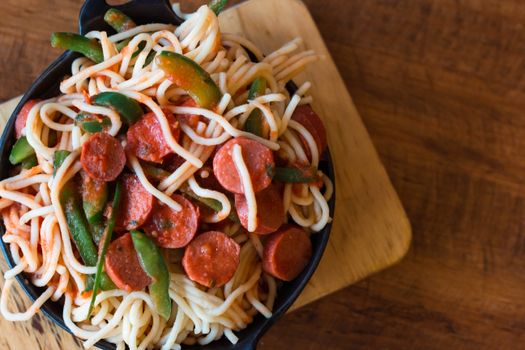
Photo: Alejandro Aznar / Pexels
Italian
Italian Sausage and Peppers
The diets react (see scores below)
Common Ingredients
- Italian sausage
- bell peppers
- yellow onion
- tomato sauce
- garlic
- olive oil
- oregano
- fennel seed
Specific recipes may vary.
Incompatible with 5 of 11 diets
Diet Ratings
Italian Sausage and Peppers is a borderline keto dish. The Italian sausage itself is keto-friendly — high in fat and protein with minimal carbs. However, the combination of bell peppers, yellow onion, and tomato sauce adds meaningful net carbs. Bell peppers have roughly 4-5g net carbs per half cup, yellow onion is notably higher in sugar (~7-9g net carbs per half cup), and tomato sauce can add 6-10g per half cup depending on added sugars. A full serving could easily reach 15-25g net carbs, which is manageable for those on a flexible keto target (50g/day) but risky for strict keto practitioners aiming for 20g. With careful portion control — reducing onion and sauce quantities — this dish can fit within a keto framework. Check sausage labels for fillers or added sugar.
Strict keto practitioners would flag yellow onion and tomato sauce as problematic, arguing that onions' natural sugars and the carb load of commercial tomato sauces make this dish too risky for maintaining ketosis, especially for metabolically insulin-resistant individuals who follow clinical keto protocols.
Italian sausage is a meat product made from ground pork (or occasionally other meats), which is a direct animal product and fundamentally incompatible with a vegan diet. While the remaining ingredients — bell peppers, yellow onion, tomato sauce, garlic, olive oil, oregano, and fennel seed — are all plant-based and vegan-friendly, the primary protein and defining ingredient of this dish is animal-derived. No version of traditional Italian sausage is vegan. The dish as described cannot be approved under any interpretation of vegan ethics.
This dish is largely paleo-friendly in concept, but Italian sausage is the critical problem ingredient. Commercial Italian sausage almost universally contains added salt, preservatives, fillers, and sometimes sugar or breadcrumbs — making it a processed meat that conflicts with paleo principles. The remaining ingredients are solid: bell peppers, onion, garlic, olive oil, oregano, and fennel seed are all unprocessed and paleo-approved. Tomato sauce can be acceptable if it's plain crushed tomatoes, but commercial tomato sauces typically contain added salt, sugar, and preservatives. The dish earns a caution rating rather than avoid because the underlying framework is paleo-compatible — with clean ingredient swaps (homemade sausage from ground pork with compliant spices, no-salt-added tomato sauce), this dish becomes fully paleo. The concept is sound; the execution in its standard commercial form is not.
Some paleo practitioners, particularly those following a more flexible or ancestral health approach (e.g., Robb Wolf's practical paleo framework), accept high-quality artisan or butcher-made sausages with minimal ingredients as close enough to compliant, especially if sourced from pasture-raised pork. Strict Cordain-school paleo would flag even minimally processed sausage due to the added salt requirement.
Italian sausage is a processed red meat product, typically high in saturated fat, sodium, and preservatives — all of which directly contradict Mediterranean diet principles. While the dish includes several genuinely Mediterranean-friendly components (bell peppers, onion, tomato sauce, garlic, olive oil, herbs), the primary protein anchors it firmly outside the diet's recommendations. Red and processed meats are limited to a few times per month at most, and processed sausage is considered worse than unprocessed red meat due to additives and sodium content. The vegetable and sauce components are excellent, but they cannot offset the processed meat as the dish's centerpiece.
Some traditional Southern Italian and Sicilian culinary traditions do incorporate cured and seasoned sausages as occasional festive or celebratory foods, and moderate Mediterranean diet frameworks might permit this dish as a rare indulgence — perhaps once or twice a month — rather than a regular meal. The vegetable-to-meat ratio could also be shifted to reduce the sausage portion significantly.
Italian Sausage and Peppers is fundamentally incompatible with the carnivore diet. While the Italian sausage itself is animal-derived, the dish is dominated by plant-based ingredients: bell peppers, yellow onion, tomato sauce, garlic, olive oil, oregano, and fennel seed. Every single one of these is explicitly excluded from the carnivore diet — vegetables, plant oils, and spices are all prohibited. Even the sausage is suspect, as Italian sausage typically contains fennel seed and other plant-based seasonings mixed into the meat, plus potential sugar or filler additives. This dish is essentially a classic Italian vegetable-forward preparation that happens to contain some meat, making it a clear avoid with high confidence across all carnivore camps.
The vegetables, olive oil, garlic, and spices in this dish are all fully Whole30-compliant. Tomato sauce is generally fine but requires label-checking for added sugar, citric acid (fine), or other additives. The critical concern is the Italian sausage itself: most commercially available Italian sausages contain added sugar, wine, or other non-compliant fillers. A Whole30-compliant version does exist (pork, salt, fennel, spices only), but it requires careful label-reading or making it from scratch. The dish itself is conceptually sound for Whole30 — it's a whole-food, savory main — but the sausage makes it a conditional approval.
Official Whole30 guidelines do not exclude sausage as a category; compliant versions are perfectly acceptable. However, some practitioners and community members caution that processed sausage products — even compliant ones — can represent the kind of 'comfortable, familiar' processed food reliance that the program encourages participants to move away from. Melissa Urban's guidance emphasizes choosing the least-processed options when possible.
This dish contains multiple high-FODMAP ingredients that make it unsuitable during the elimination phase. Yellow onion is one of the highest-FODMAP foods tested by Monash University, rich in fructans, and cannot be made safe at any reasonable serving size. Garlic is similarly high in fructans and must be avoided entirely during elimination (garlic-infused oil would be an acceptable substitute, but whole garlic is not). Italian sausage typically contains garlic and onion powder as seasoning, adding further hidden fructan load. Tomato sauce in commercial form frequently contains onion and garlic as well. Even setting aside the sausage and tomato sauce concerns, the combination of whole onion and garlic alone is enough to classify this dish as high-FODMAP with high confidence. Bell peppers and olive oil are low-FODMAP, and oregano and fennel seed are low-FODMAP in culinary amounts, but they cannot offset the significant FODMAP burden from onion, garlic, and sausage.
Italian sausage is a highly processed red meat that is explicitly discouraged on the DASH diet. A typical 3 oz serving of Italian sausage contains 500–800mg of sodium and 6–9g of saturated fat, both of which directly conflict with DASH's core targets of limiting sodium to under 2,300mg/day and minimizing saturated fat intake. The dish's other components — bell peppers, onion, garlic, olive oil, oregano, and fennel seed — are all DASH-friendly and beneficial, providing potassium, fiber, and healthy fats. However, the primary protein source (Italian sausage) dominates the nutritional profile and cannot be offset by the vegetable components. DASH guidelines explicitly recommend replacing processed and red meats with lean poultry, fish, beans, or nuts. A single serving of this dish could easily consume 35–50% of the daily sodium budget and a significant portion of the saturated fat allowance, making it incompatible with regular DASH eating.
Italian Sausage and Peppers sits squarely in Zone 'caution' territory. The dish has genuinely favorable elements — bell peppers and onions are excellent low-glycemic Zone carbohydrates rich in polyphenols, tomato sauce adds lycopene and more favorable carbs, garlic provides anti-inflammatory benefits, and olive oil is the ideal Zone monounsaturated fat. However, the protein anchor — Italian sausage — is the limiting factor. Italian sausage is a high-fat, high-saturated-fat processed meat, not a lean Zone-approved protein like skinless chicken or fish. A typical 3 oz serving of Italian sausage can contain 15-20g of fat (much of it saturated), which dramatically skews both the fat ratio and fat quality away from Zone ideals. The macronutrient balance of the dish as a whole is likely closer to 20-25% carbs / 20-25% protein / 50-55% fat — far from the 40/30/30 target. With portion modification (reducing sausage quantity, removing rendered fat, loading up more bell peppers and sauce), this dish can be nudged toward Zone compliance, but it requires significant adjustment. The vegetable-heavy cooking method and olive oil use are genuine Zone positives that prevent this from scoring lower.
Some Zone practitioners note that Dr. Sears' later anti-inflammatory work (particularly 'The Anti-Inflammation Zone') places greater emphasis on omega-6 to omega-3 ratios than absolute saturated fat avoidance. If the sausage is a higher-quality variety with a better fat profile (e.g., leaner chicken or turkey Italian sausage), and the dish is portioned so that protein is approximately 25g per serving, the overall meal can approach Zone balance. In that context, a practitioner focused on the polyphenol and anti-inflammatory benefits of the peppers, tomatoes, garlic, and olive oil might rate this more favorably as a practical Zone meal with careful portioning.
Italian Sausage and Peppers presents a genuinely mixed anti-inflammatory profile. On the positive side, the dish contains several strongly anti-inflammatory ingredients: olive oil (oleocanthal, polyphenols), bell peppers (high in vitamin C, carotenoids, and flavonoids), garlic (allicin, anti-inflammatory sulfur compounds), tomato sauce (lycopene, especially when cooked), oregano (rosmarinic acid, polyphenols), and fennel seed (anethole, antioxidant properties). Yellow onion also contributes quercetin, a potent flavonoid. These ingredients collectively represent a solid anti-inflammatory foundation. However, the dish is anchored by Italian sausage, which is processed red meat — typically high in saturated fat, sodium, and often containing nitrates or artificial additives depending on the brand. Processed red meat is consistently flagged as pro-inflammatory across virtually all anti-inflammatory nutrition frameworks, associated with elevated CRP and IL-6 markers. The saturated fat content further nudges this dish in a pro-inflammatory direction. The net result is a fundamentally conflicted dish: excellent supporting cast, problematic centerpiece. Swapping to turkey or chicken Italian sausage, or a small amount of high-quality pork sausage without nitrates, would shift this toward approval. As prepared with conventional Italian sausage, it lands in caution territory — acceptable occasionally but not a regular anti-inflammatory staple.
Italian sausage and peppers is a borderline dish for GLP-1 patients. The primary concern is the Italian sausage itself: even 'sweet' or 'mild' Italian sausage is a high-fat, high-saturated-fat processed meat — typically 60-70% of calories come from fat, with significant sodium content. A standard 3 oz serving delivers roughly 18-22g fat and only 13-15g protein, making the protein-to-fat ratio poor by GLP-1 standards. The high fat content is the primary disqualifier, as it slows gastric emptying further on top of the medication's existing effect, meaningfully worsening nausea, bloating, and reflux. The remaining ingredients are largely positive: bell peppers and onion add fiber, water content, and micronutrients; tomato sauce contributes lycopene and additional fiber; olive oil is an unsaturated fat used in a small amount; garlic, oregano, and fennel are digestively benign or mildly beneficial. If the dish were made with a lean chicken or turkey Italian-style sausage, the profile would shift toward approve. As written with traditional pork Italian sausage, the fat load places this in caution territory — acceptable occasionally in a small portion if the patient tolerates it, but not a recommended regular choice.
Some GLP-1-focused RDs argue that sausage-based dishes are a practical protein source for patients struggling to meet protein targets, particularly because the fat content increases satiety in small portions — relevant for patients who find it difficult to eat enough. Others maintain that the saturated fat and processed meat status make it counterproductive given the medication's GI sensitivity profile, and that the protein is better sourced elsewhere.
*See how scores were generated at our methodology page.
Nutritional profile
Six traits that cut across every diet.
Fiber & Plants
How much whole-plant food and fiber it delivers.
Healthy Fats
The quality of its fats (unsaturated, omega-3).
Whole / Unprocessed
How close it is to its natural, unprocessed form.
Gut Gentle
How easy it is on digestion (low FODMAP, few irritants).
Low Glycemic
How little it spikes your blood sugar.
Protein Density
How much protein it packs per calorie.
Controversy Index
Higher controversy = more disagreement between diets.
Diet-Specific Tips
 Keto — 5/10
View tips
- Italian sausage is high-fat and low-carb — core keto protein source
- Yellow onion adds significant net carbs and natural sugars
- Bell peppers contribute moderate net carbs, manageable in small portions
- Tomato sauce carb content varies widely — check labels for added sugar
- Combined carb load of a standard serving risks approaching daily keto limits
- Olive oil and spices are fully keto-compatible
- Dish can be made more keto-friendly by reducing onion and sauce quantities
 Paleo — 5/10
View tips
- Commercial Italian sausage typically contains added salt, sugar, preservatives, and fillers — a processed meat
- Homemade or clean-ingredient sausage (ground pork + compliant spices) would make this dish paleo-approved
- Bell peppers, onion, garlic, fennel seed, and oregano are all paleo-approved
- Olive oil is a preferred paleo fat — approved
- Tomato sauce must be scrutinized: plain crushed tomatoes are fine, but commercial sauces often contain added salt and sugar
- The dish's core concept is paleo-compatible with clean ingredient sourcing
 Whole30 — 5/10
View tips
- Italian sausage commonly contains added sugar or wine — must verify label or make from scratch
- Tomato sauce requires label-check for added sugar or non-compliant additives
- Bell peppers, onion, garlic, olive oil, oregano, and fennel seed are all fully compliant
- Dish concept is whole-food and savory — no junk food recreation concerns
- Compliant versions of this dish are achievable with careful ingredient sourcing
 Zone — 5/10
View tips
- Italian sausage is high in saturated fat and total fat — not a lean Zone protein source
- Bell peppers and onion are excellent low-glycemic, polyphenol-rich Zone carbohydrates
- Olive oil aligns perfectly with Zone monounsaturated fat guidelines
- Tomato sauce and garlic add anti-inflammatory polyphenols favored by Sears
- Overall macro ratio skews heavily toward fat, requiring portion reduction of sausage to approach 40/30/30
- Substituting turkey or chicken Italian sausage would significantly improve Zone compatibility
- As-written, the dish likely delivers excess saturated fat per meal relative to Zone targets
 Anti-Inflammatory — 4/10
View tips
- Italian sausage is processed red meat — consistently pro-inflammatory across all major anti-inflammatory frameworks due to saturated fat, sodium, and potential nitrates/additives
- Bell peppers are rich in carotenoids and vitamin C, making them strongly anti-inflammatory
- Garlic contributes allicin and organosulfur compounds with well-documented anti-inflammatory effects
- Olive oil provides oleocanthal and polyphenols; a cornerstone of anti-inflammatory eating
- Tomato sauce delivers bioavailable lycopene, enhanced by cooking and fat (olive oil)
- Oregano and fennel seed are anti-inflammatory spices with polyphenol content
- Onion contributes quercetin, a potent anti-inflammatory flavonoid
- High saturated fat content from sausage elevates the overall inflammatory burden of the dish
 GLP-1 Friendly — 4/10
View tips
- High saturated fat content in Italian pork sausage worsens GLP-1 GI side effects (nausea, bloating, reflux)
- Poor protein-to-fat ratio — fat calories dominate over protein contribution
- High sodium from processed sausage is a secondary concern
- Bell peppers and onion contribute beneficial fiber and water content
- Olive oil is an unsaturated fat but adds to overall fat load
- Tomato sauce adds micronutrients and lycopene with minimal caloric cost
- Substituting turkey or chicken Italian sausage would significantly improve the rating
- Small portion may be tolerable; large servings high risk for GI distress on GLP-1s