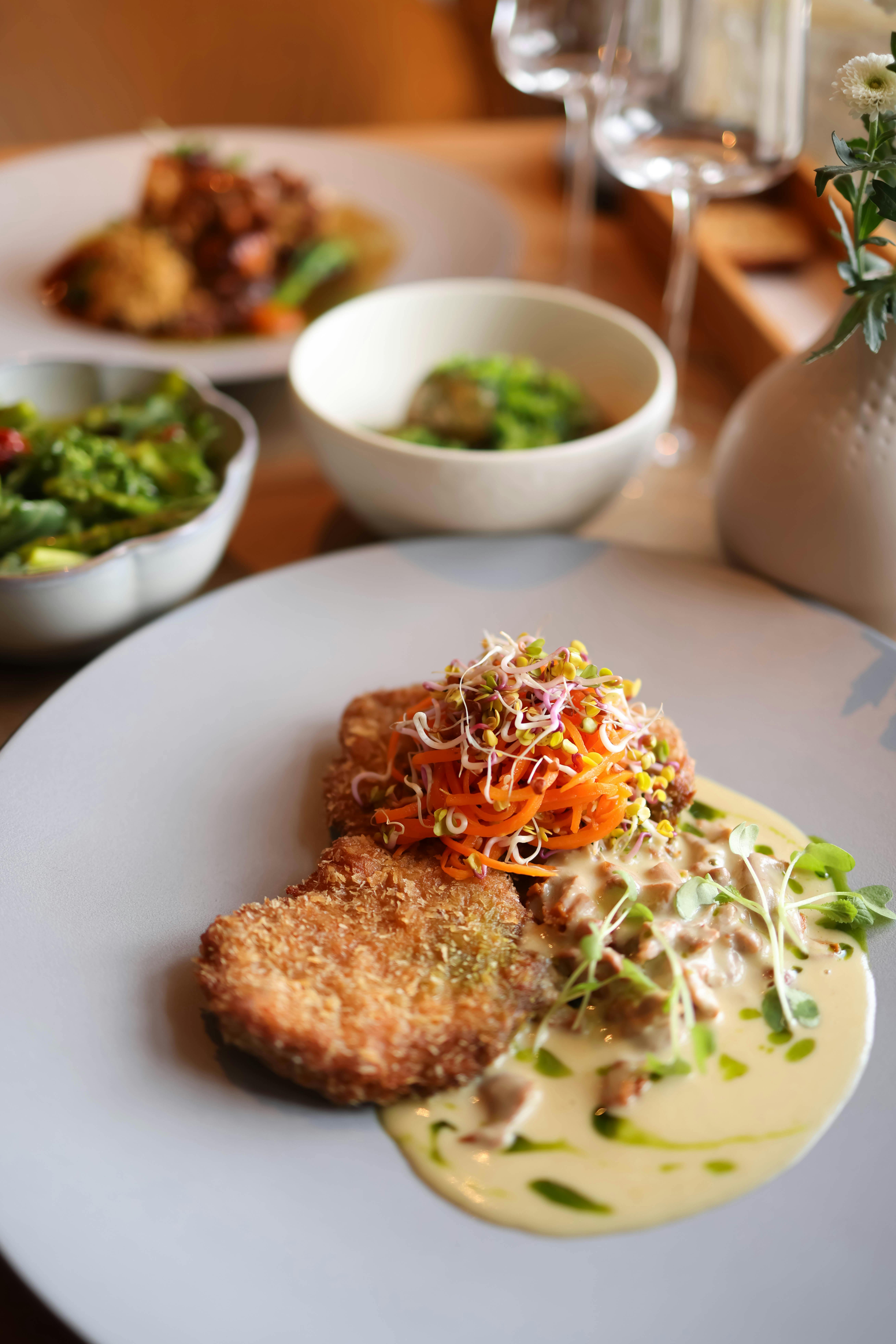
Photo: Valeria Boltneva / Pexels
French
French-Style Jägerschnitzel
The diets react (see scores below)
Common Ingredients
- veal cutlets
- mushrooms
- shallots
- white wine
- heavy cream
- butter
- flour
- parsley
Specific recipes may vary.
Incompatible with 8 of 11 diets
Diet Ratings
French-Style Jägerschnitzel is close to keto-friendly but contains two problematic ingredients: flour (used to dredge the cutlets) and white wine (used in the sauce). The flour coating adds refined grain-based carbs directly to the protein, and white wine contributes residual sugars and carbs even after cooking. The rest of the dish is very keto-compatible — veal or pork cutlets are excellent protein sources, mushrooms are low-carb, shallots are moderate in small amounts, and the heavy cream and butter sauce is ideal for keto fat macros. With simple substitutions (almond flour or no dredging, and omitting or drastically reducing the wine), this dish would easily qualify as an approve. As written, the flour coating is the biggest offender and cannot be ignored.
Some lazy keto or moderate keto practitioners would approve this dish, arguing that the flour used for dredging is a thin coating distributed across multiple servings, making the per-serving carb impact minimal, and that white wine largely loses its sugar content during reduction. They may rate it approvable with mindful portioning.
French-Style Jägerschnitzel contains multiple animal products and animal-derived ingredients, making it entirely incompatible with a vegan diet. The dish is built around veal cutlets (slaughtered calf meat), heavy cream (dairy), and butter (dairy fat) — all core animal products explicitly excluded under vegan principles. There is no ambiguity here: this is a meat-and-dairy-based dish at its foundation, with no plant-based substitution implied.
French-Style Jägerschnitzel contains multiple non-paleo ingredients that disqualify it under strict paleo guidelines. Flour is a grain-based product and is explicitly excluded. Heavy cream and butter are dairy products, both of which are avoided on paleo (butter is debated but heavy cream is not). White wine, while derived from grapes, is an alcoholic processed product that places it in the caution-to-avoid range, but combined with the other violations it does not redeem the dish. The veal itself and mushrooms, shallots, and parsley are paleo-compliant, but the foundational preparation — dredging in flour and finishing with a cream-butter sauce — makes this dish incompatible with paleo eating as a whole. This is not a borderline case; the violations (grain flour, heavy cream, butter) are core, well-established exclusions with high consensus across all major paleo authorities.
This dish conflicts with Mediterranean diet principles on multiple fronts. Veal or pork are red/white meats that should be consumed sparingly (a few times per month at most), and the preparation relies heavily on heavy cream and butter as primary fat sources rather than olive oil. Flour-based breading or thickening adds refined grains. The sauce is built on saturated-fat-rich dairy, which is the antithesis of the olive-oil-centered fat profile central to the Mediterranean pattern. While mushrooms, shallots, white wine, and parsley are Mediterranean-friendly components, they are minor supporting ingredients overwhelmed by the problematic core elements.
French-Style Jägerschnitzel is incompatible with the carnivore diet. While the veal or pork cutlets are acceptable animal proteins, the dish is built around multiple plant-derived and non-carnivore ingredients: mushrooms (fungi/plant kingdom), shallots (plant), white wine (fermented plant), flour (grain-based thickener for the sauce), and parsley (herb). Heavy cream and butter are dairy derivatives that would be debated, but the core violations here are the mushrooms, shallots, white wine, flour, and parsley — all strictly excluded on any tier of the carnivore diet. The sauce construction itself is fundamentally plant-dependent. Even a lenient carnivore practitioner cannot include this dish without a near-complete reformulation.
This dish contains multiple Whole30-excluded ingredients. Heavy cream and butter are dairy products, which are explicitly excluded on Whole30 (only ghee/clarified butter is allowed as a dairy exception). Flour is a grain-based ingredient, also explicitly excluded. White wine is alcohol, which is excluded. With three distinct categories of excluded ingredients present, this dish is clearly non-compliant.
This dish contains multiple high-FODMAP ingredients that make it unsuitable during the elimination phase. Shallots are very high in fructans — one of the most concentrated FODMAP sources — and cannot be used even in small amounts without triggering symptoms in sensitive individuals. Mushrooms (especially common button or cremini varieties) are high in polyols (mannitol) at standard serving sizes. Flour (wheat) used for dredging the cutlets contains fructans. Heavy cream is borderline but generally tolerated in small amounts; however, the combination of these three clearly high-FODMAP ingredients makes the dish a definitive avoid. White wine is low-FODMAP in moderate amounts, butter is low-FODMAP, veal/pork is low-FODMAP, and parsley is low-FODMAP — but the problematic ingredients cannot be omitted without fundamentally changing the dish.
This dish is fundamentally incompatible with DASH diet principles due to its heavy cream and butter base, which deliver high saturated fat loads — exactly what DASH explicitly limits. Heavy cream is a full-fat dairy product (the opposite of the low-fat or fat-free dairy DASH recommends), and butter adds additional saturated fat. While veal is a lean protein and mushrooms/shallots/parsley are DASH-friendly vegetables, the sauce construction relies on a rich cream-butter reduction that cannot be considered a minor ingredient — it defines the dish. White wine adds negligible concern. Flour is neutral in small amounts. The overall saturated fat content of this dish as commonly prepared would far exceed DASH's daily saturated fat ceiling (<6% of total calories). Veal is generally acceptable on DASH, but pork cutlets (an alternative primary protein) add further saturated fat depending on cut. The dish lacks the hallmark DASH nutritional profile: it is not rich in potassium, calcium from low-fat sources, magnesium, or fiber, and its dominant macronutrient contribution is saturated fat from cream and butter.
French-Style Jägerschnitzel presents several Zone Diet challenges that collectively push it into 'caution' territory rather than outright avoidance. The veal or pork cutlet provides a reasonably lean protein base, though it is typically breaded with flour (adding high-glycemic carbs) and cooked in a sauce heavily loaded with heavy cream and butter — both significant sources of saturated fat. The sauce structure fundamentally disrupts the Zone's 40/30/30 ratio: fat calories dominate, carb calories from flour and wine are present but not low-glycemic, and while protein is adequate from the veal/pork, it is overshadowed by the fat load. Mushrooms and shallots are favorable Zone carbohydrate sources — low glycemic and polyphenol-rich — and white wine in small amounts is not catastrophic. However, heavy cream and butter together create a saturated fat burden that contradicts Zone's preference for monounsaturated fats and its anti-inflammatory protocol. With significant modifications — removing the breading, replacing heavy cream with a small amount of reduced-fat stock or Greek yogurt, and limiting butter — this dish could approach Zone balance. As traditionally prepared, the fat-to-protein ratio is badly skewed and the saturated fat content is high.
Some later-era Zone practitioners following Sears' Mediterranean Zone or anti-inflammatory refinements may argue that small amounts of butter and cream are acceptable within an otherwise polyphenol-rich meal (mushrooms, shallots, wine, parsley), and that the saturated fat concern is overstated if omega-3 intake is otherwise adequate. Additionally, the unfavorable carb (flour) portion is relatively small and could be portioned to fit within one carb block.
French-Style Jägerschnitzel presents a mixed anti-inflammatory profile. On the positive side, mushrooms (a key ingredient) are recognized as beneficial in anti-inflammatory frameworks for their beta-glucans and immune-modulating compounds. Shallots provide quercetin and other flavonoids, parsley contributes antioxidants, and white wine in cooking quantities contributes minimal resveratrol. However, the dish is dominated by pro-inflammatory elements: heavy cream and butter are high in saturated fat, which is categorized as a 'limit' ingredient in anti-inflammatory protocols. The primary protein — veal or pork — falls in the moderate-to-limit zone depending on cut and preparation. Flour-dredging adds refined carbohydrates. The cooking method (pan-frying the cutlet) typically uses additional butter or oil. The overall fat profile of this dish — heavy cream sauce, butter-based cooking — represents the kind of saturated fat load that anti-inflammatory nutrition consistently recommends limiting. The dish is not in 'avoid' territory because it lacks trans fats, processed additives, and high-fructose corn syrup, and it does contain genuinely beneficial ingredients. But it is not a dish aligned with anti-inflammatory eating as a pattern.
French-Style Jägerschnitzel is a poor fit for GLP-1 patients. The sauce is built on heavy cream and butter, making it high in saturated fat — exactly the fat profile that worsens GLP-1 side effects including nausea, bloating, and reflux. Slowed gastric emptying means a rich, heavy cream-based sauce will sit in the stomach for an extended period, significantly increasing discomfort risk. The flour dredge adds refined carbohydrates with minimal fiber or nutritional value. While veal or pork cutlets do provide meaningful protein, the overall dish is dominated by its fat load. Shallots, mushrooms, white wine, and parsley offer minor nutritional benefits but do not offset the core problems. This dish fails on fat content, digestibility, and nutrient density per calorie — three of the most critical criteria for GLP-1 dietary guidance.
*See how scores were generated at our methodology page.
Nutritional profile
Six traits that cut across every diet.
Fiber & Plants
How much whole-plant food and fiber it delivers.
Healthy Fats
The quality of its fats (unsaturated, omega-3).
Whole / Unprocessed
How close it is to its natural, unprocessed form.
Gut Gentle
How easy it is on digestion (low FODMAP, few irritants).
Low Glycemic
How little it spikes your blood sugar.
Protein Density
How much protein it packs per calorie.
Controversy Index
Higher controversy = more disagreement between diets.
Diet-Specific Tips
 Keto — 5/10
View tips
- Flour dredging adds refined grain carbs — incompatible with strict keto
- White wine contributes residual sugars and carbs even after reduction
- Heavy cream and butter are ideal keto fat sources
- Veal/pork cutlets are high-quality moderate protein, fully keto-compatible
- Mushrooms and shallots are low-carb in reasonable quantities
- Easy to modify: swap flour for almond flour or skip dredging entirely to make keto-compliant
- As written, per-serving carb load is moderate but not negligible
 Zone — 4/10
View tips
- Veal or pork cutlet provides lean-to-moderate protein consistent with Zone protein blocks
- Heavy cream is high in saturated fat, significantly inflating fat calories beyond Zone 30% target
- Butter adds additional saturated fat, contrary to Zone's preference for monounsaturated fats
- Flour breading introduces high-glycemic carbohydrates, classified as 'unfavorable' in Zone terminology
- Mushrooms and shallots are favorable low-glycemic Zone carbohydrate sources
- White wine contributes minimal carbs and is not a Zone disqualifier in small amounts
- Parsley adds polyphenols, supporting the anti-inflammatory dimension of Zone
- Dish as prepared is fat-dominant and cannot easily hit 40/30/30 without significant modification
 Anti-Inflammatory — 4/10
View tips
- Heavy cream and butter contribute significant saturated fat — a 'limit' category in anti-inflammatory protocols
- Mushrooms are anti-inflammatory (beta-glucans, immune modulation) and provide meaningful benefit
- Shallots and parsley add flavonoids and antioxidants
- Veal or pork as primary protein is moderate at best; neither is an anti-inflammatory protein source
- Flour dredging adds refined carbohydrates with no nutritional upside
- No omega-3 fatty acids, antioxidant-rich produce, or other anti-inflammatory anchors
- No trans fats, processed additives, or high-fructose corn syrup — keeps it out of 'avoid' territory