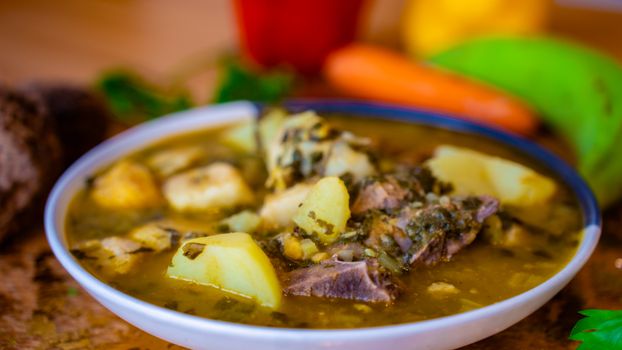
Photo: SAMY PHOTOGRAPHY / Pexels
The diets react (see scores below)
Common Ingredients
- callaloo
- onion
- garlic
- tomato
- Scotch bonnet
- thyme
- scallions
- coconut oil
Specific recipes may vary.
Incompatible with 2 of 11 diets
Diet Ratings
Callaloo (the leafy green, typically amaranth or taro leaves) is a low-carb, fiber-rich vegetable that is generally keto-friendly on its own. The dish is cooked in coconut oil, which is an excellent keto fat. However, the inclusion of tomato and onion adds moderate net carbs that require portion awareness. A standard serving of this dish would likely contribute 6-10g net carbs depending on portion size and the ratio of ingredients, which is manageable within a daily keto budget but not negligible. The scotch bonnet, thyme, scallions, and garlic are used in small quantities and contribute minimally to carb count. This dish is a reasonable keto side in moderate portions, but could push limits if consumed in large quantities alongside other carb-containing foods.
Strict keto practitioners may flag this dish due to the tomato and onion content, arguing that these ingredients add up quickly and should be eliminated or minimized even in vegetable sides. Some clinical keto protocols targeting very low carb thresholds (under 20g/day) would recommend caution and strict portion control.
This Caribbean callaloo dish is entirely plant-based. Callaloo (amaranth or taro leaves) is a nutritious leafy green, and every other ingredient — onion, garlic, tomato, Scotch bonnet pepper, thyme, scallions, and coconut oil — is fully vegan. There are no animal products, animal-derived ingredients, or ethically contested components in this preparation. The dish is built from whole plant foods with minimal processing, making it an excellent fit for both vegan and whole-food plant-based diets. Note that some traditional Caribbean callaloo recipes include saltfish, crab, or pig tail, but this version explicitly contains none of those, so it scores very highly.
Callaloo (the leafy green vegetable, typically amaranth leaves or taro leaves depending on regional variation) is a whole, unprocessed plant food well within paleo guidelines. Every ingredient in this dish is paleo-approved: callaloo greens, onion, garlic, tomato, Scotch bonnet pepper, thyme, and scallions are all vegetables, herbs, or spices available to hunter-gatherers. Coconut oil is an explicitly approved fat in paleo. There are no grains, legumes, dairy, refined sugars, seed oils, or processed ingredients. This is a clean, whole-food vegetable side dish that aligns strongly with paleo principles.
Callaloo is an excellent Mediterranean-aligned dish in most respects: it is entirely plant-based, featuring leafy greens (callaloo/amaranth or taro leaves), aromatics (onion, garlic, scallions), vegetables (tomato, Scotch bonnet), and herbs (thyme) — all strongly encouraged foods. The single point of contention is coconut oil. Extra virgin olive oil is the canonical fat of the Mediterranean diet, and coconut oil — while plant-derived — is high in saturated fat and not part of the traditional Mediterranean culinary tradition. Most clinical Mediterranean diet guidelines would flag coconut oil as inconsistent with the diet's cardiovascular principles. Were olive oil substituted, this dish would easily score 8-9 as a near-ideal plant-forward side. The coconut oil prevents a full 'approve' under strict interpretation.
Some modern Mediterranean diet practitioners argue that unrefined coconut oil, as a minimally processed plant fat, is acceptable in small amounts, particularly when the overall dish is vegetable-forward and nutrient-dense. Traditional Caribbean and some Southeast Asian dietary patterns that overlap with Mediterranean principles (high plant intake, legumes, seafood) have long used coconut oil without adverse outcomes in population studies.
Callaloo is entirely plant-based, containing zero animal products. Every single ingredient — callaloo leaves (amaranth or taro leaves), onion, garlic, tomato, Scotch bonnet pepper, thyme, scallions, and coconut oil — is plant-derived. This dish is completely incompatible with the carnivore diet at every level, including even the most liberal 'animal-based' interpretations. Coconut oil is a plant oil, all vegetables and herbs are excluded, and there is no animal protein or fat present whatsoever.
Callaloo is a leafy green vegetable (amaranth leaves or taro leaves depending on the Caribbean region), and all ingredients in this dish are fully Whole30 compliant. Callaloo leaves, onion, garlic, tomato, Scotch bonnet pepper, thyme, scallions, and coconut oil are all whole, unprocessed foods explicitly allowed on the Whole30 program. There are no grains, legumes, dairy, added sugars, alcohol, or any other excluded ingredients present. This is a clean, vegetable-forward side dish that aligns perfectly with the program's intent.
This Caribbean callaloo dish contains multiple high-FODMAP ingredients that make it unsuitable during the elimination phase. Garlic is one of the highest-FODMAP foods tested by Monash University, containing significant fructans even in small amounts. Onion is similarly very high in fructans and is a major FODMAP offender. Scallions (spring onions) are also high-FODMAP in their white/bulb portions, which are typically used in Caribbean cooking. These three allium-family ingredients alone are sufficient to classify this dish as high-FODMAP. The callaloo leaf itself (amaranth or taro leaves depending on the regional variety) has limited Monash testing data, adding uncertainty. Tomato, coconut oil, thyme, and Scotch bonnet pepper are generally low-FODMAP and do not contribute to the problem. However, the combination of garlic, onion, and scallion bulbs creates an unavoidably high-FODMAP dish as traditionally prepared.
Callaloo is an excellent DASH-aligned leafy green — rich in potassium, magnesium, calcium, and fiber, closely resembling amaranth or taro leaves. Most ingredients (onion, garlic, tomato, Scotch bonnet, thyme, scallions) are DASH-approved vegetables and aromatics with no sodium concerns. The one problematic ingredient is coconut oil, a tropical oil high in saturated fat that DASH explicitly limits. The AHA and NIH DASH guidelines recommend avoiding tropical oils (coconut, palm, palm kernel) in favor of unsaturated vegetable oils. Coconut oil's presence keeps this dish from a full 'approve,' though the overall dish remains vegetable-forward and nutrient-dense. Substituting coconut oil with olive or canola oil would elevate this to a strong DASH approve (score 8-9).
NIH DASH guidelines explicitly categorize tropical oils as foods to limit due to saturated fat content. However, some updated clinical interpretations note that coconut oil contains medium-chain triglycerides (MCTs) that may be metabolized differently than long-chain saturated fats, and given the small amount typically used in callaloo, some DASH-oriented practitioners may not consider it disqualifying in an otherwise highly nutritious dish.
Callaloo is a leafy green vegetable dish that aligns well with Zone principles in most respects — callaloo leaves are low-glycemic, nutrient-dense, and polyphenol-rich, exactly the kind of colorful vegetable Dr. Sears emphasizes. Aromatics like onion, garlic, tomato, scallions, and thyme are all Zone-favorable low-glycemic carbohydrate sources. The main caution flag is coconut oil, which is high in saturated fat rather than the monounsaturated fats (olive oil, avocado, almonds) that Sears consistently recommends. Early Zone writings strictly limited saturated fat, and coconut oil — despite its popularity in wellness circles — doesn't fit the monounsaturated fat profile Sears prescribes. The dish also lacks protein, making it incomplete as a Zone meal; it would need a lean protein source to form a proper Zone block combination. As a side dish providing primarily carbohydrate blocks from favorable vegetables, it's quite usable, but the coconut oil introduces a fat-quality concern that prevents a full approval. Substituting olive oil would push this toward an 8.
Some Zone practitioners following Sears' later anti-inflammatory work (e.g., 'The Zone Diet' updates and Omega Rx Zone) may accept small amounts of coconut oil more readily, as the anti-inflammatory conversation has evolved. Medium-chain triglycerides in coconut oil are metabolized differently than long-chain saturated fats, and some argue a modest amount poses little practical concern in an otherwise vegetable-heavy dish. However, Sears' published materials consistently favor monounsaturated fats and do not endorse coconut oil as a preferred Zone fat source.
Callaloo is a leafy green vegetable (typically amaranth or taro leaves) that is rich in vitamins A, C, and K, along with iron, calcium, and antioxidants — a strong anti-inflammatory base. The supporting aromatics — garlic, onion, tomato, scallions, and thyme — all contribute polyphenols, flavonoids, and antioxidant compounds that are well-regarded in anti-inflammatory nutrition. Scotch bonnet pepper contains capsaicin, which has documented anti-inflammatory properties, and is closely related to chili pepper, an emphasized spice in anti-inflammatory frameworks. The one ingredient that introduces complexity is coconut oil: it is high in saturated fat (primarily lauric acid), and most anti-inflammatory guidance — including Dr. Weil's framework — recommends limiting saturated fat sources and favoring extra virgin olive oil instead. However, coconut oil is used here as a cooking fat for a vegetable dish, so the overall quantity is likely modest, and the rest of the ingredient profile is strongly anti-inflammatory. Overall, this is a nutrient-dense, plant-forward dish with broad anti-inflammatory credentials, modestly tempered by the coconut oil.
The coconut oil creates a meaningful split: mainstream anti-inflammatory protocols and Dr. Weil's pyramid recommend limiting saturated fats including coconut oil, favoring EVOO instead. However, some ancestral and whole-food-based anti-inflammatory advocates argue that unrefined virgin coconut oil's medium-chain triglycerides (MCTs) and lauric acid are metabolized differently than long-chain saturated fats and do not meaningfully raise inflammatory markers — making it acceptable in traditional culinary contexts like this dish.
Callaloo (the leafy green, typically amaranth or taro leaves) is a nutrient-dense, high-fiber vegetable that is generally GLP-1 friendly — it provides iron, calcium, folate, and meaningful fiber in a low-calorie package. The aromatics (onion, garlic, tomato, scallions, thyme) add micronutrients with minimal caloric cost. The two flags here are the Scotch bonnet pepper and the coconut oil. Scotch bonnet is one of the hottest peppers commonly used in cooking and can worsen reflux, nausea, and GI irritation — all of which are already elevated risks on GLP-1 medications. Coconut oil is a saturated fat, which the guidelines flag as a concern for worsening GLP-1 GI side effects. The dish also has no meaningful protein source, making it a poor standalone choice for a patient who needs 15–30g protein per meal. As a side dish paired with a high-protein main, it earns its place — the fiber and micronutrient density are real assets. But the Scotch bonnet and coconut oil together prevent a full approve.
Some GLP-1-focused dietitians accept coconut oil in small culinary amounts (1–2 tsp across a full dish) as the saturated fat load per serving is modest, and would rate this higher if the Scotch bonnet is reduced or omitted. Individual heat tolerance varies significantly — patients who tolerated spicy food well before starting GLP-1s may still tolerate a small amount, while others find any Scotch bonnet triggers nausea or reflux on medication.
*See how scores were generated at our methodology page.
Nutritional profile
Six traits that cut across every diet.
Fiber & Plants
How much whole-plant food and fiber it delivers.
Healthy Fats
The quality of its fats (unsaturated, omega-3).
Whole / Unprocessed
How close it is to its natural, unprocessed form.
Gut Gentle
How easy it is on digestion (low FODMAP, few irritants).
Low Glycemic
How little it spikes your blood sugar.
Protein Density
How much protein it packs per calorie.
Controversy Index
Higher controversy = more disagreement between diets.
Diet-Specific Tips
 Keto — 5/10
View tips
- Callaloo leaves are a low-carb, fiber-rich leafy green — net carbs are minimal
- Coconut oil is an ideal keto fat source
- Tomato adds approximately 2-3g net carbs per serving
- Onion contributes moderate carbs (~2-4g net carbs per serving) and should be used sparingly
- Scotch bonnet, garlic, thyme, and scallions are used in small amounts with negligible carb impact
- Overall net carbs per serving are manageable but require portion control
- No grains, added sugars, or high-carb staples present
 Vegan — 9/10
View tips
- Callaloo leaves are a nutrient-dense whole plant food
- All aromatics (onion, garlic, scallions, thyme) are plant-based
- Coconut oil is plant-derived — no dairy butter or animal fat used
- Scotch bonnet and tomato are unambiguously vegan
- No animal proteins added (no saltfish, crab, or pork, which are common in some regional variants)
- Dish is minimally processed and aligns with whole-food plant-based principles
 Paleo — 9/10
View tips
- Callaloo greens are whole unprocessed leafy vegetables — fully paleo approved
- Coconut oil is an explicitly recommended paleo-friendly fat
- All aromatics (onion, garlic, scallions) are paleo-approved vegetables
- Scotch bonnet pepper, thyme are natural herbs/spices with no paleo concerns
- No grains, legumes, dairy, seed oils, or processed ingredients present
- Dish is minimally processed and cooked in a traditional whole-food manner
 Mediterranean — 6/10
View tips
- Callaloo leaves are highly nutritious leafy greens, fully aligned with Mediterranean plant emphasis
- All other ingredients (onion, garlic, tomato, herbs, Scotch bonnet) are Mediterranean staples
- No animal products, processed ingredients, added sugars, or refined grains
- Coconut oil is high in saturated fat and not part of traditional Mediterranean culinary tradition
- Extra virgin olive oil would be the preferred fat under strict Mediterranean diet guidelines
- Dish is otherwise an excellent plant-based preparation
 Whole30 — 9/10
View tips
- Callaloo (leafy green vegetable) is fully Whole30 compliant
- Coconut oil is an approved natural fat
- All aromatics (onion, garlic, scallions, thyme) are allowed herbs and vegetables
- Scotch bonnet pepper is a whole food spice/pepper — compliant
- No excluded ingredients of any kind present
- Dish represents whole, minimally processed food — aligns with program spirit
 DASH — 5/10
View tips
- Callaloo leaves are nutrient-dense — high in potassium, magnesium, calcium, and fiber, core DASH nutrients
- Coconut oil is a tropical oil high in saturated fat, explicitly limited by NIH DASH guidelines
- All other ingredients (onion, garlic, tomato, Scotch bonnet, thyme, scallions) are DASH-approved
- No added sodium in this preparation — a significant DASH advantage
- Dish is vegetable-forward with no red meat, refined grains, or added sugar
- Substituting olive or canola oil for coconut oil would make this a strong DASH-approved dish
 Zone — 6/10
View tips
- Callaloo leaves are low-glycemic, polyphenol-rich leafy greens — ideal Zone carbohydrate source
- Aromatics (onion, garlic, tomato, scallions) are all Zone-favorable low-GI vegetables
- Coconut oil is high in saturated fat, not the monounsaturated fat Dr. Sears recommends
- No protein present — dish is incomplete as a Zone meal and must be paired with lean protein
- As a vegetable side dish providing carbohydrate blocks, it is highly usable within a Zone meal structure
- Substituting olive oil for coconut oil would significantly improve Zone compatibility
 Anti-Inflammatory — 8/10
View tips
- Callaloo (amaranth/taro leaves) is rich in vitamins A, C, K, iron, calcium, and antioxidants
- Garlic has well-documented anti-inflammatory and immune-modulating properties
- Scotch bonnet pepper provides capsaicin, a clinically studied anti-inflammatory compound
- Tomato contributes lycopene and vitamin C, both associated with reduced inflammatory markers
- Thyme and scallions add additional polyphenols and antioxidant flavonoids
- Coconut oil is high in saturated fat and is not preferred in mainstream anti-inflammatory guidance; EVOO would be a superior choice
- Dish is entirely plant-based with no processed ingredients, added sugars, or refined carbohydrates
 GLP-1 Friendly — 5/10
View tips
- High-fiber leafy green — supports digestion and constipation prevention
- Nutrient-dense per calorie — iron, folate, calcium
- No protein — must be paired with a strong protein source to meet per-meal targets
- Scotch bonnet pepper — significant GI irritation risk on GLP-1 medications
- Coconut oil — saturated fat, caution flag for GI side effects
- Small serving of this dish is realistic and portion-friendly
- Aromatics (garlic, onion, tomato) add nutritional value with minimal downside