Caribbean
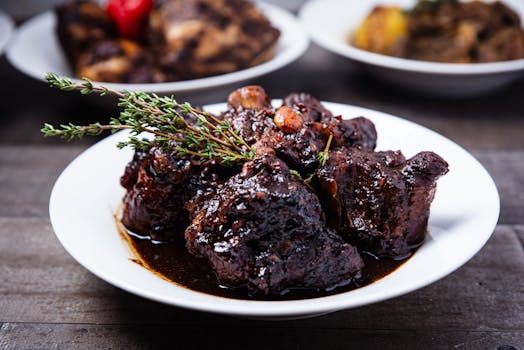
Jamaican Oxtail Stew
The diets react (see scores below)
Common Ingredients
- oxtail
- butter beans
- onion
- scallions
- thyme
- Scotch bonnet
- allspice
- browning sauce
Specific recipes may vary.
Incompatible with 8 of 11 diets
Diet Ratings
Jamaican Oxtail Stew has a strong keto foundation — oxtail is a fatty, collagen-rich beef cut that is excellent for keto — but two ingredients create meaningful carb concerns. Butter beans (lima beans) are legumes with approximately 20-25g net carbs per half-cup serving, which alone can push or exceed the daily keto limit in a typical stew portion. Browning sauce (e.g., Grace or Kitchen Bouquet) often contains caramel coloring, sugar, and molasses, adding hidden carbs. The aromatics (onion, scallions, thyme, Scotch bonnet, allspice) contribute minor carbs but are manageable. The dish as traditionally prepared is borderline-to-incompatible due to the butter beans; however, with significant portion control or substituting butter beans with a low-carb vegetable, the oxtail base itself is keto-friendly.
Strict keto practitioners would rate this as 'avoid' outright, arguing that butter beans are a high-carb legume with no place in ketogenic eating regardless of portion size, and that browning sauce introduces sugars that have zero-tolerance status under clean keto protocols. They would view any portion as risky for disrupting ketosis.
Jamaican Oxtail Stew is built on oxtail, which is a bovine tail — a direct animal product and the centerpiece of this dish. There is no ambiguity here: oxtail is beef, a clear animal product that is entirely incompatible with a vegan diet. The remaining ingredients (butter beans, onion, scallions, thyme, Scotch bonnet, allspice, browning sauce) are plant-based, but the primary protein makes this dish wholly non-vegan. No vegan version of this dish can retain oxtail; a plant-based adaptation would require a full protein substitution such as jackfruit or mushrooms.
Jamaican Oxtail Stew contains two clear paleo violations that place it firmly in the avoid category. Butter beans are legumes, which are explicitly excluded from the paleo diet due to their lectin and phytate content. Browning sauce (typically made from caramel color, additives, and often contains added salt, sugar, and preservatives) is a processed condiment incompatible with paleo principles. The oxtail itself is an excellent paleo protein, and the aromatics — onion, scallions, thyme, Scotch bonnet, and allspice — are all paleo-approved whole foods. However, the legume and processed sauce components are non-negotiable violations with strong consensus across paleo authorities.
Jamaican Oxtail Stew is built around oxtail, a fatty cut of beef that is among the most calorie-dense and saturated-fat-heavy red meats available. The Mediterranean diet explicitly limits red meat to a few times per month, and high-fat cuts like oxtail are particularly discouraged. Browning sauce is a processed condiment that adds refined sugars and artificial additives, further conflicting with Mediterranean principles. While the dish does include beneficial elements — butter beans (legumes), onion, scallions, thyme, and Scotch bonnet (vegetables and aromatics) — these cannot offset the primary protein source. The dish also lacks olive oil as the cooking fat and is not a plant-forward preparation. It is a culturally rich dish but fundamentally misaligned with Mediterranean dietary guidelines.
While oxtail itself is an excellent carnivore food — a collagen-rich, fatty ruminant cut that would score a 9-10 on its own — this Jamaican Oxtail Stew is heavily loaded with plant-based ingredients that make it incompatible with the carnivore diet. Butter beans are legumes (explicitly excluded), onion and scallions are vegetables, thyme and allspice are plant-derived spices, Scotch bonnet is a plant pepper, and browning sauce typically contains caramel color, vegetable extracts, and sugar. The dish is fundamentally a plant-forward stew that happens to contain meat, not a carnivore-compatible preparation. There is no meaningful way to consume this dish as prepared while adhering to carnivore principles.
Jamaican Oxtail Stew has two significant compliance issues. First, butter beans are legumes — unlike green beans, sugar snap peas, or snow peas (the only explicitly excepted legumes), butter beans (lima beans) are fully excluded on Whole30. Second, 'browning sauce' is a critical problem: commercial browning sauces (e.g., Grace, Kitchen Bouquet, Gravy Master) typically contain caramel color, molasses, corn syrup, or other added sugars, and sometimes gluten-based ingredients. Unless a verified compliant homemade browning substitute is used, this ingredient alone disqualifies the dish. The remaining ingredients — oxtail, onion, scallions, thyme, Scotch bonnet, and allspice — are all Whole30-compliant.
A practitioner could argue the dish deserves a 'caution' rating if the butter beans are simply omitted and a compliant browning substitute (e.g., coconut aminos-based or balsamic-based darkening agent) is used — the stew's core character would remain intact. However, as presented with standard butter beans and commercial browning sauce, the official Whole30 rules clearly exclude this dish without significant modification.
Jamaican Oxtail Stew contains multiple high-FODMAP ingredients that make it unsuitable during the elimination phase. Onion is one of the highest-FODMAP foods tested by Monash University, rich in fructans at virtually any cooking quantity. Butter beans (lima beans) are high in GOS (galacto-oligosaccharides) and are rated high-FODMAP at typical serving sizes — Monash lists them as high-FODMAP even in small portions. The oxtail itself is low-FODMAP as a plain beef cut, and scallions (green tops only) can be low-FODMAP, but traditional recipes use the whole scallion including the white bulb, which contains fructans. Browning sauce (such as Grace or Worcestershire-style) often contains onion and garlic extracts, adding further fructan load. Thyme, Scotch bonnet, and allspice are low-FODMAP spices. However, the combination of whole onion and butter beans alone disqualifies this dish during elimination, regardless of other ingredient adjustments.
Jamaican Oxtail Stew is fundamentally incompatible with DASH diet principles. Oxtail is a high-fat cut of beef with significant saturated fat content — it is red meat that is explicitly limited on DASH. The cut is fatty by nature, and traditional preparation involves slow braising that renders considerable saturated fat into the dish. Browning sauce adds meaningful sodium on top of what is already a sodium-heavy preparation. DASH guidelines explicitly limit red meat, high-saturated-fat foods, and high-sodium dishes. While some ingredients are DASH-friendly (butter beans provide fiber and potassium; onion, scallions, thyme, Scotch bonnet, and allspice are low-sodium flavor enhancers; allspice itself is a beneficial herb), the primary protein source undermines the entire dish. The combination of high saturated fat from oxtail and sodium from browning sauce places this firmly in the avoid category.
Jamaican Oxtail Stew presents a mixed Zone Diet profile. The protein source — oxtail — is a fatty cut of beef with significantly higher saturated fat than Zone-preferred lean proteins like skinless chicken or fish. A typical serving delivers meaningful protein but comes packaged with substantial saturated fat and collagen-rich connective tissue, making the fat block accounting difficult and skewing the meal away from the ideal 30% fat from monounsaturated sources. Butter beans are a Zone-acceptable legume carbohydrate (low-glycemic, fiber-rich, net carbs manageable in small portions), and the aromatics — onion, scallions, thyme, Scotch bonnet — are favorable low-glycemic vegetables with polyphenol benefits Sears would appreciate. Browning sauce typically contains caramel color and small amounts of sugar, contributing minimal but non-zero high-glycemic carbs. The core problem is the fat profile: oxtail's saturated fat load is hard to offset without dramatically reducing portion size, and the dish is traditionally served over white rice (not included here but culturally expected), which would compound the glycemic challenge. As a standalone stew without rice, it can fit Zone blocks with strict 2–3 oz protein portions, but the saturated fat content and absence of Zone-ideal monounsaturated fats make it a 'caution' food requiring careful management.
Some Zone practitioners following Sears' later anti-inflammatory framework (Zone Diet and Toxic Fat, 2008) note that Sears softened his earlier strict stance on saturated fat, acknowledging that the inflammatory impact of saturated fat is less critical than the omega-6 to omega-3 ratio. Oxtail is not particularly high in omega-6 fatty acids, and if the stew is prepared without added seed oils, the inflammatory burden may be lower than the raw saturated fat numbers suggest. In this reading, small portions of oxtail stew — particularly with the fiber from butter beans moderating glycemic response — could be treated as a 4-block Zone meal with acceptable macros.
Jamaican Oxtail Stew presents a mixed anti-inflammatory profile. On the pro-inflammatory side, oxtail is a fatty cut of beef — red meat is classified as a 'limit' food in anti-inflammatory frameworks due to saturated fat content and arachidonic acid, which can promote inflammatory signaling. Browning sauce (e.g., Grace or Kitchen Bouquet) typically contains caramel color, additives, and sometimes added sugars, nudging the dish slightly toward processed-food territory. On the anti-inflammatory side, the dish contains several genuinely beneficial ingredients: butter beans provide plant-based protein, fiber, and are in the legume category that anti-inflammatory frameworks emphasize; thyme is a recognized anti-inflammatory herb with rosmarinic acid; allspice contains eugenol, a phenolic compound with documented anti-inflammatory activity; Scotch bonnet peppers are exceptionally high in capsaicin and vitamin C; onions and scallions supply quercetin and other flavonoids; and traditional slow-cooking of oxtail yields collagen/gelatin, which some researchers associate with gut lining support. The dish is not fried and does not use seed oils or refined carbohydrates. The primary concern is the oxtail itself — a high-fat red meat that anti-inflammatory guidance recommends limiting rather than avoiding outright. Occasional consumption of this dish, particularly in modest portions, is within the spirit of the anti-inflammatory framework's 'limit' category for red meat.
Dr. Weil's Anti-Inflammatory Pyramid places red meat firmly in the 'limit' tier (a few times per month at most), and oxtail's high saturated fat content would concern stricter anti-inflammatory practitioners who align with AIP or Mediterranean-style protocols. However, some researchers in the ancestral health and nose-to-tail nutrition space argue that gelatinous cuts like oxtail — rich in glycine — may actually modulate inflammatory pathways, partly counterbalancing the arachidonic acid content when consumed as part of a whole-food, vegetable-rich meal.
Jamaican Oxtail Stew is problematic for GLP-1 patients primarily due to oxtail being one of the fattiest cuts of beef available — it is exceptionally high in saturated fat and collagen-rich connective tissue that requires long braising to break down, resulting in a very rich, heavy, high-fat dish. A typical serving delivers significant saturated fat load, which directly worsens GLP-1 side effects including nausea, bloating, and reflux due to slowed gastric emptying. The Scotch bonnet pepper adds meaningful heat that can further aggravate reflux and GI discomfort. Browning sauce contributes minimal nutrition and often contains added sugar and sodium. On the positive side, butter beans add fiber and some plant protein, and the dish does provide protein overall — but the fat-to-protein ratio is unfavorable compared to lean protein sources. The slow-braised preparation means some fat renders out, but oxtail remains a high-fat protein source even after cooking. This dish is not small-portion friendly in its traditional form, as the richness and bone-to-meat ratio mean larger volumes are needed to hit protein targets.
Some GLP-1-focused clinicians may allow oxtail occasionally if fat is skimmed aggressively after braising and refrigerating overnight, arguing the collagen-rich broth and butter beans provide meaningful protein and fiber in a tolerable slow-cooked format. However, most GLP-1 nutrition practitioners would flag the saturated fat burden and spice level as too high-risk for patients already managing GI side effects.
*See how scores were generated at our methodology page.
Nutritional profile
Six traits that cut across every diet.
Fiber & Plants
How much whole-plant food and fiber it delivers.
Healthy Fats
The quality of its fats (unsaturated, omega-3).
Whole / Unprocessed
How close it is to its natural, unprocessed form.
Gut Gentle
How easy it is on digestion (low FODMAP, few irritants).
Low Glycemic
How little it spikes your blood sugar.
Protein Density
How much protein it packs per calorie.
Controversy Index
Higher controversy = more disagreement between diets.
Diet-Specific Tips
 Keto — 4/10
View tips
- Oxtail is high-fat, high-collagen beef — excellent keto protein source
- Butter beans (lima beans) are legumes with ~20-25g net carbs per half-cup — major concern
- Browning sauce likely contains added sugar/molasses — hidden carb source
- Onion and scallions add minor carbs but are manageable in small amounts
- Traditional serving portion of this stew likely exceeds 20-50g daily net carb limit
- Dish can be modified (omit butter beans, skip browning sauce) to become keto-friendly
 Zone — 4/10
View tips
- Oxtail is a high-saturated-fat protein, not Zone-preferred lean protein
- Butter beans are low-glycemic legumes acceptable as Zone carb blocks
- Aromatics (onion, scallions, Scotch bonnet, thyme) are favorable low-GI polyphenol sources
- Browning sauce adds trace sugar/caramel color — minimal glycemic impact
- No monounsaturated fat sources present in the dish
- Traditionally paired with white rice (not listed) which would significantly worsen Zone ratio
- Portion control of oxtail (2–3 oz) is essential to manage fat blocks
- Collagen and gelatinous fat in oxtail complicates accurate fat block calculation
 Anti-Inflammatory — 4/10
View tips
- Oxtail is a high-fat red meat — classified as 'limit' in anti-inflammatory frameworks due to saturated fat and arachidonic acid
- Butter beans are an anti-inflammatory legume: high fiber, plant protein, no inflammatory profile
- Scotch bonnet peppers are very high in capsaicin and vitamin C — strong anti-inflammatory credentials
- Thyme and allspice contain rosmarinic acid and eugenol respectively — both documented anti-inflammatory phytochemicals
- Onions and scallions contribute quercetin and other flavonoids
- Browning sauce introduces minor processed-food concerns (additives, caramel color, possible added sugars)
- Slow-cooked collagen from oxtail may support gut lining integrity — potential indirect anti-inflammatory benefit
- No seed oils, no refined carbohydrates, no trans fats — dish avoids several major anti-inflammatory red flags