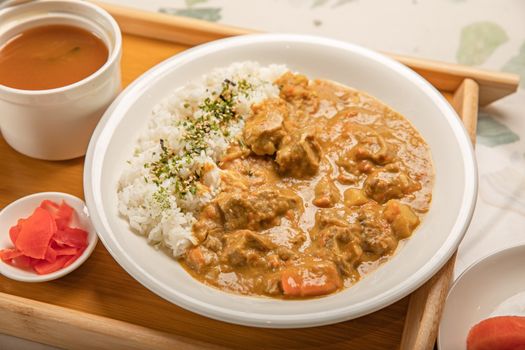
Photo: Change C.C / Pexels
Japanese
Japanese Curry Rice
The diets react (see scores below)
Common Ingredients
- chicken thighs
- potatoes
- carrots
- onion
- Japanese curry roux
- short-grain rice
- apple
- ginger
Specific recipes may vary.
Incompatible with 7 of 11 diets
Diet Ratings
Japanese Curry Rice is fundamentally incompatible with a ketogenic diet. The dish is built on multiple high-carbohydrate components: short-grain rice alone provides 45-50g of net carbs per cup, completely blowing the daily keto limit on its own. Potatoes add another 15-20g net carbs per serving, carrots contribute additional sugars and carbs, and the Japanese curry roux (S&B or similar brands) typically contains wheat flour, sugar, and starch as primary thickeners. The addition of apple introduces fruit sugars. Every major component of this dish — the grain base, starchy vegetables, fruit, and processed roux — violates keto principles. Even the smallest 'tasting' portion would likely exceed the daily net carb threshold. There is no realistic portion size that makes this dish keto-compatible without fundamentally deconstructing and replacing its core ingredients.
Japanese Curry Rice as described contains chicken thighs, a direct animal product, making it immediately incompatible with a vegan diet. Additionally, commercial Japanese curry roux (such as S&B Golden Curry or House Vermont Curry) typically contains animal-derived ingredients including dairy (butter, milk powder) and sometimes meat extracts, compounding the non-vegan status. The remaining ingredients — potatoes, carrots, onion, apple, ginger, and short-grain rice — are all plant-based, but the dish as a whole cannot be considered vegan in its standard form.
Japanese Curry Rice contains multiple hard paleo violations. Short-grain rice is a grain, excluded by virtually all paleo frameworks. Japanese curry roux is a highly processed product typically made from wheat flour, refined vegetable oils (often palm or seed oils), sugar, and artificial additives — a trifecta of paleo no-gos. These two ingredients alone are disqualifying. Potatoes add a debated element, but they are a minor concern compared to the grain and processed roux. The paleo-compliant ingredients — chicken thighs, carrots, onion, apple, and ginger — are solid, but they cannot redeem a dish fundamentally built on rice and a processed grain-based sauce block.
Japanese Curry Rice conflicts with Mediterranean diet principles on multiple fronts. The Japanese curry roux is a heavily processed ingredient, typically made from refined wheat flour, hydrogenated vegetable oils or animal fats, and high levels of sodium and added sugars — placing it firmly in the 'avoid' category for processed foods. Short-grain white rice is a refined grain with no whole-grain equivalent in this preparation. While the vegetables (potatoes, carrots, onion), apple, and ginger are positive Mediterranean-compatible elements, and chicken thighs are an acceptable moderate protein, these positives are overwhelmed by the processed roux and refined grain base. The dish has no olive oil, no legumes, and no whole grains, while centering around a processed sauce product not recognized in any Mediterranean tradition.
Japanese Curry Rice is entirely incompatible with the carnivore diet. While chicken thighs are a carnivore-approved protein, every other component of this dish is plant-derived or heavily processed with plant-based ingredients. Rice is a grain and a core excluded food. Potatoes, carrots, and onion are vegetables. Apple is a fruit. Ginger is a plant-based spice. Japanese curry roux is a processed block containing wheat flour, vegetable oils, sugar, and a blend of plant-derived spices and additives. This dish is essentially a grain-and-vegetable stew built around a processed plant-based sauce — the opposite of carnivore principles. The only salvageable element would be the chicken thighs in isolation.
Japanese Curry Rice fails Whole30 compliance on two major counts. First, Japanese curry roux (e.g., S&B Golden Curry, House Vermont Curry) is a heavily processed block that almost universally contains wheat flour, sugar, and often dairy or other excluded ingredients — all of which are explicitly banned on Whole30. Second, short-grain rice is a grain and is categorically excluded from the program. Even setting aside the roux and rice, the dish as traditionally prepared cannot be made compliant without fundamentally changing its identity. The remaining individual ingredients — chicken thighs, potatoes, carrots, onion, apple, and ginger — are all Whole30-compliant on their own, but the defining components of this dish (the roux and the rice) are both excluded.
Japanese Curry Rice as traditionally prepared contains multiple high-FODMAP ingredients that make it unsuitable for the elimination phase. The most significant offenders are: (1) Onion — a major source of fructans, high-FODMAP even in small amounts; (2) Japanese curry roux (e.g., S&B, House Vermont) — commercially prepared blocks almost universally contain onion powder and/or garlic powder, both extremely high in fructans, as well as wheat flour as a thickener; (3) Apple — contains excess fructose and sorbitol, high-FODMAP at typical serving sizes; (4) Garlic is implied in most curry roux formulations. Chicken thighs and short-grain rice are low-FODMAP. Potatoes are low-FODMAP at standard servings (~1 medium). Carrots are low-FODMAP. Ginger is low-FODMAP in culinary amounts. However, the combination of onion, commercial curry roux (fructans + wheat), and apple creates an unavoidable high-FODMAP load. Even if onion were substituted with the green tops of spring onions and apple omitted, the commercial roux alone would disqualify this dish during elimination phase.
Japanese Curry Rice presents a mixed DASH profile. The dish contains several DASH-friendly components — chicken thighs provide lean protein, potatoes and carrots contribute potassium and fiber, onions and apple add nutrients and natural sweetness, and ginger has anti-inflammatory properties. However, the Japanese curry roux is the primary concern: commercial roux blocks (e.g., S&B, House Foods) are typically high in sodium (400–700mg per serving), saturated fat from palm oil and/or beef tallow, and refined starches. A typical serving can contain 800–1,200mg of sodium, approaching or exceeding half the standard DASH daily limit in a single meal. Chicken thighs, while a reasonable protein, have higher saturated fat than chicken breast. Short-grain white rice lacks the fiber of brown rice or whole grains emphasized by DASH. The dish is not inherently incompatible with DASH if portion-controlled and modified (homemade low-sodium roux, brown rice, chicken breast), but as commonly prepared it falls into caution territory due to sodium and saturated fat load from the roux.
NIH DASH guidelines would flag this dish primarily for its high sodium and saturated fat content from commercial curry roux, placing it firmly in the caution or avoid range. However, some DASH-oriented dietitians note that when prepared with a homemade or low-sodium roux, lean chicken breast, and brown rice, this dish can align reasonably well with DASH principles — the vegetables, apple, and spices contribute meaningful potassium, fiber, and phytonutrients that DASH emphasizes.
Japanese Curry Rice presents significant Zone Diet challenges. The dish combines multiple high-glycemic carbohydrate sources that stack unfavorably: short-grain white rice is one of the highest-glycemic staple carbs (GI ~72), potatoes are explicitly listed as an 'unfavorable' carb in Sears' Zone framework, and Japanese curry roux typically contains sugar, starch thickeners, and is calorie-dense with saturated fat. Onions, carrots, apple, and ginger are acceptable Zone carbs but are minor contributors here. The chicken thighs provide reasonable protein but with more saturated fat than Zone-preferred skinless chicken breast. The overall macronutrient ratio of this dish as traditionally prepared skews heavily toward carbohydrates (rice + potatoes + roux starch) with insufficient lean protein and very little monounsaturated fat. A standard serving would far exceed Zone carbohydrate blocks while under-delivering on protein blocks, making the 40/30/30 ratio extremely difficult to achieve. The dish isn't categorically avoid-level — the chicken and vegetables have Zone value — but as a complete dish it scores at the low end of caution rather than a solid caution, because the two primary carbohydrate vehicles (white rice and potatoes) are both explicitly unfavorable in Zone methodology, and combining them makes Zone balancing very difficult without dramatically restructuring the dish.
Some Zone practitioners would argue this dish can be adapted rather than avoided: substituting cauliflower rice for white rice, omitting potatoes, and using a low-sugar curry paste instead of processed roux could transform it into a reasonable Zone meal. Additionally, Sears' later anti-inflammatory writings acknowledge that traditional Asian diets with moderate rice consumption, rich in polyphenols from spices like ginger and turmeric (common in curry), have favorable inflammatory profiles. In that context, a small portion of this dish alongside additional lean protein could fit a Zone-influenced anti-inflammatory approach.
Japanese Curry Rice presents a genuinely mixed anti-inflammatory profile. On the positive side, chicken thighs are a lean poultry protein (moderate category), carrots and onion provide antioxidants and quercetin, ginger is a well-documented anti-inflammatory spice, and apple contributes polyphenols and fiber. The curry spice blend in the roux typically includes turmeric (curcumin), which is one of the most studied anti-inflammatory compounds in nutrition science. However, the dish has several offsetting concerns. Japanese curry roux (e.g., S&B Golden Curry, Vermont Curry) is a highly processed block product containing refined wheat flour, palm oil or partially hydrogenated vegetable fats, added sugars, and artificial additives — all of which are flagged under anti-inflammatory 'avoid' or 'limit' categories. The spice benefits of turmeric and other curry spices in the roux are largely undermined by this processed delivery vehicle. Short-grain white rice is a refined carbohydrate with a high glycemic index, contributing to blood sugar spikes that can promote inflammatory signaling. Potatoes are a starchy nightshade — generally fine for most people but worth noting for those on AIP protocols. The overall dish is comfort food that borrows some anti-inflammatory ingredients but is anchored by a processed roux and refined rice, landing it firmly in the 'caution' zone rather than 'avoid' because the whole food components and spice profile provide meaningful offsetting benefits.
A more lenient reading would note that the spice profile — particularly ginger and turmeric-containing curry powder — provides genuine anti-inflammatory benefit, and that chicken with vegetables over rice is far preferable to ultra-processed alternatives; some anti-inflammatory practitioners would classify this as an acceptable occasional meal. Conversely, stricter anti-inflammatory frameworks (and certainly AIP protocols) would push this closer to 'avoid' due to the processed roux's palm oil, refined flour, added sugars, and potential trans fats in some formulations, as well as the high-glycemic white rice and nightshade potato content.
Japanese curry rice presents a mixed nutritional profile for GLP-1 patients. The dish has meaningful positives — chicken thighs provide protein (though less lean than chicken breast), and vegetables like carrots, onion, and potatoes contribute fiber and micronutrients. Apple and ginger add modest digestive-friendly benefits. However, several factors work against it: Japanese curry roux blocks are heavily processed and typically high in fat, sodium, and refined starch, contributing empty calories with low nutritional density. Short-grain white rice is a refined carbohydrate with minimal fiber, and a standard serving of curry rice is rice-heavy, diluting the protein-per-calorie ratio significantly. Potatoes add starchy carbohydrates on top of the rice, further reducing nutrient density per calorie. The overall fat content from the roux and chicken thighs (skin-on versions especially) can slow digestion further on top of GLP-1-slowed gastric emptying, risking nausea or bloating. Protein per serving is moderate but unlikely to hit the 15–30g target without a generous chicken portion. This dish can be made more GLP-1-friendly with modifications: skinless chicken breast, smaller rice portion or cauliflower rice substitution, reduced roux quantity, and larger vegetable ratio.
Some GLP-1-focused RDs may rate this more favorably because the warm, soft texture is easy to digest and highly palatable for patients struggling with appetite suppression and food aversion — palatability and caloric adequacy matter when patients are eating very little. Others flag the processed roux and refined rice as categorically poor choices for patients who need every calorie to be nutrient-dense.
*See how scores were generated at our methodology page.
Nutritional profile
Six traits that cut across every diet.
Fiber & Plants
How much whole-plant food and fiber it delivers.
Healthy Fats
The quality of its fats (unsaturated, omega-3).
Whole / Unprocessed
How close it is to its natural, unprocessed form.
Gut Gentle
How easy it is on digestion (low FODMAP, few irritants).
Low Glycemic
How little it spikes your blood sugar.
Protein Density
How much protein it packs per calorie.
Controversy Index
Higher controversy = more disagreement between diets.
Diet-Specific Tips
 DASH — 4/10
View tips
- Commercial Japanese curry roux is high in sodium (400–700mg per serving block) — a single meal may approach 800–1,200mg sodium
- Curry roux typically contains palm oil or beef tallow, contributing saturated fat that DASH limits
- Chicken thighs have moderate saturated fat; chicken breast would be more DASH-aligned
- Short-grain white rice is refined and lacks fiber; brown rice would score higher under DASH
- Potatoes, carrots, and onions are DASH-positive vegetables providing potassium and fiber
- Apple and ginger add natural compounds consistent with DASH's emphasis on whole plant foods
- Low-sodium homemade roux version of this dish would score significantly higher (6–7 range)
- Portion size is critical — large servings compound sodium and saturated fat concerns
 Zone — 5/10
View tips
- Short-grain white rice is high-glycemic and a primary 'unfavorable' carb in Zone methodology
- Potatoes are explicitly listed as unfavorable/avoid carbs by Dr. Sears due to high glycemic index
- Japanese curry roux contains added sugars and starch thickeners, adding glycemic load and saturated fat
- Double stacking of two unfavorable carbs (rice + potato) makes Zone block balancing extremely difficult
- Chicken thighs are usable Zone protein but less ideal than skinless breast due to higher saturated fat
- Apple, ginger, carrots, and onion are acceptable Zone carb sources but are overwhelmed by the high-GI staples
- Dish as traditionally prepared likely achieves 60-70% calories from carbohydrates, far exceeding Zone's 40% target
- Could theoretically be Zone-adapted with cauliflower rice and potato substitution, but that is a major recipe transformation
 Anti-Inflammatory — 4/10
View tips
- Ginger: well-established anti-inflammatory spice (gingerols, shogaols)
- Curry roux contains turmeric/curcumin but is delivered via a processed block with palm oil, refined flour, and added sugar
- Japanese curry roux (commercial) is a processed food — contains artificial additives, potentially trans fats in some formulations
- Short-grain white rice is a refined, high-glycemic carbohydrate
- Chicken thighs are acceptable lean poultry (moderate category)
- Carrots, onion, and apple contribute antioxidants, quercetin, and polyphenols
- Potatoes are nightshades — neutral for general population, flagged in autoimmune protocols
- Palm oil in most commercial roux brands is a saturated fat in the 'limit' category
 GLP-1 Friendly — 4/10
View tips
- Curry roux is high in fat, sodium, and refined starch — processed with low nutritional density
- Short-grain white rice is low fiber and contributes significant refined carbohydrates
- Chicken thighs are moderate protein but higher fat than breast; protein per serving depends heavily on chicken-to-rice ratio
- Potatoes add starchy carbohydrate load on top of rice, worsening glycemic and satiety profile
- Fat content from roux plus thighs may worsen GLP-1 GI side effects (nausea, bloating, delayed gastric emptying)
- Vegetables and apple add modest fiber and micronutrients but insufficient to offset negatives
- Dish is portion-sensitive — a small, protein-heavy, rice-light version performs significantly better
- Easily modified: cauliflower rice, chicken breast, reduced roux, and more vegetables can shift this toward caution-high or approve