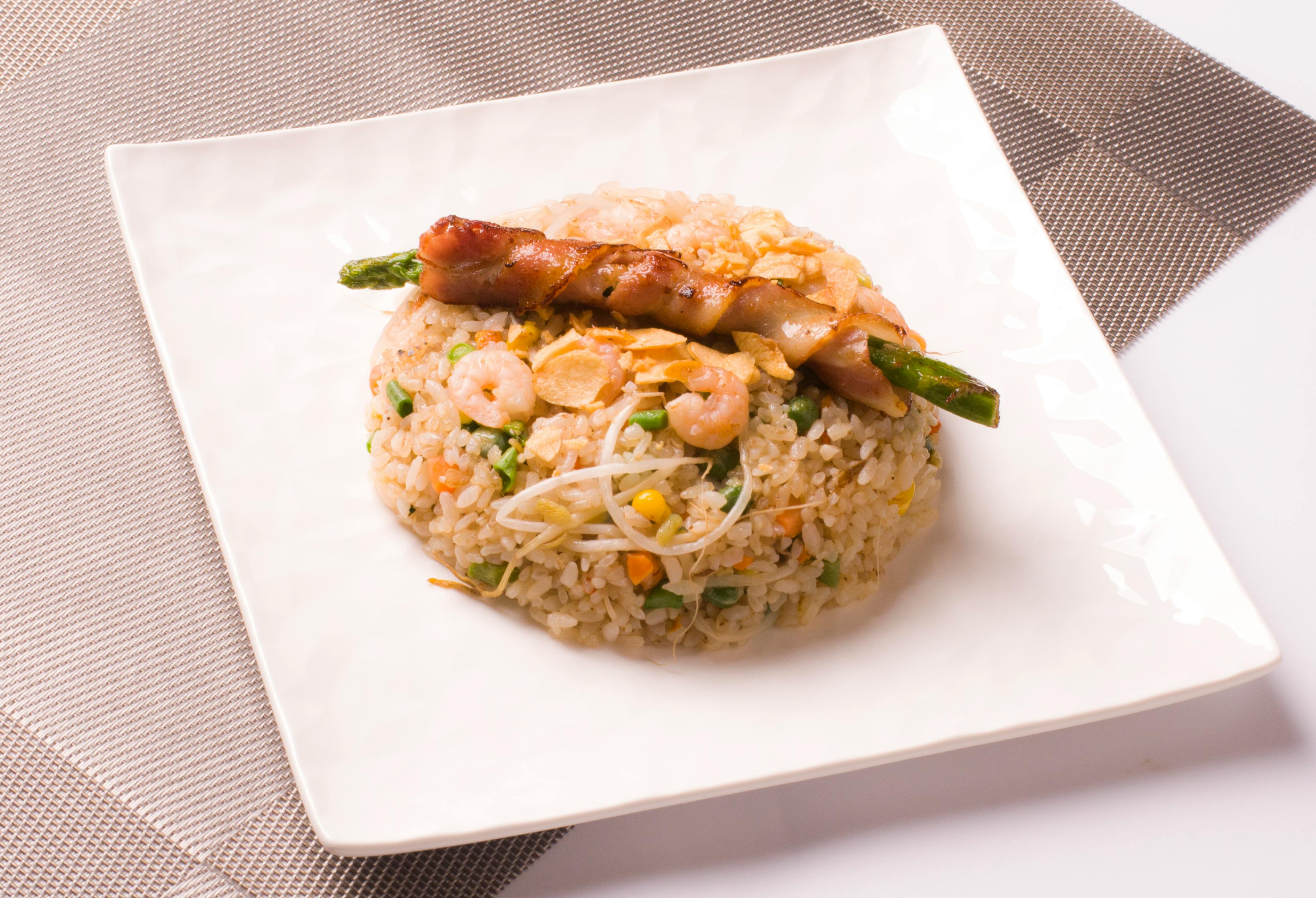
Photo: King David / Pexels
Japanese
Japanese Fried Rice (Chahan)
The diets react (see scores below)
Common Ingredients
- short-grain rice
- eggs
- char siu
- green onions
- soy sauce
- sesame oil
- ginger
- peas
Specific recipes may vary.
Incompatible with 8 of 11 diets
Diet Ratings
Japanese Fried Rice (Chahan) is fundamentally incompatible with a ketogenic diet. The primary ingredient is short-grain rice, one of the highest net-carb foods available, delivering roughly 45-50g of net carbs per cup of cooked rice alone — enough to exceed or saturate the entire daily keto carb budget in a single serving. A standard portion of chahan would typically contain 1.5–2 cups of cooked rice, placing net carbs well above 60-80g, making ketosis impossible. Peas add additional starch and net carbs. Char siu (Chinese BBQ pork) often contains added sugars and honey in its marinade, contributing further sugar. The only keto-friendly elements are eggs, green onions, sesame oil, ginger, and soy sauce (in moderation), but these cannot compensate for the overwhelming carbohydrate load from the rice and peas. This dish cannot be consumed in any reasonable portion without breaking ketosis.
Japanese Fried Rice (Chahan) as described contains two clear animal-derived ingredients: eggs and char siu (Chinese-style BBQ pork). Both are unambiguous animal products that are strictly excluded under any definition of veganism. Eggs are an animal product regardless of farming method, and char siu is a pork-based meat. The remaining ingredients — short-grain rice, green onions, soy sauce, sesame oil, ginger, and peas — are all plant-based, but the presence of eggs and pork makes this dish entirely incompatible with a vegan diet. There is no meaningful debate within the vegan community about either of these ingredients.
Japanese Fried Rice (Chahan) is fundamentally incompatible with the Paleo diet. Short-grain rice is a grain and is excluded under strict paleo rules. Soy sauce contains both soy (a legume) and wheat (a grain), making it doubly non-paleo. Sesame oil is a seed oil on the excluded list. Peas are legumes and also excluded. Char siu (Chinese BBQ pork) is a processed meat typically made with soy sauce, sugar, and other non-paleo additives. With five out of eight ingredients being clear paleo violations — and those five being foundational to the dish's identity — there is no meaningful way to consider this dish paleo-compatible in its standard form.
Japanese Fried Rice (Chahan) conflicts with Mediterranean diet principles on multiple fronts. The primary fat is sesame oil rather than extra virgin olive oil. The grain base is refined short-grain white rice, not a whole grain. Char siu is a processed, sweetened red meat (pork), which falls into the most restricted category — limited to a few times per month. Soy sauce adds significant sodium and is a highly processed condiment foreign to the Mediterranean pattern. While eggs, green onions, peas, and ginger are acceptable or even encouraged, these positive elements are outweighed by the refined grain base, processed red meat, and non-Mediterranean fat source. The dish as a whole represents a pattern that substantially contradicts Mediterranean diet principles.
Japanese Fried Rice (Chahan) is fundamentally incompatible with the carnivore diet. The dish is built around short-grain rice, a grain that is entirely plant-derived and one of the most carbohydrate-dense foods excluded from carnivore. Beyond rice, virtually every other ingredient outside of eggs and pork is plant-based or plant-derived: green onions, soy sauce (fermented soybeans and wheat), sesame oil (plant seed oil), ginger (root spice), and peas (legume). The char siu pork, while animal-derived, is typically prepared with hoisin sauce, soy sauce, honey or sugar, and five-spice — making it a heavily processed, plant-additive-laden preparation. Even setting aside all plant ingredients, the soy sauce and sesame oil alone would disqualify this dish. There is virtually no carnivore-compatible version of this dish without a complete reconstruction of every component except the egg and plain pork.
Japanese Fried Rice (Chahan) contains multiple excluded ingredients. Short-grain rice is a grain and is explicitly excluded from Whole30. Soy sauce contains soy (a legume) and typically wheat (a grain), both of which are excluded. Char siu (Chinese BBQ pork) is typically made with soy sauce, sugar, and other non-compliant ingredients. Peas are a legume and are excluded (unlike green beans, sugar snap peas, and snow peas, which are explicitly excepted). Even if soy sauce were swapped for coconut aminos, the rice alone would disqualify this dish entirely.
Japanese Fried Rice (Chahan) contains several significant FODMAP concerns. The most problematic ingredient is char siu (Chinese BBQ pork), which is typically marinated with honey and/or hoisin sauce — both high-FODMAP due to excess fructose and fructans respectively. Green onions (scallions) are low-FODMAP in the green tops only, but dishes typically use both white and green parts; the white bulb portion is high in fructans. Soy sauce contains wheat (fructans), though at small amounts per serving the FODMAP load may be low — tamari is the low-FODMAP alternative. Peas are high-FODMAP at typical serving sizes (GOS and fructans become significant above 1/4 cup), and fried rice commonly contains a notable quantity of peas. Short-grain rice, eggs, ginger, and sesame oil are all low-FODMAP. However, the combination of char siu (high-FODMAP marinade), peas, and likely use of white parts of green onions makes this dish high-FODMAP as standardly prepared in restaurants or home kitchens.
Monash University rates several individual components (rice, eggs, ginger, sesame oil, green onion tops) as low-FODMAP, and some clinical FODMAP practitioners may consider a modified version of this dish acceptable if char siu is replaced with plain pork, peas are omitted, only green onion tops are used, and tamari substitutes for soy sauce. However, as traditionally prepared, the dish is not safe during the strict elimination phase.
Japanese Fried Rice (Chahan) conflicts with DASH diet principles on multiple fronts. The primary concern is sodium: soy sauce is extremely high in sodium (roughly 900–1,000mg per tablespoon), and char siu (Chinese BBQ pork) is a cured, sweetened meat that adds significant additional sodium and saturated fat. Together, a typical restaurant or home serving can easily exceed 1,500–2,000mg of sodium — surpassing even the standard DASH ceiling of 2,300mg in a single dish. Short-grain white rice is refined rather than whole grain, providing minimal fiber. Char siu also contains added sugar and is classified as a processed red meat, both of which DASH explicitly limits. Sesame oil adds healthy unsaturated fat, and eggs, green onions, ginger, and peas are DASH-compatible ingredients, but they cannot offset the sodium and processed meat concerns. The dish is fundamentally incompatible with DASH as prepared.
Japanese Fried Rice (Chahan) presents significant Zone Diet challenges primarily due to its carbohydrate base. Short-grain white rice is a high-glycemic, 'unfavorable' carbohydrate in Zone terminology — it spikes insulin rapidly and provides little fiber. A typical serving of chahan is heavily rice-dominant, meaning the carbohydrate load will be excessive relative to Zone block targets, and those carbs will be the wrong kind. On the positive side, eggs provide lean protein and char siu (Chinese BBQ pork) adds protein, though char siu tends to have added sugar in its marinade and moderate saturated fat, making it a less-than-ideal Zone protein. Sesame oil is omega-6-heavy rather than monounsaturated, which conflicts with Zone's anti-inflammatory fat preference. Green onions, peas, ginger, and soy sauce are minor positives — adding polyphenols and micronutrients. However, peas do contribute additional carbohydrate blocks. The overall dish macro ratio is likely skewed heavily toward carbohydrates (perhaps 60-70% of calories from carbs), with insufficient protein and fat to create a Zone-balanced 40/30/30 ratio. It could theoretically be 'zoned' by drastically reducing the rice, doubling the eggs and pork, and adding avocado or olive oil on the side — but as traditionally prepared, it falls well outside Zone ratios. A caution score of 4 reflects that the protein components are usable, but the dish as-served is structurally imbalanced for Zone.
Japanese Fried Rice (Chahan) is a mixed dish from an anti-inflammatory standpoint. On the positive side, it contains several anti-inflammatory ingredients: ginger (a potent anti-inflammatory spice with gingerol compounds), green onions (quercetin and antioxidants), sesame oil (lignans like sesamin with some anti-inflammatory properties, though high in omega-6), soy sauce (fermented, containing some beneficial compounds in small amounts), and peas (fiber, plant protein, antioxidants). Eggs contribute choline and selenium, which have mixed but generally acceptable profiles. The problematic elements are the char siu (BBQ pork) — a processed, fatty, sugar-glazed red meat that is pro-inflammatory due to saturated fat, added sugar, and typical preservatives — and short-grain white rice, a refined carbohydrate with a high glycemic index that can promote insulin spikes and inflammatory cascades. The dish is also typically high in sodium from soy sauce, and sesame oil, while flavorful, is omega-6 dominant and used in relatively high heat contexts. Overall, the dish has a neutral-to-mixed inflammatory profile: some genuinely beneficial spices and vegetables are offset by refined starch, processed pork, and high sodium. Suitable occasionally but not a regular anti-inflammatory staple.
Some anti-inflammatory practitioners (aligned with Dr. Weil's more permissive whole-diet approach) would note that the ginger, green onions, peas, and fermented soy sauce meaningfully offset the negatives, and that eggs and modest pork portions are acceptable in a varied diet. Others following stricter protocols (e.g., AIP-adjacent or low-glycemic anti-inflammatory frameworks) would rate this lower due to the refined white rice, processed char siu with added sugars, and the omega-6 load from sesame oil.
Japanese fried rice (chahan) presents a mixed nutritional profile for GLP-1 patients. The primary concerns are the refined short-grain rice base (high glycemic index, low fiber, low protein density per calorie) and the char siu pork, which is a fatty, often sugar-glazed cut that adds saturated fat and added sugars. Sesame oil, while an unsaturated fat, further increases the fat load per serving. The cooking method — stir-frying in oil — adds additional fat. On the positive side, eggs provide quality protein, peas contribute some fiber and plant protein, green onions and ginger support digestion and are well-tolerated, and soy sauce adds flavor without significant calories. The dish is not fried in the deep-fry sense, which moderates the concern slightly compared to deep-fried foods. However, the overall protein density per calorie is low for a GLP-1 patient's needs, the fat content from char siu and sesame oil may worsen nausea or reflux, and the refined rice offers empty carbohydrate calories with minimal fiber. A small portion could be acceptable, but the dish is difficult to make GLP-1-friendly without significant modification (swapping char siu for chicken breast or shrimp, using brown or cauliflower rice, reducing oil).
Some GLP-1-focused dietitians note that traditional chahan portions in Japanese cuisine are naturally small and the egg and pea content provides a meaningful protein-fiber combination that makes it more acceptable than Western fried rice versions; others flag the char siu's saturated fat and sugar glaze as a consistent concern for patients experiencing nausea or reflux on GLP-1 therapy, making ingredient substitution strongly preferred.
*See how scores were generated at our methodology page.
Nutritional profile
Six traits that cut across every diet.
Fiber & Plants
How much whole-plant food and fiber it delivers.
Healthy Fats
The quality of its fats (unsaturated, omega-3).
Whole / Unprocessed
How close it is to its natural, unprocessed form.
Gut Gentle
How easy it is on digestion (low FODMAP, few irritants).
Low Glycemic
How little it spikes your blood sugar.
Protein Density
How much protein it packs per calorie.
Controversy Index
Higher controversy = more disagreement between diets.
Diet-Specific Tips
 Zone — 4/10
View tips
- Short-grain white rice is a high-glycemic 'unfavorable' carbohydrate — the dominant ingredient and the primary Zone concern
- Carbohydrate-to-protein ratio is heavily skewed; traditional chahan portion likely delivers 3-4x more carb calories than protein calories
- Char siu contains added sugars in the glaze/marinade, adding glycemic load beyond the rice
- Sesame oil is omega-6 dominant, conflicting with Zone's preference for monounsaturated fats and anti-inflammatory focus
- Eggs offer lean protein (favorable), partially redeeming the protein component
- Green onions, ginger, and peas add polyphenols and fiber — minor Zone positives
- As served, dish is not Zone-balanced; would require dramatic restructuring (much less rice, more protein, better fat) to approach 40/30/30
 Anti-Inflammatory — 5/10
View tips
- Char siu (BBQ pork): processed red meat with saturated fat, added sugar, and likely preservatives — pro-inflammatory
- Short-grain white rice: refined carbohydrate with high glycemic index, promotes insulin response
- Ginger: contains gingerols and shogaols with well-documented anti-inflammatory effects
- Green onions and peas: provide antioxidants, quercetin, fiber, and plant nutrients
- Sesame oil: rich in omega-6 fatty acids; anti-inflammatory lignans present but omega-6 dominance is a concern
- Soy sauce: high sodium content; fermented but typically highly processed commercial varieties
- Eggs: moderate/neutral — some arachidonic acid concern offset by choline and selenium
 GLP-1 Friendly — 4/10
View tips
- Refined short-grain rice is low fiber and high glycemic — poor nutrient density per calorie for GLP-1 patients
- Char siu is a fatty, sugar-glazed pork — adds saturated fat and added sugar, both problematic on GLP-1s
- Stir-frying with sesame oil increases fat content per serving, risking nausea and reflux
- Eggs provide moderate quality protein but total protein per serving is insufficient to meet GLP-1 priority targets without a large portion
- Peas add small amounts of fiber and plant protein — a modest positive
- Ginger is a digestive aid and generally well-tolerated, a minor positive
- Portion-sensitive: a small side-sized portion is more acceptable than a full entrée serving
- Dish is modifiable — swapping char siu for lean protein and rice for cauliflower rice would significantly improve the rating