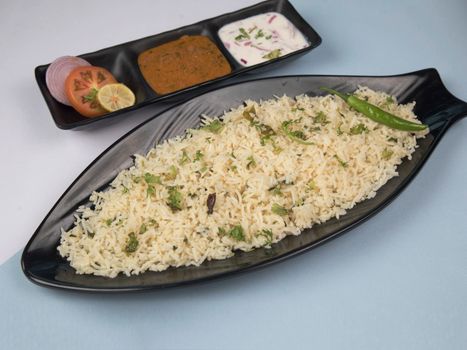
Photo: Milton Das / Pexels
The diets react (see scores below)
Common Ingredients
- basmati rice
- cumin seeds
- ghee
- bay leaf
- salt
- cilantro
Specific recipes may vary.
Incompatible with 5 of 11 diets
Diet Ratings
Jeera Rice is built on basmati rice, which is a high-glycemic grain and the primary incompatibility with ketogenic eating. A standard serving (1 cup cooked) contains approximately 45g of net carbs, which alone meets or exceeds the entire daily keto carb allowance. While the other ingredients — ghee, cumin seeds, bay leaf, cilantro, and salt — are keto-friendly, they are present in negligible quantities and cannot offset the rice's carb load. Even a small portion would consume a significant fraction of the daily net carb budget, leaving no room for other foods. Rice is a grain and is categorically excluded from a ketogenic diet.
Jeera Rice as listed contains ghee, which is clarified butter — a dairy product derived from cow's milk. This makes it non-vegan. All other ingredients (basmati rice, cumin seeds, bay leaf, salt, cilantro) are fully plant-based. The dish is easily made vegan by substituting ghee with a neutral plant-based oil such as coconut oil or refined avocado oil, which is a common adaptation in vegan Indian cooking.
Jeera Rice is fundamentally a grain-based dish. Basmati rice is a grain and is explicitly excluded from the paleo diet. Additionally, salt is a non-paleo additive, and ghee occupies a debated position. Even setting aside the secondary concerns, basmati rice alone disqualifies this dish under mainstream paleo guidelines.
Paul Jaminet's Perfect Health Diet — widely respected in paleo-adjacent circles — classifies white rice (and by extension other refined rices like basmati) as a 'safe starch' due to its low anti-nutrient profile once the bran is removed, arguing it is one of the least harmful grains. Some practitioners following this framework would permit rice-based dishes in moderation.
Jeera Rice is a simple Indian rice dish made with white basmati rice cooked in ghee with cumin seeds. The main concerns for Mediterranean diet compatibility are: (1) white basmati rice is a refined grain, preferred less than whole grains in modern Mediterranean guidelines; (2) ghee (clarified butter) is animal-derived saturated fat, which is not the canonical Mediterranean fat — extra virgin olive oil is strongly preferred. However, the dish is minimally processed, uses aromatic spices, and is relatively low in problematic ingredients like sugar or excessive saturated fat. Basmati rice does have a lower glycemic index than many refined grains, which some authorities consider a moderate mitigating factor. The dish is acceptable occasionally but is not aligned with Mediterranean staples.
Some Mediterranean diet practitioners note that white rice is consumed in traditional Greek, Turkish, and Middle Eastern cuisines (e.g., pilaf dishes) and is not strictly excluded — moderate portions are acceptable. Additionally, ghee, while not traditional Mediterranean, is used sparingly here and some modern integrative nutrition frameworks allow small amounts of clarified butter as a whole-food fat source.
Jeera Rice is composed almost entirely of plant-based ingredients and is fundamentally incompatible with the carnivore diet. Basmati rice is a grain — one of the core foods excluded on carnivore. Cumin seeds, bay leaf, and cilantro are all plant-derived spices and herbs. The only animal-derived ingredient is ghee, which is a minor component used as a cooking fat. There is no animal protein present whatsoever. This dish is a classic plant-based side dish with no pathway to carnivore approval regardless of the tier or camp.
Jeera Rice is disqualified by its primary ingredient: basmati rice is a grain, and all grains are explicitly excluded on the Whole30 program for the full 30 days. There are no exceptions for rice of any variety. The remaining ingredients — cumin seeds, ghee (the one allowed dairy exception), bay leaf, salt, and cilantro — are all individually compliant, but the foundational grain-based ingredient makes this dish incompatible regardless of preparation method.
Jeera Rice is an excellent low-FODMAP dish. Basmati rice is one of the safest low-FODMAP grains, tested and confirmed by Monash University at standard servings. Ghee is low-FODMAP as it is clarified butter with negligible lactose. Cumin seeds are low-FODMAP at culinary amounts (1 tsp or less). Bay leaf is used in trace quantities and poses no FODMAP concern. Salt and cilantro are both FODMAP-free. There are no high-FODMAP ingredients such as onion, garlic, wheat, or legumes in this dish. The entire ingredient list is clean and straightforward for the elimination phase.
Jeera Rice is a moderately DASH-compatible dish. Basmati rice is a refined grain (not a whole grain), which DASH de-emphasizes in favor of whole grains like brown rice. However, it is low in sodium, fat, and added sugars in its base form. The primary concern is ghee, which is clarified butter high in saturated fat — DASH explicitly limits saturated fat and recommends vegetable oils over animal fats. Cumin seeds, bay leaf, and cilantro are DASH-neutral aromatics with negligible nutritional impact at typical quantities. Salt is controllable and can be minimized. The dish lacks significant fiber, potassium, calcium, or magnesium — the key nutrients DASH emphasizes. It functions acceptably as an occasional side but is not a DASH staple due to the refined grain base and ghee content.
NIH DASH guidelines recommend whole grains and vegetable oils, making standard jeera rice with ghee a suboptimal choice. However, some updated DASH-aligned clinicians note that ghee in small quantities (1 tsp per serving) contributes minimal saturated fat load, and substituting a small amount of olive or canola oil plus using brown basmati rice would bring this dish into solid DASH alignment — a practical compromise some dietitians accept.
Jeera Rice is a fragrant basmati rice dish cooked with cumin seeds, ghee, and aromatics. While basmati rice has a lower glycemic index than white rice (GI ~50-58 vs. ~72 for white rice), it is still classified as an 'unfavorable' carbohydrate in Zone terminology — a grain-based, starchy carb that delivers a moderate glycemic load and lacks the fiber and polyphenol density of vegetables. The dish provides only carbohydrates and fat (from ghee), with no protein component, making it difficult to use as a standalone Zone meal. As a side dish, it could theoretically occupy the carb block portion of a Zone meal, but the ghee (saturated fat) conflicts with Zone's preference for monounsaturated fats, and the absence of fiber-rich vegetables means the carb quality is suboptimal. Zone guidelines allow 0-1 grain servings per day, so a small portion of Jeera Rice could fit within that allowance if the rest of the meal is carefully constructed with lean protein and low-GI vegetables. However, typical serving sizes in Indian cuisine are generous, easily exceeding a single carb block (9g net carbs), which would crowd out more favorable carbohydrate sources.
Basmati rice occupies an ambiguous position in Zone literature. Sears' earlier books place all white rice firmly in the 'unfavorable' column, but later Zone practitioners and Sears' anti-inflammatory writings acknowledge that basmati rice, due to its lower GI and higher amylose content, is meaningfully better than standard white rice. Some Zone-friendly meal planners treat a small portion of basmati as an acceptable occasional carb block, particularly in a mixed meal with lean protein and vegetables. The ghee also reflects evolving thinking: early Zone strictly limited saturated fat, but Sears' later work on polyphenols and traditional fats suggests small amounts of ghee are not the metabolic threat once thought.
Jeera Rice is a simple Indian side dish with a mixed anti-inflammatory profile. Basmati rice is a refined-to-moderate glycemic grain — white basmati has a lower glycemic index than most white rices due to its amylose content, but it still lacks the fiber and phytonutrients of whole grains like brown rice, making it less ideal from a strict anti-inflammatory standpoint. Ghee is a saturated fat that is limited under anti-inflammatory guidelines, though it is not as categorically condemned as butter or cream — it lacks trans fats and contains butyrate, a short-chain fatty acid with some anti-inflammatory properties in gut research. Cumin seeds are a meaningful positive: they contain thymoquinone and other bioactive compounds with documented anti-inflammatory and antioxidant activity. Bay leaf contributes minor antioxidant polyphenols. Cilantro adds flavonoids and has been associated with reduced oxidative stress in some studies. Overall, the dish is inoffensive but not a strong anti-inflammatory choice — the white rice base and ghee temper what could otherwise be a more beneficial profile. As an occasional side dish in a broadly anti-inflammatory diet, it is acceptable.
Ghee occupies contested ground: mainstream anti-inflammatory protocols (Dr. Weil's pyramid) limit saturated fats including ghee, while Ayurvedic-influenced and some paleo-adjacent anti-inflammatory practitioners highlight ghee's butyrate content and high smoke point as beneficial. Similarly, white basmati rice is accepted in traditional anti-inflammatory frameworks tied to South Asian diets (e.g., the work of researchers studying the 'Asian paradox'), while stricter protocols would recommend substituting brown basmati for its fiber and bran content.
Jeera rice is a refined carbohydrate base with minimal protein, low fiber (white basmati is lower in fiber than whole grains), and a small amount of ghee (saturated fat). For GLP-1 patients eating significantly reduced portions, this dish delivers mostly empty starch calories with little nutritional payoff per bite. The ghee content is modest in a standard serving (~1 tsp for the whole dish), so fat is not the primary concern — the main issue is poor protein and fiber density. Cumin seeds offer trace digestive benefits and may mildly ease GI discomfort, which is a minor positive. As a side dish accompanying a high-protein main (e.g., dal, chicken, fish), a small portion is acceptable, but it should not occupy significant plate real estate for GLP-1 patients who need every calorie to count nutritionally.
*See how scores were generated at our methodology page.
Nutritional profile
Six traits that cut across every diet.
Fiber & Plants
How much whole-plant food and fiber it delivers.
Healthy Fats
The quality of its fats (unsaturated, omega-3).
Whole / Unprocessed
How close it is to its natural, unprocessed form.
Gut Gentle
How easy it is on digestion (low FODMAP, few irritants).
Low Glycemic
How little it spikes your blood sugar.
Protein Density
How much protein it packs per calorie.
Controversy Index
Higher controversy = more disagreement between diets.
Diet-Specific Tips
 Mediterranean — 4/10
View tips
- White basmati rice is a refined grain, less preferred than whole grains in Mediterranean guidelines
- Ghee is a saturated animal fat, not aligned with extra virgin olive oil as the primary fat
- No vegetables, legumes, or other plant-forward Mediterranean staples included
- Dish is minimally processed with no added sugar or artificial ingredients
- Cumin and aromatics are flavorful, low-calorie additions consistent with Mediterranean herb use
- Basmati rice has a lower glycemic index compared to other white rices, a modest positive factor
 Low-FODMAP — 9/10
View tips
- Basmati rice is low-FODMAP at standard servings per Monash University
- Ghee is clarified butter with negligible lactose — safe for low-FODMAP diet
- Cumin seeds are low-FODMAP at typical culinary quantities (up to 1 tsp)
- No onion or garlic present — the most common high-FODMAP culprits in Indian cuisine
- Bay leaf used in trace amounts poses no FODMAP concern
- Cilantro is FODMAP-free
- Salt is FODMAP-free
- Portion size of rice should be kept to approximately 1 cup cooked to stay within safe range
 DASH — 5/10
View tips
- Basmati rice is a refined grain, not a whole grain — DASH prefers whole grains
- Ghee is high in saturated fat, which DASH limits
- No significant source of potassium, calcium, magnesium, or fiber
- Sodium is controllable and can be kept low with minimal added salt
- Could be improved by substituting ghee with olive oil and using brown basmati rice
- Cumin and cilantro are DASH-neutral and add flavor without sodium
 Zone — 4/10
View tips
- Basmati rice is an 'unfavorable' Zone carb — grain-based, moderate GI (~50-58), low fiber relative to vegetables
- No protein in the dish — cannot balance the 40/30/30 macro ratio on its own
- Ghee provides saturated fat, conflicting with Zone's preference for monounsaturated fats like olive oil or avocado
- Zone allows only 0-1 grain servings per day; Jeera Rice would consume that entire allowance
- Cumin seeds offer minor polyphenol benefit consistent with Zone's anti-inflammatory focus
- Cilantro adds negligible polyphenol value but is Zone-neutral
- Small portion (1/3 cup cooked, ~1 carb block) could technically fit as part of a balanced Zone plate with lean protein and non-starchy vegetables
 Anti-Inflammatory — 5/10
View tips
- White basmati rice: low-fiber refined carbohydrate, moderate glycemic index — less ideal than whole grains
- Ghee: saturated fat limited under anti-inflammatory guidelines, but contains butyrate with some gut anti-inflammatory evidence
- Cumin seeds: contain thymoquinone and antioxidants with documented anti-inflammatory properties
- Cilantro: source of flavonoids and antioxidants, minor positive contributor
- Bay leaf: minor antioxidant polyphenol content
- No added sugars, seed oils, processed ingredients, or trans fats — clean ingredient list
- No significant omega-3 or strong anti-inflammatory compounds; dish is neutral-to-mildly mixed overall
 GLP-1 Friendly — 4/10
View tips
- No meaningful protein source — fails the #1 GLP-1 priority
- White basmati rice is low in fiber compared to whole grain alternatives
- Ghee adds saturated fat, though quantity is small per serving
- High glycemic index refined carbohydrate with low nutrient density per calorie
- Cumin may offer mild digestive/anti-bloating benefit, a minor positive
- Acceptable only in small portions alongside a protein- and fiber-rich main dish
- Portion-sensitive: even a modest increase in serving size worsens the nutritional profile significantly