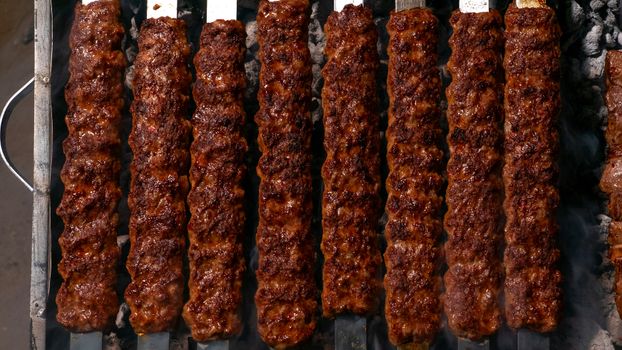
Photo: Mohamed Olwy / Pexels
Middle-Eastern
Kabab Koobideh
The diets react (see scores below)

That’s a heavy plate — want to see the leaner version?
Common Ingredients
- ground beefGround turkey
Lean ground turkey cuts the saturated fat of ground beef while keeping the dish a ground-meat dish.
- ground lambGround turkey
Lean ground turkey cuts the saturated fat of ground lamb while keeping the dish a ground-meat dish.
- onion
- sumac
- salt
- saffron
- black pepper
- butterExtra virgin olive oil
Extra-virgin olive oil swaps saturated fat for monounsaturated fat in place of butter.
Specific recipes may vary.
Incompatible with 5 of 11 diets
Diet Ratings
Kabab Koobideh is an excellent keto-compatible dish. The primary ingredients are ground beef and ground lamb, both high in fat and protein with zero carbohydrates. Onion contributes minimal net carbs in the small quantities used as a seasoning/binder. Sumac, saffron, salt, and black pepper are used in trace amounts and add negligible carbs. Butter adds additional healthy saturated fat, aligning perfectly with keto macros. The dish is naturally grain-free, sugar-free, and unprocessed. Net carbs per serving are well under 5g, making it solidly keto-approved.
Kabab Koobideh is entirely incompatible with a vegan diet. The dish is built around ground beef and ground lamb as its primary proteins — both are direct animal flesh and are categorically excluded under any definition of veganism. Additionally, butter (a dairy product derived from cow's milk) is used, adding a second category of animal-derived ingredient. There is no ambiguity here: multiple core ingredients are animal products.
Kabab Koobideh is built around ground beef and lamb — both strongly paleo-approved proteins. Onion, sumac, saffron, and black pepper are all whole, unprocessed ingredients fully consistent with a paleo diet. However, two ingredients pull this dish into caution territory: salt (added salt is excluded under strict paleo rules) and butter (a dairy derivative). Butter retains milk fat along with trace casein and lactose, making it more controversial than ghee. While many modern paleo practitioners accept small amounts of grass-fed butter, strict Cordain-school paleo excludes all dairy. The salt issue is similarly clear in strict interpretations — Paleolithic humans did not add refined salt to food. Without the butter and salt, this dish would score a strong 8-9.
Mark Sisson and many modern paleo practitioners accept grass-fed butter and consider modest salt use a practical concession, effectively approving dishes like this one. The Whole30 protocol, which aligns closely with paleo principles, permits clarified butter and some salt, and would likely view this kabab favorably.
Kabab Koobideh is built on a dual red meat base (ground beef and ground lamb), both of which are explicitly limited in the Mediterranean diet to a few times per month at most. The dish contains no vegetables, no whole grains, no legumes, and uses butter as a fat rather than olive oil — directly contradicting the core principle of olive oil as the primary fat source. The combination of two red meats in a single dish amplifies the saturated fat load. While spices like sumac and saffron are Mediterranean-friendly, they cannot offset the fundamental incompatibility of the protein and fat sources. This dish, as composed, is squarely in the 'avoid' category for regular consumption.
Kabab Koobideh is built on a strong carnivore-friendly foundation of ground beef and ground lamb — two excellent ruminant meats — with butter adding beneficial animal fat. However, several plant-derived ingredients disqualify it from a clean approve: onion (a vegetable), sumac (a plant-based spice), saffron (a plant-based spice), and black pepper (a plant spice) are all excluded on a strict carnivore protocol. Salt is the only seasoning that is universally accepted. The meat and butter components are ideal; the plant additives are the problem. Many relaxed carnivore practitioners tolerate spices like black pepper and saffron in small amounts as flavoring, and some include onion as a minor ingredient, but strict adherents would reject all of these. The dish cannot be approved as traditionally prepared.
Strict carnivore and Lion Diet adherents (following Shawn Baker's purist approach) would reject this dish outright due to onion, sumac, saffron, and black pepper — all plant-derived compounds that introduce antinutrients and plant toxins. To make it carnivore-compliant, it would need to be stripped down to ground ruminant meat, salt, and butter only.
Kabab Koobideh is otherwise a highly Whole30-compatible dish — ground beef, ground lamb, onion, sumac, salt, saffron, and black pepper are all fully compliant ingredients. However, the recipe includes regular butter, which is explicitly excluded under the Whole30 dairy rules. Only ghee and clarified butter are permitted as dairy exceptions. The presence of even a small amount of regular butter makes this dish non-compliant as listed. A simple swap to ghee would render this dish fully approvable.
Kabab Koobideh contains onion as a core structural ingredient mixed directly into the ground meat mixture. Onion is one of the highest-FODMAP foods tested by Monash University, rich in fructans, and there is no safe serving size during the elimination phase. Unlike garlic, where the infused-oil workaround exists, onion is physically incorporated into the kabab mixture and cannot be separated out. The quantity used in a standard recipe is significant — typically one medium onion per 500g of meat — making the fructan load per serving very high. Ground beef and ground lamb are both low-FODMAP proteins. Saffron, sumac, salt, and black pepper are all low-FODMAP spices. Butter is low-FODMAP at standard serving sizes (lactose is minimal in butter). However, the onion content alone disqualifies this dish during the elimination phase regardless of how well the other ingredients perform.
Kabab Koobideh is primarily composed of ground beef and ground lamb, both of which are red meats high in saturated fat — a category explicitly limited by NIH/NHLBI DASH guidelines. The combination of two fatty ground meats (lamb especially carries significant saturated fat) along with added butter further elevates saturated fat content well beyond DASH recommendations. Salt is a direct ingredient, contributing to sodium load. DASH guidelines specifically call for limiting red meat consumption to no more than 1-2 servings per week in small portions, and this dish features it as the primary — and substantial — protein source. The butter addition compounds the saturated fat concern. While onion, sumac, and saffron are DASH-friendly aromatics and spices, they cannot offset the core macronutrient profile of this dish.
Kabab Koobideh is a Middle Eastern ground meat kebab made primarily from a blend of ground beef and ground lamb. From a Zone perspective, the protein content is solid and usable, but the fat profile raises concerns. Ground lamb and ground beef (especially regular grind) tend to be higher in saturated fat than Zone-ideal lean proteins like skinless chicken, fish, or egg whites. The addition of butter further increases saturated fat load. Zone Diet protocol calls for lean protein at roughly 25g per meal and favors monounsaturated fats over saturated fat. However, in Zone's ratio-based framework, this dish is not categorically excluded — a smaller, carefully portioned serving (perhaps 2-3 oz) paired with a large low-glycemic vegetable base (grilled peppers, tomatoes, herbs) and a drizzle of olive oil rather than butter could be structured into a Zone-compliant meal. Onion and sumac are Zone-favorable ingredients — sumac is a polyphenol-rich spice that aligns well with Sears' anti-inflammatory focus, and onion is a low-glycemic vegetable. Saffron adds negligible macro impact but has anti-inflammatory properties. The core issue is the fat composition: this dish skews saturated rather than monounsaturated, and the butter reinforces that. Portion control is essential — a large serving easily overshoots the fat block allowance while delivering excessive saturated fat.
Dr. Sears' earlier Zone writings (Enter the Zone, 1995) were quite strict about limiting red meat and saturated fat in favor of lean proteins. However, Sears' later work (The Zone Diet and anti-inflammatory writings) softened somewhat, acknowledging that grass-fed red meat has a more favorable omega-6 to omega-3 ratio and that moderate saturated fat is acceptable in context. If the beef and lamb used are lean grinds (90%+ lean) and the butter is omitted or minimized, some Zone practitioners would rate this more favorably, possibly scoring it a 6-7 with careful portioning.
Kabab Koobideh presents a mixed anti-inflammatory profile. On the positive side, the dish includes several beneficial ingredients: onion provides quercetin and sulfur compounds with anti-inflammatory properties; sumac is notably rich in antioxidants, particularly gallic acid and anthocyanins, making it one of the more anti-inflammatory spices; saffron contains crocin and crocetin, which have demonstrated anti-inflammatory effects in research; and black pepper contains piperine, which has anti-inflammatory activity. However, the core protein — a blend of ground beef and ground lamb — represents a significant concern. Red meat, particularly in ground form (which often includes higher-fat cuts), is categorized under 'limit' in anti-inflammatory frameworks due to its saturated fat content and arachidonic acid, which can promote inflammatory eicosanoid production. The addition of butter compounds this issue, adding saturated fat and placing the dish squarely in the 'limit' category for fat profile. The dish is not in the 'avoid' tier because it lacks trans fats, refined sugars, processed additives, or seed oils, and the spice profile genuinely contributes anti-inflammatory value. However, regular consumption of red meat plus butter makes this a dish best enjoyed occasionally rather than as a dietary staple in an anti-inflammatory eating pattern.
Some anti-inflammatory-aligned researchers (including those who follow Mediterranean or ancestral diet frameworks) argue that high-quality grass-fed lamb and beef contain meaningful amounts of conjugated linoleic acid (CLA) and a more favorable omega-6 to omega-3 ratio than conventionally raised alternatives, partially mitigating their inflammatory potential. Dr. Weil's framework places red meat in 'limit' rather than 'avoid,' acknowledging that occasional consumption in the context of an otherwise anti-inflammatory diet is acceptable — making this dish more defensible as an occasional meal than the standard anti-inflammatory guidance might suggest.
Kabab Koobideh is a ground beef and lamb kebab seasoned with onion, sumac, saffron, black pepper, and finished with butter. It delivers solid protein — roughly 20-28g per 2-skewer serving — which is a meaningful GLP-1 benefit. However, the combination of ground lamb (typically 20-25% fat), ground beef (often 15-20% fat), and added butter makes this a high saturated-fat dish per serving. High dietary fat worsens GLP-1 side effects including nausea, bloating, and delayed gastric emptying on top of the medication's already-slowed gastric emptying. The dish contains virtually no fiber, no vegetables, and limited micronutrient density beyond protein and iron. The butter finish adds unnecessary saturated fat with no nutritional benefit for GLP-1 patients. Spice level is mild and should not trigger reflux. If portioned to one skewer, paired with high-fiber sides (grilled vegetables, shirazi salad, whole grain lavash), and the butter is reduced or omitted, this dish becomes more acceptable. As typically prepared and served, the fat load is the primary concern.
Some GLP-1-focused dietitians accept fatty red meat dishes like koobideh on the grounds that red meat provides high bioavailable protein and iron — both important during rapid weight loss — and that total fat per meal can be managed through portion control and low-fat accompaniments. Others hold a stricter position, noting that the saturated fat from lamb plus butter meaningfully increases nausea and GI discomfort risk, making leaner protein substitutions (ground chicken or turkey koobideh) a preferable adaptation for patients on GLP-1 therapy.
*See how scores were generated at our methodology page.
Nutritional profile
Six traits that cut across every diet.
Fiber & Plants
How much whole-plant food and fiber it delivers.
Healthy Fats
The quality of its fats (unsaturated, omega-3).
Whole / Unprocessed
How close it is to its natural, unprocessed form.
Gut Gentle
How easy it is on digestion (low FODMAP, few irritants).
Low Glycemic
How little it spikes your blood sugar.
Protein Density
How much protein it packs per calorie.
Controversy Index
Higher controversy = more disagreement between diets.
Diet-Specific Tips
 Keto — 9/10
View tips
- Ground beef and lamb are zero-carb, high-fat proteins — ideal keto base
- Butter adds beneficial saturated fat, boosting fat macros
- Onion used in small binding amounts contributes minimal net carbs (est. 1-2g per serving)
- Sumac, saffron, salt, pepper are negligible in carb contribution
- No grains, sugar, starchy vegetables, or high-carb binders
- Whole, minimally processed ingredients align with clean keto principles
- Naturally high in fat and moderate-to-high in protein — fits the 70-80% fat / 20-25% protein keto macro split
 Paleo — 5/10
View tips
- Ground beef and lamb are core paleo proteins — strongly approved
- Onion, sumac, saffron, and black pepper are whole unprocessed ingredients — fully paleo
- Added salt is excluded under strict paleo guidelines
- Butter is a dairy derivative; unlike ghee, it retains trace casein and lactose — debated
- Strict Cordain-school paleo excludes all dairy including butter
- Modern and practical paleo approaches often permit grass-fed butter and modest salt
 Carnivore — 5/10
View tips
- Ground beef and ground lamb are excellent ruminant meats — core carnivore foods
- Butter is an approved animal fat
- Onion is a plant vegetable — excluded on strict carnivore
- Sumac is a plant-derived spice — excluded on strict carnivore
- Saffron is a plant-derived spice — excluded on strict carnivore
- Black pepper is a plant spice — excluded on strict carnivore, tolerated by many relaxed practitioners
- Salt is universally accepted
- As traditionally prepared, this dish contains multiple plant ingredients that violate strict carnivore rules
 Zone — 5/10
View tips
- Ground beef and lamb are higher in saturated fat than Zone-preferred lean proteins — requires lean grind selection
- Butter adds additional saturated fat, pushing the fat profile away from Zone-ideal monounsaturated fats
- Protein content is Zone-usable but portion must be controlled to ~2-3 oz to stay within 1 protein block range
- Sumac is a polyphenol-rich spice, strongly aligned with Sears' anti-inflammatory focus
- Onion is a Zone-favorable low-glycemic carbohydrate
- No carbohydrate balance is provided by the dish itself — must be paired with low-GI vegetables to complete a Zone meal
- Saffron has anti-inflammatory properties consistent with Zone principles
- Dish is salvageable in Zone with lean meat selection, butter substitution with olive oil, and appropriate vegetable pairing
 Anti-Inflammatory — 4/10
View tips
- Ground beef and lamb are red meats — classified as 'limit' due to saturated fat and arachidonic acid content
- Butter adds saturated fat, compounding the inflammatory concern of the meat
- Sumac is rich in antioxidants (gallic acid, anthocyanins) — a meaningful anti-inflammatory contributor
- Saffron contains crocin and crocetin with demonstrated anti-inflammatory properties
- Onion provides quercetin and organosulfur compounds that reduce inflammatory markers
- Black pepper (piperine) enhances bioavailability of anti-inflammatory compounds and has mild anti-inflammatory activity
- No trans fats, refined sugars, seed oils, or artificial additives — avoids the worst inflammatory offenders
- Best consumed occasionally rather than regularly in an anti-inflammatory diet
 GLP-1 Friendly — 4/10
View tips
- High saturated fat from ground lamb, ground beef, and added butter — primary concern for GLP-1 side effect worsening
- Meaningful protein content (~20-28g per 2-skewer serving) supports the #1 GLP-1 dietary priority
- Zero fiber — no vegetables or whole grains in the dish itself
- Butter finish adds saturated fat with no nutritional benefit
- Easy to under-eat in small portions, but fat density per calorie remains high regardless of portion size
- Pairs well with high-fiber sides that can partially offset the dish's nutritional gaps
- Mild spice profile — sumac and saffron unlikely to worsen reflux or nausea
- Leaner adaptation (ground chicken or turkey) would significantly improve GLP-1 compatibility