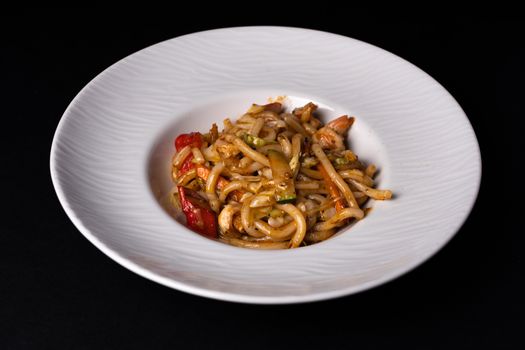
The diets react (see scores below)
Common Ingredients
- udon noodles
- dashi
- soy sauce
- mirin
- scallions
- kamaboko
- wakame
Specific recipes may vary.
Incompatible with 8 of 11 diets
Diet Ratings
Kake Udon is fundamentally incompatible with a ketogenic diet. The primary ingredient, udon noodles, is made from wheat flour and delivers an enormous carbohydrate load — a single serving contains roughly 40-60g of net carbs from the noodles alone, which meets or exceeds the entire daily keto carb allowance. Mirin adds additional sugar. Kamaboko (fish cake) contains starch binders. The only keto-friendly elements are the dashi broth, soy sauce (in small amounts), scallions, and wakame seaweed, but these are peripheral to the dish. There is no version of this dish that can be made keto-compatible without fundamentally replacing the udon noodles entirely, at which point it is no longer Kake Udon.
Kake Udon as traditionally prepared contains two clear animal-derived ingredients: dashi and kamaboko. Traditional dashi is made from katsuobushi (dried bonito fish flakes) and/or niboshi (dried sardines), making it directly fish-derived. Kamaboko is a Japanese fish cake made from surimi (processed white fish), which is unambiguously an animal product. These are not incidental or contested ingredients — they are foundational to the dish's identity. The remaining ingredients (udon noodles, soy sauce, mirin, scallions, wakame) are all plant-based, so a vegan adaptation is possible by substituting kombu-only or shiitake dashi and omitting kamaboko, but the dish as listed cannot be considered vegan.
Kake Udon is fundamentally incompatible with the paleo diet. Udon noodles are made from wheat flour, a grain explicitly excluded from paleo. Soy sauce contains both wheat and soy (a legume), making it doubly non-paleo. Mirin is a sweet rice wine, introducing another grain-based ingredient. Kamaboko (fish cake) is a processed food typically made with added starch, salt, and preservatives. Even the dashi broth, while fish-based, is commonly prepared with soy sauce additives in commercial forms. The only paleo-compatible ingredients in this dish are scallions and wakame (seaweed). With multiple grain and legume-derived ingredients forming the backbone of the dish, this is a clear avoid with high confidence.
Kake Udon is a Japanese noodle soup built around udon noodles — refined wheat noodles that fall into the 'refined grain' category the Mediterranean diet discourages. The broth ingredients (dashi, soy sauce, mirin) are flavorful but bring added sodium and a small amount of sugar (mirin). Kamaboko is a processed fish cake, which counts as a processed food rather than whole fish. On the positive side, wakame is a sea vegetable that aligns well with Mediterranean principles, scallions are a plant-based garnish, and dashi (typically from kombu and bonito) does provide seafood-derived nutrition. There is no red meat, no added saturated fat, and the dish is relatively light in calories. The primary concern is the refined grain base and the processed fish component, placing this in the 'caution' zone — acceptable occasionally but not a Mediterranean staple.
Some Mediterranean diet interpreters apply looser criteria to noodle dishes in the context of overall dietary pattern: if the rest of one's diet is plant-forward and olive oil-rich, an occasional bowl of udon soup with sea vegetables and seafood-derived broth could be considered a reasonable whole-meal choice, similar to how white pasta is tolerated in traditional Italian Mediterranean eating.
Kake Udon is almost entirely plant-based and grain-based, making it completely incompatible with the carnivore diet. Udon noodles are wheat flour — a grain and one of the most prohibited foods on carnivore. The broth base (dashi) may contain some animal-derived components like bonito flakes or kombu, but is mixed with soy sauce (fermented soy — a legume) and mirin (a sweet rice wine — grain and sugar). Scallions are plant-based vegetables, wakame is a seaweed (plant), and kamaboko is a processed fish cake that typically contains starch fillers and additives. Not a single core ingredient is a clean animal product, and the primary component is wheat noodles — a category carnivore eliminates entirely.
Kake Udon contains multiple Whole30-excluded ingredients, making it clearly non-compliant. Udon noodles are made from wheat flour, a grain explicitly excluded from the Whole30 program. Soy sauce contains both soy (a legume) and wheat (a grain), both of which are excluded — coconut aminos would be the compliant substitute. Mirin is a sweet rice wine, containing both alcohol and rice (a grain), both excluded. Kamaboko (Japanese fish cake) is a processed food typically made with wheat starch and sometimes sugar. Dashi (if commercial/powdered) often contains MSG historically, though MSG is now allowed per 2024 rules; however, the remaining excluded ingredients are disqualifying on their own. This dish is fundamentally built on wheat-based noodles and grain-derived condiments, placing it firmly in the 'avoid' category with no easy modification that would preserve its identity as Kake Udon.
Kake Udon is fundamentally incompatible with the low-FODMAP elimination diet due to two major high-FODMAP components. First and foremost, udon noodles are made from wheat flour, which is high in fructans — a primary FODMAP category. There is no low-FODMAP serving size for standard udon noodles. Second, scallions (green onions) are problematic: while the green tops are low-FODMAP, the white bulb portions are high in fructans and are almost always included in kake udon preparation. Dashi (traditional kombu/bonito stock) is generally considered low-FODMAP. Soy sauce is low-FODMAP in standard servings (1 tablespoon). Mirin is low-FODMAP in small culinary amounts. Kamaboko (fish cake) is typically low-FODMAP as a processed fish product, though some commercial versions may contain high-FODMAP additives. Wakame seaweed is low-FODMAP. The wheat-based udon noodles alone make this dish a clear avoid during the elimination phase, regardless of the otherwise relatively FODMAP-friendly broth components.
Kake Udon is a classic Japanese noodle soup that poses significant challenges for the DASH diet, primarily due to its very high sodium content. The broth (dashi + soy sauce + mirin) is the main concern — a typical serving of kake udon contains 1,500–2,500mg of sodium, which approaches or exceeds the entire daily sodium allowance on the standard DASH plan (2,300mg) and far exceeds the low-sodium DASH target (1,500mg) in a single dish. Soy sauce alone contributes ~900mg sodium per tablespoon. Kamaboko (fish cake) is a processed food with additional sodium. Udon noodles are refined white flour with minimal fiber and nutritional value compared to DASH-preferred whole grains. The dish has limited potassium, calcium, magnesium, or fiber to offset these concerns. Wakame seaweed and scallions are DASH-friendly components, but they do not compensate for the sodium load. This dish is essentially incompatible with DASH dietary principles as commonly prepared.
Kake Udon is fundamentally incompatible with Zone Diet principles in its standard form. The dish is built around udon noodles, which are made from refined white wheat flour — a high-glycemic, low-fiber carbohydrate that Sears explicitly classifies as 'unfavorable.' Udon has a high glycemic index (around 55-80 depending on preparation) and delivers a large carbohydrate load with virtually no fiber to slow absorption. The dish is also categorized as having no primary protein, meaning it fails the Zone's 40/30/30 macronutrient ratio entirely — it skews heavily toward carbohydrates with minimal protein and fat. The broth (dashi, soy sauce, mirin) adds additional simple sugars via mirin. Kamaboko (fish cake) provides a small amount of protein and wakame seaweed contributes modest nutritional value, but neither is sufficient to bring this dish into Zone balance. To salvage it for Zone compliance, one would need to dramatically reduce the noodle portion, add substantial lean protein, and add a monounsaturated fat source — at which point the dish is fundamentally altered. As served, Kake Udon represents exactly the type of high-glycemic, protein-deficient, fat-deficient meal that the Zone Diet was designed to avoid.
Kake Udon is a simple Japanese noodle soup with a mixed anti-inflammatory profile. On the positive side, wakame seaweed is a standout ingredient — rich in fucoxanthin (a carotenoid with anti-inflammatory properties), omega-3 fatty acids, and minerals. Dashi (typically made from kombu and katsuobushi/bonito) provides iodine, glutamates, and some omega-3s from the fish base. Scallions contribute quercetin and other flavonoids. Soy sauce and mirin in moderate culinary quantities are acceptable. However, the primary base is udon noodles, which are made from refined white wheat flour — a refined carbohydrate that offers minimal fiber or nutrients and can modestly elevate blood sugar and pro-inflammatory markers when consumed regularly. Kamaboko (fish cake) is a processed food containing additives, starch fillers, and potentially artificial colorings, which conflicts with anti-inflammatory principles. The overall dish is not strongly pro-inflammatory, but the refined noodles and processed fish cake prevent it from being a net positive. It's a moderate, occasional meal — acceptable in the context of an otherwise anti-inflammatory diet.
Some anti-inflammatory practitioners, particularly those following stricter approaches like the Autoimmune Protocol (AIP), would rate this lower due to the refined wheat flour in udon noodles (gluten) and the processed nature of kamaboko. Conversely, traditional Japanese dietary patterns — which include dishes like this regularly — are frequently cited as anti-inflammatory models due to their overall low saturated fat, high fish, and high vegetable content, suggesting context and dietary pattern matter more than any single dish.
Kake udon is a light Japanese noodle soup with a clean, low-fat dashi broth, making it easy to digest and gentle on the GI tract — a real advantage for GLP-1 patients struggling with nausea or gastroparesis-like slowing. However, the dish falls short on the two most critical GLP-1 priorities. Protein is negligible: udon noodles contribute minimal protein, kamaboko (fish cake) adds only a small amount (~3-5g per standard serving), and wakame seaweed contributes virtually none. A typical bowl delivers well under 10g of protein, far short of the 15-30g per meal target. Fiber is also low — udon is made from refined wheat flour with minimal fiber content, and the vegetable components (scallions, wakame) contribute only trace amounts. The broth is high in sodium from soy sauce and dashi, which matters for hydration balance. On the positive side: very low fat, easy to digest, high water content from the broth, small-portion friendly, and the warm liquid supports hydration. This dish is not harmful, but as presented it is nutritionally thin for GLP-1 patients who need every meal to deliver protein and fiber. It scores higher if protein is added (tofu, a poached egg, or grilled chicken).
*See how scores were generated at our methodology page.
Nutritional profile
Six traits that cut across every diet.
Fiber & Plants
How much whole-plant food and fiber it delivers.
Healthy Fats
The quality of its fats (unsaturated, omega-3).
Whole / Unprocessed
How close it is to its natural, unprocessed form.
Gut Gentle
How easy it is on digestion (low FODMAP, few irritants).
Low Glycemic
How little it spikes your blood sugar.
Protein Density
How much protein it packs per calorie.
Controversy Index
Higher controversy = more disagreement between diets.
Diet-Specific Tips
 Mediterranean — 4/10
View tips
- Udon noodles are refined grains, not whole grains — a core Mediterranean diet concern
- Kamaboko is a processed fish cake, not whole fish or seafood
- Wakame (sea vegetable) is a plant-based, nutrient-rich ingredient consistent with Mediterranean principles
- Dashi broth provides seafood-derived umami without added saturated fat
- Mirin adds a small amount of sugar to the broth
- No red meat, no saturated fat, low calorie density
- Dish is not Mediterranean in origin; evaluation is cross-cultural
 Anti-Inflammatory — 5/10
View tips
- Udon noodles are refined white flour — low fiber, high glycemic index, minimal anti-inflammatory benefit
- Wakame seaweed is anti-inflammatory: rich in fucoxanthin, omega-3s, and minerals
- Dashi broth provides omega-3 fatty acids and iodine from fish/kombu base
- Kamaboko is a processed fish cake with additives and starch fillers — a mild concern
- Scallions contribute quercetin and other anti-inflammatory flavonoids
- Soy sauce and mirin in culinary quantities are acceptable; sodium content is notable
- No strongly pro-inflammatory fats, sugars, or seed oils present
 GLP-1 Friendly — 4/10
View tips
- Very low protein (~5-8g per bowl) — falls well short of the 15-30g per meal GLP-1 target
- Refined udon noodles contribute minimal fiber
- Low fat and gentle broth make it easy to digest — a plus for GI side effects
- High sodium from dashi and soy sauce — relevant for hydration balance
- High water content from broth supports hydration needs
- Nutritionally thin per calorie — does not meet nutrient density standards for GLP-1 patients without additions
- Easily upgraded with added protein (egg, tofu, chicken) which would change the rating significantly