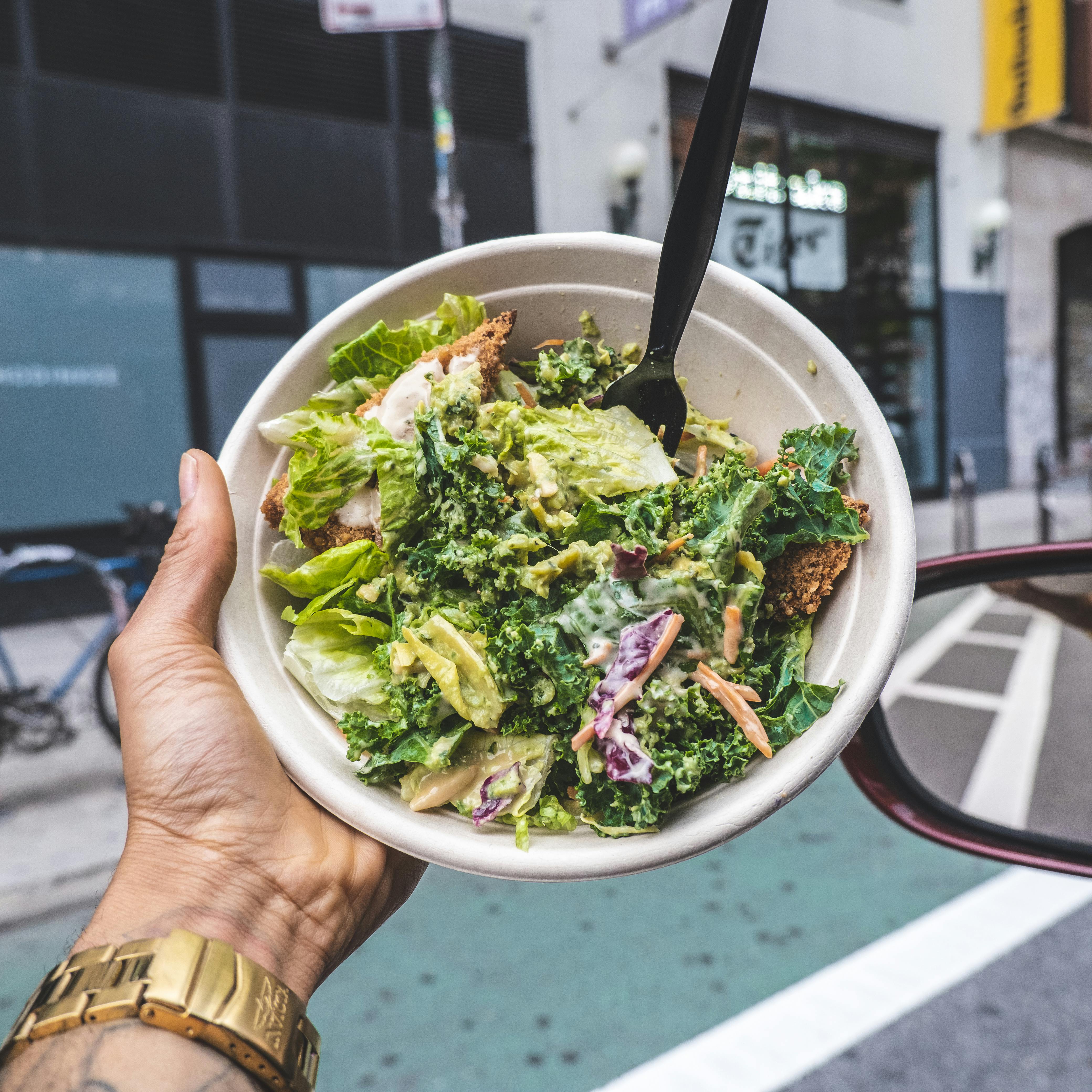
Photo: Malcolm Garret / Pexels
American
Kale Caesar Salad
The diets react (see scores below)
Common Ingredients
- kale
- parmesan cheese
- croutons
- anchovies
- garlic
- lemon juice
- olive oil
- Dijon mustard
Specific recipes may vary.
Incompatible with 5 of 11 diets
Diet Ratings
This Kale Caesar Salad has mostly keto-friendly components — kale is a fiber-rich leafy green with low net carbs, parmesan and anchovies provide healthy fats and protein, and olive oil is an excellent keto fat source. Garlic, lemon juice, and Dijon mustard add minimal carbs in typical dressing quantities. However, the croutons are a direct disqualifier in their standard form, as they are made from bread (grains) and add significant net carbs, making the dish as listed incompatible with strict keto. Without croutons, this salad would easily score 8-9. With croutons, a standard serving pushes it into caution territory. The dish is easily made keto-compliant by omitting or substituting the croutons (e.g., with pork rinds or parmesan crisps).
This Kale Caesar Salad contains multiple animal-derived ingredients that make it clearly incompatible with a vegan diet. Anchovies are fish, parmesan cheese is a dairy product (and traditionally contains animal rennet), and standard Caesar dressing often relies on these as foundational flavor components. Two distinct animal products are explicitly listed as ingredients, leaving no ambiguity about this dish's non-vegan status.
This Kale Caesar Salad contains multiple non-paleo ingredients that disqualify it. Croutons are made from wheat bread, a grain explicitly excluded from the paleo diet. Parmesan cheese is a dairy product, also excluded. Dijon mustard typically contains added vinegar, salt, and sometimes wine or other additives, making it a processed condiment. While kale, anchovies, garlic, lemon juice, and olive oil are all paleo-approved, the presence of croutons (grains) and parmesan (dairy) are hard exclusions with strong consensus in the paleo community. The dish as described cannot be considered paleo-compatible in its standard form.
This Kale Caesar Salad aligns well with Mediterranean diet principles. Kale is an excellent leafy green vegetable, anchovies provide the encouraged fish/seafood component, olive oil is the primary fat, garlic and lemon juice are classic Mediterranean flavors, and Dijon mustard is a minor ingredient. Parmesan cheese is a moderate dairy element, acceptable in small amounts. The main concern is the croutons, which are typically made from refined white bread — a less ideal ingredient under Mediterranean guidelines. However, the overall dish is predominantly plant-based with healthy fats and fish protein, making it a solid Mediterranean-compatible choice.
Some Mediterranean diet purists may downgrade this dish due to the refined grain croutons and the relatively high sodium from anchovies and parmesan; substituting whole-grain croutons or omitting them entirely would bring it closer to strict Mediterranean guidelines. Traditional Mediterranean salads rarely include croutons, so this Americanized adaptation has slight deviations from classical form.
This dish is overwhelmingly plant-based and directly violates core carnivore diet principles. Kale is a leafy vegetable and the primary bulk of the dish. Croutons are grain-based bread. Garlic, lemon juice, and olive oil are all plant-derived ingredients. Dijon mustard is a processed plant-based condiment. While anchovies and parmesan cheese are animal-derived, they are minor components in a dish that is fundamentally incompatible with the carnivore diet. The presence of so many excluded food categories — vegetables, grains, plant oils, citrus, and plant-based condiments — makes this an unambiguous avoid with near-universal consensus in the carnivore community.
This Kale Caesar Salad contains two clearly excluded ingredients: parmesan cheese (dairy) and croutons (grains/bread). Both are explicitly prohibited on the Whole30 program. Parmesan is a hard cheese and falls squarely under the dairy exclusion, and croutons are toasted bread, which is a grain product. The remaining ingredients — kale, anchovies, garlic, lemon juice, olive oil, and Dijon mustard — are generally Whole30-compatible (though Dijon mustard labels should be checked for added sugar or sulfites, which are now permitted under 2024 rules). However, the presence of dairy and grains makes this dish non-compliant as described.
This Kale Caesar Salad contains multiple high-FODMAP ingredients that make it unsuitable during the elimination phase. Garlic is one of the highest-FODMAP foods tested by Monash University, rich in fructans, and even trace amounts can trigger symptoms — it cannot be made safe by portion control. Croutons are almost certainly wheat-based, which is high-FODMAP due to fructans. These two ingredients alone disqualify the dish. Kale is low-FODMAP at standard servings (up to 1 cup). Parmesan is low-FODMAP as a hard, aged cheese with negligible lactose. Anchovies are low-FODMAP (plain fish, no significant FODMAPs). Lemon juice and olive oil are low-FODMAP. Dijon mustard is generally low-FODMAP at small servings. However, the combination of garlic and wheat croutons makes this dish a clear avoid for anyone in the elimination phase.
Kale Caesar Salad has a mixed DASH profile. On the positive side, kale is an exceptional DASH food — rich in potassium, calcium, magnesium, and fiber, making it a core DASH vegetable. Olive oil aligns well with DASH's preference for healthy vegetable oils, and lemon juice and garlic are DASH-friendly flavor enhancers. However, several ingredients raise concerns. Anchovies are very high in sodium (a typical 2-oz serving can contribute 700–1,000mg), which is a significant DASH concern. Parmesan cheese is a full-fat, high-sodium dairy product (one ounce contains ~430mg sodium and notable saturated fat), conflicting with DASH's emphasis on low-fat dairy and sodium limits. Croutons add refined carbohydrates and often additional sodium. Dijon mustard adds modest sodium. The combined sodium load of anchovies, parmesan, and croutons can easily push a single serving toward or beyond 1,000–1,500mg, which is problematic against the DASH target of ≤2,300mg/day (or ≤1,500mg for low-sodium DASH). The dish can be made more DASH-compatible by reducing anchovies, using low-sodium parmesan sparingly, replacing croutons with whole-grain alternatives, and controlling portion sizes.
NIH DASH guidelines emphasize limiting sodium and full-fat dairy, which would flag anchovies and parmesan as problematic. However, some updated DASH-oriented clinicians note that anchovies provide omega-3 fatty acids beneficial for cardiovascular health, and when used in small amounts as a flavoring agent rather than a primary protein, the sodium impact may be manageable within a well-controlled daily sodium budget.
Kale Caesar Salad is a mostly Zone-friendly dish with some notable caveats. Kale is an excellent Zone carbohydrate — a dark, leafy, low-glycemic vegetable rich in polyphenols, fitting squarely into Zone's preferred carb sources. Anchovies provide lean protein with a bonus of omega-3 fatty acids, which aligns perfectly with Sears' anti-inflammatory emphasis. Olive oil is the ideal Zone fat — monounsaturated and anti-inflammatory. Lemon juice, garlic, and Dijon mustard are essentially free foods in Zone terms. The problems are the croutons and the parmesan cheese. Croutons are made from refined white bread — a high-glycemic, unfavorable carb in Zone terminology that can spike insulin. Parmesan adds saturated fat and some additional protein that may skew the fat block ratio. As served in a typical restaurant portion, the croutons likely represent a meaningful glycemic load, and the overall fat profile may run higher than the 30% target due to combined olive oil and cheese. However, with portion control — reducing croutons significantly or eliminating them, and moderating parmesan — this dish can be brought into reasonable Zone balance. The strong foundation of kale, anchovies, and olive oil makes it salvageable rather than problematic.
Some Zone practitioners following Sears' later work (The Mediterranean Zone, The OmegaRx Zone) would rate this more favorably, arguing the dish's polyphenol density from kale, anti-inflammatory omega-3s from anchovies, and monounsaturated fats from olive oil are exactly what the advanced Zone protocol prioritizes. In that framing, a small amount of croutons represents just one unfavorable carb block easily offset by the overall favorable profile. Others would keep the caution rating firm, noting that croutons as typically portioned represent a glycemic disruption inconsistent with Zone's low-glycemic carb preference.
This Kale Caesar Salad has a strong anti-inflammatory foundation with several standout ingredients. Kale is one of the most nutrient-dense leafy greens available, rich in vitamins K, C, and A, along with glucosinolates and quercetin — compounds associated with reduced inflammatory markers. Anchovies provide omega-3 fatty acids (EPA and DHA), placing them in the same category as other fatty fish that are strongly emphasized in anti-inflammatory frameworks. Olive oil contributes oleocanthal, a polyphenol with COX-inhibiting properties similar to ibuprofen. Garlic contains allicin and organosulfur compounds shown to suppress NF-κB inflammatory pathways. Lemon juice adds vitamin C and flavonoids. Dijon mustard contains turmeric and other anti-inflammatory compounds in small amounts. The two moderating factors are parmesan cheese (full-fat dairy, which is advised to limit due to saturated fat content, though the amount in a typical Caesar is modest) and croutons (refined white bread carbohydrates that can trigger mild glycemic response and offer little nutritional value). Neither ingredient is present in large enough quantity to override the dish's strongly anti-inflammatory profile. Overall, this is a well-balanced dish that aligns well with Dr. Weil's Anti-Inflammatory Food Pyramid principles.
Traditional Caesar dressing often contains egg yolks and anchovy paste, and some anti-inflammatory practitioners note that arachidonic acid in egg yolks can be mildly pro-inflammatory in large quantities; however, this recipe omits eggs. The croutons represent the main point of debate — some strict anti-inflammatory protocols (such as those addressing autoimmune conditions) would flag refined grain croutons as problematic, while mainstream anti-inflammatory guidance treats small amounts of whole-grain products as acceptable.
Kale Caesar Salad has a genuinely mixed nutritional profile for GLP-1 patients. Kale is an excellent base — high fiber, nutrient-dense, and easy on calories. Anchovies provide a meaningful omega-3 protein source, and lemon juice, Dijon mustard, and garlic are all GLP-1-friendly. However, the dish has notable drawbacks: parmesan cheese adds saturated fat alongside its protein contribution, olive oil dressing is calorie-dense and portion-sensitive (a heavy hand raises fat load significantly), and croutons are refined carbs with low nutritional value that contribute little beyond texture. The overall protein content from anchovies alone is modest — likely 5-10g per serving — falling well short of the 15-30g per meal target unless anchovies are served in generous quantity. For a GLP-1 patient, this salad works better as a side or base than a standalone meal. It could be upgraded meaningfully by adding grilled chicken or a boiled egg, reducing croutons, and keeping dressing portions controlled.
Some GLP-1-focused RDs view kale-based salads favorably as fiber-rich, low-calorie vehicles that support fullness and digestion, and would approve this with simple modifications like added lean protein. Others flag the olive oil dressing and parmesan as too fat-dense given GLP-1 patients' slowed gastric emptying and heightened nausea risk, recommending a lighter lemon-tahini or yogurt-based dressing instead — individual GI tolerance to higher-fat dressings varies considerably on these medications.
*See how scores were generated at our methodology page.
Nutritional profile
Six traits that cut across every diet.
Fiber & Plants
How much whole-plant food and fiber it delivers.
Healthy Fats
The quality of its fats (unsaturated, omega-3).
Whole / Unprocessed
How close it is to its natural, unprocessed form.
Gut Gentle
How easy it is on digestion (low FODMAP, few irritants).
Low Glycemic
How little it spikes your blood sugar.
Protein Density
How much protein it packs per calorie.
Controversy Index
Higher controversy = more disagreement between diets.
Diet-Specific Tips
 Keto — 5/10
View tips
- Croutons contain grain-based carbs and must be removed for keto compliance
- Kale is a low net-carb leafy green suitable for keto in moderate portions
- Parmesan and anchovies are high-fat, high-protein keto staples
- Olive oil dressing base is ideal for keto fat macros
- Lemon juice and Dijon mustard contribute negligible carbs at typical serving sizes
- Simple modification (removing croutons) would make this dish keto-approved
 Mediterranean — 8/10
View tips
- Kale is a nutrient-dense leafy green, strongly encouraged
- Anchovies provide Mediterranean-approved fish/seafood protein
- Extra virgin olive oil is the primary fat source
- Garlic and lemon juice are quintessential Mediterranean ingredients
- Parmesan cheese is acceptable in moderate/small amounts
- Croutons are typically refined grains, a minor negative factor
- Overall dish is plant-forward with healthy fats and lean protein
 DASH — 5/10
View tips
- Kale is an excellent DASH vegetable — high in potassium, calcium, magnesium, and fiber
- Anchovies are very high in sodium (~700–1,000mg per 2 oz), a significant DASH concern
- Parmesan cheese is full-fat and high in sodium (~430mg/oz), conflicting with DASH low-fat dairy guidelines
- Croutons contribute refined carbohydrates and additional sodium
- Olive oil is DASH-approved as a healthy vegetable oil
- Combined sodium from anchovies, parmesan, and croutons may approach or exceed low-sodium DASH daily limits in one serving
- Dish can be improved by reducing anchovies, using parmesan sparingly, and swapping croutons for whole-grain alternatives
 Zone — 6/10
View tips
- Kale is an ideal Zone carb — dark, leafy, low-glycemic, polyphenol-rich
- Anchovies are a lean protein with excellent omega-3 content, highly favorable in Zone
- Olive oil is the gold standard Zone fat — monounsaturated and anti-inflammatory
- Croutons are high-glycemic refined carbs, classified as 'unfavorable' in Zone terminology
- Parmesan adds saturated fat, which Zone limits in favor of monounsaturated sources
- Dish is easily modified to Zone-compliant by reducing/eliminating croutons
- Overall macro balance skews toward fat-heavy if olive oil and cheese portions are generous
 Anti-Inflammatory — 7/10
View tips
- Kale is a top anti-inflammatory leafy green rich in quercetin, glucosinolates, and vitamins K and C
- Anchovies provide omega-3 fatty acids (EPA/DHA), a cornerstone of anti-inflammatory eating
- Olive oil contributes oleocanthal, a potent natural anti-inflammatory polyphenol
- Garlic contains organosulfur compounds that inhibit NF-κB inflammatory signaling
- Croutons are refined carbohydrates with minimal nutritional value — a modest pro-inflammatory element
- Parmesan is full-fat dairy (saturated fat), advised in limited quantities in anti-inflammatory frameworks
- Lemon juice adds vitamin C and flavonoids with antioxidant properties
- Dijon mustard is a low-calorie, minimally processed condiment with anti-inflammatory spice content
 GLP-1 Friendly — 5/10
View tips
- Kale is high-fiber and nutrient-dense — strong GLP-1-friendly base
- Anchovies provide omega-3 fats and protein but insufficient protein per serving to meet 15-30g meal target
- Olive oil dressing is calorie-dense and fat-heavy if not portion-controlled — may worsen GI side effects
- Parmesan adds some protein but also saturated fat
- Croutons are refined carbs with minimal nutritional value — low nutrient density per calorie
- Dish benefits significantly from added lean protein (chicken, egg, white beans) to meet protein goals
- Lemon juice, Dijon mustard, garlic are all well-tolerated and GLP-1-appropriate