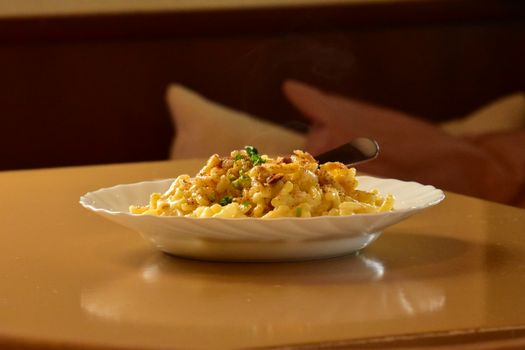
Photo: Carla Kroell / Pexels
Eastern-European
Käsespätzle
The diets react (see scores below)

That’s a heavy plate — want to see the leaner version?
Common Ingredients
- flourWhole wheat flour
Whole-wheat flour adds fiber and lowers the refined-grain load versus flour.
- eggs
- milk
- Emmental
- Gruyère
- onions
- butterExtra virgin olive oil
Extra-virgin olive oil swaps saturated fat for monounsaturated fat in place of butter.
- nutmeg
Specific recipes may vary.
Incompatible with 11 of 11 diets
Diet Ratings
Käsespätzle is fundamentally incompatible with a ketogenic diet. The dish is built on a flour-based egg noodle (Spätzle), which is a wheat grain product delivering a very high net carbohydrate load — a standard serving easily contains 40–60g of net carbs from flour alone, blowing through the entire daily keto carb budget in a single dish. While the Emmental and Gruyère cheeses and butter are keto-friendly high-fat ingredients, and eggs contribute positively, they cannot offset the dominant flour base. Onions add minor additional carbs. There is no meaningful way to consume a traditional portion of Käsespätzle and maintain ketosis.
Käsespätzle contains multiple animal-derived ingredients that are unambiguously non-vegan. Eggs and milk are used in the spätzle dough itself, Emmental and Gruyère are dairy cheeses, and butter is used for the caramelized onions and finishing. This dish is built entirely around animal products and cannot be considered vegan in any standard interpretation.
Käsespätzle is fundamentally incompatible with the paleo diet. The dish is built on flour (wheat, a grain) and milk and cheese (Emmental and Gruyère, both unprocessed dairy), with butter also being a dairy product. Three of the core ingredients — flour, milk, and cheese — are explicitly excluded under paleo rules. Eggs, onions, and nutmeg are paleo-approved, but they are minor supporting ingredients that cannot redeem a dish whose entire structure depends on non-paleo foods. This is a grain-and-dairy-centric dish with no viable paleo interpretation in its traditional form.
Käsespätzle is a central European comfort dish built around refined white flour dumplings, generous amounts of full-fat aged cheese (Emmental and Gruyère), butter, eggs, and milk. It conflicts with Mediterranean diet principles on multiple fronts: refined flour is a processed grain with no whole-grain equivalent here, butter replaces olive oil as the primary fat, and the dish is dominated by high-saturated-fat dairy rather than plant-forward ingredients. While eggs and dairy are allowed in moderation, this dish uses them as the structural and flavour base rather than as minor accompaniments. There are no vegetables, legumes, whole grains, or olive oil present. The overall nutritional profile — high in refined carbs, saturated fat, and sodium — is far removed from the Mediterranean dietary pattern.
Käsespätzle is fundamentally incompatible with the carnivore diet. The dish is built around flour-based egg noodles (spätzle), which are made primarily from wheat flour — a grain and therefore a prohibited plant food. While eggs, milk, butter, and the cheeses (Emmental, Gruyère) are animal-derived, they are secondary to a grain-based foundation. Additional plant ingredients include onions (vegetable) and nutmeg (plant spice). The primary protein is listed as none, reinforcing that this is a carbohydrate-dominant dish with no meaningful animal protein source. Even the animal-derived components (dairy) are debated on carnivore, but the flour and onions alone make this a clear avoid with high confidence across all carnivore tiers.
Käsespätzle contains multiple Whole30-excluded ingredients. Flour (a grain) is the base of the spätzle dough, making it a grain-based pasta product. Emmental and Gruyère are both dairy cheeses, which are explicitly excluded. Butter (regular, not ghee) is also excluded dairy. Additionally, spätzle is a pasta/noodle dish, which falls squarely into the 'no recreating pasta or noodles' rule even if somehow made with compliant ingredients. This dish fails on grains, dairy, and the junk food/pasta recreation rule simultaneously.
Käsespätzle contains multiple high-FODMAP ingredients that make it unsuitable during the elimination phase. Wheat flour is the primary ingredient and is high in fructans at any standard serving size. Onions are one of the highest-FODMAP foods tested by Monash, being rich in fructans and problematic even in small amounts. Milk contributes lactose, which is a disaccharide FODMAP. While Emmental and Gruyère are aged hard cheeses that are generally low in lactose and considered low-FODMAP, they cannot offset the other high-FODMAP ingredients. Eggs, butter, and nutmeg are low-FODMAP. However, the combination of wheat flour (fructans), onions (fructans), and milk (lactose) creates a dish that is fundamentally incompatible with the FODMAP elimination phase at any realistic serving size.
Käsespätzle is a rich Alpine cheese-and-egg-noodle dish that conflicts with DASH diet principles on multiple fronts. The dish is dominated by full-fat cheeses (Emmental and Gruyère), which are high in saturated fat and sodium — two nutrients DASH explicitly limits. Butter adds additional saturated fat. The pasta base (flour, eggs, milk) is refined-grain carbohydrates with no whole-grain benefit. A typical serving of Käsespätzle can contain 15–25g of saturated fat and 600–900mg of sodium, and the cheese load alone may push saturated fat well above the DASH ceiling (~6% of calories). There is no lean protein, fiber, or meaningful potassium/magnesium contribution. The only DASH-positive elements are eggs (acceptable in moderation), onions (a vegetable), and nutmeg (a spice). The dish would require fundamental reformulation — whole-grain flour, reduced-fat cheese, minimal butter — to become even marginally DASH-compatible.
Käsespätzle is a German/Austrian egg noodle dish that presents multiple Zone Diet challenges simultaneously. The base is flour-and-egg pasta (spätzle), which is a high-glycemic refined carbohydrate that spikes insulin rapidly — exactly what the Zone aims to prevent. The dish is then loaded with Emmental and Gruyère cheeses (high saturated fat, moderate protein) and finished with butter-caramelized onions and more butter. The macronutrient profile is roughly inverted from Zone ideals: very high in carbohydrates (predominantly high-glycemic), high in saturated fat, and the protein present (from eggs and cheese) comes packaged with substantial saturated fat rather than being lean. There is no lean protein source to anchor a proper Zone block. The fat profile is dominated by saturated fat from butter and aged cheeses rather than the preferred monounsaturated fats. The dish lacks the low-glycemic vegetable bulk that Zone meals depend on for favorable carbohydrate blocks. While a tiny portion could theoretically be worked into a Zone meal alongside lean protein and vegetables, the dish as designed offers essentially no pathway to a 40/30/30 ratio without radical restructuring that would no longer resemble the dish. This is a textbook 'unfavorable' combination of high-GI carbs and saturated fat.
Käsespätzle is a Central European (Austrian/German/Swiss) comfort dish made from refined wheat flour egg noodles smothered in melted high-fat alpine cheeses (Emmental and Gruyère) and topped with butter-fried onions. From an anti-inflammatory standpoint, the dish is heavily loaded with pro-inflammatory components: refined white flour provides high-glycemic refined carbohydrates with minimal fiber; butter contributes significant saturated fat; and full-fat hard cheeses (Emmental, Gruyère) add more saturated fat and are categorized as 'limit' or 'avoid' foods in the anti-inflammatory framework. The dish lacks omega-3 fatty acids, meaningful antioxidants, polyphenols, or fiber. The onions provide a modest anti-inflammatory contribution (quercetin, fructooligosaccharides), and nutmeg has minor beneficial properties, but these are far outweighed by the inflammatory load. Eggs offer some neutral-to-modest nutritional value (choline, selenium), but they cannot redeem the overall profile. This dish is essentially a refined carbohydrate and saturated fat delivery vehicle with virtually no anti-inflammatory redeeming qualities beyond the onions and spice.
Käsespätzle is a heavy, cheese-laden egg noodle dish that is poorly suited for GLP-1 patients. The primary macronutrient is refined carbohydrate (white flour noodles), and the dominant caloric contributors are saturated fat from Emmental, Gruyère, and butter. Protein content is modest relative to calories — the eggs in the dough and cheese provide some protein, but not in a density that offsets the high fat and carbohydrate load. A typical serving delivers substantial saturated fat, which is known to worsen GLP-1 side effects including nausea, bloating, and reflux due to slowed gastric emptying. Butter adds additional saturated fat with no fiber or meaningful micronutrient benefit. The dish contains virtually no fiber. Caramelized onions contribute negligible fiber and nutrients at the quantities typically used. The caloric density is high and nutrient density per calorie is low, which is exactly the profile GLP-1 patients should avoid given their reduced appetite and need for every calorie to count. This dish fails on nearly every GLP-1 dietary priority: low protein density, zero fiber, high saturated fat, heavy and slow to digest, and not small-portion friendly in a satisfying way.
*See how scores were generated at our methodology page.
Nutritional profile
Six traits that cut across every diet.
Fiber & Plants
How much whole-plant food and fiber it delivers.
Healthy Fats
The quality of its fats (unsaturated, omega-3).
Whole / Unprocessed
How close it is to its natural, unprocessed form.
Gut Gentle
How easy it is on digestion (low FODMAP, few irritants).
Low Glycemic
How little it spikes your blood sugar.
Protein Density
How much protein it packs per calorie.
Controversy Index
Higher controversy = more disagreement between diets.