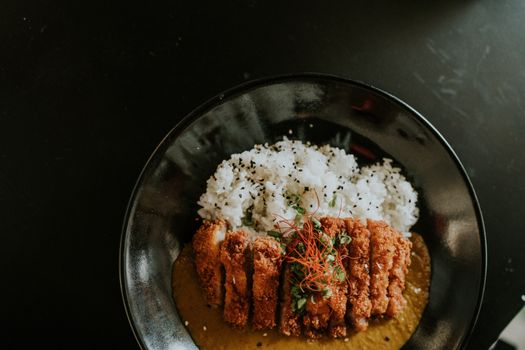
Photo: Amar Preciado / Pexels
Japanese
Katsu Curry
The diets react (see scores below)
Common Ingredients
- pork cutlet
- panko breadcrumbs
- Japanese curry roux
- short-grain rice
- potatoes
- carrots
- onion
- cabbage
Specific recipes may vary.
Incompatible with 9 of 11 diets
Diet Ratings
Katsu Curry is fundamentally incompatible with a ketogenic diet. This dish stacks multiple high-carbohydrate components that would collectively deliver hundreds of grams of net carbs in a single serving. Short-grain rice alone provides approximately 45g net carbs per cup. Panko breadcrumbs coat the protein cutlet, adding significant carbs and preventing any keto modification while keeping the dish recognizable. Japanese curry roux is typically made with wheat flour and contains added sugars. Potatoes are a starchy vegetable with ~15-17g net carbs per 100g. Carrots add additional sugar and starch. The combination of rice, breadcrumbs, curry roux, and potatoes makes this one of the most keto-incompatible dishes possible — there is no realistic portion size that brings this within ketogenic limits without completely deconstructing the dish into something unrecognizable as Katsu Curry.
Katsu Curry as described contains pork cutlet as its primary protein, which is a direct animal product (meat). This is an unambiguous disqualifier under vegan principles. Additionally, Japanese curry roux blocks commonly contain animal-derived ingredients such as dairy (butter, milk solids) or animal fats, compounding the non-vegan status. The dish is fundamentally built around a breaded and fried meat cutlet, making it incompatible with a vegan diet without complete reconstruction using plant-based substitutes.
Katsu Curry is fundamentally incompatible with the Paleo diet. The dish contains multiple major non-Paleo ingredients: panko breadcrumbs are made from wheat (a grain), short-grain rice is a grain, and Japanese curry roux is a heavily processed product typically containing wheat flour, vegetable oils, sugar, and artificial additives. These three ingredients alone — each a clear Paleo violation — form the structural foundation of the dish. The pork cutlet, carrots, onion, and cabbage are Paleo-compliant, and potatoes occupy a debated gray area, but no amount of compliant ingredients can offset the core grains and processed components that define this dish.
Katsu Curry conflicts with Mediterranean diet principles on multiple fronts. The dish centers on a breaded, deep-fried pork or chicken cutlet (panko-breaded, fried in oil), which combines processed refined grain coating with high saturated fat from frying — a double strike against Mediterranean principles. The Japanese curry roux is typically a processed, packaged product loaded with refined fats, added sugars, and artificial additives. Short-grain white rice is a refined grain with minimal fiber. While the vegetables (potatoes, carrots, onion, cabbage) are positive elements, they are overwhelmed by the problematic components. If pork is the protein, it further compounds the issue as red/processed meat. Even with chicken, the deep-fried preparation, refined breadcrumb coating, processed curry roux, and white rice make this dish fundamentally incompatible with Mediterranean dietary patterns.
Katsu Curry is almost entirely incompatible with the carnivore diet. While the pork cutlet itself is an animal product, it is coated in panko breadcrumbs (wheat-based grain product) and deep-fried, making it non-compliant. The Japanese curry roux is a processed product containing wheat flour, vegetable oils, sugar, and various plant-based spices and additives. The dish is served over short-grain rice (a grain), and the curry sauce is loaded with plant foods: potatoes, carrots, onion, and cabbage. The only salvageable element would be a plain pork cutlet stripped of all coatings and accompaniments. As presented, this dish is overwhelmingly plant-based and processed, with animal protein playing a minor structural role surrounded by grains, vegetables, and industrial sauces.
Katsu Curry contains multiple excluded ingredients that make it incompatible with Whole30. First, panko breadcrumbs are made from wheat, a grain explicitly excluded from the program. Second, Japanese curry roux is a pre-made block product that typically contains wheat flour, added sugars, dairy, and other non-compliant additives. Third, short-grain rice is a grain and is explicitly excluded. The breaded-and-fried preparation (katsu) also falls into the spirit-of-the-program violation territory of recreating comfort food with non-compliant coatings. There is no realistic way to make this dish in its traditional form while staying Whole30-compliant.
Katsu Curry as traditionally prepared contains multiple high-FODMAP ingredients that make it unsuitable during the elimination phase. The Japanese curry roux is the biggest offender — commercial curry roux blocks (e.g., S&B, House Vermont) invariably contain wheat (fructans), onion powder, and garlic powder, all high-FODMAP. Onion as a whole ingredient is also cooked into the dish, contributing significant fructans. Panko breadcrumbs are wheat-based, adding further fructan load. Potatoes are low-FODMAP, carrots are low-FODMAP, short-grain rice is low-FODMAP, and the pork or chicken protein itself is low-FODMAP — but the combination of wheat-based curry roux, wheat-based breadcrumbs, and whole onion creates an unavoidably high-FODMAP dish. Even a small serving would deliver substantial fructans from multiple sources simultaneously. This dish cannot be made FODMAP-safe without significant reformulation: replacing the curry roux with a homemade low-FODMAP version (using garlic-infused oil, no onion, gluten-free thickener), substituting gluten-free breadcrumbs for panko, and omitting onion entirely.
Katsu Curry presents multiple significant conflicts with DASH diet principles. The pork cutlet is deep-fried in panko breadcrumbs, contributing substantial saturated fat, total fat, and often high sodium. Japanese curry roux (sold in block form like S&B or Vermont Curry) is heavily processed and typically contains 400–700mg sodium per serving, added saturated fats (including palm oil in many brands), and added sugars. Combined with the fried cutlet, a standard serving can easily exceed 1,000–1,500mg sodium — a large fraction of even the standard DASH daily limit of 2,300mg. The pork cutlet, depending on the cut (typically tonkatsu-style loin or shoulder), also contributes meaningful saturated fat. White short-grain rice lacks the fiber of whole grains emphasized by DASH. While potatoes, carrots, and onion are DASH-friendly vegetables, they are insufficient to offset the sodium, saturated fat, and refined carbohydrate load of the dish as a whole. This dish is heavily processed and calorie-dense by preparation method, placing it firmly in the avoid category.
Katsu Curry presents significant challenges for Zone compliance due to a combination of multiple high-glycemic carbohydrate sources stacked in a single dish. The foundation — short-grain white rice — is one of the highest-glycemic staples in any cuisine, causing rapid blood sugar spikes that Sears explicitly warns against. Potatoes add a second high-glycemic carb load, both classified as 'unfavorable' carbohydrates in Zone terminology. The Japanese curry roux is typically a processed block containing refined starch, sugar, and saturated fat, further disrupting Zone ratios. The pork cutlet is deep-fried in panko breadcrumbs, adding refined carbohydrates and likely omega-6-heavy frying oils on top of the protein source. While the protein component (pork or chicken) and vegetables (carrots, onion, cabbage) have Zone-friendly elements, they are completely overwhelmed by the carbohydrate density and glycemic load of the dish as traditionally prepared. The 40/30/30 ratio is essentially impossible to achieve in any reasonable serving of this dish without wholesale reconstruction. This is not a food that can simply be 'portioned carefully' into Zone compliance — the entire macronutrient architecture is skewed heavily toward high-glycemic carbohydrates with added saturated fat from frying.
Katsu Curry presents a mixed anti-inflammatory profile. On the positive side, the dish includes several anti-inflammatory vegetables — carrots (beta-carotene, carotenoids), onions (quercetin, polyphenols), cabbage (glucosinolates, vitamin C), and potatoes (potassium, resistant starch when cooled). Japanese curry spices typically include turmeric and sometimes ginger, both well-established anti-inflammatory compounds. However, significant inflammatory concerns exist: (1) The protein is typically pork (or occasionally chicken), both of which are in the 'moderate' category at best, with pork being higher in saturated fat. (2) The katsu preparation involves deep-frying in oil — most commercial deep-frying uses refined seed oils (soybean, canola, sunflower) with high omega-6 content and oxidation potential at high heat, creating a notable pro-inflammatory load. (3) Panko breadcrumbs are refined carbohydrates with minimal nutritional value. (4) Japanese curry roux is typically a processed block containing refined flour, palm oil or hydrogenated fats, artificial flavor enhancers, and added sugar — this is a significant concern, as commercial roux (House, S&B brands) often contains partially hydrogenated or saturated fats. (5) Short-grain white rice is a refined carbohydrate with a high glycemic index. The cumulative effect of deep-fried refined-breaded protein + processed curry roux + white rice makes this a caution dish despite its vegetable content. It is not as acutely pro-inflammatory as fast food, but the processing density keeps it well below an anti-inflammatory recommendation.
Katsu curry presents multiple significant concerns for GLP-1 patients. The defining preparation method — deep-frying a breaded cutlet in panko — is the primary problem: fried, high-fat foods are among the worst triggers for GLP-1 side effects including nausea, bloating, and reflux, due to the medication's slowed gastric emptying. The Japanese curry roux is typically a fat-and-flour-based block (similar to a roux), making it high in saturated fat, refined carbohydrates, and sodium, with minimal fiber or protein contribution per calorie. Short-grain white rice adds a substantial refined carbohydrate load with very low fiber and low protein density. The dish as a whole is calorie-dense, fat-heavy, and fiber-poor relative to its volume — the opposite of what GLP-1 patients need when appetite is suppressed and every bite must be nutritionally efficient. While the pork or chicken protein source has value, it is largely offset by the frying method, the breadcrumb coating, and the high-fat roux sauce. The potato and carrot provide some micronutrients and minimal fiber, and the cabbage garnish (if present) adds modest benefit, but these cannot rehabilitate the overall profile.
*See how scores were generated at our methodology page.
Nutritional profile
Six traits that cut across every diet.
Fiber & Plants
How much whole-plant food and fiber it delivers.
Healthy Fats
The quality of its fats (unsaturated, omega-3).
Whole / Unprocessed
How close it is to its natural, unprocessed form.
Gut Gentle
How easy it is on digestion (low FODMAP, few irritants).
Low Glycemic
How little it spikes your blood sugar.
Protein Density
How much protein it packs per calorie.
Controversy Index
Higher controversy = more disagreement between diets.
Diet-Specific Tips
 Zone — 5/10
View tips
- Short-grain white rice is a high-glycemic 'unfavorable' carbohydrate explicitly discouraged by Sears
- Potatoes are a second high-glycemic carb source classified as unfavorable in Zone
- Japanese curry roux contains processed starch, sugar, and saturated fat
- Panko breading adds refined carbs and the frying process introduces omega-6-heavy oils
- Multiple stacked unfavorable carb sources make Zone ratio balancing practically impossible
- Protein source (pork/chicken) and some vegetables (cabbage, carrots) have Zone-friendly properties but cannot compensate
- Dish as traditionally prepared cannot achieve 40/30/30 macronutrient ratio without complete reconstruction
 Anti-Inflammatory — 4/10
View tips
- Pork cutlet is higher in saturated fat than preferred anti-inflammatory proteins like fish or legumes
- Deep-frying introduces high-heat oxidized seed oils with elevated omega-6 fatty acids
- Panko breading is refined carbohydrate with no anti-inflammatory benefit
- Commercial Japanese curry roux typically contains refined flour, palm oil or hydrogenated fats, added sugars, and artificial additives
- White short-grain rice is a high-glycemic refined carbohydrate
- Beneficial vegetables present: carrots, onion, cabbage, potatoes provide polyphenols and antioxidants
- Curry spice blend likely includes turmeric and ginger, which are anti-inflammatory