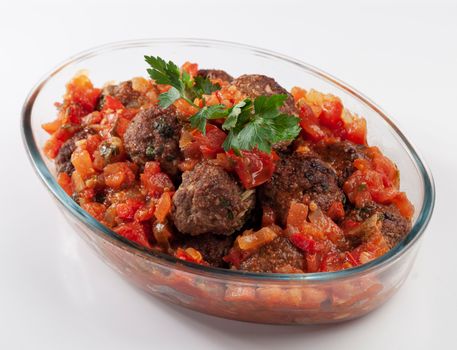
Photo: ERIVELTO Martins / Pexels
Mediterranean
Keftedes (Greek Meatballs)
The diets react (see scores below)
Common Ingredients
- ground beef
- onion
- breadcrumbs
- eggs
- mint
- oregano
- red wine vinegar
- olive oil
Specific recipes may vary.
Incompatible with 6 of 11 diets
Diet Ratings
Keftedes are primarily ground beef or lamb with herbs and eggs — all keto-friendly components — but the traditional recipe includes breadcrumbs as a binder, which introduces wheat-based carbs and disqualifies the dish in its standard form. A typical serving of 4-6 meatballs may contain 10-15g of net carbs from breadcrumbs alone, which eats significantly into the daily keto carb budget. The dish is easily remedied by substituting breadcrumbs with almond flour, crushed pork rinds, or simply omitting them, making it very keto-compatible. Onion adds a small amount of net carbs but is manageable in typical quantities. Olive oil and the fatty meat base align well with keto macros. The caution rating reflects the standard recipe with breadcrumbs; a modified version would rate 8-9.
Keftedes contains multiple animal products that are strictly excluded from a vegan diet. Ground beef is slaughtered animal flesh, and eggs are an animal by-product — both are fundamental violations of vegan principles. There is no ambiguity here; this dish is entirely incompatible with a vegan diet.
Keftedes in their traditional form contain breadcrumbs, which are made from wheat — a grain explicitly excluded from the Paleo diet. Although most other ingredients (ground beef, onion, eggs, mint, oregano, red wine vinegar, olive oil) are paleo-compliant, the breadcrumbs are a core structural component of this dish, not an optional garnish. Their presence as a binder is fundamental to the recipe, making the dish as described non-paleo. The dish could be made paleo-compatible by substituting breadcrumbs with almond flour or other paleo binders, but the traditional version cannot be approved.
Keftedes are made primarily with ground beef (or lamb), which is red meat — a category the Mediterranean diet limits to just a few times per month. The dish is a traditional Greek preparation, so it sits in a grey zone: clearly part of Mediterranean culinary heritage, yet its dominant ingredient contradicts the diet's core principle of limiting red meat. Breadcrumbs from refined white bread further reduce compatibility. The use of olive oil, herbs (oregano, mint), eggs, and onion are positive elements, but they cannot offset the primary concern of red meat as the main protein source. An occasional serving is not catastrophic, but as a regular main dish it conflicts with Mediterranean diet guidelines.
Traditional Greek culinary practice does include keftedes as a legitimate, culturally rooted dish, and some Mediterranean diet authorities (particularly those emphasizing the traditional Cretan or Greek dietary pattern) permit small portions of lean red meat a few times per month — keftedes served in modest portions as part of a vegetable-rich meal could fit within this allowance. The lamb variant, being leaner and more traditional, is viewed more favorably by some practitioners than the beef version.
Keftedes are fundamentally incompatible with the carnivore diet. While the ground beef or lamb base is carnivore-approved, the dish contains multiple plant-derived ingredients that are strictly excluded. Breadcrumbs are a grain-based filler that violates the no-grains rule. Onion is a plant vegetable. Mint and oregano are plant-based herbs/spices. Red wine vinegar is plant-derived and fermented. Olive oil is a plant-based oil. The only carnivore-compatible ingredients are the ground meat and eggs. With the majority of the recipe's ingredients being plant-derived, this dish clearly falls into the 'avoid' category with high confidence — there is no debate in the carnivore community about breadcrumbs, plant oils, or vinegar being acceptable.
Keftedes contains breadcrumbs, which are made from wheat — a grain explicitly excluded on the Whole30 program. This single ingredient disqualifies the dish entirely. All other ingredients (ground beef, onion, eggs, mint, oregano, red wine vinegar, olive oil) are fully Whole30-compliant. To make a compliant version, the breadcrumbs would need to be omitted or replaced with a compliant binder such as almond flour or arrowroot powder, though care should be taken not to simply recreate a breaded/baked-good-style meatball that violates the spirit of the program.
Keftedes contain two significant high-FODMAP ingredients that make this dish problematic during the elimination phase. Onion is one of the highest-fructan foods tested by Monash University and is high-FODMAP at any amount — even small quantities cooked into a dish release fructans. Standard breadcrumbs are wheat-based, making them high in fructans as well. Together, these two ingredients make traditional Keftedes a clear avoid during elimination. Ground beef, eggs, olive oil, mint, oregano, and red wine vinegar are all low-FODMAP. The dish could be made low-FODMAP with modifications: replacing onion with the green tops of spring onions (scallions) and using gluten-free breadcrumbs (rice or corn-based).
Keftedes contain several DASH-compatible elements — olive oil (heart-healthy monounsaturated fat), onion, herbs (mint, oregano), eggs, and red wine vinegar — but are moderated by the use of ground beef or lamb, both of which are red meats higher in saturated fat, a category DASH explicitly limits. Ground beef in particular, depending on fat content (e.g., 80/20 vs. 93/7), can contribute significant saturated fat per serving. Breadcrumbs add refined carbohydrates with potential sodium depending on the type used. The dish is not inherently high-sodium if prepared at home without added salt, but portion size matters. DASH does not exclude lean red meat entirely but recommends limiting it to ≤5 servings per week and choosing lean cuts. Using lean ground beef (≥90% lean) or substituting ground turkey/chicken would improve the score meaningfully. Olive oil is a DASH-positive fat. Overall, this dish is acceptable in moderation with lean meat selection and portion control, but not a core DASH food.
NIH DASH guidelines categorize red meat as a limited food due to saturated fat content and recommend lean poultry and fish as preferred proteins. However, updated clinical interpretations note that lean red meat consumed in moderate portions (3 oz) within an otherwise DASH-compliant dietary pattern does not necessarily impair cardiovascular outcomes, and some Mediterranean-DASH hybrid approaches (e.g., MIND diet) accommodate occasional lean red meat more permissively.
Keftedes present a mixed Zone profile. The ground beef provides adequate protein but is higher in saturated fat than ideal Zone protein sources like skinless chicken or fish. The breadcrumbs add high-glycemic refined carbohydrates that are 'unfavorable' in Zone terminology, though the quantity per serving is relatively small. Olive oil is an ideal Zone fat source (monounsaturated), and the herbs and red wine vinegar are essentially free foods with anti-inflammatory benefits. The eggs are a reasonable Zone protein contributor. The core challenge is the combination of fatty red meat plus refined carb binder — neither is a Zone ideal — but the dish is far from a Zone disaster. With careful portioning (small serving of 3-4 meatballs as a protein block, paired with a large low-glycemic vegetable base and minimal additional fat), keftedes can be incorporated into a Zone meal. The Mediterranean herb profile and olive oil align well with Sears' anti-inflammatory emphasis. Using leaner ground beef (90%+ lean) and substituting whole grain or oat breadcrumbs would meaningfully improve the Zone profile.
Zone practitioners differ on ground beef and lamb. In Sears' earlier work (Enter the Zone), fatty red meat was more strictly discouraged in favor of lean proteins. His later anti-inflammatory writings (The OmegaRx Zone, Zone Perfect Meals in Minutes) show slightly more flexibility around omega-3-rich meats and Mediterranean dietary patterns, which could argue for a more favorable view of this dish given its olive oil, herbs, and vinegar components. Some Zone practitioners would rate this higher simply because the Mediterranean context and monounsaturated fat profile partially offset the saturated fat concerns.
Keftedes present a mixed anti-inflammatory profile. On the positive side, the dish includes olive oil (oleocanthal, a potent anti-inflammatory compound), oregano and mint (both polyphenol-rich herbs), eggs (choline, selenium), onion (quercetin), and red wine vinegar (acetic acid with some evidence for glycemic moderation). These ingredients align well with Mediterranean and anti-inflammatory principles. The problematic element is ground beef as the primary protein. Red meat is categorized as 'limit' in anti-inflammatory frameworks due to saturated fat content and arachidonic acid, which can upregulate inflammatory pathways (COX-2). If lamb is used, the profile is similar — slightly higher in CLA (potentially beneficial) but also higher in saturated fat. Breadcrumbs are a refined carbohydrate, a minor negative. The dish is not fried in excessive oil but pan-fried or baked in olive oil, which is a meaningful distinction. Overall, this is a moderate Mediterranean dish — the anti-inflammatory herbs and olive oil partially offset the red meat concern, but the beef/lamb base prevents an 'approve' rating. Portion size and frequency matter considerably here.
Dr. Weil's Mediterranean-influenced anti-inflammatory framework allows red meat occasionally and emphasizes the overall dietary pattern; some practitioners would approve this dish given its herb-forward, olive-oil-based preparation and cultural Mediterranean context. However, stricter anti-inflammatory protocols (e.g., those focused on reducing arachidonic acid load) would rate it lower, particularly if beef is used instead of leaner lamb or if consumed frequently.
Keftedes provide meaningful protein from ground beef or lamb, supporting the GLP-1 priority of 15-30g protein per meal. However, the fat content is a significant concern: standard ground beef (80/20) or lamb contains substantial saturated fat, which can worsen GLP-1 side effects like nausea, bloating, and delayed gastric emptying — especially problematic since GLP-1 medications already slow stomach emptying. Breadcrumbs add refined carbohydrates with minimal fiber or nutritional value. Olive oil used in frying adds additional fat load. The herbs, egg binder, and vinegar are benign or beneficial. If made with leaner ground beef (90/10 or 93/7) and baked rather than pan-fried, the dish becomes considerably more GLP-1 compatible. As typically prepared with fattier beef or lamb and pan-fried in olive oil, it sits firmly in caution territory. Portion sensitivity is high — 2-3 small meatballs may be well tolerated; a full traditional serving may trigger GI distress.
Some GLP-1-focused dietitians accept traditional keftedes in moderation given their protein density and Mediterranean diet credentials, particularly when lamb fat is viewed as a more natural saturated fat source. Others are stricter about any high-fat red meat preparation given how reliably fat content amplifies nausea and reflux in GLP-1 patients, especially in the early dose-escalation phase.
*See how scores were generated at our methodology page.
Nutritional profile
Six traits that cut across every diet.
Fiber & Plants
How much whole-plant food and fiber it delivers.
Healthy Fats
The quality of its fats (unsaturated, omega-3).
Whole / Unprocessed
How close it is to its natural, unprocessed form.
Gut Gentle
How easy it is on digestion (low FODMAP, few irritants).
Low Glycemic
How little it spikes your blood sugar.
Protein Density
How much protein it packs per calorie.
Controversy Index
Higher controversy = more disagreement between diets.
Diet-Specific Tips
 Keto — 5/10
View tips
- Breadcrumbs are a grain-based binder adding net carbs — primary concern
- Ground beef or lamb provides high-quality fat and protein, ideal for keto
- Eggs are fully keto-compatible and serve as an additional binder
- Onion adds minor net carbs (~1-2g per serving) — manageable in small amounts
- Olive oil is a preferred keto fat source
- Simple swap of breadcrumbs for almond flour or pork rinds makes this fully keto-approved
- Red wine vinegar is negligible in carbs at typical quantities
 DASH — 5/10
View tips
- Ground beef or lamb is red meat — DASH limits red meat due to saturated fat
- Saturated fat content depends heavily on meat fat percentage (80/20 vs. 93/7 lean)
- Olive oil is DASH-positive (monounsaturated fat)
- Breadcrumbs may add refined carbs and sodium depending on preparation
- No inherently high-sodium ingredients if made at home without added salt
- Herbs and vinegar add flavor without sodium — DASH-compatible seasoning strategy
- Portion control is key — 3 oz lean meatballs can fit within DASH limits
- Substituting ground turkey or chicken would elevate this to an 'approve' rating
 Zone — 5/10
View tips
- Ground beef contains saturated fat, making it a less favorable Zone protein than chicken, fish, or tofu
- Breadcrumbs are a refined, high-glycemic carbohydrate — an 'unfavorable' Zone carb that should be minimized
- Olive oil is an ideal Zone fat source supporting the 30% fat target with monounsaturated fat
- Eggs contribute both protein and fat in reasonable Zone-compatible proportions
- Herbs (mint, oregano) and red wine vinegar are anti-inflammatory, polyphenol-rich additions that align with Sears' later work
- Dish is portionable — small servings can fit within Zone protein blocks when paired with low-GI vegetable carbs
- Lean ground beef swap (93%+ lean) would significantly improve Zone compatibility
 Anti-Inflammatory — 5/10
View tips
- Ground beef or lamb = red meat, classified as 'limit' in anti-inflammatory guidelines due to saturated fat and arachidonic acid
- Olive oil is a strongly anti-inflammatory fat (oleocanthal, polyphenols)
- Oregano and mint contribute anti-inflammatory polyphenols
- Onion provides quercetin, a flavonoid with anti-inflammatory activity
- Breadcrumbs are refined carbohydrates — minor pro-inflammatory factor
- Red wine vinegar has modest glycemic and antioxidant benefits
- Cooking method (pan-fry in olive oil vs. deep-fry) significantly affects inflammatory profile
- Mediterranean dietary context — red meat in moderation within an otherwise plant-forward pattern is acceptable
 GLP-1 Friendly — 5/10
View tips
- Moderate-to-high protein content supports GLP-1 muscle preservation goals
- Saturated fat from beef or lamb may worsen nausea, bloating, and reflux
- Pan-frying in olive oil increases total fat load significantly
- Breadcrumbs contribute refined carbs with negligible fiber
- Baking with lean ground beef (90/10+) substantially improves GLP-1 compatibility
- High portion sensitivity — small servings better tolerated
- No significant fiber contribution from this dish alone
- Herbs and vinegar are GLP-1 neutral or mildly beneficial for digestion