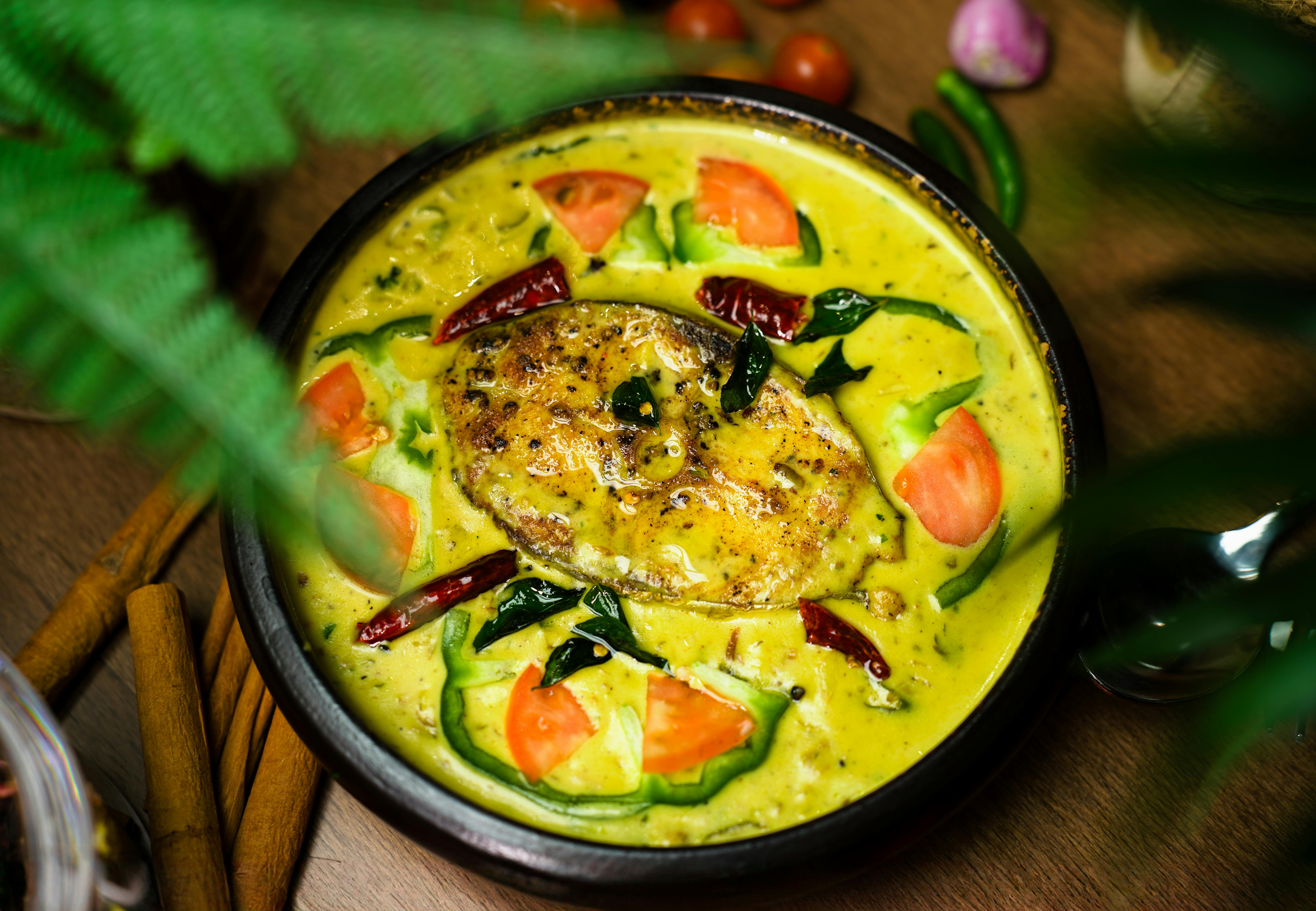
Photo: athul santhosh / Pexels
Indian
Kerala Fish Curry
The diets react (see scores below)
Common Ingredients
- white fish
- coconut milk
- kokum
- curry leaves
- ginger
- green chilies
- mustard seeds
- turmeric
Specific recipes may vary.
Incompatible with 2 of 11 diets
Diet Ratings
Kerala Fish Curry is a strong keto fit. White fish provides lean, high-quality protein, and full-fat coconut milk adds healthy saturated fats that align well with keto macros. Kokum (a souring agent used in small quantities) contributes negligible carbs. Curry leaves, ginger, green chilies, mustard seeds, and turmeric are all low-carb aromatics and spices used in small amounts. Net carbs per serving are very low — likely 3-6g — well within the 20-50g daily limit. No grains, starches, or added sugars are present. This dish is naturally keto-compatible as traditionally prepared.
Some stricter keto practitioners flag full-fat coconut milk for its moderate carbohydrate content (~3-4g net carbs per 100ml) and the potential for overconsumption in curry dishes; they may prefer coconut cream or limit portion size to avoid accumulating carbs across the day from multiple coconut-milk-based dishes.
Kerala Fish Curry contains white fish as its primary protein, which is an animal product explicitly excluded under all vegan dietary frameworks. Fish is unambiguously non-vegan regardless of how it is prepared or what plant-based ingredients accompany it. While the remaining ingredients — coconut milk, kokum, curry leaves, ginger, green chilies, mustard seeds, and turmeric — are all fully plant-based, the inclusion of fish disqualifies this dish entirely.
Kerala Fish Curry is an excellent paleo dish. Every ingredient aligns cleanly with paleo principles: white fish is a lean, nutrient-dense protein fully approved by all paleo authorities; coconut milk is a whole-food fat source widely accepted in the paleo community; kokum (a dried fruit souring agent) is a natural, unprocessed fruit product; curry leaves, ginger, green chilies, and turmeric are all whole herbs and spices with no paleo objections; and mustard seeds are a natural seed spice used in small culinary quantities. There are no grains, legumes, dairy, refined sugars, seed oils, or processed ingredients present. This dish is essentially how a coastal hunter-gatherer population might have eaten — protein-rich fish cooked in natural fats with wild plants and spices.
Kerala Fish Curry is built around white fish, which is a Mediterranean diet staple and strongly encouraged 2-3 times per week. The aromatics — ginger, curry leaves, green chilies, turmeric, mustard seeds — are whole, plant-based ingredients that align well with Mediterranean principles of herb and spice use. However, the primary fat and liquid base is coconut milk, a saturated fat source that is not part of the traditional Mediterranean pantry and displaces extra virgin olive oil, the canonical fat of the diet. Kokum is a regional souring agent with no Mediterranean analog but poses no nutritional conflict. The dish is whole-food, minimally processed, and nutritionally rich, but coconut milk's high saturated fat content and non-traditional status prevent a full approval under strict Mediterranean diet interpretation.
Some modern Mediterranean diet researchers and integrative nutrition practitioners argue that coconut milk, as a minimally processed plant-derived fat, is preferable to many processed alternatives and acceptable in moderation; this view is more common in broader 'plant-forward' or 'flexitarian' frameworks than in classical Mediterranean diet scholarship anchored in the Seven Countries Study tradition. Traditional Mediterranean cuisines do not use coconut products, so purists would flag this as a meaningful deviation.
Kerala Fish Curry contains white fish as its only carnivore-compatible ingredient. The remaining ingredients are entirely plant-derived: coconut milk (plant fat), kokum (a sour fruit), curry leaves, ginger, green chilies, mustard seeds, and turmeric. While fish itself is fully approved on a carnivore diet, this dish is overwhelmingly a plant-based preparation that happens to contain fish. The base is coconut milk rather than animal fat or broth, and the flavor profile is built entirely from plant spices and acidic fruit. This is fundamentally incompatible with carnivore principles regardless of the fish protein present.
Kerala Fish Curry is fully Whole30 compliant as listed. Every ingredient — white fish, coconut milk, kokum (a natural souring fruit), curry leaves, ginger, green chilies, mustard seeds, and turmeric — is either a whole food protein, natural fat, fruit, vegetable, or spice that the Whole30 program explicitly allows. Coconut milk is a compliant natural fat (watch only for added sugars or thickeners in packaged versions, though carrageenan is no longer excluded per the 2024 rule change). Kokum is a Garcinia fruit used as a souring agent, fully compliant. All spices and aromatics are unambiguously permitted. This is a clean, whole-food, traditionally prepared dish that aligns well with the spirit of Whole30.
Kerala Fish Curry is largely low-FODMAP, but the primary concern is coconut milk. White fish is completely FODMAP-free, and most spices here are safe: curry leaves, turmeric, mustard seeds, and green chilies are all low-FODMAP. Ginger is low-FODMAP at typical culinary amounts (up to 1 tsp fresh per Monash). Kokum (dried Garcinia indica) is a traditional souring agent used in small quantities and has no significant FODMAP load. The critical variable is coconut milk: Monash rates canned coconut milk as low-FODMAP at 1/2 cup (125ml) per serve, but high-FODMAP at larger amounts due to polyols (sorbitol). A typical curry serving often contains more than this threshold, especially if the dish is coconut-milk-heavy as Kerala curries traditionally are. The dish scores a cautious approval — safe if coconut milk is measured carefully, but risky at typical restaurant or home-serving portions.
Monash University approves coconut milk at 1/2 cup per serve, but clinical FODMAP practitioners often note that a standard Kerala fish curry uses significantly more coconut milk per portion, and restaurant servings are especially difficult to gauge. Some practitioners advise treating coconut milk-heavy curries as a caution during strict elimination regardless of the per-serving Monash data.
Kerala Fish Curry presents a mixed DASH profile. The white fish is an excellent lean protein strongly endorsed by DASH guidelines, and the spices (turmeric, ginger, curry leaves, mustard seeds, green chilies) are low-sodium, anti-inflammatory ingredients fully compatible with DASH. However, the dish is anchored in full-fat coconut milk, which is high in saturated fat and a tropical oil derivative — a category DASH explicitly limits. The saturated fat content from coconut milk is the primary concern, as DASH recommends limiting total and saturated fat and specifically calls out tropical oils. Kokum (a souring agent) and the aromatics are DASH-neutral. The sodium content of the dish is relatively controlled given no added salt is listed, which is a positive factor. Overall, the lean fish base and spice profile are DASH-aligned, but the coconut milk volume typical in Kerala-style curries pushes this into 'caution' territory rather than 'approve.'
NIH DASH guidelines explicitly limit saturated fat and tropical oils including coconut, placing coconut milk-heavy dishes outside the 'approve' category. However, some updated clinical interpretations note that the saturated fat in coconut milk consists largely of medium-chain triglycerides (MCTs) with potentially different metabolic effects than long-chain saturated fats, and that modest portions of coconut milk in an otherwise fish-forward, low-sodium dish may be acceptable within a broader DASH framework — though the AHA and most DASH protocols still recommend against regular coconut milk use.
Kerala Fish Curry has a solid Zone-compatible foundation in its white fish protein, but coconut milk introduces significant saturated fat that requires careful management. White fish (tilapia, cod, snapper) is an excellent lean protein source — highly favorable in Zone terminology. The aromatics (ginger, curry leaves, green chilies, turmeric, mustard seeds) are essentially calorie-free and polyphenol-rich, which aligns well with Sears' anti-inflammatory focus. Kokum is a low-glycemic souring agent with minimal carb impact. The problem is coconut milk: it is high in saturated fat and medium-chain triglycerides (MCTs), contributing substantial fat calories that skew toward saturated rather than monounsaturated. A typical serving of Kerala Fish Curry may contain 15-25g of fat from coconut milk alone, well above the Zone's 10-15g fat target per meal, and predominantly saturated. To fit Zone blocks, the coconut milk portion must be strictly controlled (light coconut milk or a reduced quantity) and paired with additional low-GI vegetables to balance the carb block. The dish also lacks a dedicated carb component, so it should be served alongside favorable Zone carbs (cauliflower rice, leafy greens) rather than white rice. With disciplined portioning, this dish can be incorporated, but the coconut milk fat profile makes it an 'unfavorable' fat source by classic Zone standards.
Dr. Sears' later work, particularly 'The OmegaRx Zone' and his anti-inflammatory writings, takes a more nuanced view of coconut-derived fats, acknowledging MCTs as metabolically distinct from long-chain saturated fats and potentially less inflammatory than once thought. Some Zone practitioners following Sears' updated anti-inflammatory framework would treat light coconut milk more permissively, potentially rating this dish higher (7-8). The early Zone books (Enter the Zone, 1995) were more strictly opposed to saturated fat sources, which would push the score lower.
Kerala Fish Curry is a strong anti-inflammatory dish anchored by several powerhouse ingredients. White fish provides lean protein with some omega-3 fatty acids (though less than fatty fish like salmon). Turmeric is one of the most well-researched anti-inflammatory spices, with curcumin shown to reduce CRP and IL-6 markers. Ginger contains gingerols and shogaols that inhibit NF-κB inflammatory pathways. Green chilies and curry leaves contribute polyphenols and antioxidants. Kokum (Garcinia indica) is rich in anthocyanins and hydroxycitric acid, with emerging research suggesting anti-inflammatory and antioxidant properties. Mustard seeds contain glucosinolates and selenium. The main nuance is coconut milk: it is high in saturated fat (predominantly medium-chain triglycerides, particularly lauric acid), which places it in a contested zone. Most anti-inflammatory frameworks recommend limiting saturated fat, and full-fat coconut milk used generously could partially offset the otherwise excellent ingredient profile. However, MCTs are metabolized differently than long-chain saturated fats, and some practitioners view them neutrally or even favorably. The overall dish remains strongly net anti-inflammatory due to the density of beneficial spices and lean fish.
Coconut milk's high saturated fat content is flagged by mainstream anti-inflammatory guidelines (including Dr. Weil's framework, which recommends limiting saturated fat) as potentially pro-inflammatory. However, a growing camp — including proponents of the Paleo and ancestral health approaches — argues that lauric acid in coconut milk has neutral or beneficial effects on inflammatory markers and lipid profiles, and does not behave like saturated fats from animal sources.
Kerala Fish Curry has real strengths for GLP-1 patients — white fish is a lean, high-quality protein source that is easy to digest, and the spice base (turmeric, ginger, curry leaves, mustard seeds) is anti-inflammatory and nutrient-dense per calorie. Kokum adds negligible calories. However, the primary concern is coconut milk, which is high in saturated fat. A standard Kerala fish curry uses full-fat coconut milk in meaningful quantities, which increases fat load per serving, can worsen GLP-1 side effects like nausea, bloating, and reflux, and adds significant calories with limited protein return. Green chilies are a secondary concern — most patients tolerate mild-to-moderate chili well, but some GLP-1 patients experience heightened reflux or GI irritability, and Kerala preparations can be quite spicy. The dish is not high in fiber. Overall it is acceptable in moderation — particularly if prepared with light or reduced coconut milk and moderate chili — but the full traditional version warrants caution rather than approval.
Some GLP-1-focused dietitians accept coconut milk in moderate portions, noting that the medium-chain triglycerides (MCTs) in coconut fat may be more readily metabolized than other saturated fats, and that the satiety value of the dish can support adherence. Others maintain that any high-saturated-fat sauce meaningfully worsens nausea and gastric emptying delay in GLP-1 patients and should be limited regardless of fat type.
*See how scores were generated at our methodology page.
Nutritional profile
Six traits that cut across every diet.
Fiber & Plants
How much whole-plant food and fiber it delivers.
Healthy Fats
The quality of its fats (unsaturated, omega-3).
Whole / Unprocessed
How close it is to its natural, unprocessed form.
Gut Gentle
How easy it is on digestion (low FODMAP, few irritants).
Low Glycemic
How little it spikes your blood sugar.
Protein Density
How much protein it packs per calorie.
Controversy Index
Higher controversy = more disagreement between diets.
Diet-Specific Tips
 Keto — 8/10
View tips
- White fish is a clean, zero-carb protein source
- Full-fat coconut milk provides keto-friendly saturated fats with moderate carb contribution
- Kokum used in small amounts adds negligible net carbs
- All spices and aromatics (turmeric, ginger, curry leaves, mustard seeds, green chilies) are very low carb
- No grains, starches, or added sugars in the ingredient list
- Estimated net carbs per serving: 3-6g, comfortably within keto limits
- Whole, minimally processed ingredients align with keto quality standards
 Paleo — 9/10
View tips
- White fish is a fully approved paleo protein source
- Coconut milk is a whole-food fat widely accepted across all paleo frameworks
- Kokum is a natural fruit souring agent — unprocessed and paleo-compatible
- Curry leaves, ginger, green chilies, and turmeric are all whole, unprocessed spices and herbs
- Mustard seeds used as a spice in small quantities are paleo-acceptable
- No grains, legumes, dairy, seed oils, refined sugars, or processed additives present
 Mediterranean — 5/10
View tips
- White fish is a core Mediterranean protein, strongly encouraged
- Coconut milk is high in saturated fat and not part of traditional Mediterranean cuisine
- No olive oil present — primary fat source deviates from Mediterranean principles
- All aromatics and spices are whole, minimally processed plant foods
- No added sugars, refined grains, or highly processed ingredients
- Dish is otherwise whole-food and nutritionally dense
 Whole30 — 9/10
View tips
- White fish is a Whole30-approved protein
- Coconut milk is an allowed natural fat — verify no added sugar in packaged versions
- Kokum is a compliant fruit-based souring agent
- All spices (mustard seeds, turmeric, curry leaves, ginger, green chilies) are explicitly allowed
- No grains, legumes, dairy, alcohol, or other excluded ingredients present
- Dish represents whole, unprocessed cooking in the spirit of the program
 Low-FODMAP — 6/10
View tips
- White fish is completely FODMAP-free — a safe primary protein
- Coconut milk is low-FODMAP at ≤1/2 cup (125ml) but high-FODMAP beyond that due to sorbitol
- Curry leaves, mustard seeds, turmeric, and green chilies are all low-FODMAP
- Ginger is low-FODMAP at standard culinary doses (≤1 tsp fresh)
- Kokum used as a souring agent in small quantities poses no FODMAP concern
- No onion or garlic listed — a major positive for fructan avoidance
- Serving size of coconut milk is the determining factor for overall dish safety
 DASH — 5/10
View tips
- White fish is a DASH-recommended lean protein source
- Coconut milk is high in saturated fat and is a tropical oil derivative, both limited by DASH
- No added salt listed keeps sodium in an acceptable range
- Anti-inflammatory spices (turmeric, ginger, curry leaves) are DASH-compatible
- Portion size of coconut milk significantly affects the DASH compatibility
- Substituting light coconut milk would meaningfully improve the DASH score
 Zone — 6/10
View tips
- White fish is an ideal Zone lean protein source — favorable and easy to block
- Coconut milk is high in saturated fat, an 'unfavorable' fat in classic Zone methodology
- MCTs in coconut milk are metabolically distinct from long-chain saturated fats — Sears' later work is more permissive
- Spice blend (turmeric, ginger, curry leaves) provides anti-inflammatory polyphenols, strongly aligned with Zone principles
- Kokum is low-glycemic with minimal carb impact — favorable
- Dish lacks a carb component; must be paired with low-GI vegetables to complete Zone balance
- Portion control of coconut milk is essential — light coconut milk recommended to stay within fat block targets
- No omega-6-heavy seed oils present — a positive factor for Zone anti-inflammatory goals
 Anti-Inflammatory — 8/10
View tips
- Turmeric (curcumin) — potent anti-inflammatory, reduces CRP and IL-6
- Ginger — gingerols inhibit NF-κB and COX-2 inflammatory pathways
- White fish — lean protein with modest omega-3 content
- Kokum — anthocyanins and antioxidant compounds, underresearched but promising
- Green chilies — capsaicin and polyphenols with anti-inflammatory activity
- Curry leaves — rich in carbazole alkaloids with antioxidant properties
- Mustard seeds — glucosinolates and selenium
- Coconut milk — high in saturated fat (MCTs); contested in anti-inflammatory frameworks
 GLP-1 Friendly — 5/10
View tips
- White fish is a lean, high-quality protein — strong positive
- Coconut milk adds substantial saturated fat, increasing nausea and reflux risk on GLP-1s
- Green chilies may worsen reflux or GI irritability in sensitive patients
- Dish is low in fiber
- Spice base (turmeric, ginger, curry leaves) is nutrient-dense and anti-inflammatory
- Preparation matters significantly — light coconut milk version scores higher than full-fat traditional version
- Small portion of this dish over plain rice is more GLP-1 compatible than a large serving