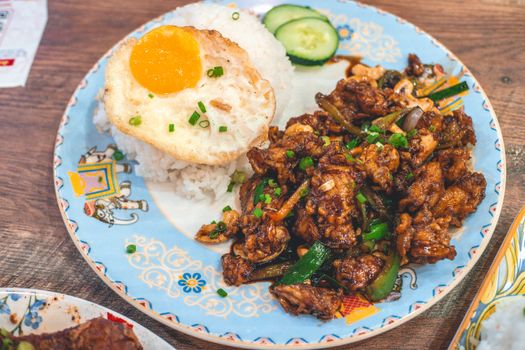
Photo: Josh Eleazar / Pexels
Thai
Khao Pad (Thai Fried Rice)
The diets react (see scores below)
Common Ingredients
- jasmine rice
- shrimp
- egg
- garlic
- scallions
- fish sauce
- soy sauce
- lime
Specific recipes may vary.
Incompatible with 6 of 11 diets
Diet Ratings
Khao Pad is fundamentally built on jasmine rice, a high-glycemic refined carbohydrate that is completely incompatible with ketosis. A standard serving (1 cup cooked) contains roughly 45g of net carbs on its own, already at or exceeding the entire daily keto carb limit. The dish cannot be modified to be keto-friendly without removing its defining ingredient. The protein components (shrimp, egg, chicken) and aromatics (garlic, scallions) are keto-compatible, as are the condiments in small amounts, but they are irrelevant given the rice base. Fish sauce and soy sauce add negligible carbs and are not a concern. This is a grain-based dish with no viable keto adaptation under its original form.
Traditional Khao Pad contains multiple animal-derived ingredients that make it incompatible with a vegan diet. Shrimp and chicken are direct animal proteins; eggs are an animal product; and fish sauce is derived from fermented fish. With three to four distinct animal-product violations present simultaneously, this dish is unambiguously non-vegan. A vegan version is theoretically possible by substituting tofu or tempeh for the protein, omitting the egg, and replacing fish sauce with soy sauce or a seaweed-based alternative, but the dish as described here cannot be approved.
Khao Pad is fundamentally built around jasmine rice, a grain that is clearly excluded from the paleo diet. Beyond the rice, soy sauce introduces both a legume derivative (soy) and often wheat, making it doubly non-compliant. Fish sauce, while derived from fermented fish, typically contains added salt and sometimes sugar, placing it in a gray area — but it is a minor concern compared to the core violations. The remaining ingredients (shrimp, egg, garlic, scallions, lime) are individually paleo-approved, but they cannot redeem a dish whose primary ingredient and a key condiment are firmly off the paleo list. This dish would require a near-total reconstruction — substituting cauliflower rice for jasmine rice and coconut aminos for soy sauce — to become paleo-compatible.
Khao Pad presents a mixed Mediterranean diet profile. The shrimp or chicken protein is acceptable (seafood aligns well, poultry in moderation), and garlic, scallions, egg, and lime are all compatible ingredients. However, jasmine rice is a refined white grain — not a whole grain — which conflicts with Mediterranean principles favoring whole grains like farro, barley, or brown rice. The dish lacks olive oil (typically cooked in vegetable or neutral oil), and fish sauce plus soy sauce introduce high sodium and processed condiments not typical of the diet. The overall dish is not inherently harmful but leans on a refined grain base with non-traditional fats and flavorings.
Some Mediterranean diet interpreters apply a flexible 'whole foods' lens that accommodates white rice, as it is a minimally processed grain used traditionally across Mediterranean-adjacent regions (e.g., rice pilaf in Turkey, Greece). Under this view, a shrimp-and-egg fried rice with aromatics could be seen as broadly compatible, earning a slightly higher tolerance if olive oil were substituted and sodium-heavy sauces minimized.
Khao Pad is fundamentally a rice-based dish, making it incompatible with the carnivore diet at its core. Jasmine rice is a grain — a plant food that is categorically excluded from the carnivore diet. Beyond the rice, the dish contains multiple other plant-based ingredients: garlic, scallions, soy sauce (fermented soy — a legume), and lime. Soy sauce also introduces processed plant compounds and typically gluten. While shrimp, egg, and fish sauce are carnivore-compatible ingredients, they are minor components of a dish that is fundamentally plant-grain-based. No amount of modification short of completely rebuilding the dish would make this carnivore-appropriate.
Khao Pad contains two excluded ingredients that make it clearly non-compliant. First, jasmine rice is a grain and grains are explicitly excluded on Whole30. Second, soy sauce is a soy-based product, and soy is an excluded legume. Even if soy sauce were swapped for coconut aminos, the rice alone disqualifies this dish entirely. There is no workaround for rice on Whole30 — it is a straightforward exclusion.
Khao Pad as traditionally prepared contains two well-established high-FODMAP ingredients that make it unsuitable during the elimination phase. Garlic is one of the highest-fructan foods tested by Monash University — even a small clove is high-FODMAP and it is a core flavoring in this dish, not merely incidental. Scallions (spring onions) are a nuanced case: the green tops are low-FODMAP but the white bulb portions are high in fructans. In Thai fried rice, both parts are typically used together, making it difficult to ensure only the green portions are included. The remaining ingredients are largely low-FODMAP: jasmine rice is safe, shrimp and egg are protein sources with no FODMAPs, fish sauce in small quantities is low-FODMAP per Monash, soy sauce (wheat-based) contains minimal fructans at the small amounts typically used but is borderline, and lime juice is low-FODMAP. The dish could theoretically be modified — using garlic-infused oil instead of garlic and using only the green scallion tops — but as standardly prepared in restaurants or homes, garlic is always present as a whole ingredient, making this a high-FODMAP dish.
Khao Pad (Thai Fried Rice) presents a mixed DASH diet profile. While it contains lean protein (shrimp or chicken), eggs, garlic, scallions, and lime — all acceptable or beneficial ingredients — the dish is heavily undermined by its two primary seasonings: fish sauce and soy sauce. Fish sauce contains approximately 1,400–1,500mg of sodium per tablespoon, and soy sauce adds another 900–1,000mg per tablespoon. A typical restaurant or home serving of Khao Pad can easily deliver 1,200–2,000mg of sodium in a single dish, consuming the majority of or exceeding the standard DASH daily sodium limit (2,300mg) and far exceeding the low-sodium DASH limit (1,500mg) in one meal. Additionally, jasmine rice is a refined white grain, not a whole grain as DASH emphasizes, offering limited fiber. The cooking method (stir-frying, typically in oil) adds fat, though this is less problematic than the sodium load. The dish is not inherently incompatible with DASH principles — the protein and aromatics are fine — but as traditionally prepared, the sodium burden makes it a food requiring significant caution and portion control. A home-modified version using low-sodium soy sauce sparingly, reducing fish sauce, and substituting brown rice would score considerably higher (6–7).
Khao Pad is built on a foundation of jasmine rice, a high-glycemic, low-fiber white rice that Zone classifies as an 'unfavorable' carbohydrate. Jasmine rice has one of the highest glycemic indices among rice varieties, causing rapid blood sugar spikes that disrupt eicosanoid balance — the core concern of Zone methodology. The protein components (shrimp and egg) are actually excellent Zone choices: lean, low-fat, and easy to portion into blocks. Garlic, scallions, lime, and the aromatic seasonings (fish sauce, soy sauce) add negligible macros and contribute polyphenols. The dish lacks meaningful fat, which would need to be added to hit the 30% fat target. The fundamental problem is ratio imbalance: a standard serving is carbohydrate-dominant (the rice), with the protein and fat portions typically insufficient to offset the carb load. To bring this into Zone compliance, one would need to dramatically reduce the rice portion (to perhaps 1/3 cup cooked, representing roughly 1-1.5 carb blocks), increase the shrimp/egg protein significantly, and add a monounsaturated fat source. In restaurant portions, the rice-to-protein ratio makes Zone balance essentially impossible. As a home-cooked dish with strict portioning, it becomes workable but remains challenged by the high-GI base carbohydrate.
Khao Pad sits in neutral-to-mixed territory on an anti-inflammatory framework. On the positive side, shrimp provides lean protein and some omega-3s, eggs contribute choline and antioxidants, garlic and scallions are genuinely anti-inflammatory aromatics with allicin and quercetin, and lime juice adds vitamin C and polyphenols. Fish sauce and soy sauce in culinary amounts are not meaningfully pro-inflammatory. However, jasmine rice is a refined, high-glycemic white rice that provides little fiber and can spike blood glucose, which is a driver of inflammatory signaling — this is the dish's main liability. Traditional fried rice is also typically cooked in neutral seed oils (vegetable or canola oil), which at high heat can increase oxidized lipids and omega-6 load, though the specific oil matters significantly. The dish lacks the colorful vegetables, whole grains, legumes, and omega-3-rich fats that would push it toward 'approve.' It is a reasonable moderate choice — not actively harmful, but not optimized for anti-inflammatory eating. Substituting brown or red rice and adding colorful vegetables (bell pepper, broccoli) would improve the profile meaningfully.
Khao Pad is a mixed picture for GLP-1 patients. The protein sources — shrimp or chicken plus egg — are genuinely GLP-1-friendly: lean, high protein density, easy to digest. Fish sauce, soy sauce, lime, garlic, and scallions are low-calorie flavor contributors with no meaningful fat load. The problem is the jasmine rice base. Jasmine rice is a refined, high-glycemic carbohydrate with minimal fiber and modest nutrient density per calorie — exactly the kind of food that occupies limited stomach capacity without delivering strong nutritional return. It also digests quickly, providing less satiety than higher-fiber carbohydrates. The dish is not fried in the deep-fry sense, but stir-frying in a wok typically adds a moderate amount of oil, which raises the fat content and could contribute to GLP-1-related nausea or reflux if the portion is large or the oil is heavy-handed. Restaurant versions are often prepared with significantly more oil than home versions. Sodium from fish sauce and soy sauce is a secondary concern — GLP-1 patients eating smaller volumes may be more sensitive to high-sodium foods causing water retention or thirst. A modified home version with a smaller rice portion, extra protein, and light oil use is acceptable. A standard restaurant serving — typically a large rice-dominant plate — is less appropriate.
Some GLP-1-aware dietitians accept jasmine rice in controlled portions as a practical carbohydrate source, particularly for patients who struggle with adequate caloric intake, and note that shrimp or chicken makes this dish meaningfully more protein-dense than most fried rice preparations. Others flag refined white rice as a poor carbohydrate choice for GLP-1 patients specifically because slowed gastric emptying combined with a high-glycemic carb can produce erratic postprandial glucose responses, and would recommend substituting cauliflower rice or brown rice to improve fiber and glycemic profile.
*See how scores were generated at our methodology page.
Nutritional profile
Six traits that cut across every diet.
Fiber & Plants
How much whole-plant food and fiber it delivers.
Healthy Fats
The quality of its fats (unsaturated, omega-3).
Whole / Unprocessed
How close it is to its natural, unprocessed form.
Gut Gentle
How easy it is on digestion (low FODMAP, few irritants).
Low Glycemic
How little it spikes your blood sugar.
Protein Density
How much protein it packs per calorie.
Controversy Index
Higher controversy = more disagreement between diets.
Diet-Specific Tips
 Mediterranean — 4/10
View tips
- Jasmine rice is a refined white grain, not a whole grain — conflicts with Mediterranean grain guidance
- Shrimp is an excellent Mediterranean protein source; chicken is acceptable in moderation
- Egg is compatible within moderate dairy/egg allowance
- Fish sauce and soy sauce are high-sodium processed condiments not part of Mediterranean tradition
- No olive oil — dish is typically cooked in neutral oil, missing the primary Mediterranean fat
- Garlic, scallions, and lime are positive, diet-compatible aromatics
 DASH — 4/10
View tips
- Very high sodium from fish sauce (~1,400–1,500mg/tbsp) and soy sauce (~900–1,000mg/tbsp) — primary DASH concern
- Refined jasmine rice rather than DASH-preferred whole grain (e.g., brown rice)
- Lean proteins (shrimp or chicken) and egg are acceptable within DASH guidelines
- Garlic, scallions, and lime are DASH-compatible aromatics with nutritional benefit
- Typical single serving may exceed the entire daily sodium budget on low-sodium DASH
- Low-sodium soy sauce and fish sauce alternatives would significantly improve DASH compatibility
- Restaurant preparations often use larger volumes of sodium-containing sauces than home cooking
 Zone — 4/10
View tips
- Jasmine rice is a high-glycemic 'unfavorable' carbohydrate in Zone terminology — one of the highest GI rice varieties
- Standard restaurant portions are heavily carbohydrate-skewed, making the 40/30/30 ratio very difficult to achieve
- Shrimp and egg are excellent lean Zone protein sources, earning positive marks
- No significant fat source in the dish — olive oil or avocado would need to be added to hit the 30% fat target
- Fish sauce and soy sauce add sodium but minimal macronutrient impact; lime juice adds polyphenols
- Theoretically Zone-adaptable at home by reducing rice to 1/3 cup cooked and boosting protein portions substantially
 Anti-Inflammatory — 5/10
View tips
- Jasmine rice is refined and high-glycemic, contributing to postprandial glucose spikes and downstream inflammatory signaling
- Shrimp is a lean protein with modest omega-3 content — a better choice than red meat
- Garlic and scallions provide allicin, quercetin, and other anti-inflammatory phytonutrients
- Eggs are moderate on the anti-inflammatory scale — some caution around arachidonic acid is noted in certain protocols
- Lime juice contributes vitamin C and polyphenols, a mild positive
- Typical preparation uses high-heat cooking with neutral seed oils, which may increase oxidized lipids
- No colorful vegetables, legumes, or high-fiber whole foods to balance the glycemic load
- Fish sauce and soy sauce add sodium but are not independently pro-inflammatory at culinary doses
 GLP-1 Friendly — 5/10
View tips
- Lean protein sources (shrimp, chicken, egg) are GLP-1-appropriate and raise the protein floor of the dish
- Jasmine rice is a refined, low-fiber, high-glycemic carbohydrate — nutritionally weak per calorie
- Stir-fry cooking method adds moderate fat from oil; restaurant versions often use substantially more oil than home preparation
- No major GLP-1 trigger ingredients (not deep-fried, not very spicy, not high-sugar)
- High sodium from fish sauce and soy sauce — relevant for hydration and water retention on reduced food intake
- Large restaurant portion is rice-dominant and reduces the protein-to-carb ratio significantly
- Home-modified version with extra protein and reduced rice is a reasonable caution-tier option