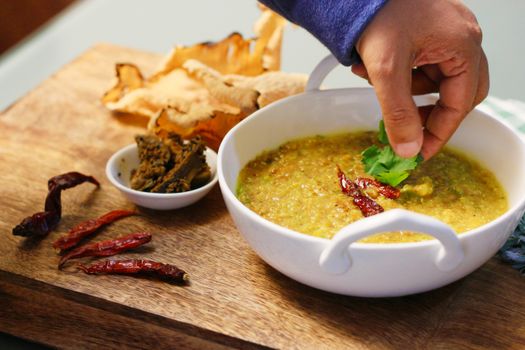
Photo: Thomas Nahar / Pexels
The diets react (see scores below)
Common Ingredients
- rice
- yellow moong dal
- ghee
- cumin seeds
- ginger
- turmeric
- green chilies
- salt
Specific recipes may vary.
Incompatible with 5 of 11 diets
Diet Ratings
Khichdi is fundamentally incompatible with a ketogenic diet. Its two primary ingredients — rice and yellow moong dal — are both high-carbohydrate foods. A standard serving of khichdi (approximately 1 cup cooked) can contain 40-60g of net carbs, easily exceeding the entire daily keto carb budget in a single meal. Rice is a starchy grain with virtually no fiber offset, and moong dal, while containing some fiber and protein, is still a legume with significant net carb content. The ghee, cumin, ginger, turmeric, and green chilies are all keto-friendly, but they cannot compensate for the dominant carb load from rice and lentils. There is no practical portion size that would make khichdi fit within a ketogenic framework.
Khichdi as described contains ghee, which is clarified butter — a dairy product derived from cows. Dairy is unambiguously excluded from a vegan diet by all major vegan organizations. The base ingredients (rice, yellow moong dal, cumin seeds, ginger, turmeric, green chilies, salt) are entirely plant-based and would otherwise make this a wholesome, high-scoring vegan dish. However, the presence of ghee disqualifies it. A vegan version is easily achievable by substituting ghee with a plant-based fat such as coconut oil, mustard oil, or vegan butter, which is a common adaptation.
Khichdi is fundamentally built on two core non-paleo ingredients: rice (a grain) and yellow moong dal (a legume). Both are explicitly excluded from the Paleolithic diet — grains and legumes were not part of the pre-agricultural hunter-gatherer diet and are rejected due to their antinutrient content (phytates, lectins). Salt is also a non-paleo addition. Ghee occupies a gray area, and the remaining ingredients (cumin, ginger, turmeric, green chilies) are paleo-approved spices, but they cannot redeem a dish whose very foundation is two major excluded food categories. This dish cannot be made paleo without fundamentally changing its identity.
Khichdi is a wholesome, minimally processed dish built around lentils (yellow moong dal) and rice — both staples with strong nutritional profiles. The lentils provide plant-based protein and fiber, aligning well with Mediterranean principles. Anti-inflammatory spices (turmeric, ginger, cumin, green chilies) are fully compatible. However, two factors introduce nuance: (1) White rice, rather than a whole grain, is the carbohydrate base — modern Mediterranean diet guidelines prefer whole grains like brown rice, farro, or barley. (2) Ghee (clarified butter) replaces olive oil as the cooking fat, which is the canonical Mediterranean fat. Ghee is a saturated animal fat not traditional to the Mediterranean pattern. If olive oil were substituted and brown rice used, this would easily score 8-9. As prepared, it earns a moderate caution rating — nutritious and plant-forward overall, but not fully aligned with core Mediterranean fat and grain principles.
Some modern Mediterranean diet practitioners take a broader 'plant-forward, whole-food' view and would approve Khichdi as written: the lentil-to-rice ratio delivers excellent plant protein and fiber, ghee is used in small amounts (similar to how butter appears in some regional Mediterranean traditions like parts of North Africa and the Levant), and the anti-inflammatory spice profile is highly valued. From this perspective, the dish's overall nutrient density and minimal processing outweigh the non-canonical fat source.
Khichdi is a fundamentally plant-based dish with no animal products forming its base. The primary ingredients — rice (a grain) and yellow moong dal (a legume) — are entirely excluded on the carnivore diet. Additional ingredients including cumin seeds, ginger, turmeric, and green chilies are plant-derived spices also prohibited. The only carnivore-adjacent ingredient is ghee, a dairy derivative, which itself is debated. There is nothing in this dish that qualifies as an animal product in any meaningful proportion. This is a complete and unambiguous avoid under all carnivore diet tiers.
Khichdi contains two excluded ingredients: rice (a grain) and yellow moong dal (a legume). Both are explicitly prohibited on the Whole30 program. Rice is a grain and falls squarely in the excluded category, and moong dal is a lentil, which is explicitly listed as a forbidden legume. Ghee is the one dairy exception allowed on Whole30, and all other ingredients (cumin, ginger, turmeric, green chilies, salt) are fully compliant. However, the two core structural ingredients of this dish are both excluded, making it entirely incompatible with Whole30 regardless of preparation method.
Khichdi is a comforting rice and lentil porridge that sits in a grey zone for the low-FODMAP elimination phase. White rice is clearly low-FODMAP. Ghee is lactose-free and low-FODMAP. Cumin seeds, ginger, turmeric, green chilies, and salt are all low-FODMAP at typical culinary quantities. The critical issue is yellow moong dal (split mung beans). Per Monash University, canned and well-rinsed lentils and mung beans are lower in GOS than their dried counterparts because the oligosaccharides leach into soaking/cooking water. Split yellow moong dal cooked in fresh water and drained has a lower FODMAP load than whole dried legumes. Monash rates canned, rinsed mung beans as low-FODMAP at approximately 1/4 cup (46g). In traditional khichdi, moong dal is cooked together with the rice in a single pot without draining the cooking liquid, meaning GOS compounds remain in the dish rather than being discarded. The serving size of dal in a standard bowl of khichdi (roughly 1/4 to 1/3 cup dry dal split across a serving) may approach or exceed safe thresholds, particularly when cooking water is retained. This makes the dish potentially moderate-FODMAP at a typical serving, warranting caution rather than outright avoidance or full approval.
Monash University rates mung beans as low-FODMAP at small canned and rinsed portions, but many clinical FODMAP practitioners advise avoiding all legume-based dishes during the strict elimination phase due to unpredictable GOS levels, especially when cooking liquid is not discarded as in khichdi. Some practitioners consider even moong dal khichdi a reintroduction-phase food rather than an elimination-safe option.
Khichdi is a wholesome one-pot dish combining rice and yellow moong dal, offering a good balance of complex carbohydrates, plant-based protein, and fiber — all consistent with DASH principles. The spices (cumin, ginger, turmeric, green chilies) are DASH-friendly and add anti-inflammatory value with negligible sodium. However, two factors temper full approval: (1) Ghee is a clarified butter high in saturated fat, which DASH guidelines limit; traditional khichdi uses 1-2 tsp per serving, keeping saturated fat moderate but not negligible. (2) White rice, rather than a whole grain, is the typical base — DASH favors whole grains like brown rice. Salt content is variable; home-cooked versions can be kept low-sodium, which would push this closer to 'approve.' If prepared with minimal ghee and moderate salt, khichdi is close to an ideal DASH meal.
NIH DASH guidelines specify limiting saturated fat and choosing low-fat cooking methods, which would flag ghee as a concern. However, updated clinical interpretations note that small amounts of ghee (1 tsp) contribute only ~3-4g saturated fat per serving — within acceptable limits when total daily saturated fat is managed — and some DASH-oriented dietitians recognize ghee-based Indian cooking as compatible with the diet's spirit when portions are controlled.
Khichdi is a traditional Indian one-pot dish combining rice and yellow moong dal, which creates a mixed macro profile that requires careful management for Zone compliance. The primary challenges are: (1) White rice is a high-glycemic, 'unfavorable' carb in Zone terminology — it rapidly raises blood sugar and provides dense carbohydrate blocks with little fiber to slow absorption. (2) Moong dal provides vegetarian protein, which means the fat block requirement doubles (3g fat per fat block rather than 1.5g), and the protein density is lower per gram than animal sources. (3) Ghee is a saturated fat, not the preferred monounsaturated fat of the Zone. However, Khichdi has genuine Zone-positive attributes: moong dal adds protein and fiber simultaneously, reducing the net carb load somewhat. The dish is minimally processed, anti-inflammatory spices (turmeric, ginger, cumin) align with Sears' polyphenol emphasis, and the overall glycemic load can be moderated by controlling the rice-to-dal ratio. A Zone-adapted version would increase the dal proportion, reduce rice significantly, replace ghee with olive oil or reduce ghee quantity, and add a side of colorful vegetables to improve the carb quality profile. As served traditionally, the rice-dominant version is unfavorable, but a dal-dominant version with modest rice portions can approximate Zone blocks with effort.
Some Zone practitioners and Sears' later writings on the Mediterranean-Zone approach show more flexibility toward legume-based meals. Moong dal is one of the more Zone-friendly legumes due to its high protein-to-carb ratio and low glycemic index relative to other legumes. If the dish is prepared with more dal than rice (or substituting brown rice), some Zone coaches would classify this closer to a 6-7 score, viewing it as a reasonable vegetarian Zone meal with mindful portioning. The traditional equal-parts preparation, however, leans carb-heavy and saturated-fat-heavy, which most Zone practitioners would flag as needing modification.
Khichdi is a traditional Indian one-pot dish combining rice and yellow moong dal (split mung beans) with anti-inflammatory spices. The overall profile is mixed but leans modestly favorable. Yellow moong dal is a whole legume rich in plant protein, fiber, folate, and polyphenols — consistent with the anti-inflammatory emphasis on beans and legumes. Turmeric (curcumin) and ginger are among the most well-supported anti-inflammatory spices in the literature. Cumin seeds and green chilies add further antioxidant and anti-inflammatory phytochemicals. Ginger has documented inhibitory effects on NF-κB and COX-2 pathways. The main anti-inflammatory concern is ghee (clarified butter), a saturated animal fat that falls in the 'limit' category under anti-inflammatory principles due to saturated fat content and its association with raised LDL and pro-inflammatory signaling at higher doses. However, ghee is typically used in modest amounts in khichdi (1–2 tsp per serving), which mitigates concern. White rice, the other less-favorable ingredient, is a refined carbohydrate with a moderate glycemic index — neutral to mildly pro-inflammatory depending on quantity, and notably not a whole grain. The dish lacks omega-3-rich components or colorful vegetables that would push it into 'approve' territory. Overall, khichdi is a nutritionally balanced, easily digestible, fiber-rich meal with meaningful anti-inflammatory spicing, but the refined white rice and ghee prevent a higher score.
Some anti-inflammatory practitioners, particularly in Ayurvedic-informed nutrition (which informs Dr. Weil's integrative approach), view ghee favorably as a source of butyrate — a short-chain fatty acid with gut anti-inflammatory properties — and consider white basmati rice an acceptable low-antinutrient starch; this perspective would rate khichdi more favorably, potentially in the 'approve' range. Conversely, stricter anti-inflammatory protocols would flag white rice as a glycemic stressor and ghee as a saturated fat to limit, keeping the dish at 'caution.'
Khichdi is a traditional Indian comfort dish made from rice and yellow moong dal cooked together with ghee and mild spices. It is one of the most easily digestible meals in South Asian cuisine, which makes it genuinely well-suited for GLP-1 patients struggling with nausea, slow gastric emptying, or GI side effects. The moong dal contributes moderate protein and fiber, and the dish is low in fat if ghee is used sparingly. However, it falls short of ideal GLP-1 nutrition on a few fronts. The protein density is relatively low — a standard serving of khichdi provides roughly 8–12g of protein, well below the 15–30g per meal target. The base is predominantly rice (refined carbohydrate), which reduces nutrient density per calorie. Ghee is a saturated fat; even a small amount (1–2 tsp) adds saturated fat load, which should be limited. Green chilies are mild enough in typical quantities to be well-tolerated by most patients, but individuals with reflux or heightened GI sensitivity may need to omit them. Overall, khichdi is a reasonable choice during GI-difficult periods or early dose escalation phases, but should be protein-boosted (e.g., added paneer, tofu, or a side of yogurt) to meet GLP-1 nutritional requirements consistently.
Some GLP-1-focused dietitians specifically recommend khichdi during nausea-heavy phases of dose escalation because its easy digestibility and soft texture outweigh its moderate protein density in the short term. Others caution that relying on it too frequently risks under-meeting protein targets, and prefer higher-protein alternatives even when digestibility is a concern.
*See how scores were generated at our methodology page.
Nutritional profile
Six traits that cut across every diet.
Fiber & Plants
How much whole-plant food and fiber it delivers.
Healthy Fats
The quality of its fats (unsaturated, omega-3).
Whole / Unprocessed
How close it is to its natural, unprocessed form.
Gut Gentle
How easy it is on digestion (low FODMAP, few irritants).
Low Glycemic
How little it spikes your blood sugar.
Protein Density
How much protein it packs per calorie.
Controversy Index
Higher controversy = more disagreement between diets.
Diet-Specific Tips
 Mediterranean — 6/10
View tips
- Lentils (yellow moong dal) are an excellent plant-based protein and fiber source — strongly Mediterranean-aligned
- White rice rather than a whole grain is the carbohydrate base — modern guidelines prefer whole grains
- Ghee (saturated animal fat) used instead of extra virgin olive oil — the canonical Mediterranean fat
- Spices (turmeric, ginger, cumin, chili) are anti-inflammatory and fully compatible
- Dish is minimally processed with no added sugars or refined ingredients
- Overall plant-forward composition and simplicity favor a positive assessment despite non-canonical fat
 Low-FODMAP — 5/10
View tips
- Yellow moong dal contains GOS, a high-FODMAP oligosaccharide; safe only at restricted portions
- Cooking method retains GOS in dish liquid rather than draining it away, increasing FODMAP load
- White rice, ghee, cumin, ginger, turmeric, and green chilies are all low-FODMAP
- Monash University rates rinsed mung beans as low-FODMAP at ~46g (canned), but this assumes rinsing discards GOS
- Standard khichdi serving likely contains moong dal at or near the upper threshold for GOS tolerance
- No garlic or onion — a significant positive for FODMAP compliance
 DASH — 6/10
View tips
- Yellow moong dal provides plant-based protein and fiber — core DASH foods
- White rice used instead of whole grain (brown rice would be more DASH-aligned)
- Ghee adds saturated fat — DASH recommends limiting saturated fat; small amounts are borderline acceptable
- Spices are DASH-friendly with no sodium contribution
- Salt is added but amount is preparation-dependent; low-sodium versions score higher
- Overall sodium can be kept well within DASH limits in home preparation
- Good source of potassium and magnesium from lentils
 Zone — 5/10
View tips
- White rice is a high-glycemic 'unfavorable' carb that dominates the carbohydrate blocks
- Moong dal provides dual protein+carb blocks, requiring careful accounting — vegetarian protein rules apply (3g fat per fat block)
- Ghee is saturated fat, not preferred monounsaturated fat; small amounts are tolerable but not ideal
- Turmeric, ginger, and cumin are polyphenol-rich anti-inflammatory spices strongly aligned with Zone principles
- No vegetables in the dish — Zone recommends 8 servings of colorful vegetables daily; serving with vegetables would improve balance
- Dal-to-rice ratio is the key lever: increasing dal and reducing rice significantly improves Zone compatibility
- Dish is minimally processed and whole-food-based, which aligns with Zone's anti-processed-food stance
 Anti-Inflammatory — 6/10
View tips
- Yellow moong dal: anti-inflammatory legume, high in fiber and plant protein
- Turmeric: strong anti-inflammatory spice (curcumin inhibits NF-κB)
- Ginger: well-documented COX-2 and NF-κB inhibitor
- Green chilies and cumin: antioxidant and anti-inflammatory phytochemicals
- Ghee: saturated fat — in 'limit' category, though butyrate content has some anti-inflammatory benefit
- White rice: refined carbohydrate, not a whole grain — neutral to mildly pro-inflammatory
- No omega-3 sources or colorful vegetables to elevate the anti-inflammatory profile
- Small serving size of ghee significantly moderates the saturated fat concern
 GLP-1 Friendly — 6/10
View tips
- High digestibility — well-suited for GLP-1 patients with active nausea or GI side effects
- Protein per serving is low (approx 8–12g) — falls short of the 15–30g per meal target
- Moderate fiber from moong dal — supports digestion and constipation prevention
- Rice base is a refined carbohydrate — lower nutrient density per calorie
- Ghee contributes saturated fat — should be minimized to 1 tsp or less per serving
- Green chilies are mild and generally well-tolerated but may worsen reflux in sensitive individuals
- Protein-boosting with paneer, tofu, or low-fat yogurt is strongly recommended to make this meal GLP-1 adequate
- Small-portion friendly — soft texture and mild flavor work well with reduced appetite