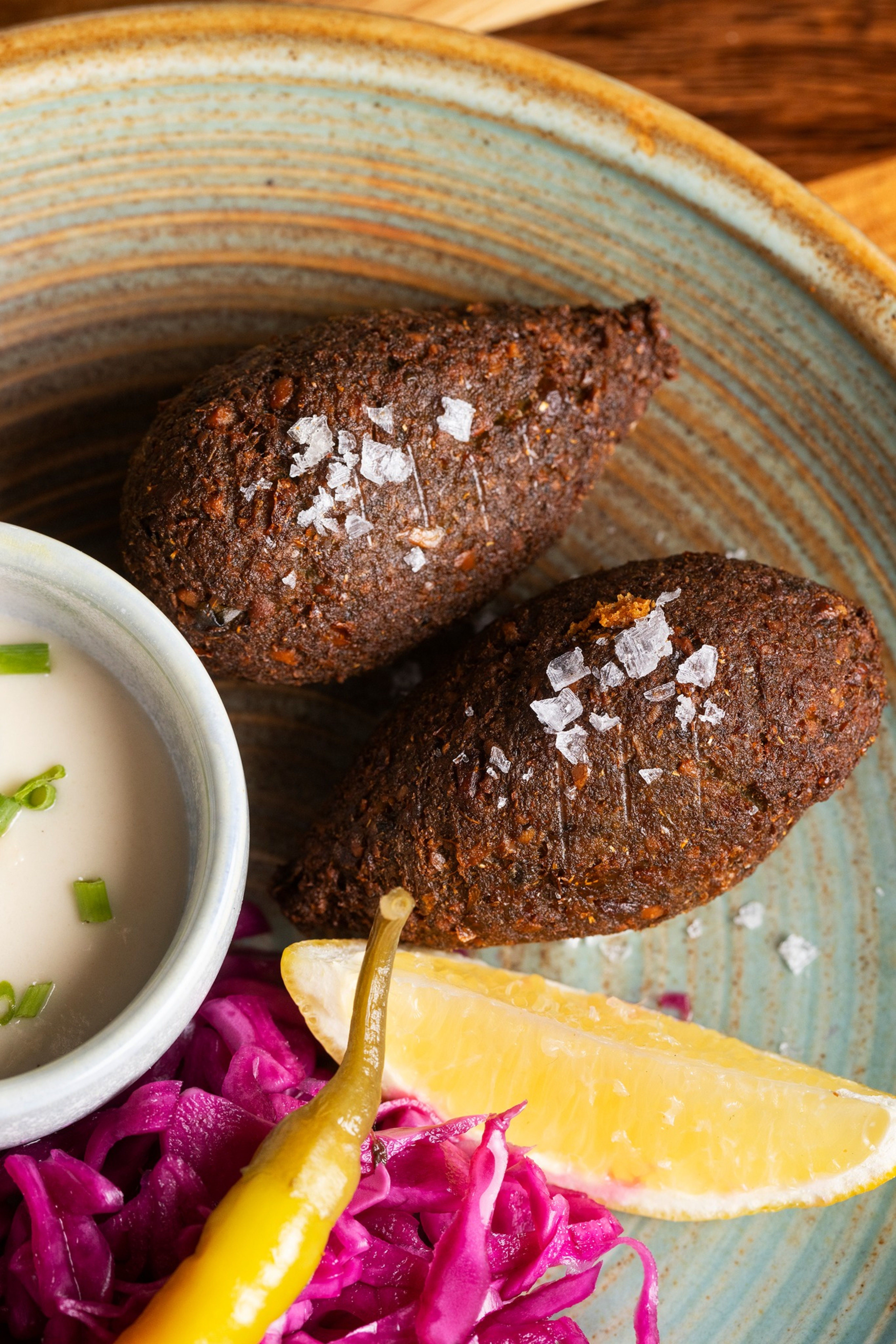
Photo: Bivouac canteen and bar / Pexels
The diets react (see scores below)
Common Ingredients
- bulgur
- ground beef
- ground lamb
- onion
- pine nuts
- cinnamon
- allspice
- parsley
Specific recipes may vary.
Incompatible with 7 of 11 diets
Diet Ratings
Kibbeh's primary structural ingredient is bulgur wheat, a whole grain that is extremely high in net carbs (approximately 25-30g net carbs per 100g). A standard serving of kibbeh (2-3 pieces) would easily contain 30-45g of net carbs from the bulgur alone, which would consume or exceed an entire day's carb allowance on a ketogenic diet. While the ground beef, ground lamb, pine nuts, and spices are all keto-compatible, the bulgur wheat makes traditional kibbeh fundamentally incompatible with ketosis. This is not a portion-control situation — even a small serving is problematic.
Kibbeh contains ground beef and ground lamb as primary proteins, both of which are animal flesh and strictly excluded under all vegan dietary frameworks. There is no ambiguity here — this dish is fundamentally built around meat. The remaining ingredients (bulgur, onion, pine nuts, spices, parsley) are all plant-based, but the presence of two distinct animal products makes this entirely incompatible with a vegan diet.
Kibbeh is fundamentally built around bulgur wheat, which is a cracked whole grain — a clear violation of core paleo principles. Grains are among the most consistently excluded food groups in all paleo frameworks due to their anti-nutrient content (lectins, phytates, gluten). While the remaining ingredients — ground beef, ground lamb, onion, pine nuts, cinnamon, allspice, and parsley — are all paleo-approved, the bulgur is structural to the dish and cannot be removed without fundamentally changing what kibbeh is. This dish cannot be considered paleo-compatible in its traditional form.
Kibbeh's primary proteins are ground beef and lamb — both red meats — which the Mediterranean diet restricts to only a few times per month. While bulgur is a wholesome whole grain and the aromatics (onion, parsley, cinnamon, allspice) and pine nuts are Mediterranean-friendly ingredients, the dish is fundamentally red-meat-forward. As a snack category item, it would likely be consumed in addition to other meals, making it easy to exceed the recommended red meat frequency. The combination of two red meats in one dish pushes this firmly into 'avoid' territory for regular consumption.
Kibbeh is a traditional Levantine dish eaten across Mediterranean-adjacent Middle Eastern cuisines, and some broader Mediterranean diet frameworks — particularly those acknowledging Eastern Mediterranean food traditions — consider it acceptable on occasion. The use of bulgur as a substantial base and the modest seasoning profile align with whole-food principles, and some authorities would classify it as a 'caution' food suitable for the allowed few-times-monthly red meat allotment rather than a food to avoid outright.
Kibbeh is fundamentally incompatible with the carnivore diet. The dish's base ingredient is bulgur wheat — a whole grain that is entirely plant-derived and strictly excluded from all tiers of carnivore eating. Beyond the bulgur, the recipe contains multiple additional plant-based ingredients: onion, pine nuts (a seed/nut), parsley (herb), cinnamon (spice), and allspice (spice). While the ground beef and ground lamb are carnivore-approved proteins, they are outnumbered and structurally bound with plant ingredients that cannot simply be removed. This dish cannot be adapted to carnivore without a complete reconstruction — at which point it would no longer be kibbeh.
Kibbeh contains bulgur, which is a cracked wheat product and therefore a grain — one of the core excluded food groups on the Whole30 program. Regardless of the otherwise compliant ingredients (ground beef, ground lamb, onion, pine nuts, cinnamon, allspice, parsley), the inclusion of bulgur makes this dish incompatible with Whole30. There is no compliant substitution that would still make it 'kibbeh' in the traditional sense.
Kibbeh contains two major high-FODMAP ingredients that make it unsuitable during the elimination phase. First, bulgur wheat is a high-FODMAP grain due to its significant fructan content — it is not low-FODMAP at any standard serving size used in a dish like kibbeh. Second, onion is one of the highest-FODMAP foods tested by Monash University, rich in fructans, and is a core structural ingredient in kibbeh both in the shell and filling. These two ingredients alone are sufficient to classify the dish as high-FODMAP. Pine nuts are low-FODMAP at small servings (up to ~1 tablespoon), and the spices (cinnamon, allspice, parsley) are low-FODMAP at culinary amounts. Ground beef and lamb are FODMAP-free proteins. However, the bulgur and onion are non-negotiable high-FODMAP components that cannot be portioned down to safe levels within the context of a standard kibbeh serving.
Kibbeh contains a mix of DASH-friendly and DASH-cautioned ingredients. Bulgur wheat is an excellent whole grain highly compatible with DASH, providing fiber, magnesium, and complex carbohydrates. Onion, parsley, pine nuts, and spices (cinnamon, allspice) are all DASH-positive. However, the dual use of ground beef and ground lamb raises concerns: both are red meats that DASH limits, and lamb in particular tends to be higher in saturated fat. The saturated fat content depends heavily on the fat percentage of the ground meats used — lean ground beef (90%+ lean) is more acceptable under DASH, while fattier cuts or typical ground lamb push this dish toward caution. Kibbeh is also frequently deep-fried (as a shell or torpedo shape), which would add significant fat and push it toward 'avoid'; baked or raw kibbeh preparations are more DASH-compatible. The dish has no inherently high-sodium ingredients in this formulation, which is a positive. Overall, this is a borderline dish: the whole grain bulgur base and spice profile are DASH-positive, but the red meat content (especially lamb) and common frying preparation warrant caution and portion control.
NIH DASH guidelines clearly limit red meat and recommend lean poultry or fish as primary proteins, making lamb a poor fit. However, updated clinical interpretations note that when lean ground beef is used, portions are controlled (1-2 oz per serving as a snack), and preparation is baked rather than fried, some DASH practitioners consider kibbeh acceptable within the weekly red meat allowance, especially given the beneficial whole grain bulgur base.
Kibbeh presents a mixed Zone Diet profile. The bulgur wheat provides moderate-glycemic carbohydrates — it's lower GI than white rice or white bread but still a grain-based carb that Zone classifies as 'unfavorable' when consumed in significant quantities. As a snack, the bulgur-to-protein ratio may be carb-heavy relative to Zone block targets. The protein from ground beef and lamb is real but fatty — these are not lean Zone-preferred proteins like skinless chicken or fish; the saturated fat content from two red meats in combination is a concern for the 30% fat target quality. Pine nuts offer monounsaturated fat (Zone-favorable), partially offsetting the saturated fat issue. Onion, parsley, and spices (cinnamon, allspice) contribute polyphenols and anti-inflammatory value, which Sears would appreciate. The core challenge is that traditional kibbeh is relatively dense in both moderate-GI carbs and saturated fat simultaneously, making it difficult to fit cleanly into a Zone block structure without careful portioning. A small portion (1-2 pieces) could theoretically be balanced within a meal with added vegetables and lean protein, but as a standalone snack it lacks the lean protein and low-GI carb balance Zone targets.
Some Zone practitioners note that bulgur is among the more favorable grains due to its relatively lower glycemic index and fiber content, making it more manageable in Zone blocks than pasta or white bread. Additionally, Sears' later anti-inflammatory work (The Anti-Inflammation Zone) acknowledges that moderate amounts of lean red meat are acceptable, and lamb and beef in small portions can fit. A smaller kibbeh portion with extra vegetables on the side could approach Zone balance, making this more of a 'portion discipline' issue than a fundamental incompatibility.
Kibbeh presents a mixed anti-inflammatory profile. On the positive side, bulgur is a whole grain providing fiber and modest anti-inflammatory benefit. Onion and parsley supply quercetin, flavonoids, and vitamin C. Cinnamon and allspice are both recognized anti-inflammatory spices. Pine nuts provide healthy monounsaturated fats and some anti-inflammatory minerals. However, the dish is built around red meat (beef and lamb), which anti-inflammatory guidelines consistently recommend limiting due to saturated fat content, arachidonic acid, and associations with elevated inflammatory markers like CRP and IL-6 at regular consumption. The combination of two red meats in a single dish is a notable concern. The preparation method also matters significantly — baked or raw kibbeh is considerably better than the deep-fried version (kibbeh maqlieh), which would push this lower due to likely use of inflammatory seed oils. This rating assumes baked/raw preparation. Overall, kibbeh is not a dish to build an anti-inflammatory diet around, but consumed occasionally it is not actively harmful for most people given the mitigating whole grain and spice components.
Dr. Weil's anti-inflammatory framework places red meat in the 'limit' rather than 'avoid' category, and some Mediterranean-diet researchers note that traditional red meat consumed in modest portions within a spice-rich, vegetable-forward dietary pattern (as in Middle Eastern cuisine) shows less inflammatory impact than red meat in Western processed contexts. However, stricter anti-inflammatory protocols and researchers focused on arachidonic acid pathways would rate any regular red meat dish more harshly.
Kibbeh offers a meaningful protein contribution from ground beef and lamb, and bulgur provides fiber and complex carbohydrates — both positive attributes for GLP-1 patients. However, the combination of two fatty red meats (beef and lamb) raises the saturated fat content per serving significantly, which can worsen GLP-1 side effects like nausea, bloating, and reflux given slowed gastric emptying. Pine nuts add additional fat, though these are unsaturated. The spice profile (cinnamon, allspice) is generally mild and unlikely to trigger GI irritation. Bulgur is a relatively easy-to-digest whole grain and contributes fiber. The main concern is fat load per serving — if kibbeh is baked or raw (as in kibbeh nayeh), the fat profile is somewhat more manageable than the fried version. The fried preparation (the most common snack form) would push this toward a 2-3 and an avoid rating. Rated here assuming a baked preparation. As a snack category, portion size is especially important — a single small baked kibbeh ball can be reasonable, but the fatty meat base limits how favorably this can be rated.
Some GLP-1-focused dietitians would approve small portions of baked kibbeh as a culturally relevant, whole-food protein and fiber source, arguing the bulgur and lean-adjacent red meat blend is preferable to processed snack alternatives. Others would caution against any red meat–dominant snack given the elevated saturated fat burden and the heightened GI sensitivity common in GLP-1 patients, particularly in the first several months of treatment.
*See how scores were generated at our methodology page.
Nutritional profile
Six traits that cut across every diet.
Fiber & Plants
How much whole-plant food and fiber it delivers.
Healthy Fats
The quality of its fats (unsaturated, omega-3).
Whole / Unprocessed
How close it is to its natural, unprocessed form.
Gut Gentle
How easy it is on digestion (low FODMAP, few irritants).
Low Glycemic
How little it spikes your blood sugar.
Protein Density
How much protein it packs per calorie.
Controversy Index
Higher controversy = more disagreement between diets.
Diet-Specific Tips
 DASH — 5/10
View tips
- Bulgur wheat is a DASH-approved whole grain with fiber and magnesium
- Ground lamb is a red meat high in saturated fat, which DASH limits
- Ground beef acceptability depends on fat percentage — lean (90%+) is preferable
- Deep-frying (common preparation) significantly worsens DASH compatibility; baked or raw versions score higher
- No high-sodium ingredients in this formulation
- Pine nuts provide healthy unsaturated fats compatible with DASH
- Portion size critical — as a snack, smaller servings reduce red meat and saturated fat impact
- Spices and aromatics (onion, parsley, cinnamon, allspice) are DASH-positive
 Zone — 5/10
View tips
- Bulgur is a moderate-GI grain carb — Zone 'unfavorable' but lower GI than white rice or bread
- Ground beef and lamb are fatty proteins — not Zone-preferred lean protein sources
- Combined saturated fat from two red meats conflicts with Zone fat quality guidelines
- Pine nuts provide Zone-favorable monounsaturated fat
- Parsley, onion, cinnamon, and allspice offer polyphenols (anti-inflammatory positive)
- As a snack category, the carb-to-protein ratio likely skews toward excess carbs without careful portioning
- Small portions can be incorporated into Zone meals but require complementary lean protein and vegetables
 Anti-Inflammatory — 5/10
View tips
- Red meat (beef + lamb) is the primary protein — both are saturated fat sources associated with elevated inflammatory markers
- Bulgur whole grain provides fiber and is anti-inflammatory relative to refined grains
- Cinnamon and allspice are beneficial anti-inflammatory spices
- Onion and parsley contribute quercetin, flavonoids, and antioxidants
- Pine nuts offer healthy monounsaturated fats
- Preparation method is critical — baked/raw is significantly better than deep-fried versions
- Occasional consumption in a generally healthy diet is acceptable; not suitable as a regular staple
 GLP-1 Friendly — 4/10
View tips
- High saturated fat from combined ground beef and lamb — worsens nausea and reflux on GLP-1s
- Bulgur provides beneficial fiber and is relatively easy to digest
- Protein content is meaningful but comes paired with a high fat load
- Pine nuts add unsaturated fat — less concerning than saturated fat but still increases total fat per serving
- Mild spice profile (cinnamon, allspice) is GLP-1 tolerable
- Preparation method is critical: baked is caution, fried is avoid
- Small snack portions reduce but do not eliminate fat load concern
- Red meat as primary protein is generally limited in GLP-1 dietary guidance