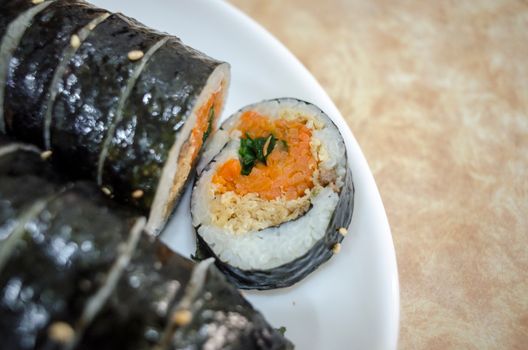
The diets react (see scores below)
Common Ingredients
- rice
- nori
- beef
- spinach
- carrots
- egg
- pickled radish
- sesame oil
Specific recipes may vary.
Incompatible with 5 of 11 diets
Diet Ratings
Kimbap is fundamentally incompatible with a ketogenic diet. The primary ingredient is white rice, which is a high-glycemic grain dense in net carbs — a single kimbap roll can contain 40-60g of net carbs from rice alone, which exceeds or nearly saturates the entire daily keto carb budget. Pickled radish (danmuji) often contains added sugar, compounding the carb load. While several ingredients are keto-friendly in isolation — nori, beef, egg, spinach, and sesame oil — the rice is the structural and caloric foundation of the dish and cannot be reduced to a 'small portion' without fundamentally deconstructing the dish. There is no meaningful way to consume kimbap as prepared and maintain ketosis.
Kimbap as described contains multiple animal products that are strictly excluded from a vegan diet. Beef is animal flesh, and egg is an animal product — either one alone would disqualify this dish. Together they make this clearly incompatible with veganism. The remaining ingredients (rice, nori, spinach, carrots, pickled radish, sesame oil) are all plant-based, meaning a vegan version of kimbap is achievable by substituting tofu, marinated mushrooms, or other plant proteins for the beef and omitting or replacing the egg.
Kimbap is fundamentally incompatible with the paleo diet. The two primary structural components — rice (a grain) and sesame oil (a seed oil) — are both clearly excluded under paleo rules. Rice is a grain explicitly avoided in paleo, and sesame oil is a seed oil on the prohibited list. Pickled radish is also typically prepared with added salt and sugar, making it a processed food. While several ingredients are paleo-friendly (beef, spinach, carrots, egg, nori), the non-negotiable role of rice as the base and sesame oil as the binding/flavoring agent means this dish cannot be modified into a paleo meal without fundamentally ceasing to be kimbap.
Kimbap contains several Mediterranean-compatible ingredients — spinach, carrots, egg, and sesame oil are wholesome components — but it also includes notable concerns. The primary protein is beef, which is limited to a few times per month in Mediterranean guidelines, immediately pulling the score down. The rice used is white refined rice rather than a whole grain, which is discouraged in modern Mediterranean diet interpretation. Sesame oil, while a healthy plant fat, is not olive oil and is not a traditional Mediterranean fat. Pickled radish is a fermented vegetable that has some parallels to Mediterranean preserved foods. Overall, the dish is not deeply contradictory (it's not fried, not heavily processed, not sugar-laden), but the beef protein and refined rice prevent it from being endorsed, landing it in cautious moderation territory.
Some Mediterranean diet researchers apply a broader 'traditional whole-food diet' framework and would view Kimbap's vegetable-rich filling, modest beef portion, and fermented components more favorably. In certain regional Mediterranean traditions (e.g., Spain, Turkey), white rice is used regularly, and small amounts of red meat in a vegetable-forward dish could be considered acceptable occasionally.
Kimbap is almost entirely plant-based in its composition. While it contains beef and egg — both carnivore-approved ingredients — they are minor components surrounded by a dominant plant food base: rice (grain), spinach (vegetable), carrots (vegetable), pickled radish (vegetable, likely with sugar/vinegar), sesame oil (plant oil), and nori (seaweed/plant). The dish is structurally a grain-and-vegetable roll with trace animal protein. No amount of beef or egg rescues a dish that is fundamentally built around rice and multiple plant ingredients. This is incompatible with carnivore diet principles at every tier.
Kimbap contains rice, which is a grain explicitly excluded on the Whole30 program. Rice is on the list of prohibited grains regardless of context. Additionally, pickled radish (danmuji) is typically made with sugar and sometimes vinegar-based brine — the sugar content makes it non-compliant. The dish is also a rolled rice-and-filling format analogous to a wrap or noodle-style construction, which further conflicts with the program's spirit of avoiding recreated comfort/convenience foods. The remaining ingredients — beef, nori, spinach, carrots, egg, and sesame oil — are individually Whole30-compliant, but the rice alone is a disqualifying excluded ingredient.
Most Kimbap ingredients are individually low-FODMAP: white rice is safe at standard servings, nori (seaweed) is low-FODMAP, plain cooked beef is low-FODMAP, egg is low-FODMAP, spinach is low-FODMAP in moderate amounts (up to 75g per Monash), carrots are low-FODMAP up to 61g, and sesame oil is low-FODMAP. The primary concern is pickled radish (danmuji/yellow pickled radish). While plain radish is low-FODMAP, commercial pickled radish preparations often contain high-fructose corn syrup, sugar, and/or garlic and onion seasonings that introduce FODMAPs. Additionally, Kimbap typically uses seasoned rice (with vinegar and sometimes sugar), which at typical serving sizes remains acceptable. If the pickled radish is commercially prepared with problematic additives, this dish could trigger symptoms. Without knowing the exact pickled radish preparation, caution is warranted.
Monash University rates plain radish as low-FODMAP, but commercial Korean pickled radish (danmuji) is not independently tested and frequently contains garlic, onion, or HFCS in its brine — clinical FODMAP practitioners would likely advise avoidance of commercial versions during the elimination phase and recommend homemade versions with verified low-FODMAP ingredients only.
Kimbap contains several DASH-friendly ingredients — spinach, carrots, nori, and egg provide potassium, magnesium, fiber, and lean protein. However, several factors temper its DASH compatibility. White rice (the standard base) lacks the fiber of whole grains preferred by DASH. Beef, depending on the cut, may contribute saturated fat beyond DASH limits for red meat. Pickled radish (danmuji) is typically high in sodium due to the brining/pickling process, adding meaningfully to total sodium load. Sesame oil, while a vegetable oil, is used for flavor and adds caloric fat. The dish is not intrinsically high-sodium like processed foods, but the combination of pickled radish, seasoned rice (often salted), and beef in a portion-controlled roll lands it in the caution zone. DASH does not explicitly address kimbap, requiring inference from its components.
NIH DASH guidelines emphasize whole grains and limit red meat and high-sodium foods, which would flag standard kimbap. However, an updated clinical interpretation notes that kimbap's overall nutrient profile — rich in vegetables, moderate portions, and balanced macronutrients — resembles Mediterranean-style eating patterns also associated with cardiovascular benefit; substituting brown rice, lean beef or tuna, and low-sodium pickled radish would substantially improve its DASH alignment.
Kimbap presents a mixed Zone profile. The white rice is the primary concern — it is a high-glycemic carbohydrate that Zone methodology classifies as 'unfavorable,' spiking insulin and disrupting eicosanoid balance. A standard kimbap roll contains roughly 30-40g of cooked white rice per serving, which dominates the carb blocks and pushes glycemic load high. However, several ingredients work strongly in Zone's favor: spinach and carrots are low-glycemic, polyphenol-rich vegetables that Zone actively encourages; egg contributes quality lean protein blocks; nori is essentially a free food with negligible macros but good micronutrient density; and sesame oil provides fat, though it is higher in omega-6 than ideal (Zone prefers monounsaturated fats like olive oil). Beef, depending on the cut, may carry moderate saturated fat, making lean cuts preferable. The pickled radish adds negligible carbs. The core issue is the 40/30/30 ratio: in a typical kimbap serving, carbohydrates from white rice will be disproportionately high-glycemic relative to the protein and fat content, making the macro ratio skewed and the insulin response unfavorable. A Zone-adapted kimbap using cauliflower rice or reduced rice portions with more vegetables and egg could shift this significantly toward approval.
Some Zone practitioners note that the vegetable ingredients (spinach, carrots), lean protein (egg, lean beef), and reasonable fat from sesame oil make kimbap structurally closer to a balanced meal than most rice-based dishes. In Sears' later writings, he softened strict glycemic index concerns in favor of overall meal balance and polyphenol content — by that lens, the nori, spinach, and carrots provide meaningful anti-inflammatory polyphenols that partially offset the white rice's glycemic impact, especially if portion size is controlled to 1-2 rolls.
Kimbap is a mixed dish with both anti-inflammatory positives and some concerns. On the beneficial side: nori (seaweed) is rich in iodine, antioxidants, and contains some omega-3s; spinach and carrots provide carotenoids, flavonoids, and antioxidant vitamins; sesame oil contains sesamol and sesamin, which have demonstrated anti-inflammatory properties in research, though it is also moderately high in omega-6. Eggs offer choline and selenium with a mixed but generally acceptable inflammatory profile. On the less favorable side: white rice is a refined carbohydrate with a high glycemic index that can modestly promote inflammatory markers when consumed in excess; beef (unspecified cut) is a red meat associated with saturated fat and arachidonic acid, placing it in the 'limit' category per anti-inflammatory guidelines; pickled radish may contain added sugar and sodium depending on preparation. Overall, Kimbap is a balanced, whole-food-forward dish with meaningful vegetables and seaweed, but the white rice base and red meat protein temper the anti-inflammatory profile. It is acceptable in moderation, especially if lean beef cuts are used and portion sizes are reasonable.
Some anti-inflammatory practitioners, including those aligned with the IF Rating system, may view the white rice and beef combination as more problematic, particularly for individuals with elevated CRP or metabolic syndrome, and would recommend substituting brown rice and a leaner protein like tofu or salmon. Conversely, Dr. Weil's framework and traditional Asian diet research suggest that white rice consumed as part of a vegetable-rich, minimally processed meal pattern — as in traditional Korean cuisine — does not carry the same inflammatory risk as Western refined carbohydrate patterns.
Kimbap is a mixed dish with meaningful nutritional trade-offs for GLP-1 patients. On the positive side, it contains several GLP-1-friendly components: spinach and carrots add fiber and micronutrients, egg contributes bioavailable protein, nori provides trace minerals, and the overall dish is relatively easy to digest. However, the primary protein is beef (typically bulgogi-style or thin-cut beef), which is moderate in saturated fat compared to preferred lean proteins like chicken breast or fish. White rice is the dominant ingredient by volume — it is a refined grain with low fiber and moderate glycemic load, displacing more nutrient-dense calories in a context where every bite counts. Sesame oil adds unsaturated fat, which is acceptable in small amounts, but contributes calories with limited protein or fiber payoff. Pickled radish is generally fine in small amounts. The core issue is that kimbap is carbohydrate-heavy and moderate in protein density per calorie — a typical 2-3 roll serving (roughly 300-400 kcal) may deliver only 12-18g protein, falling short of the 15-30g per meal target unless portion is increased, which may be difficult given reduced appetite. It is not harmful, but it underperforms on protein density and fiber relative to ideal GLP-1 meals.
Some GLP-1-focused dietitians view kimbap favorably as a portion-controlled, culturally appropriate food with diverse whole ingredients that supports dietary adherence — a practical priority often weighted heavily in clinical practice. Others flag the white rice base as a consistent concern given the low fiber content and the risk of blood sugar fluctuation in patients who also have insulin resistance or prediabetes, which is common in this population.
*See how scores were generated at our methodology page.
Nutritional profile
Six traits that cut across every diet.
Fiber & Plants
How much whole-plant food and fiber it delivers.
Healthy Fats
The quality of its fats (unsaturated, omega-3).
Whole / Unprocessed
How close it is to its natural, unprocessed form.
Gut Gentle
How easy it is on digestion (low FODMAP, few irritants).
Low Glycemic
How little it spikes your blood sugar.
Protein Density
How much protein it packs per calorie.
Controversy Index
Higher controversy = more disagreement between diets.
Diet-Specific Tips
 Mediterranean — 4/10
View tips
- Beef is the primary protein — red meat is limited to a few times per month in Mediterranean guidelines
- White refined rice is used rather than a whole grain, conflicting with modern Mediterranean dietary preferences
- Sesame oil replaces extra virgin olive oil as the fat source — not traditional or canonical to the Mediterranean diet
- Spinach and carrots are excellent Mediterranean-compatible vegetables
- Egg content is acceptable in moderation per Mediterranean guidelines
- Pickled radish has some parallels to Mediterranean fermented/preserved vegetables
- Dish is minimally processed and not high in added sugars — a positive factor
 Low-FODMAP — 5/10
View tips
- White rice is low-FODMAP and safe at standard Kimbap serving sizes
- Nori, beef, egg, and sesame oil are all low-FODMAP
- Spinach is low-FODMAP up to 75g — portion in Kimbap is typically within safe range
- Carrots are low-FODMAP up to ~61g — usually safe in Kimbap portions
- Pickled radish (danmuji) is the key risk factor — commercial versions may contain garlic, onion, or HFCS
- Seasoned rice with vinegar is generally tolerated at typical serving sizes
- Dish is potentially low-FODMAP if homemade with verified ingredients, but risky with commercial pickled radish
 DASH — 5/10
View tips
- White rice used instead of DASH-preferred whole grains
- Beef as red meat is limited on DASH; cut and portion matter significantly
- Pickled radish (danmuji) is high in sodium due to brining, a significant DASH concern
- Sesame oil is a vegetable oil — acceptable but adds fat calories
- Spinach, carrots, and nori are DASH-positive vegetables rich in potassium and magnesium
- Egg contributes lean protein; moderate DASH acceptability
- Total sodium load across all ingredients likely moderate-to-high per serving
- Portion control possible given roll format, but commonly consumed in multiple pieces
 Zone — 5/10
View tips
- White rice is a high-glycemic 'unfavorable' carbohydrate in Zone methodology, raising insulin response
- Spinach and carrots are ideal low-glycemic Zone vegetables adding favorable carb blocks
- Egg and lean beef provide quality protein blocks
- Sesame oil is omega-6 dominant — Zone prefers monounsaturated fats (olive oil, avocado); not ideal but not disqualifying
- Nori is nutritionally neutral/positive — minimal macros, rich in micronutrients
- Typical serving ratio is carb-heavy due to rice volume, making 40/30/30 balance difficult to achieve
- Portion control (1-2 rolls) can partially mitigate glycemic load
- Zone-friendly modification: substitute cauliflower rice to dramatically improve score
 Anti-Inflammatory — 5/10
View tips
- Nori (seaweed) provides antioxidants and trace omega-3s — anti-inflammatory positive
- Spinach and carrots supply carotenoids and polyphenols — anti-inflammatory positive
- Sesame oil contains sesamol/sesamin with anti-inflammatory activity, but moderate omega-6 content
- White rice is a refined carbohydrate with moderate glycemic index — mild inflammatory concern
- Beef is a red meat in the 'limit' category due to saturated fat and arachidonic acid
- Pickled radish may add sugar and sodium depending on preparation
- Eggs are acceptable in moderation with a mixed but broadly neutral inflammatory profile
- Overall dish is whole-food-forward and minimally processed, which is a net positive
 GLP-1 Friendly — 5/10
View tips
- White rice is a refined grain — low fiber, lower nutrient density per calorie, dominant by volume
- Protein content per serving is moderate but may fall short of 15-30g per meal target depending on beef quantity
- Beef as primary protein carries more saturated fat than preferred GLP-1 proteins (chicken breast, fish, tofu)
- Sesame oil adds unsaturated fat — acceptable in small amounts but calorie-dense
- Spinach, carrots, and nori contribute fiber, vitamins, and minerals — positive factors
- Pickled radish is low calorie and tolerable for most patients in small amounts
- Egg contributes high-quality bioavailable protein — positive
- Easy to digest overall — no fried components, not heavily spiced
- Portion-sensitive: nutritional profile improves with more egg and beef relative to rice